Please mind our dust!

We are currently working on revamping our website!
Thank you for your patience!

CRD Solutions

St. Junipero Serra


St. Junipero Serra

Feast date: Jul 01

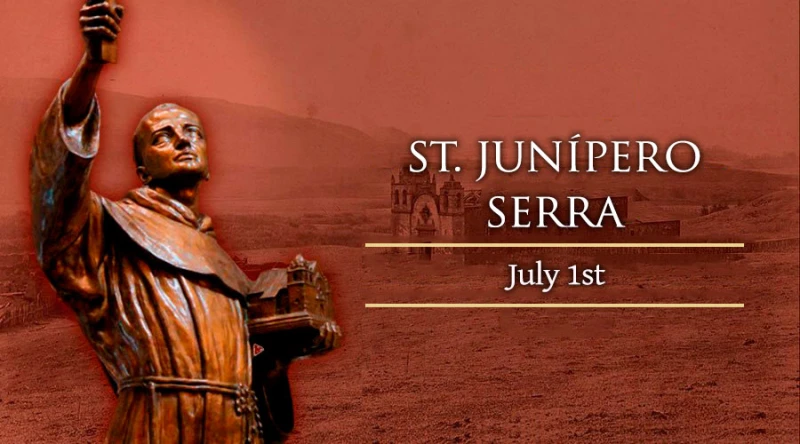
St. Junípero Serra was born on November 24, 1713 on the island of Majorca, Spain. He joined the Franciscans in 1730, and became so accomplished as a student that he was appointed a lector of philosophy before his ordination.
 
As an academic, he was promising. After earning his PhD, he began teaching eventually earning the Duns Scotus chair of philosophy. However, at 36, he gave up this career, desiring instead to be a missionary in the New World. 
 
Padre Serra began his missionary work in Mexico. While working among the Pame Indians, he learned their language and translated the catechism for their understanding. Working in Mexico, he gained a reputation as a preacher deeply devoted to penance and mortification. He would pound his breast with a stone and even hold a lighted torch to his bare chest. He was also known for doing the work of young boys in cleaning the convent of San Fernando, where he was first assigned. Soon after his arrival in the New World, he sustained a spider bite to his leg that would leave him permanently injured. However, he was still known to walk everywhere whenever possible.
 
In 1767, Serra  was assigned to preach in what was then called Upper California, encompassing much of the modern-day state. Here, he established several missions, for which he became famous. These missions remain today, and stretch from San Diego to San Francisco.
 
Padre Serra died in 1784. Many native peoples whom he had worked with wept openly at his funeral. He is at San Carlos Borromeo Mission in Carmel by the Sea. He is credited with bringing the faith to the California region.

St. Junipero Serra Read More »
St. Arnulf of Metz


St. Arnulf of Metz

Feast date: Jul 01

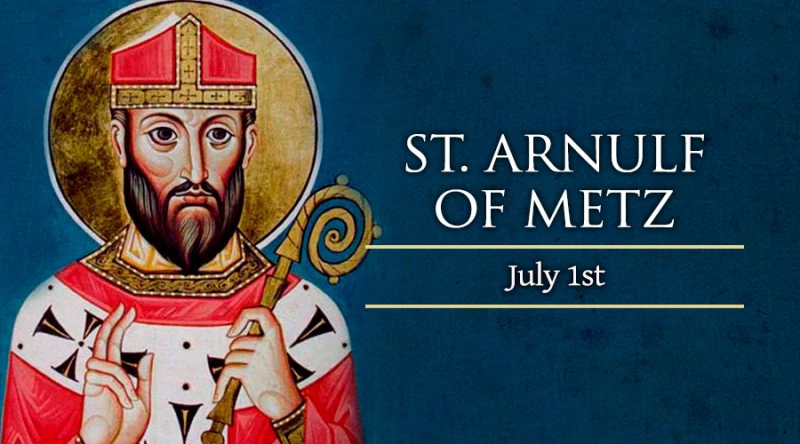
A statesman and bishop under the Merovingians, St. Arnulf was born in 580 and died in 640. His parents belonged to a distinguished Frankish family, and lived in Austrasia in the eastern section of the kingdom founded by Clovis.

In the school where Arnulf was placed as a boy, he excelled through his talent and his good behaviour. According to the custom of the age, he was sent in due time to the court of Theodebert II, King of Austrasia (595-612), to be initiated in the various branches of the government. Under the guidance of Gundulf, the Mayor of the Palace, he soon became so proficient that he was placed on the regular list of royal officers, and among the first of the kings ministers. He distinguished himself both as a military commander as well as in the civil administration, and at one time he had six distinct provinces under his care.

In due course, Arnulf was married to a Frankish woman of noble lineage, by whom he had two sons; Anseghisel and Clodulf. While Arnulf was enjoying worldly emoluments and honours, he did not forget higher and spiritual things. His thoughts often dwelt on monasteries, and with his friend Romaricus, also an officer of the court, he planned to make a pilgrimage to the Abbey of Lérins, evidently for the purpose of devoting his life to God.

However, in the meantime the Episcopal See of Metz became vacant. Arnulf was universally designated as a worthy candidate for the office, and he was consecrated bishop of that see around 611. In his new position he set the example of a virtuous life to his subjects, and attended to matters of ecclesiastical government. In 625 he took part in a council held by the Frankish bishops at Reims. With all these different activities, Arnulf still retained his station at the court of the king, and played a prominent role in the national life of his people.

In 613, after the death of Theodebert, he, with Pepin of Landen and other nobles, called to Austrasia Clothaire II, King of Neustria. When, in 625, the realm of Austrasia was entrusted to the kings son Dagobert, Arnulf became not only the tutor, but also the chief minister, of the young king. At the time of the estrangement between the two kings in 625 Arnulf, with other bishops and nobles, tried to bring about a reconciliation, but Arnulf dreaded the responsibilities of the episcopal office, and grew weary of court life.

About the year 626 he obtained the appointment of a successor to the Episcopal See of Metz, and he and his friend Romaricus withdrew to a solitary place in the mountains of the Vosges. There he lived in communion with God until his death. His remains, interred by Romaricus, were transferred about a year afterwards, by Bishop Goeric, to the basilica of the Holy Apostles in Metz.

St. Arnulf of Metz Read More »

Thursday of the Thirteenth Week in Ordinary Time

Reading I Am 7:10-17

Amaziah, the priest of Bethel, sent word to Jeroboam,
king of Israel:
“Amos has conspired against you here within Israel;
the country cannot endure all his words.
For this is what Amos says:
Jeroboam shall die by the sword,
and Israel shall surely be exiled from its land.”

To Amos, Amaziah said:
“Off with you, visionary, flee to the land of Judah!
There earn your bread by prophesying,
but never again prophesy in Bethel;
for it is the king’s sanctuary and a royal temple.”
Amos answered Amaziah, “I was no prophet,
nor have I belonged to a company of prophets;
I was a shepherd and a dresser of sycamores.
The LORD took me from following the flock, and said to me,
‘Go, prophesy to my people Israel.’
Now hear the word of the LORD!”

You say: prophesy not against Israel,
preach not against the house of Isaac.
Now thus says the LORD:
Your wife shall be made a harlot in the city,
and your sons and daughters shall fall by the sword;
Your land shall be divided by measuring line,
and you yourself shall die in an unclean land;
Israel shall be exiled far from its land.

Responsorial Psalm 19:8, 9, 10, 11

R. (10cd) The judgments of the Lord are true, and all of them are just.
The law of the LORD is perfect,
refreshing the soul;
The decree of the LORD is trustworthy,
giving wisdom to the simple.
R. The judgments of the Lord are true, and all of them are just.
The precepts of the LORD are right,
rejoicing the heart;
The command of the LORD is clear,
enlightening the eye.
R. The judgments of the Lord are true, and all of them are just.
The fear of the LORD is pure,
enduring forever;
The ordinances of the LORD are true,
all of them just.
R. The judgments of the Lord are true, and all of them are just.
They are more precious than gold,
than a heap of purest gold;
Sweeter also than syrup
or honey from the comb.
R. The judgments of the Lord are true, and all of them are just.

Alleluia 2 Cor 5:19

R. Alleluia, alleluia.
God was reconciling the world to himself in Christ
and entrusting to us the message of reconciliation.
R. Alleluia, alleluia.

Gospel Mt 9:1-8

After entering a boat, Jesus made the crossing, and came into his own town.
And there people brought to him a paralytic lying on a stretcher.
When Jesus saw their faith, he said to the paralytic,
“Courage, child, your sins are forgiven.”
At that, some of the scribes said to themselves,
“This man is blaspheming.”
Jesus knew what they were thinking, and said,
“Why do you harbor evil thoughts?
Which is easier, to say, ‘Your sins are forgiven,’
or to say, ‘Rise and walk’?
But that you may know that the Son of Man
has authority on earth to forgive sins”

he then said to the paralytic,
“Rise, pick up your stretcher, and go home.”
He rose and went home.
When the crowds saw this they were struck with awe
and glorified God who had given such authority to men.

– – –

Lectionary for Mass for Use in the Dioceses of the United States, second typical edition, Copyright © 2001, 1998, 1997, 1986, 1970 Confraternity of Christian Doctrine; Psalm refrain © 1968, 1981, 1997, International Committee on English in the Liturgy, Inc. All rights reserved. Neither this work nor any part of it may be reproduced, distributed, performed or displayed in any medium, including electronic or digital, without permission in writing from the copyright owner.

Thursday of the Thirteenth Week in Ordinary Time Read More »

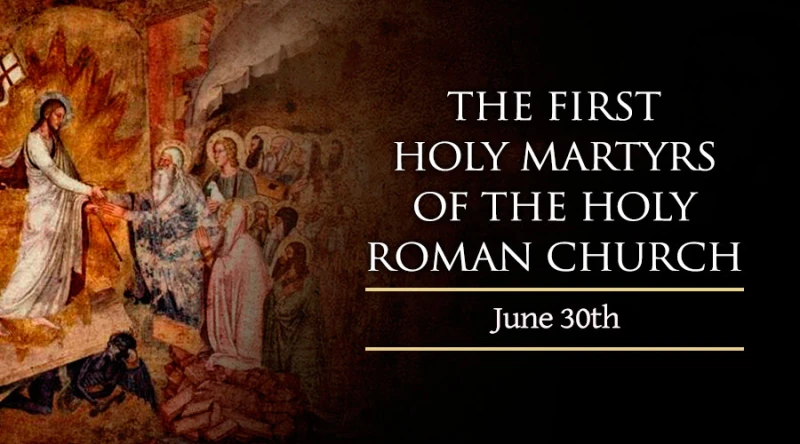
The First Holy Martyrs of the Holy Roman Church


The First Holy Martyrs of the Holy Roman Church

Feast date: Jun 30

These “proto-martyrs” of Rome were the first Christians persecuted en masse by the Emperor Nero in the year 64, before the martyrdom of Saints Peter and Paul.

Nero was widely believed to have caused the fire that burned down much of Rome in the same year.  He blamed the fire on the Christians and put them to death, many by crucifixion, being feeding to the wild animals in his circus, or by being tied to posts and lit up as human torches.

Today, the site of Nero’s Circus, also the location of St. Peter’s martyrdom, is marked by the Piazza dei Protomartiri Romani (Square of the Roman Protomartyrs) in the Vatican next to St. Peter’s basilica.

These martyrs were called the “Disciples of the Apostles” and their firmness in the face of their gruesome deaths were a powerful testimony that led to many conversions in the early Roman Church.

The First Holy Martyrs of the Holy Roman Church Read More »

Solemnity of Saints Peter and Paul, Apostles

Vigil

Mass during the Day

– – –

Lectionary for Mass for Use in the Dioceses of the United States, second typical edition, Copyright © 2001, 1998, 1997, 1986, 1970 Confraternity of Christian Doctrine; Psalm refrain © 1968, 1981, 1997, International Committee on English in the Liturgy, Inc. All rights reserved. Neither this work nor any part of it may be reproduced, distributed, performed or displayed in any medium, including electronic or digital, without permission in writing from the copyright owner.

Solemnity of Saints Peter and Paul, Apostles Read More »