
Please mind our dust!

We are currently working on revamping our website!
Thank you for your patience!

CRD Solutions

St. Irenaeus


St. Irenaeus

Feast date: Jun 28

Celebrated by the Roman Catholic Church on June 28, and by Eastern Catholics of the Byzantine tradition on August 23, Saint Irenaeus of Lyons was a second-century bishop and writer in present-day France.

He is best known for defending Christian orthodoxy, especially the reality of Christ’s human incarnation, against the set of heresies known as Gnosticism.

Pope Benedict XVI spoke admiringly of St. Irenaeus in a 2007 general audience, recalling how this early Church Father “refuted the Gnostic dualism and pessimism which debased corporeal realities. He decisively claimed the original holiness of matter, of the body, of the flesh no less than of the spirit.”

“But his work went far beyond the confutation of heresy: in fact, one can say that he emerges as the first great Church theologian who created systematic theology; he himself speaks of the system of theology, that is, of the internal coherence of all faith.”

While some of St. Irenaeus’ most important writings have survived, the details of his life are not as well-preserved. He was born in the Eastern half of the Roman Empire, likely in the Aegean coastal city of Smyrna, probably around the year 140. As a young man he heard the preaching of the early bishop (and eventual martyr) Saint Polycarp, who had been personally instructed by the Apostle John.

Irenaeus eventually became a priest, and served in the Church of Lyons (in the region of Gaul) during a difficult period in the late 170s. During this time of state persecution and doctrinal controversy, Irenaeus was sent to Rome to provide Pope St. Eleutherius with a letter about the heretical movement known as Montanism. After returning to Lyons, Irenaeus became the city’s second bishop, following the martyrdom of his predecessor Saint Pothinus.

In the course of his work as a pastor and evangelist, the second Bishop of Lyon came up against various heretical doctrines and movements, many of which sounded a common note in their insistence that the material world was evil and not part of God’s original plan. The proponents of these ideas often claimed to be more deeply “enlightened” or “spiritual” than ordinary Christians, on account of their supposed secret knowledge (or “gnosis”).

Irenaeus recognized this movement, in all its forms, as a direct attack on the Catholic faith. The Gnostics’ disdain for the physical world was irreconcilable with the Biblical doctrine of creation, which stated that God had made all things according to his good purpose. Gnostics, by contrast, saw the material world as the work of an evil power, crediting God only with the creation of a higher and purely spiritual realm.

In keeping with its false view of creation, Gnosticism also distorted the concept of redemption. The Church knew Christ as the savior of the world: redeeming believers’ bodies and souls, and investing creation with a sacramental holiness. Gnostics, meanwhile, saw Jesus merely as saving souls from the physical world in which they were trapped. Gnostic “redemption” was not liberation from sin, but a supposed promise of release from the material world.

Irenaeus refuted the Gnostic errors in his lengthy book “Against Heresies,” which is still studied today for its historical value and theological insights. A shorter work, the “Proof of the Apostolic Preaching,” contains Irenaeus’ presentation of the Gospel message, with a focus on Jesus Christ’s fulfillment of Old Testament prophecies. Several of his other works are now lost, though a collection of fragments from them has been compiled and translated.

St. Irenaeus’ earthly life ended around 202 – possibly through martyrdom, though this is not definitively known.
St. Irenaeus Read More »

Monday of the Thirteenth Week in Ordinary Time

Reading I Am 2:6-10, 13-16

Thus says the LORD:
For three crimes of Israel, and for four,
I will not revoke my word;
Because they sell the just man for silver,
and the poor man for a pair of sandals.
They trample the heads of the weak
into the dust of the earth,
and force the lowly out of the way.
Son and father go to the same prostitute,
profaning my holy name.
Upon garments taken in pledge
they recline beside any altar;
And the wine of those who have been fined
they drink in the house of their god.

Yet it was I who destroyed the Amorites before them,
who were as tall as the cedars,
and as strong as the oak trees.
I destroyed their fruit above,
and their roots beneath.
It was I who brought you up from the land of Egypt,
and who led you through the desert for forty years,
to occupy the land of the Amorites.

Beware, I will crush you into the ground
as a wagon crushes when laden with sheaves.
Flight shall perish from the swift,
and the strong man shall not retain his strength;
The warrior shall not save his life,
nor the bowman stand his ground;
The swift of foot shall not escape,
nor the horseman save his life.
And the most stouthearted of warriors
shall flee naked on that day, says the LORD.
 

Responsorial Psalm 50:16bc-17, 18-19, 20-21, 22-23

R. (22a) Remember this, you who never think of God.
“Why do you recite my statutes,
and profess my covenant with your mouth,
Though you hate discipline
and cast my words behind you?”
R. Remember this, you who never think of God.
“When you see a thief, you keep pace with him,
and with adulterers you throw in your lot.
To your mouth you give free rein for evil,
you harness your tongue to deceit.”
R. Remember this, you who never think of God.
“You sit speaking against your brother;
against your mother’s son you spread rumors.
When you do these things, shall I be deaf to it?
Or do you think that I am like yourself?
I will correct you by drawing them up before your eyes.”
R. Remember this, you who never think of God.
“Consider this, you who forget God,
lest I rend you and there be no one to rescue you.
He that offers praise as a sacrifice glorifies me;
and to him that goes the right way I will show the salvation of God.”
R. Remember this, you who never think of God.

Alleluia Ps 95:8

R. Alleluia, alleluia.
If today you hear his voice,
harden not your hearts.
R. Alleluia, alleluia.

Gospel Mt 8:18-22

When Jesus saw a crowd around him,
he gave orders to cross to the other shore.
A scribe approached and said to him,
“Teacher, I will follow you wherever you go.”
Jesus answered him, “Foxes have dens and birds of the sky have nests,
but the Son of Man has nowhere to rest his head.”
Another of his disciples said to him,
“Lord, let me go first and bury my father.”
But Jesus answered him, “Follow me,
and let the dead bury their dead.”

– – –

Lectionary for Mass for Use in the Dioceses of the United States, second typical edition, Copyright © 2001, 1998, 1997, 1986, 1970 Confraternity of Christian Doctrine; Psalm refrain © 1968, 1981, 1997, International Committee on English in the Liturgy, Inc. All rights reserved. Neither this work nor any part of it may be reproduced, distributed, performed or displayed in any medium, including electronic or digital, without permission in writing from the copyright owner.

Monday of the Thirteenth Week in Ordinary Time Read More »

St. Cyril of Alexandria


St. Cyril of Alexandria

Feast date: Jun 27

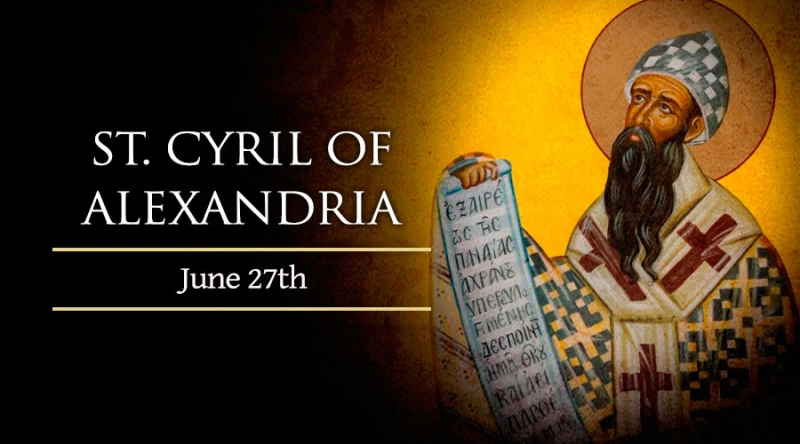
On June 27, Roman Catholics honor St. Cyril of Alexandria. An Egyptian bishop and theologian, he is best known for his role in the Council of Ephesus, where the Church confirmed that Christ is both God and man in one person. The Eastern churches celebrate St. Cyril of Alexandria on June 9.

Cyril was most likely born in Alexandria, the metropolis of ancient Egypt, between 370 and 380. From his writings, it appears he received a solid literary and theological education. Along with his uncle, Patriarch Theophilus of Alexandria, he played a role in an early fifth-century dispute between the Egyptian and Greek churches. There is evidence he may have been a monk before becoming a bishop.

When Theophilus died in 412, Cyril was chosen to succeed him at the head of the Egyptian Church. He continued his uncle’s policy of insisting on Alexandria’s preeminence within the Church over Constantinople, despite the political prominence of the imperial capital. The two Eastern churches eventually re-established communion in approximately 418.

Ten years later, however, a theological dispute caused a new break between Alexandria and Constantinople. Cyril’s reputation as a theologian, and later Doctor of the Church, arose from his defense of Catholic orthodoxy during this time.

In 428, a monk named Nestorius became the new Patriarch of Constantinople. It became clear that Nestorius was not willing to use the term “Mother of God” (“Theotokos”) to describe the Virgin Mary. Instead, he insisted on the term “Mother of Christ” (“Christotokos”).

During the fourth century, the Greek Church had already held two ecumenical councils to confirm Christ’s eternal preexistence as God prior to his incarnation as a man. From this perennial belief, it followed logically that Mary was the mother of God. Veneration of Mary as “Theotokos” confirmed the doctrine of the incarnation, and Christ’s status as equal to the God the Father.

Nestorius insisted that he, too, held these doctrines. But to Cyril, and many others, his refusal to acknowledge Mary as the Mother of God seemed to reveal a heretical view of Christ which would split him into two united but distinct persons: one fully human and born of Mary, the other fully divine and not subject to birth or death.

Cyril responded to this heretical tendency first through a series of letters to Nestorius (which are still in existence and studied today), then through an appeal to the Pope, and finally through the summoning of an ecumenical council in 431. Cyril presided over this council, stating that he was “filling the place of the most holy and blessed Archbishop of the Roman Church,” Pope Celestine, who had authorized it.

The council was a tumultuous affair. Patriarch John of Antioch, a friend of Nestorius, came to the city and convened a rival council which sought to condemn and depose Cyril. Tension between the advocates of Cyril and Nestorius erupted into physical violence at times, and both parties sought to convince the emperor in Constantinople to back their position.

During the council, which ran from June 22 to July 31 of the year 431, Cyril brilliantly defended the orthodox belief in Christ as a single eternally divine person who also became incarnate as a man. The council condemned Nestorius, who was deposed as patriarch and later suffered exile. Cyril, however, reconciled with John and many of the other Antiochian theologians who once supported Nestorius.

St. Cyril of Alexandria died on June 27, 444, having been a bishop for nearly 32 years. Long celebrated as a saint, particularly in the Eastern Catholic and Eastern Orthodox churches, he was declared a Doctor of the Church in 1883.

St. Cyril of Alexandria Read More »

St. Ladislaus


St. Ladislaus

Feast date: Jun 27

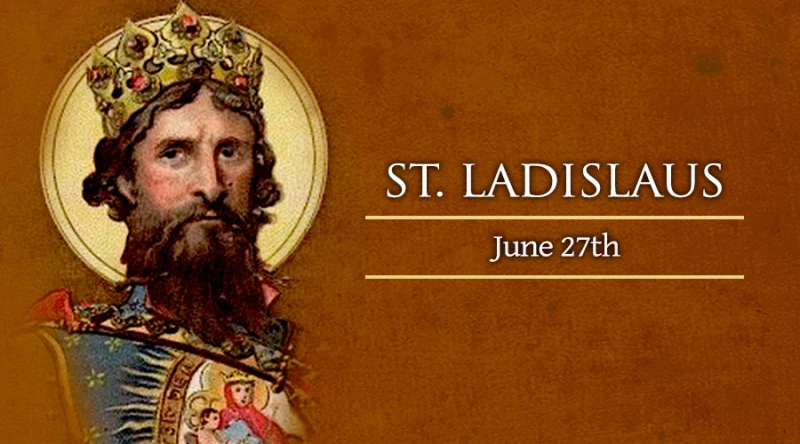
St. Ladislaus was the King of Hungary, born 1040  and died at Neutra, July 29, 1095 as one of Hungary’s national Christian heroes. He was the son of Béla I, and the nobles, after the death of Geisa I, passed over Solomon, the son of Andrew I, and chose Ladislaus to be their king in 1077.

Ladislaus eventually made peace with Solomon, when the latter gave up all claims to the throne of Hungary, however, later on he rebelled against Ladislaus, who took him prisoner and held him in the fortress of Visegrád. On the occasion of the canonization of Stephen I, Ladislaus gave Solomon his freedom, but in 1086 Solomon, with the aid of the heathen Cumans, revolted against Ladislaus a second time. Ladislaus, however, vanquished them again, and in 1089 gained another victory over theTurkish Cumans. In 1091 Ladislaus marched into Croatia at the request of his sister, the widowed Queen Helena, and took possession of the kingdom for the crown of Hungary where, in 1092, he founded the Bishopric of Agram (Zágráb). In the same year (1092), he also founded the Bishopric of Grosswardein (Nagy-Várad) in Hungary, which, however, some trace back to Stephen I.

Ladislaus governed the religious and civil affairs of his assembly of the Imperial States at Szabolcs, that might almost be called a synod. He tried vigorously to suppress the remaining heathen customs. He was buried in the cathedral of Grosswardein. He still lives in the sagas and poems of his people as a chivalrous king.

He was canonized by Celestine III in 1192.

St. Ladislaus Read More »

Thirteenth Sunday in Ordinary Time

Reading I 1 Kgs 19:16b, 19-21

The LORD said to Elijah:
“You shall anoint Elisha, son of Shaphat of Abelmeholah,
as prophet to succeed you.”

Elijah set out and came upon Elisha, son of Shaphat,
as he was plowing with twelve yoke of oxen;
he was following the twelfth.
Elijah went over to him and threw his cloak over him.
Elisha left the oxen, ran after Elijah, and said,
“Please, let me kiss my father and mother goodbye,
and I will follow you.”
Elijah answered, “Go back!
Have I done anything to you?”
Elisha left him, and taking the yoke of oxen, slaughtered them;
he used the plowing equipment for fuel to boil their flesh,
and gave it to his people to eat.
Then Elisha left and followed Elijah as his attendant.

Responsorial Psalm Ps 16:1-2, 5, 7-8, 9-10, 11

R (cf. 5a) You are my inheritance, O Lord.
Keep me, O God, for in you I take refuge;
            I say to the LORD, “My Lord are you.
O LORD, my allotted portion and my cup,
            you it is who hold fast my lot.”
R You are my inheritance, O Lord.
I bless the LORD who counsels me;
            even in the night my heart exhorts me.
I set the LORD ever before me;
            with him at my right hand I shall not be disturbed.
R You are my inheritance, O Lord.
Therefore my heart is glad and my soul rejoices,
            my body, too, abides in confidence
because you will not abandon my soul to the netherworld,
            nor will you suffer your faithful one to undergo corruption.
R You are my inheritance, O Lord.
You will show me the path to life,
            fullness of joys in your presence,
            the delights at your right hand forever.
R You are my inheritance, O Lord.

Reading II Gal 5:1, 13-18

Brothers and sisters:
For freedom Christ set us free;
so stand firm and do not submit again to the yoke of slavery.

For you were called for freedom, brothers and sisters.
But do not use this freedom
as an opportunity for the flesh;
rather, serve one another through love.
For the whole law is fulfilled in one statement,
namely, You shall love your neighbor as yourself.
But if you go on biting and devouring one another,
beware that you are not consumed by one another.

I say, then: live by the Spirit
and you will certainly not gratify the desire of the flesh.
For the flesh has desires against the Spirit,
and the Spirit against the flesh;
these are opposed to each other,
so that you may not do what you want.
But if you are guided by the Spirit, you are not under the law.

Alleluia 1 Sm 3:9; Jn 6:68c

R. Alleluia, alleluia.
Speak, Lord, your servant is listening;
you have the words of everlasting life.
R. Alleluia, alleluia.

Gospel Lk 9:51-62

When the days for Jesus’ being taken up were fulfilled,
he resolutely determined to journey to Jerusalem,
and he sent messengers ahead of him.
On the way they entered a Samaritan village
to prepare for his reception there,
but they would not welcome him
because the destination of his journey was Jerusalem.
When the disciples James and John saw this they asked,
“Lord, do you want us to call down fire from heaven
to consume them?”
Jesus turned and rebuked them, and they journeyed to another village.

As they were proceeding on their journey someone said to him,
“I will follow you wherever you go.”
Jesus answered him,
“Foxes have dens and birds of the sky have nests,
but the Son of Man has nowhere to rest his head.”

And to another he said, “Follow me.”
But he replied, “Lord, let me go first and bury my father.”
But he answered him, “Let the dead bury their dead.
But you, go and proclaim the kingdom of God.”
And another said, “I will follow you, Lord,
but first let me say farewell to my family at home.”
To him Jesus said, “No one who sets a hand to the plow
and looks to what was left behind is fit for the kingdom of God.”

– – –

Lectionary for Mass for Use in the Dioceses of the United States, second typical edition, Copyright © 2001, 1998, 1997, 1986, 1970 Confraternity of Christian Doctrine; Psalm refrain © 1968, 1981, 1997, International Committee on English in the Liturgy, Inc. All rights reserved. Neither this work nor any part of it may be reproduced, distributed, performed or displayed in any medium, including electronic or digital, without permission in writing from the copyright owner.

Thirteenth Sunday in Ordinary Time Read More »