Please mind our dust!

We are currently working on revamping our website!
Thank you for your patience!

CRD Solutions

Thirteenth Sunday in Ordinary Time

Reading I 1 Kgs 19:16b, 19-21

The LORD said to Elijah:
“You shall anoint Elisha, son of Shaphat of Abelmeholah,
as prophet to succeed you.”

Elijah set out and came upon Elisha, son of Shaphat,
as he was plowing with twelve yoke of oxen;
he was following the twelfth.
Elijah went over to him and threw his cloak over him.
Elisha left the oxen, ran after Elijah, and said,
“Please, let me kiss my father and mother goodbye,
and I will follow you.”
Elijah answered, “Go back!
Have I done anything to you?”
Elisha left him, and taking the yoke of oxen, slaughtered them;
he used the plowing equipment for fuel to boil their flesh,
and gave it to his people to eat.
Then Elisha left and followed Elijah as his attendant.

Responsorial Psalm Ps 16:1-2, 5, 7-8, 9-10, 11

R (cf. 5a) You are my inheritance, O Lord.
Keep me, O God, for in you I take refuge;
            I say to the LORD, “My Lord are you.
O LORD, my allotted portion and my cup,
            you it is who hold fast my lot.”
R You are my inheritance, O Lord.
I bless the LORD who counsels me;
            even in the night my heart exhorts me.
I set the LORD ever before me;
            with him at my right hand I shall not be disturbed.
R You are my inheritance, O Lord.
Therefore my heart is glad and my soul rejoices,
            my body, too, abides in confidence
because you will not abandon my soul to the netherworld,
            nor will you suffer your faithful one to undergo corruption.
R You are my inheritance, O Lord.
You will show me the path to life,
            fullness of joys in your presence,
            the delights at your right hand forever.
R You are my inheritance, O Lord.

Reading II Gal 5:1, 13-18

Brothers and sisters:
For freedom Christ set us free;
so stand firm and do not submit again to the yoke of slavery.

For you were called for freedom, brothers and sisters.
But do not use this freedom
as an opportunity for the flesh;
rather, serve one another through love.
For the whole law is fulfilled in one statement,
namely, You shall love your neighbor as yourself.
But if you go on biting and devouring one another,
beware that you are not consumed by one another.

I say, then: live by the Spirit
and you will certainly not gratify the desire of the flesh.
For the flesh has desires against the Spirit,
and the Spirit against the flesh;
these are opposed to each other,
so that you may not do what you want.
But if you are guided by the Spirit, you are not under the law.

Alleluia 1 Sm 3:9; Jn 6:68c

R. Alleluia, alleluia.
Speak, Lord, your servant is listening;
you have the words of everlasting life.
R. Alleluia, alleluia.

Gospel Lk 9:51-62

When the days for Jesus’ being taken up were fulfilled,
he resolutely determined to journey to Jerusalem,
and he sent messengers ahead of him.
On the way they entered a Samaritan village
to prepare for his reception there,
but they would not welcome him
because the destination of his journey was Jerusalem.
When the disciples James and John saw this they asked,
“Lord, do you want us to call down fire from heaven
to consume them?”
Jesus turned and rebuked them, and they journeyed to another village.

As they were proceeding on their journey someone said to him,
“I will follow you wherever you go.”
Jesus answered him,
“Foxes have dens and birds of the sky have nests,
but the Son of Man has nowhere to rest his head.”

And to another he said, “Follow me.”
But he replied, “Lord, let me go first and bury my father.”
But he answered him, “Let the dead bury their dead.
But you, go and proclaim the kingdom of God.”
And another said, “I will follow you, Lord,
but first let me say farewell to my family at home.”
To him Jesus said, “No one who sets a hand to the plow
and looks to what was left behind is fit for the kingdom of God.”

– – –

Lectionary for Mass for Use in the Dioceses of the United States, second typical edition, Copyright © 2001, 1998, 1997, 1986, 1970 Confraternity of Christian Doctrine; Psalm refrain © 1968, 1981, 1997, International Committee on English in the Liturgy, Inc. All rights reserved. Neither this work nor any part of it may be reproduced, distributed, performed or displayed in any medium, including electronic or digital, without permission in writing from the copyright owner.

Thirteenth Sunday in Ordinary Time Read More »
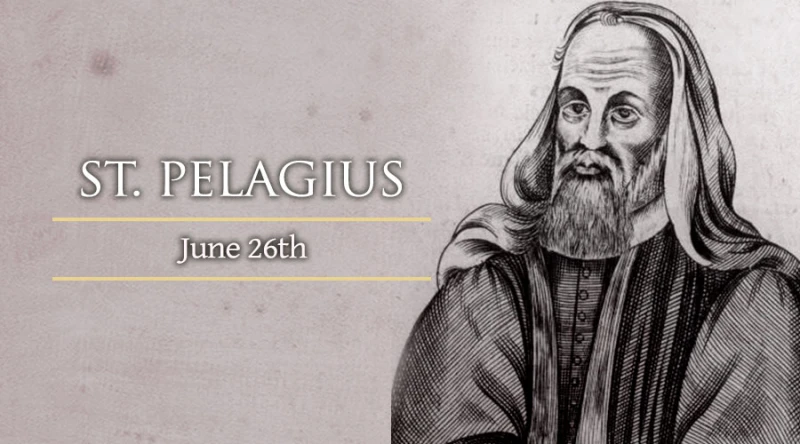
St. Pelagius


St. Pelagius

Feast date: Jun 26

St. Pelagius was a thirteen year old Christian who was martyred for refusing to denounce his faith and convert to Islam in Cordoba, Spain in 925.

10th century Cordoba was the most powerful and glorious time in the world for the muslim caliphates and they boasted the largest mosque outside of the Caaba in Mecca.

Pelagius, as a ten year old boy, was taken hostage by the Moors of Cordoba during a rampage in a Christian town. He was in captivity for three years and nobody had made any attempt to ransom him.

The Emir of Cordoba offered him his freedom if he would convert to Islam. The boy refused and the Emir had him tortured and killed. He is said to have endured six hours of constant excruciating pain until he died.

Saint Pelagius is venerated in Leon, Cordoba, and Oviedo, where his relics have been kept since they were transferred there in 985.

St. Pelagius Read More »

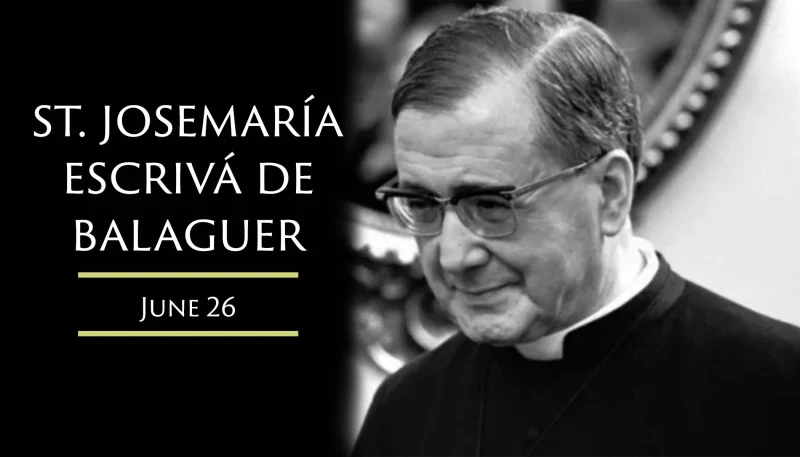
St. Josemaria Escriva de Balaguer


St. Josemaria Escriva de Balaguer

Feast date: Jun 26

On June 26, the Catholic Church commemorates the life of Saint Josemaría Escrivá, priest and founder of The Prelature of the Holy Cross and Opus Dei.

He was born in Barbastro, Spain on January 9, 1902 into a pious family. When he was young, he one day saw bare footprints left in the snow by a monk. The small sign left a great impression of holiness on the young man that would begin to guide his life and foster a vocation to the priesthood.

He developed a prayer life intensely centered on the Eucharist during his priestly studies in Logroño, and also cultivated deep devotion to Mary. “The Blessed Virgin has always helped me to discover her Son’s desires,” he said, and would often pray for her to ask God to reveal his will to him.

On March 28, 1925, Josemaría was ordained to the priesthood. During his early ministry, he worked among a variety of people, including children, students, artists, and workers, while also teaching law to help support his mother and sister.

Three years later, while on retreat, Josemaría saw the mission God intended for him, that of opening up a new spirituality and vocational path for the laity in the form of Opus Dei (“the work of God”). This prelature would become the central focus of his life, serving many of the unmet spiritual needs of lay people at the time.

The young movement began to grow quickly, attracting in particular university students. In the late 1930’s, the Spanish Civil War brought great hardships for the Church while Josemaría continued his work. His reputation for holiness, and thus his movement, began to grow in this time.

In 1946, Josemaría moved to Rome to obtain papal recognition of his movement from Pope Pius XII, which was granted the following year. Even as successive popes sent their blessings and affection, the work involved in expanding Opus Dei took a toll on Josemaría. Nonetheless, he is said to have never stopped smiling.

Josemaría welcomed Pope John XXIII’s calling of the Second Vatican Council. His work in expanding the way to holiness for lay persons was seen by the Council Fathers seen as a precursor to Vatican II’s renewed focus on the life of the laity. He worked swiftly to implement the Council’s decisions into the life and worship of Opus Dei.

In the latter years of his life, Josemaría traveled throughout the world to catechize his organization, often drawing crowds of thousands.

On June 26, 1975, Josemaría died in his workroom of a heart attack. The last thing he ever looked upon was an hanging icon of Our Lady. At his death, Opus Dei was present on all inhabited continents, numbering over 60,000 people from more than 80 nationalities.

St. Josemaria Escriva de Balaguer Read More »

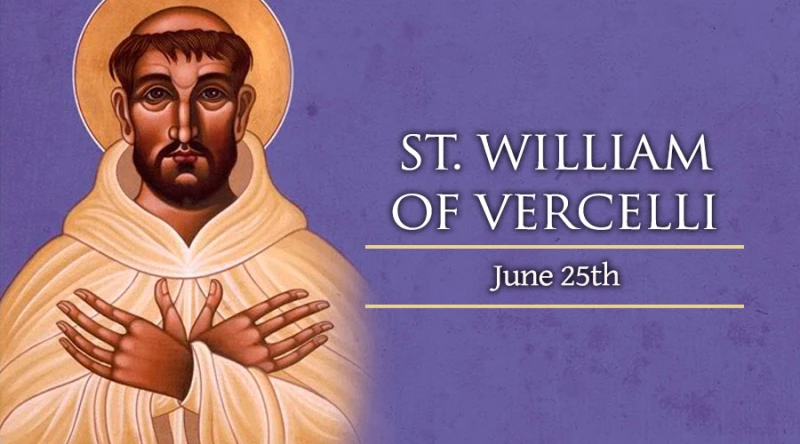
St. William of Vercelli


St. William of Vercelli

Feast date: Jun 25

Image courtesy of William Hart McNichols via Fine Art America.

William was born in 11th-century Italy to a noble family. He was orphaned as an infant and raised by relatives. At the young age of 14, he made a pilgrimage to Santiago de Compostela in Spain, and decided to devote his life to God as a hermit.

He returned to Italy and lived as a hermit for two years at Monte Solicoli, where he was credited with healing a blind man. At Monte Vergiliano, his reputation for holiness attracted many disciples, and in 1119, he established a monastery with a Rule based on the Benedictines.

Five other houses were formed during his lifetime, but only the original survives today. He died June 25, 1142 of natural causes.

St. William of Vercelli Read More »

Memorial of the Immaculate Heart of the Blessed Virgin Mary

Reading I Lam 2:2, 10-14, 18-19

The Lord has consumed without pity
all the dwellings of Jacob;
He has torn down in his anger
the fortresses of daughter Judah;
He has brought to the ground in dishonor
her king and her princes.

On the ground in silence sit
the old men of daughter Zion;
They strew dust on their heads
and gird themselves with sackcloth;
The maidens of Jerusalem
bow their heads to the ground.

Worn out from weeping are my eyes,
within me all is in ferment;
My gall is poured out on the ground
because of the downfall of the daughter of my people,
As child and infant faint away
in the open spaces of the town.

In vain they ask their mothers,
“Where is the grain?”
As they faint away like the wounded
in the streets of the city,
And breathe their last
in their mothers’ arms.

To what can I liken or compare you,
O daughter Jerusalem?
What example can I show you for your comfort,
virgin daughter Zion?
For great as the sea is your downfall;
who can heal you?

Your prophets had for you
false and specious visions;
They did not lay bare your guilt,
to avert your fate;
They beheld for you in vision
false and misleading portents.

Cry out to the Lord;
moan, O daughter Zion!
Let your tears flow like a torrent
day and night;
Let there be no respite for you,
no repose for your eyes.

Rise up, shrill in the night,
at the beginning of every watch;
Pour out your heart like water
in the presence of the Lord;
Lift up your hands to him
for the lives of your little ones
Who faint from hunger
at the corner of every street.
 

Responsorial Psalm 74:1b-2, 3-5, 6-7, 20-21

R. (19b) Lord, forget not the souls of your poor ones.
Why, O God, have you cast us off forever?
Why does your anger smolder against the sheep of your pasture?
Remember your flock which you built up of old,
the tribe you redeemed as your inheritance,
Mount Zion, where you took up your abode.
R. Lord, forget not the souls of your poor ones.
Turn your steps toward the utter ruins;
toward all the damage the enemy has done in the sanctuary.
Your foes roar triumphantly in your shrine;
they have set up their tokens of victory.
They are like men coming up with axes to a clump of trees.
R. Lord, forget not the souls of your poor ones.
With chisel and hammer they hack at all the paneling of the sanctuary.
They set your sanctuary on fire;
the place where your name abides they have razed and profaned.
R. Lord, forget not the souls of your poor ones.
Look to your covenant,
for the hiding places in the land and the plains are full of violence.
May the humble not retire in confusion;
may the afflicted and the poor praise your name.
R. Lord, forget not the souls of your poor ones.

Alleluia See Lk 2:19

R. Alleluia, alleluia.
Blessed is the Virgin Mary who kept the word of God
and pondered it in her heart.
R. Alleluia, alleluia.

Gospel Lk 2:41-51

Each year Jesus’ parents went to Jerusalem for the feast of Passover,
and when he was twelve years old,
they went up according to festival custom.
After they had completed its days, as they were returning,
the boy Jesus remained behind in Jerusalem,
but his parents did not know it.
Thinking that he was in the caravan,
they journeyed for a day
and looked for him among their relatives and acquaintances,
but not finding him,
they returned to Jerusalem to look for him.
After three days they found him in the temple,
sitting in the midst of the teachers,
listening to them and asking them questions,
and all who heard him were astounded
at his understanding and his answers.
When his parents saw him,
they were astonished,
and his mother said to him,
“Son, why have you done this to us?
Your father and I have been looking for you with great anxiety.”
And he said to them,
“Why were you looking for me?
Did you not know that I must be in my Father’s house?”
But they did not understand what he said to them.
He went down with them and came to Nazareth,
and was obedient to them;
and his mother kept all these things in her heart.


– – –

Lectionary for Mass for Use in the Dioceses of the United States, second typical edition, Copyright © 2001, 1998, 1997, 1986, 1970 Confraternity of Christian Doctrine; Psalm refrain © 1968, 1981, 1997, International Committee on English in the Liturgy, Inc. All rights reserved. Neither this work nor any part of it may be reproduced, distributed, performed or displayed in any medium, including electronic or digital, without permission in writing from the copyright owner.

Memorial of the Immaculate Heart of the Blessed Virgin Mary Read More »