Please mind our dust!

We are currently working on revamping our website!
Thank you for your patience!

CRD Solutions

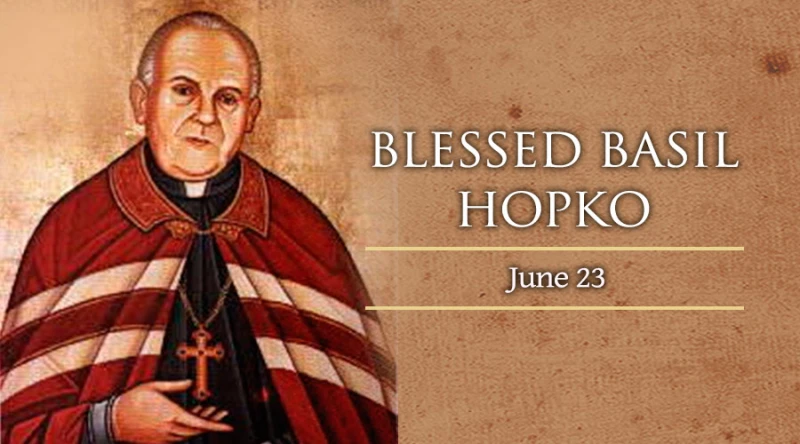
Blessed Basil Hopko


Blessed Basil Hopko

Feast date: Jun 23

Blessed Basil Hopko is considered one of the many priests and religious martyred by Communism. He was born in Slovakia to poor parents. His father died when he was a year old and his mother left for the United States when he was four in seach of work.

He remained in Europe and was an excellent student. He wanted to join his mother in the United States and pursue his vocation to the priesthood there, but his poor health did not permit him to travel.

He was ordained in 1929 and served as a parish priest in Prague, with a spcial mission to assist the poor, unemployed and students. In 1947, he was named auxiliary bishop of Prjashev. Three years later, he was arrested by Communist officials and tortured.

He was given a trial and sentenced to 15 years for “subversive activity.” His health failed as he was continually tortured. In 1964, he was transferred to a home for seniors. There, he was kept under guard but managed to minister to a group of 120 nuns who had been imprisoned in the home as well.

Though his eparchy was restored in 1968, officials did not permit him to resume his leadership. A Slovak bishop was appointed in his place. He never recovered from his health and died in 1976. He was beatified by Pope John Paul II in 2003 in the Slovak Republic.

Blessed Basil Hopko Read More »

St. Etheldreda

Feast date: Jun 23

St. Etheldreda, commonly known as Audry, was Queen of Northumbria. She was born at around 630, and while still very young she was given in marriage by her father, Anna, King of East Anglia, to a subordinate prince, who gave her a piece of land locally known as the Isle of Ely. She remained a virgin even during her marriage, and five years after his early death, lived in isolation.

St. Etheldreda was forced to marry again out political convenience, this time to the heir of Oswy, King of Northumbria. Throughout her 12 years of marriage, she kept her virginity, and she gave much of her time to devotion and charity.

St. Wilfrid was her friend and spiritual guide, and helped to persuade her husband that St. Etheldreda should live for some time in peace as a sister of the Coldingham nunnery, founded by her aunt, St. Ebb.

During this time, St. Etheldreda only ate once a day, except on feast days or while she was sick, and wore only clothes made of wool. After midnight prayers, she would always go back to the church and continue praying until morning.

St. Etheldreda took pain and humiliation as a blessing – on her death bed, she thanked God for an illness that had painfully swollen her neck, which she considered to be punishment for having vainly worn necklaces with jewels as a young lady.

She died on June 23, 679, and was buried in a wooden coffin, as she had asked.

When St. Etheldreda’s body was moved to a stone coffin, it was found incorrupt and her neck was perfectly healed, according to physicians.

St. Etheldreda Read More »

Wednesday of the Twelfth Week in Ordinary Time

Reading I 2 Kgs 22:8-13; 23:1-3

The high priest Hilkiah informed the scribe Shaphan,
“I have found the book of the law in the temple of the LORD.”
Hilkiah gave the book to Shaphan, who read it.
Then the scribe Shaphan went to the king and reported,
“Your servants have smelted down the metals available in the temple
and have consigned them to the master workmen
in the temple of the LORD.”
The scribe Shaphan also informed the king
that the priest Hilkiah had given him a book,
and then read it aloud to the king.
When the king heard the contents of the book of the law,
he tore his garments and issued this command to Hilkiah the priest,
Ahikam, son of Shaphan,
Achbor, son of Micaiah, the scribe Shaphan,
and the king’s servant Asaiah:
“Go, consult the LORD for me, for the people, for all Judah,
about the stipulations of this book that has been found,
for the anger of the LORD has been set furiously ablaze against us,
because our fathers did not obey the stipulations of this book,
nor fulfill our written obligations.”

The king then had all the elders of Judah
and of Jerusalem summoned together before him.
The king went up to the temple of the LORD with all the men of Judah
and all the inhabitants of Jerusalem:
priests, prophets, and all the people, small and great.
He had the entire contents of the book of the covenant
that had been found in the temple of the LORD, read out to them.
Standing by the column, the king made a covenant before the LORD
that they would follow him
and observe his ordinances, statutes and decrees
with their whole hearts and souls,
thus reviving the terms of the covenant
which were written in this book.
And all the people stood as participants in the covenant.

Responsorial Psalm 119:33, 34, 35, 36, 37, 40

R. (33a) Teach me the way of your decrees, O Lord.
Instruct me, O LORD, in the way of your statutes,
that I may exactly observe them.
R. Teach me the way of your decrees, O Lord.
Give me discernment, that I may observe your law
and keep it with all my heart.
R. Teach me the way of your decrees, O Lord.
Lead me in the path of your commands,
for in it I delight.
R. Teach me the way of your decrees, O Lord.
Incline my heart to your decrees
and not to gain.
R. Teach me the way of your decrees, O Lord.
Turn away my eyes from seeing what is vain:
by your way give me life.
R. Teach me the way of your decrees, O Lord.
Behold, I long for your precepts;
in your justice give me life.
R. Teach me the way of your decrees, O Lord.


Alleluia Jn 15:4a, 5b

R. Alleluia, alleluia.
Remain in me, as I remain in you, says the Lord;
whoever remains in me will bear much fruit.
R. Alleluia, alleluia.


Gospel Mt 7:15-20

Jesus said to his disciples:
“Beware of false prophets, who come to you in sheep’s clothing,
but underneath are ravenous wolves.
By their fruits you will know them.
Do people pick grapes from thornbushes, or figs from thistles?
Just so, every good tree bears good fruit,
and a rotten tree bears bad fruit.
A good tree cannot bear bad fruit,
nor can a rotten tree bear good fruit.
Every tree that does not bear good fruit will be cut down
and thrown into the fire.
So by their fruits you will know them.”

– – –

Lectionary for Mass for Use in the Dioceses of the United States, second typical edition, Copyright © 2001, 1998, 1997, 1986, 1970 Confraternity of Christian Doctrine; Psalm refrain © 1968, 1981, 1997, International Committee on English in the Liturgy, Inc. All rights reserved. Neither this work nor any part of it may be reproduced, distributed, performed or displayed in any medium, including electronic or digital, without permission in writing from the copyright owner.

Wednesday of the Twelfth Week in Ordinary Time Read More »

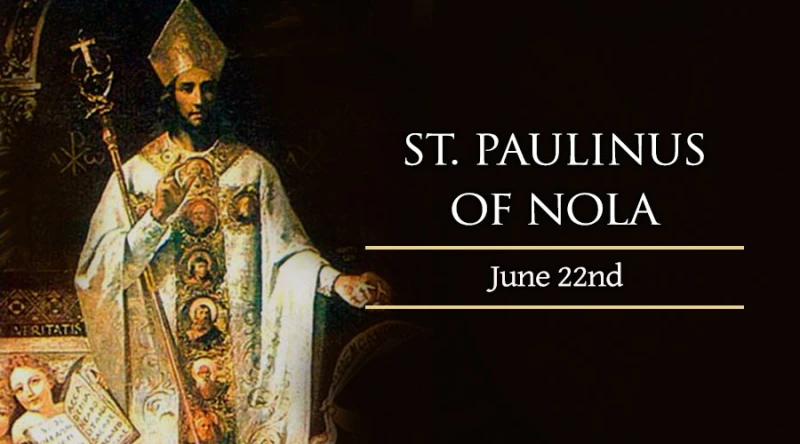
St. Paulinus of Nola


St. Paulinus of Nola

Feast date: Jun 22

On June 22, the Catholic Church remembers Saint Paulinus of Nola, who gave up his life in politics to become a monk, a bishop, and a revered Christian poet of the 5th century.

In a December 2007 general audience on St. Paulinus, Pope Benedict XVI remarked on the saint’s artistic gifts, which inspired “songs of faith and love in which the daily history of small and great events is seen as a history of salvation, a history of God with us.”

The poet-bishop’s ministry, Pope Benedict said, was also “distinguished by special attention to the poor” – confirming his legacy as “a bishop with a great heart who knew how to make himself close to his people in the sorrowful trials of the barbarian invasions” during the 5th century.

Born at Bordeaux in present-day France during 354, Paulinus came from an illustrious family in the Roman imperial province of Aquitania. He received his literary education from the renowned poet and professor Ausonius, and eventually rose to the rank of governor in the Italian province of Campania.

Not yet baptized or a believer in Christ, Paulinus was nonetheless struck by the Campanians’ devotion to the martyr Saint Felix at his local shrine. He took the initiative to build a road for pilgrims, as well as a hospice for the poor near the site of Felix’s veneration.

But Paulinus grew dissatisfied with his civil position, leaving Campania and returning to his native region from 380 to 390. He also married a Spanish Catholic woman named Therasia. She, along with Bishop Delphinus of Bordeaux, and St. Martin the Bishop of Tours, guided him toward conversion.

Paulinus and his brother were baptized on the same day by Delphinus. But it was not long into his life as a Christian, that two shattering upheavals took place. Paulinus’ infant son died shortly after birth; and when Paulinus’ brother also died, he was accused in his murder.

After these catastrophes, Paulinus and Therasia mutually agreed to embrace monasticism, living in poverty and chastity. Around 390, they both moved to Spain. Approximately five years after his change of residence and lifestyle, the residents of Barcelona arranged for Paulinus’ ordination as a priest.

During 395 he returned to the Italian city of Nola, where he and his wife both continued to live in chastity as monks. Paulinus made important contributions to the local church, particularly in the construction of basilicas. In 409, the monk was consecrated as the city’s bishop.

Paulinus served as the Bishop of Nola for two decades. His gifts as a poet and composer of hymns were matched by his knowledge of Scripture, generosity toward the poor, and devotion to the saints who had preceded him – especially St. Felix, whose intercession he regarded as central to his conversion.

Praised by the likes of St. Augustine and St. Jerome for the depth of his conversion to Christ, the Bishop of Nola was regarded as a saint even before his death on the evening of June 22, 431.

St. Paulinus of Nola Read More »

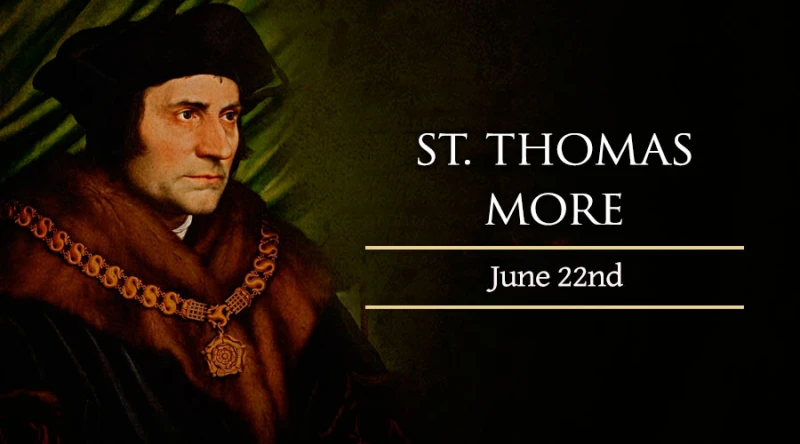
St. Thomas More


St. Thomas More

Feast date: Jun 22

On June 22, the Catholic Church honors the life and martyrdom of St. Thomas More, the lawyer, author and statesman who lost his life opposing King Henry VIII’s plan to subordinate the Church to the English monarchy.

Thomas More was born in 1478, son of the lawyer and judge John More and his wife Agnes. He received a classical education from the age of six, and at age 13 became the protege of Archbishop John Morton, who also served an important civic role as the Lord Chancellor. Although Thomas never joined the clergy, he would eventually come to assume the position of Lord Chancellor himself.

More received a well-rounded college education at Oxford, becoming a “renaissance man” who knew several ancient and modern languages and was well-versed in mathematics, music and literature. His father, however, determined that Thomas should become a lawyer, so he withdrew his son from Oxford after two years to focus him on that career.

Despite his legal and political orientation, Thomas was confused in regard to his vocation as a young man. He seriously considered joining either the Carthusian monastic order or the Franciscans, and followed a number of ascetic and spiritual practices throughout his life – such as fasting, corporal mortification, and a regular rule of prayer – as means of growing in holiness.

In 1504, however, More was elected to Parliament. He gave up his monastic ambitions, though not his disciplined spiritual life, and married Jane Colt of Essex. They were happily married for several years and had four children together, though Jane tragically died in childbirth in 1511. Shortly after her death, More married a widow named Alice Middleton, who proved to be a devoted wife and mother.

Two years earlier, in 1509, King Henry VIII had acceded to the throne. For years, the king showed fondness for Thomas, working to further his career as a public servant. He became a part of the king’s inner circle, eventually overseeing the English court system as Lord Chancellor. More even authored a book published in Henry’s name, defending Catholic doctrine against Martin Luther.

More’s eventual martyrdom would come as a consequence o f Henry VIII’s own tragic downfall. The king wanted an annulment of his marriage to Catherine of Aragon, a marriage that Pope Clement VII declared to be valid and indissoluble. By 1532, More had resigned as Lord Chancellor, refusing to support the king’s efforts to defy the Pope and control the Church.

In 1534, Henry VIII declared that every subject of the British crown would have to swear an oath affirming the validity of his new marriage to Anne Boleyn. Refusal of these demands would be regarded as treason against the state.

In April of that year, a royal commission summoned Thomas to force him to take the oath affirming the King’s new marriage as valid. While accepting certain portions of the act which pertained to Henry’s royal line of succession, he could not accept the king’s defiance of papal authority on the marriage question. More was taken from his wife and children, and imprisoned in the Tower of London.

For 15 months, More’s wife and several friends tried to convince him to take the oath and save his life, but he refused. In 1535, while More was imprisoned, an act of Parliament came into effect declaring Henry VIII to be “the only supreme head on earth of the Church in England,” once again under penalty of treason. Members of the clergy who would not take the oath began to be executed.

In June of 1535, More was finally indicted and formally tried for the crime of treason in Westminster Hall. He was charged with opposing the king’s “Act of Supremacy” in private conversations which he insisted had never occurred. But after his defense failed, and he was sentenced to death, he finally spoke out in open opposition to what he had previously opposed through silence and refusal.

More explained that Henry’s Act of Supremacy, was contrary “to the laws of God and his holy Church.” He explained that “no temporal prince” could take away the prerogatives that belonged to St. Peter and his successors according to the words of Christ. When he was told that most of the English bishops had accepted the king’s order, More replied that the saints in heaven did not accept it.

On July 6, 1535, the 57-year-old More came before the executioner to be beheaded. “I die the king’s good servant,” he told the onlookers, “but God’s first.” His head was displayed on London Bridge, but later returned to his daughter Margaret who preserved it as a holy relic of her father.

St. Thomas More was beatified by Pope Leo XIII in 1886 and canonized in 1935 by Pope Piux XI. The Academy Award-winning film “A Man For All Seasons” portrayed the events that led to his martyrdom.

St. Thomas More Read More »