Please mind our dust!

We are currently working on revamping our website!
Thank you for your patience!

CRD Solutions

Memorial of Saint Aloysius Gonzaga, Religious

Reading I 2 Kgs 19:9b-11, 14-21, 31-35a, 36

Sennacherib, king of Assyria, sent envoys to Hezekiah
with this message:
“Thus shall you say to Hezekiah, king of Judah:
‘Do not let your God on whom you rely deceive you
by saying that Jerusalem will not be handed over
to the king of Assyria.
You have heard what the kings of Assyria have done
to all other countries: they doomed them!
Will you, then, be saved?’”

Hezekiah took the letter from the hand of the messengers and read it;
then he went up to the temple of the LORD,
and spreading it out before him,
he prayed in the LORD’s presence:
“O LORD, God of Israel, enthroned upon the cherubim!
You alone are God over all the kingdoms of the earth.
You have made the heavens and the earth.
Incline your ear, O LORD, and listen!
Open your eyes, O LORD, and see!
Hear the words of Sennacherib which he sent to taunt the living God.
Truly, O LORD, the kings of Assyria have laid waste the nations
and their lands, and cast their gods into the fire;
they destroyed them because they were not gods,
but the work of human hands, wood and stone.
Therefore, O LORD, our God, save us from the power of this man,
that all the kingdoms of the earth may know
that you alone, O LORD, are God.”

Then Isaiah, son of Amoz, sent this message to Hezekiah:
“Thus says the LORD, the God of Israel,
in answer to your prayer for help against Sennacherib, king of Assyria:
I have listened!
This is the word the LORD has spoken concerning him:

“‘She despises you, laughs you to scorn,
the virgin daughter Zion!
Behind you she wags her head,
daughter Jerusalem.

“‘For out of Jerusalem shall come a remnant,
and from Mount Zion, survivors.
The zeal of the LORD of hosts shall do this.’

“Therefore, thus says the LORD concerning the king of Assyria:
‘He shall not reach this city, nor shoot an arrow at it,
nor come before it with a shield,
nor cast up siege-works against it.
He shall return by the same way he came,
without entering the city, says the LORD.
I will shield and save this city for my own sake,
and for the sake of my servant David.’”

That night the angel of the LORD went forth and struck down
one hundred and eighty-five thousand men in the Assyrian camp.
So Sennacherib, the king of Assyria, broke camp,
and went back home to Nineveh.

Responsorial Psalm 48:2-3ab, 3cd-4, 10-11

R. (see 9d) God upholds his city for ever.
Great is the LORD and wholly to be praised
in the city of our God.
His holy mountain, fairest of heights,
is the joy of all the earth.
R. God upholds his city for ever.
Mount Zion, “the recesses of the North,”
is the city of the great King.
God is with her castles;
renowned is he as a stronghold.
R. God upholds his city for ever.
O God, we ponder your mercy
within your temple.
As your name, O God, so also your praise
reaches to the ends of the earth.
Of justice your right hand is full.
R. God upholds his city for ever.


Alleluia Jn 8:12

R. Alleluia, alleluia.
I am the light of the world, says the Lord;
whoever follows me will have the light of life.
R. Alleluia, alleluia.

Gospel Mt 7:6, 12-14

Jesus said to his disciples:
“Do not give what is holy to dogs, or throw your pearls before swine,
lest they trample them underfoot, and turn and tear you to pieces.

“Do to others whatever you would have them do to you.
This is the Law and the Prophets.

“Enter through the narrow gate;
for the gate is wide and the road broad that leads to destruction,
and those who enter through it are many.
How narrow the gate and constricted the road that leads to life.
And those who find it are few.”

– – –

Lectionary for Mass for Use in the Dioceses of the United States, second typical edition, Copyright © 2001, 1998, 1997, 1986, 1970 Confraternity of Christian Doctrine; Psalm refrain © 1968, 1981, 1997, International Committee on English in the Liturgy, Inc. All rights reserved. Neither this work nor any part of it may be reproduced, distributed, performed or displayed in any medium, including electronic or digital, without permission in writing from the copyright owner.

Memorial of Saint Aloysius Gonzaga, Religious Read More »
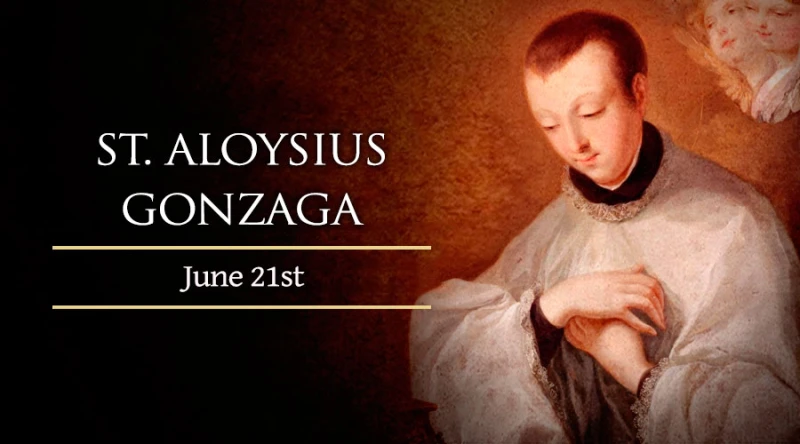
St. Aloysius Gonzaga


St. Aloysius Gonzaga

Feast date: Jun 21

As a young boy, St. Aloysius always had a great desire to know and serve God, but his family life was not always supportive of this desire. He was born into a noble Italian family, and his father was a compulsive gambler. He grew up in a castle and was trained from a very young age to be a soldier and courtier, and despite the opposition of his family, he taught catechism to poor boys.

He encountered many holy people in his lifetime; he received his first Communion from St. Charles Borromeo and studied under St. Robert Bellarmine. As a teen, he suffered from a kidney disease which he considered a blessing, as it left him with plenty of time for prayer.

At 18 he signed away his legal claim to his title and his family’s lands and entered the Jesuits. He died shortly thereafter of the plague at the age of 23, having devotedly cared for plague victims in Rome in the outbreak of 1591.

He was canonized in 1726 and is the patron saint of youth, AIDS patients and AIDS caregivers.

St. Aloysius Gonzaga Read More »

Monday of the Twelfth Week in Ordinary Time

Reading I 2 Kgs 17:5-8, 13-15a, 18

Shalmaneser, king of Assyria, occupied the whole land
and attacked Samaria, which he besieged for three years.
In the ninth year of Hoshea, king of Israel
the king of Assyria took Samaria,
and deported the children of Israel to Assyria,
setting them in Halah, at the Habor, a river of Gozan,
and the cities of the Medes.

This came about because the children of Israel sinned against the LORD,
their God, who had brought them up from the land of Egypt,
from under the domination of Pharaoh, king of Egypt,
and because they venerated other gods.
They followed the rites of the nations
whom the Lord had cleared out of the way of the children of Israel
and the kings of Israel whom they set up.

And though the LORD warned Israel and Judah
by every prophet and seer,
“Give up your evil ways and keep my commandments and statutes,
in accordance with the entire law which I enjoined on your fathers
and which I sent you by my servants the prophets,”
they did not listen, but were as stiff-necked as their fathers,
who had not believed in the LORD, their God.
They rejected his statutes,
the covenant which he had made with their fathers,
and the warnings which he had given them, till,
in his great anger against Israel,
the LORD put them away out of his sight.
Only the tribe of Judah was left.

Responsorial Psalm 60:3, 4-5, 12-13

R. (7b) Help us with your right hand, O Lord, and answer us.
O God, you have rejected us and broken our defenses;
you have been angry; rally us!
R. Help us with your right hand, O Lord, and answer us.
You have rocked the country and split it open;
repair the cracks in it, for it is tottering.
You have made your people feel hardships;
you have given us stupefying wine.
R. Help us with your right hand, O Lord, and answer us.
Have not you, O God, rejected us,
so that you go not forth, O God, with our armies?
Give us aid against the foe,
for worthless is the help of men.
R. Help us with your right hand, O Lord, and answer us.

Alleluia Heb 4:12

R. Alleluia, alleluia.
The word of God is living and effective,
able to discern reflections and thoughts of the heart.
R. Alleluia, alleluia.

Gospel Mt 7:1-5

Jesus said to his disciples:
“Stop judging, that you may not be judged.
For as you judge, so will you be judged,
and the measure with which you measure will be measured out to you.
Why do you notice the splinter in your brother’s eye,
but do not perceive the wooden beam in your own eye?
How can you say to your brother,
‘Let me remove that splinter from your eye,’
while the wooden beam is in your eye?
You hypocrite, remove the wooden beam from your eye first;
then you will see clearly
to remove the splinter from your brother’s eye.”

– – –

Lectionary for Mass for Use in the Dioceses of the United States, second typical edition, Copyright © 2001, 1998, 1997, 1986, 1970 Confraternity of Christian Doctrine; Psalm refrain © 1968, 1981, 1997, International Committee on English in the Liturgy, Inc. All rights reserved. Neither this work nor any part of it may be reproduced, distributed, performed or displayed in any medium, including electronic or digital, without permission in writing from the copyright owner.

Monday of the Twelfth Week in Ordinary Time Read More »

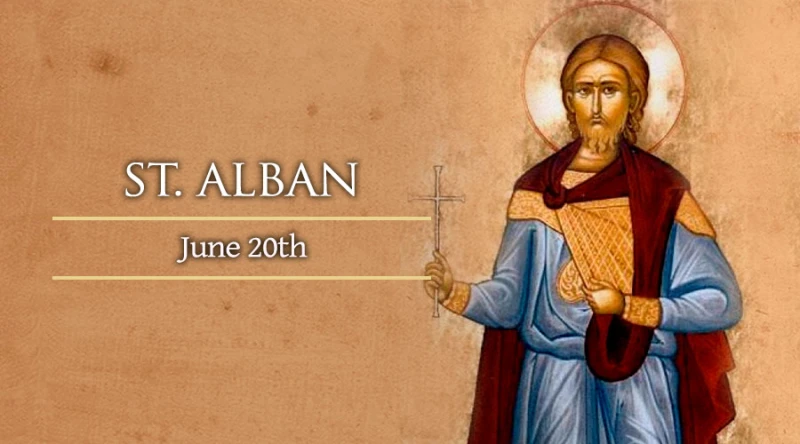
St. Alban


St. Alban

Feast date: Jun 20

St. Alban was the first Christian martyr in Britain during the early 4th century. He is the patron saint of converts and torture victims.

Although he was not a man of faith, St. Alban was very hospitable and compassionate. As a soldier, he sheltered a persecuted priest, Amphibalus, during a time when Christians were being put to death in Britain. The priest’s faith and piety struck St. Alban, as well as his dedication to prayer.

Alban soon converted to Christianity.

In an effort to help the priest escape, he switched clothes with him. But Alban was caught and ordered to renounce his faith. St. Alban refused to worship idols, and when asked to state his name, answered “My name is Alban, and I worship the only true and living God, who created all things.

For his refusal to deny his beliefs, he was to be tortured and beheaded. The person first selected to execute Alban heard his testimony and converted on the spot. After refusing to kill Alban, he was executed as well.

A number of other conversions are claimed to have happened thanks to the witness of St. Alban’s martyrdom, specifically on behalf of spectators of his execution.

Finally, when the priest learned that Alban was arrested in his place, he turned himself in, hoping to save Alban’s life. But that wasn’t the case. The priest was killed as well.

St. Alban’s Cathedral now stands near the execution site. The town where he was born was also renamed after him.

St. Alban Read More »

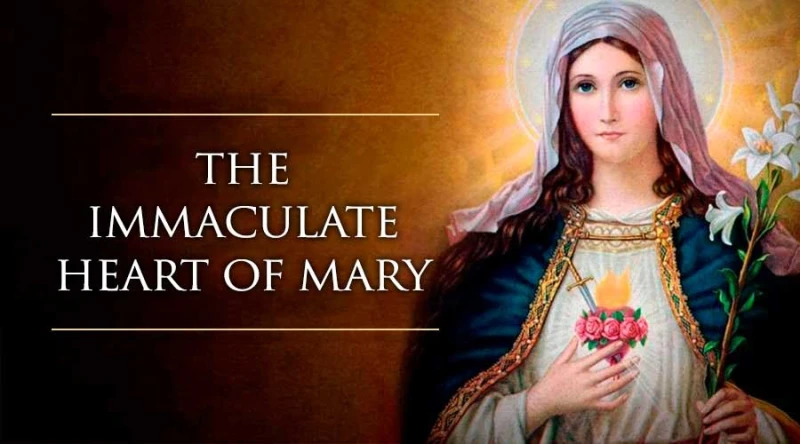
The Immaculate Heart of Mary


The Immaculate Heart of Mary

Feast date: Jun 20

Just as devotion to the Sacred Heart of Jesus is only a form of devotion to the adorable Person of Jesus, so also is devotion to the Holy Heart of Mary, but a special form of devotion to Mary. In order that, properly speaking, there may be devotion to the Heart of Mary, the attention and the homage of the faithful must be directed to the physical heart itself.


However, this in itself is not sufficient; the faithful must read therein all that the human heart of Mary suggests, all of which it is the expressive symbol and the living reminder: Mary’s interior life, her joys and sorrows, her virtues and hidden perfections, and, above all, her virginal love for her God, her maternal love for her Divine Son, and her motherly and compassionate love for her sinful and miserable children here below. The consideration of Mary’s interior life and the beauties of her soul, without any thought of her physical heart, does not constitute our devotion; still less does it consist in the consideration of the Heart of Mary merely as a part of her virginal body. The two elements are essential to the devotion, just as soul and body are necessary to the constitution of man.


All this is made sufficiently clear in the explanations given elsewhere, and, if our devotion to Mary must not be confounded with our devotion to Jesus, on the other hand, it is equally true that our veneration of the Heart of Mary is, as such, analogous to our worship of the Heart of Jesus. It is, however, necessary to indicate a few differences in this analogy, the better to explain the character of Catholic devotion to the Heart of Mary. Some of these differences are very marked, whereas others are barely perceptible. Devotion to the Heart of Jesus is especially directed to the Divine Heart as overflowing with love for men, and it presents this love to us as despised and outraged.


In the devotion to the Heart of Mary, on the other hand, what seems to attract us above all else is the love of this Heart for Jesus and for God. Its love for men is not overlooked, but it is not so much in evidence nor so dominant. With this difference is linked another. The first, act of the devotion to the Heart of Jesus is the love eager to respond to love, in devotion to the Heart of Mary there is no first act so clearly indicated: in this devotion, perhaps, study and imitation hold as important a place as love. For, although this study and imitation are impregnated with filial affection, the devotion presents itself with no object sufficiently conspicuous to call forth our love, which is, on the contrary, naturally awakened and increased by the study and imitation. Hence, accurately speaking, love is more the result than the object of the devotion, the object being rather to love God, and Jesus better by uniting ourselves to Mary for this purpose and by imitating her virtues.


It would also seem that, although in the devotion to the Heart of Mary the heart has an essential part as symbol and sensible object, it does not stand out as prominently as in the devotion to the Heart of Jesus; we think rather of the thing symbolized, of love, virtues, and sentiments, of Mary’s interior life.

The Immaculate Heart of Mary Read More »