Please mind our dust!

We are currently working on revamping our website!
Thank you for your patience!

CRD Solutions

The Solemnity of the Most Holy Body and Blood of Christ

Reading I Gn 14:18-20

In those days, Melchizedek, king of Salem, brought out bread and wine,
and being a priest of God Most High,
he blessed Abram with these words:
            “Blessed be Abram by God Most High,
                        the creator of heaven and earth;
            and blessed be God Most High,
                        who delivered your foes into your hand.”
Then Abram gave him a tenth of everything.

Responsorial Psalm Ps 110:1, 2, 3, 4

R (4b)  You are a priest for ever, in the line of Melchizedek.
The LORD said to my Lord: “Sit at my right hand
            till I make your enemies your footstool.”
R You are a priest for ever, in the line of Melchizedek.
The scepter of your power the LORD will stretch forth from Zion:
            “Rule in the midst of your enemies.”
R You are a priest for ever, in the line of Melchizedek.
“Yours is princely power in the day of your birth, in holy splendor;
            before the daystar, like the dew, I have begotten you.”
R You are a priest for ever, in the line of Melchizedek.
The LORD has sworn, and he will not repent:
            “You are a priest forever, according to the order of  Melchizedek.”
R You are a priest for ever, in the line of Melchizedek.


Reading II 1 Cor 11:23-26

Brothers and sisters:
I received from the Lord what I also handed on to you,
that the Lord Jesus, on the night he was handed over,
took bread, and, after he had given thanks,
broke it and said, “This is my body that is for you.
Do this in remembrance of me.”
In the same way also the cup, after supper, saying,
“This cup is the new covenant in my blood.
Do this, as often as you drink it, in remembrance of me.”
For as often as you eat this bread and drink the cup,
you proclaim the death of the Lord until he comes.

Sequence Lauda Sion

Laud, O Zion, your salvation,
Laud with hymns of exultation,
            Christ, your king and shepherd true:

Bring him all the praise you know,
He is more than you bestow.
            Never can you reach his due.

Special theme for glad thanksgiving
Is the quick’ning and the living
            Bread today before you set:

From his hands of old partaken,
As we know, by faith unshaken,
            Where the Twelve at supper met.

Full and clear ring out your chanting,
Joy nor sweetest grace be wanting,
            From your heart let praises burst:

For today the feast is holden,
When the institution olden
            Of that supper was rehearsed.

Here the new law’s new oblation,
By the new king’s revelation,
            Ends the form of ancient rite:

Now the new the old effaces,
Truth away the shadow chases,
            Light dispels the gloom of night.

What he did at supper seated,
Christ ordained to be repeated,
            His memorial ne’er to cease:

And his rule for guidance taking,
Bread and wine we hallow, making
            Thus our sacrifice of peace.

This the truth each Christian learns,
Bread into his flesh he turns,
            To his precious blood the wine:

Sight has fail’d, nor thought conceives,
But a dauntless faith believes,
            Resting on a pow’r divine.

Here beneath these signs are hidden
Priceless things to sense forbidden;
            Signs, not things are all we see:

Blood is poured and flesh is broken,
Yet in either wondrous token
            Christ entire we know to be.

Whoso of this food partakes,
Does not rend the Lord nor breaks;
            Christ is whole to all that taste:

Thousands are, as one, receivers,
One, as thousands of believers,
            Eats of him who cannot waste.

Bad and good the feast are sharing,
Of what divers dooms preparing,
            Endless death, or endless life.

Life to these, to those damnation,
See how like participation
            Is with unlike issues rife.

When the sacrament is broken,
Doubt not, but believe ‘tis spoken,
            That each sever’d outward token
            doth the very whole contain.

Nought the precious gift divides,
Breaking but the sign betides
            Jesus still the same abides,
            still unbroken does remain.

The shorter form of the sequence begins here.

Lo! the angel’s food is given
To the pilgrim who has striven;
            see the children’s bread from heaven,
            which on dogs may not be spent.

Truth the ancient types fulfilling,
Isaac bound, a victim willing,
            Paschal lamb, its lifeblood spilling,
            manna to the fathers sent.

Very bread, good shepherd, tend us,
Jesu, of your love befriend us,
            You refresh us, you defend us,
            Your eternal goodness send us
In the land of life to see.

You who all things can and know,
Who on earth such food bestow,
            Grant us with your saints, though lowest,
            Where the heav’nly feast you show,
Fellow heirs and guests to be. Amen. Alleluia.

Alleluia Jn 6:51

R. Alleluia, alleluia.
I am the living bread that came down from heaven, says the Lord;
whoever eats this bread will live forever.
R. Alleluia, alleluia.

Gospel Lk 9:11b-17

Jesus spoke to the crowds about the kingdom of God,
and he healed those who needed to be cured.
As the day was drawing to a close,
the Twelve approached him and said,
“Dismiss the crowd
so that they can go to the surrounding villages and farms
and find lodging and provisions;
for we are in a deserted place here.”
He said to them, “Give them some food yourselves.”
They replied, “Five loaves and two fish are all we have,
unless we ourselves go and buy food for all these people.”
Now the men there numbered about five thousand.
Then he said to his disciples,
“Have them sit down in groups of about fifty.”
They did so and made them all sit down.
Then taking the five loaves and the two fish,
and looking up to heaven,
he said the blessing over them, broke them,
and gave them to the disciples to set before the crowd.
They all ate and were satisfied.
And when the leftover fragments were picked up,
they filled twelve wicker baskets.

– – –

Lectionary for Mass for Use in the Dioceses of the United States, second typical edition, Copyright © 2001, 1998, 1997, 1986, 1970 Confraternity of Christian Doctrine; Psalm refrain © 1968, 1981, 1997, International Committee on English in the Liturgy, Inc. All rights reserved. Neither this work nor any part of it may be reproduced, distributed, performed or displayed in any medium, including electronic or digital, without permission in writing from the copyright owner.

The Solemnity of the Most Holy Body and Blood of Christ Read More »
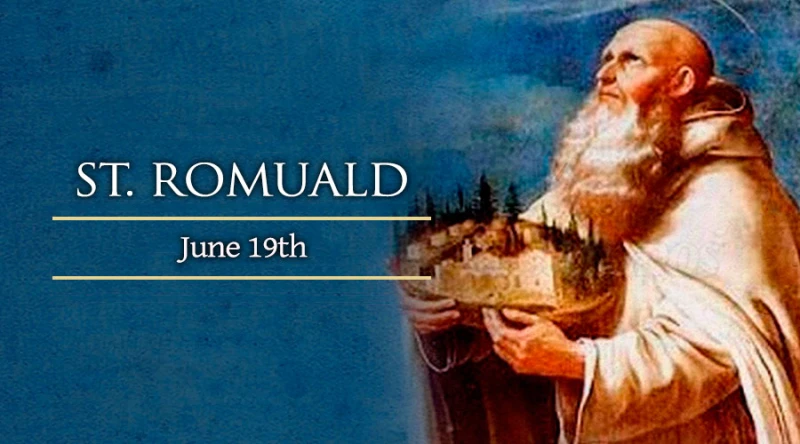
St. Romuald


St. Romuald

Feast date: Jun 19

Saint Romuald, who founded the Camaldolese monastic order during the early eleventh century, has his liturgical memorial on June 19.

Working within the Western Church’s Benedictine tradition, he revived the primitive monastic practice of hermit life, allowing for greater solitude in a communal setting.

Born into an aristocratic family during the middle of the tenth century, Romuald grew up in a luxurious and worldly environment, where he learned little in the way of self-restraint or religious devotion. Yet he also felt an unusual attraction toward the simplicity of monastic life, prompted by the beauty of nature and the experience of solitude .

It was not beauty or tranquility, but a shocking tragedy that spurred him to act on this desire. When Romuald was 20 years old, he saw his father Sergius kill one of his relatives in a dispute over some property. Disgusted by the crime he had witnessed, the young man went to the Monastery of St. Apollinaris to do 40 days of penance for his father.

These 40 days confirmed Romuald’s monastic calling, as they became the foundation for an entire life of penance. But this would not be lived out at St. Apollinaris, where Romuald’s strict asceticism brought him into conflict with some of the other monks. He left the area near Ravenna and went to Venice, where he became the disciple of the hermit Marinus.

Both men went on to encourage the monastic vocation of Peter Urseolus, a Venetian political leader who would later be canonized as a saint. When Peter joined a French Benedictine monastery, Romuald followed him and lived for five years in a nearby hermitage.

In the meantime, Romuald’s father Sergius had followed his son’s course, repenting of his sins and becoming a monk himself. Romuald returned to Italy to help his father, after learning that Sergius was struggling in his vocation. Through his son’s guidance, Sergius found the strength to persist in religious life.

After guiding his penitent father in the way of salvation, Romuald traveled throughout Italy serving the Church. By 1012 he had helped to establish or reform almost 100 hermitages and monasteries, though these were not connected to one another in the manner of a distinct religious order.

The foundations of the Camaldolese order were not laid until 1012 – when a piece of land called the ”Camaldoli,” located in the Diocese of Arezzo, was granted to Romuald. It became the site of five hermits’ quarters, and a full monastery soon after. This combination of hermits’ cells and community life, together with other distinctive features, gave this monastery and its later affiliates a distinct identity and charism.

Romuald’s approach to the contemplative life, reminiscent of the early Desert Fathers, can be seen in the short piece of writing known as his “Brief Rule.” It reads as follows:

“Sit in your cell as in paradise. Put the whole world behind you and forget it. Watch your thoughts like a good fisherman watching for fish. The path you must follow is in the Psalms – never leave it.”

“If you have just come to the monastery, and in spite of your good will you cannot accomplish what you want, take every opportunity you can to sing the Psalms in your heart and to understand them with your mind. And if your mind wanders as you read, do not give up; hurry back and apply your mind to the words once more.”

“Realize above all that you are in God’s presence, and stand there with the attitude of one who stands before the emperor. Empty yourself completely and sit waiting, content with the grace of God, like the chick who tastes nothing and eats nothing but what his mother brings him.”

St. Romuald of Ravenna died in his monastic cell on June 19, 1027. Pope Gregory XIII canonized him in 1582.

St. Romuald Read More »

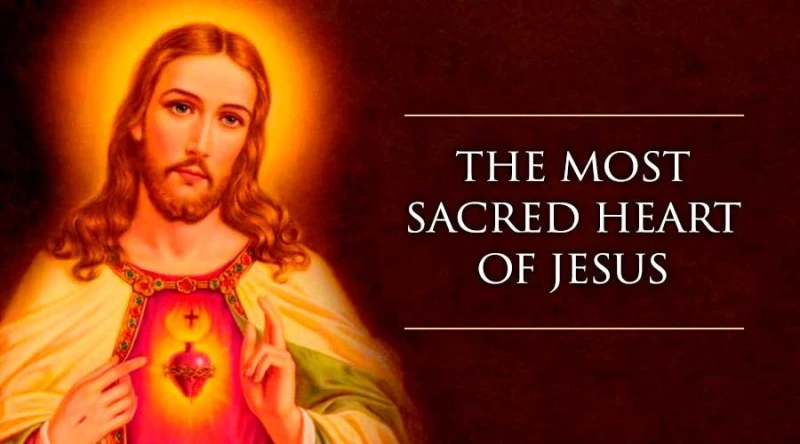
The Most Sacred Heart of Jesus


The Most Sacred Heart of Jesus

Feast date: Jun 19

The heart has always been seen as the “center” or essence a person (“the heart of the matter,” “you are my heart,” “take it to heart,” etc.) and the wellspring of our emotional lives and love (“you break my heart,” “my heart sings,” etc.) Devotion to the Sacred Heart of Jesus is devotion to Jesus Christ Himself, but in the particular ways of meditating on his interior life and on His threefold love — His divine love, His burning love that fed His human will, and His sensible love that affects His interior life.

Pope Pius XII of blessed memory writes on this topic in his 1956 encyclical, Haurietis Aquas (On Devotion To The Sacred Heart).

The Friday that follows the Second Sunday in Time After Pentecost is the Feast of the Sacred Heart which brings to mind all the attributes of His Divine Heart mentioned above. Many Catholics prepare for this Feast by beginning a Novena to the Sacred Heart on the Feast of Corpus Christi, which is the Thursday of the week before. On the Feast of the Sacred Heart itself, we can gain a plenary indulgence by making an Act of Reparation to the Sacred Heart.


From the earliest days of the Church, “Christ’s open side and the mystery of blood and water were meditated upon, and the Church was beheld issuing from the side of Jesus, as Eve came forth from the side of Adam. It is in the eleventh and twelfth centuries that we find the first unmistakable indications of devotion to the Sacred Heart. Through the wound in the side, the wound in the Heart was gradually reached, and the wound in the Heart symbolized the wound of love.” (Catholic Encyclopedia)


This general devotion arose first in Benedictine and Cistercian monasteries of that time, especially in response to the devotion of St. Gertrude the Great, but specific devotions became popularized when St. Margaret Mary Alacoque (1647-1690), a Visitation nun, had a personal revelation involving a series of visions of Christ as she prayed before the Blessed Sacrament. She wrote, “He disclosed to me the marvels of his Love and the inexplicable secrets of his Sacred Heart.” Christ emphasized to her His love — and His woundedness caused by Man’s indifference to this love.


He promised that, in response to those who consecrate themselves and make reparations to His Sacred Heart, that:  

  • He will give them all the graces necessary in their state of life.

  • He will establish peace in their homes.

  • He will comfort them in all their afflictions.

  • He will be their secure refuge during life, and above all, in death.

  • He will bestow abundant blessings upon all their undertakings.

  • Sinners will find in His Heart the source and infinite ocean of mercy.

  • Lukewarm souls shall become fervent.

  • Fervent souls shall quickly mount to high perfection.

  • He will bless every place in which an image of His Heart is exposed and honored.

  • He will give to priests the gift of touching the most hardened hearts.

  • Those who shall promote this devotion shall have their names written in His Heart.
  • In the excessive mercy of His Heart that His all-powerful love will grant to all those who receive Holy Communion on the First Fridays in nine consecutive months the grace of final perseverance; they shall not die in His disgrace, nor without receiving their sacraments. His divine Heart shall be their safe refuge in this last moment.

The Most Sacred Heart of Jesus Read More »

Saturday of the Eleventh Week in Ordinary Time

Reading I 2 Chr 24:17-25

After the death of Jehoiada,
the princes of Judah came and paid homage to King Joash,
and the king then listened to them.
They forsook the temple of the LORD, the God of their fathers,
and began to serve the sacred poles and the idols;
and because of this crime of theirs,
wrath came upon Judah and Jerusalem.
Although prophets were sent to them to convert them to the LORD,
the people would not listen to their warnings.
Then the Spirit of God possessed Zechariah,
son of Jehoiada the priest.
He took his stand above the people and said to them:
“God says, ‘Why are you transgressing the LORD’s commands,
so that you cannot prosper?
Because you have abandoned the LORD, he has abandoned you.’”
But they conspired against him,
and at the king’s order they stoned him to death
in the court of the LORD’s temple.
Thus King Joash was unmindful of the devotion shown him
by Jehoiada, Zechariah’s father, and slew his son.
And as Zechariah was dying, he said, “May the LORD see and avenge.”

At the turn of the year a force of Arameans came up against Joash.
They invaded Judah and Jerusalem,
did away with all the princes of the people,
and sent all their spoil to the king of Damascus.
Though the Aramean force came with few men,
the Lord surrendered a very large force into their power,
because Judah had abandoned the LORD, the God of their fathers.
So punishment was meted out to Joash.
After the Arameans had departed from him,
leaving him in grievous suffering,
his servants conspired against him
because of the murder of the son of Jehoiada the priest.
He was buried in the City of David,
but not in the tombs of the kings.

Responsorial Psalm 89:4-5, 29-30, 31-32, 33-34

R. (29a) For ever I will maintain my love for my servant.
“I have made a covenant with my chosen one,
I have sworn to David my servant:
Forever will I confirm your posterity
and establish your throne for all generations.”
R. For ever I will maintain my love for my servant.
“Forever I will maintain my kindness toward him,
and my covenant with him stands firm.
I will make his posterity endure forever
and his throne as the days of heaven.”
R. For ever I will maintain my love for my servant.
“If his sons forsake my law
and walk not according to my ordinances,
If they violate my statutes
and keep not my commands.”
R. For ever I will maintain my love for my servant.
“I will punish their crime with a rod
and their guilt with stripes.
Yet my mercy I will not take from him,
nor will I belie my faithfulness.”
R. For ever I will maintain my love for my servant.

Alleluia 2 Cor 8:9

R. Alleluia, alleluia.
Jesus Christ became poor although he was rich,
so that by his poverty you might become rich.
R. Alleluia, alleluia.

Gospel Mt 6:24-34

Jesus said to his disciples:
“No one can serve two masters.
He will either hate one and love the other,
or be devoted to one and despise the other.
You cannot serve God and mammon.

“Therefore I tell you, do not worry about your life,
what you will eat or drink,
or about your body, what you will wear.
Is not life more than food and the body more than clothing?
Look at the birds in the sky;
they do not sow or reap, they gather nothing into barns,
yet your heavenly Father feeds them.
Are not you more important than they?
Can any of you by worrying add a single moment to your life-span?
Why are you anxious about clothes?
Learn from the way the wild flowers grow.
They do not work or spin.
But I tell you that not even Solomon in all his splendor
was clothed like one of them.
If God so clothes the grass of the field,
which grows today and is thrown into the oven tomorrow,
will he not much more provide for you, O you of little faith?
So do not worry and say, ‘What are we to eat?’
or ‘What are we to drink?’ or ‘What are we to wear?’
All these things the pagans seek.
Your heavenly Father knows that you need them all.
But seek first the Kingdom of God and his righteousness,
and all these things will be given you besides.
Do not worry about tomorrow; tomorrow will take care of itself.
Sufficient for a day is its own evil.”

– – –

Lectionary for Mass for Use in the Dioceses of the United States, second typical edition, Copyright © 2001, 1998, 1997, 1986, 1970 Confraternity of Christian Doctrine; Psalm refrain © 1968, 1981, 1997, International Committee on English in the Liturgy, Inc. All rights reserved. Neither this work nor any part of it may be reproduced, distributed, performed or displayed in any medium, including electronic or digital, without permission in writing from the copyright owner.

Saturday of the Eleventh Week in Ordinary Time Read More »

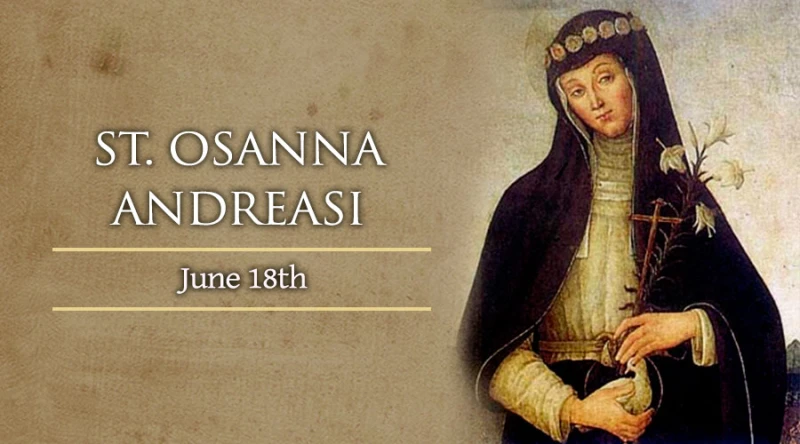
St. Osanna Andreasi


St. Osanna Andreasi

Feast date: Jun 18

St. Osanna was a Dominican tertiary, who spent her adult life serving the poor and the sick and offering spiritual direction to many. However, she was also a mystic and a visionary, eventually bearing the pain and red marks of the stigmata, though not the bleeding.

She was born in 1449 to a noble Italian family. Her visions, first of angels and of the Trinity, began at the young age of five. She felt a call to religious life and became a tertiary at 17, having already rejected a marriage arranged by her father.

Her visions continued into her adult life, and she often fell into ecstasies. She was also a strong critic of the lack of morality of her day. She died in 1505.

St. Osanna Andreasi Read More »