Please mind our dust!

We are currently working on revamping our website!
Thank you for your patience!

CRD Solutions

Friday of the Eleventh Week in Ordinary Time

Reading I 2 Kgs 11:1-4, 9-18, 20

When Athaliah, the mother of Ahaziah,
saw that her son was dead,
she began to kill off the whole royal family.
But Jehosheba, daughter of King Jehoram and sister of Ahaziah,
took Joash, his son, and spirited him away, along with his nurse,
from the bedroom where the princes were about to be slain.
She concealed him from Athaliah, and so he did not die.
For six years he remained hidden in the temple of the LORD,
while Athaliah ruled the land.

But in the seventh year,
Jehoiada summoned the captains of the Carians
and of the guards.
He had them come to him in the temple of the LORD,
exacted from them a sworn commitment,
and then showed them the king’s son.

The captains did just as Jehoiada the priest commanded.
Each one with his men, both those going on duty for the sabbath
and those going off duty that week,
came to Jehoiada the priest.
He gave the captains King David’s spears and shields,
which were in the temple of the LORD.
And the guards, with drawn weapons,
lined up from the southern to the northern limit of the enclosure,
surrounding the altar and the temple on the king’s behalf.
Then Jehoiada led out the king’s son
and put the crown and the insignia upon him.
They proclaimed him king and anointed him,
clapping their hands and shouting, “Long live the king!”

Athaliah heard the noise made by the people,
and appeared before them in the temple of the LORD.
When she saw the king standing by the pillar, as was the custom,
and the captains and trumpeters near him,
with all the people of the land rejoicing and blowing trumpets,
she tore her garments and cried out, “Treason, treason!”
Then Jehoiada the priest instructed the captains
in command of the force:
“Bring her outside through the ranks.
If anyone follows her,” he added, “let him die by the sword.”
He had given orders that she
should not be slain in the temple of the LORD.
She was led out forcibly to the horse gate of the royal palace,
where she was put to death.

Then Jehoiada made a covenant between the LORD as one party
and the king and the people as the other,
by which they would be the LORD’s people;
and another covenant, between the king and the people.
Thereupon all the people of the land went to the temple of Baal
and demolished it.
They shattered its altars and images completely,
and slew Mattan, the priest of Baal, before the altars.
Jehoiada appointed a detachment for the temple of the LORD.
All the people of the land rejoiced and the city was quiet,
now that Athaliah had been slain with the sword
at the royal palace.
 

Responsorial Psalm 132:11, 12, 13-14, 17-18

R. (13) The Lord has chosen Zion for his dwelling.
The LORD swore to David
a firm promise from which he will not withdraw:
“Your own offspring
I will set upon your throne.”
R. The Lord has chosen Zion for his dwelling.
“If your sons keep my covenant
and the decrees which I shall teach them,
Their sons, too, forever
shall sit upon your throne.”
R. The Lord has chosen Zion for his dwelling.
For the LORD has chosen Zion;
he prefers her for his dwelling.
“Zion is my resting place forever;
in her will I dwell, for I prefer her.”
R. The Lord has chosen Zion for his dwelling.
“In her will I make a horn to sprout forth for David;
I will place a lamp for my anointed.
His enemies I will clothe with shame,
but upon him my crown shall shine.”
R. The Lord has chosen Zion for his dwelling.

Alleluia Mt 5:3

R. Alleluia, alleluia.
Blessed are the poor in spirit;
for theirs is the Kingdom of heaven.
R. Alleluia, alleluia.

Gospel Mt 6:19-23

Jesus said to his disciples:
“Do not store up for yourselves treasures on earth,
where moth and decay destroy, and thieves break in and steal.
But store up treasures in heaven,
where neither moth nor decay destroys, nor thieves break in and steal.
For where your treasure is, there also will your heart be.

“The lamp of the body is the eye.
If your eye is sound, your whole body will be filled with light;
but if your eye is bad, your whole body will be in darkness.
And if the light in you is darkness, how great will the darkness be.”

– – –

Lectionary for Mass for Use in the Dioceses of the United States, second typical edition, Copyright © 2001, 1998, 1997, 1986, 1970 Confraternity of Christian Doctrine; Psalm refrain © 1968, 1981, 1997, International Committee on English in the Liturgy, Inc. All rights reserved. Neither this work nor any part of it may be reproduced, distributed, performed or displayed in any medium, including electronic or digital, without permission in writing from the copyright owner.

Friday of the Eleventh Week in Ordinary Time Read More »
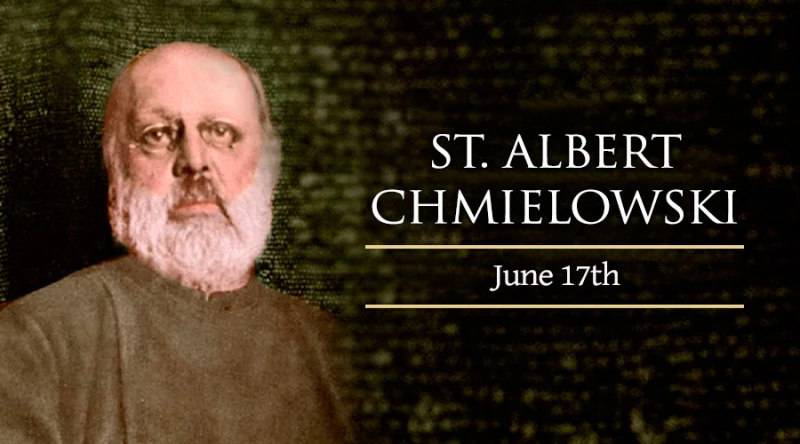
St. Albert Chmielowski


St. Albert Chmielowski

Feast date: Jun 17

Founder of the Albertine Brothers and Sisters, and one of the saints who inspired the vocation of the young Karol Wojtyla, the future Pope John Paul II was born on August 20, 1845 in (near Kraków) as Adam Hilary Bernard Chmielowski. Born into a wealthy and aristocratic family, Adam was the oldest of four children. Actively involved in politics from his youth, Adam lost a leg fighting in an insurrection against Czar Alexander III at age 18. In Krakow, he became a popular artist and his talent in the subject led him to study in Munich and Paris.


A kind and compassionate person, Adam was always deeply aware of human suffering, and felt called to help those in need.  Realizing that God was calling Him to a life of service, he returned to Krakow in 1874, determined to dedicate his talents to the glory of God.  Instead of continuing his work as an artist, he decided to care for the poor and became a Secular Franciscan, taking the name Albert.


In 1887, Albert founded the Brothers of the Third Order of Saint Francis, Servants of the Poor, known as the Albertines or the Gray Brothers.  Then, in 1891, he founded a community of Albertine sisters, known as the Gray Sisters.


The Albertines organized food and shelter for the poor and homeless of any age or religion.  Albert preached on the great crisis that results from a refusal to see and aid the suffering individuals in society.


In 1949, Pope John Paul II, who was at the time Father Karol Wojtyla, wrote a well-received play about Albert called Our God’s Brother.  John Paul II later said that he found great spiritual support for his own vocation in the life of St. Albert, whom he saw as an example of leaving behind a world of art, literature, and theater to make a radical choice for the priesthood.


Brother Albert died on Christmas Day, 1916.  He was canonized on November 12, 1989 by Pope John Paul II.  The Church celebrates St. Albert’s feast day on June 17.


St. Albert Chmielowski Read More »

Thursday of the Eleventh Week in Ordinary Time

Reading I Sir 48:1-14

Like a fire there appeared the prophet Elijah
whose words were as a flaming furnace.
Their staff of bread he shattered,
in his zeal he reduced them to straits;
By the Lord’s word he shut up the heavens
and three times brought down fire.
How awesome are you, Elijah, in your wondrous deeds!
Whose glory is equal to yours?
You brought a dead man back to life
from the nether world, by the will of the LORD.
You sent kings down to destruction,
and easily broke their power into pieces.
You brought down nobles, from their beds of sickness.
You heard threats at Sinai,
at Horeb avenging judgments.
You anointed kings who should inflict vengeance,
and a prophet as your successor.
You were taken aloft in a whirlwind of fire,
in a chariot with fiery horses.
You were destined, it is written, in time to come
to put an end to wrath before the day of the LORD,
To turn back the hearts of fathers toward their sons,
and to re-establish the tribes of Jacob.
Blessed is he who shall have seen you
And who falls asleep in your friendship.
For we live only in our life,
but after death our name will not be such.
O Elijah, enveloped in the whirlwind!

Then Elisha, filled with the twofold portion of his spirit,
wrought many marvels by his mere word.
During his lifetime he feared no one,
nor was any man able to intimidate his will.
Nothing was beyond his power;
beneath him flesh was brought back into life.
In life he performed wonders,
and after death, marvelous deeds.

Responsorial Psalm 97:1-2, 3-4, 5-6, 7

R. (12a) Rejoice in the Lord, you just!
The LORD is king; let the earth rejoice;
let the many isles be glad.
Clouds and darkness are round about him,
justice and judgment are the foundation of his throne.
R. Rejoice in the Lord, you just!
Fire goes before him
and consumes his foes round about.
His lightnings illumine the world;
the earth sees and trembles.
R. Rejoice in the Lord, you just!
The mountains melt like wax before the LORD,
before the Lord of all the earth.
The heavens proclaim his justice,
and all peoples see his glory.
R. Rejoice in the Lord, you just!
All who worship graven things are put to shame,
who glory in the things of nought;
all gods are prostrate before him.
R. Rejoice in the Lord, you just!

Alleluia Rom 8:15bc

R. Alleluia, alleluia.
You have received a spirit of adoption as sons
through which we cry: Abba! Father!
R. Alleluia, alleluia.

Gospel Mt 6:7-15

Jesus said to his disciples:
“In praying, do not babble like the pagans,
who think that they will be heard because of their many words.
Do not be like them.
Your Father knows what you need before you ask him.

“This is how you are to pray:

‘Our Father who art in heaven,
hallowed be thy name,
thy Kingdom come,
thy will be done,
on earth as it is in heaven.
Give us this day our daily bread;
and forgive us our trespasses,
as we forgive those who trespass against us;
and lead us not into temptation,
but deliver us from evil.’

“If you forgive others their transgressions,
your heavenly Father will forgive you.
But if you do not forgive others,
neither will your Father forgive your transgressions.”

– – –

Lectionary for Mass for Use in the Dioceses of the United States, second typical edition, Copyright © 2001, 1998, 1997, 1986, 1970 Confraternity of Christian Doctrine; Psalm refrain © 1968, 1981, 1997, International Committee on English in the Liturgy, Inc. All rights reserved. Neither this work nor any part of it may be reproduced, distributed, performed or displayed in any medium, including electronic or digital, without permission in writing from the copyright owner.

Thursday of the Eleventh Week in Ordinary Time Read More »
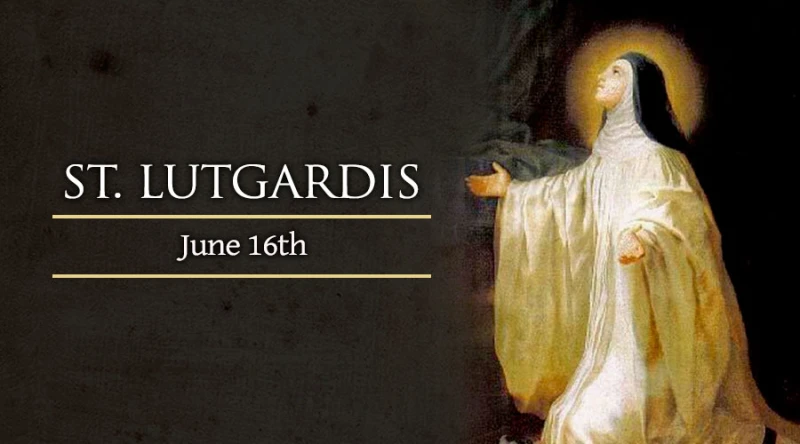
St. Lutgardis


St. Lutgardis

Feast date: Jun 16

St. Lutgardis is the patron saint of the blind and physically disabled. Born in the 12th century, she came to her vocation in part due to her father’s bad business sense. Her father lost her dowry in a failed business venture and sent her to a Benedictine convent at the age of 12.

A few years later, she received a vision of Christ showing her his wounds, and at age 20 she became a Benedictine nun. Her visions continued and she is said to have levitated and dripped blood from her head when meditating on the Passion.

Seeking a stricter life, she joined the Cistercians and displayed the gifts of healing, prophecy, spiritual wisdom and teaching on the Gospels.

She accepted the blindness that afflicted her for the last 11 years of her life as a gift that helped reduce the distractions of the outside world. In her last vision, Christ told her when she was to die, the day after the Feast of the Holy Trinity, June 16, 1246. She was 64.

St. Lutgardis Read More »

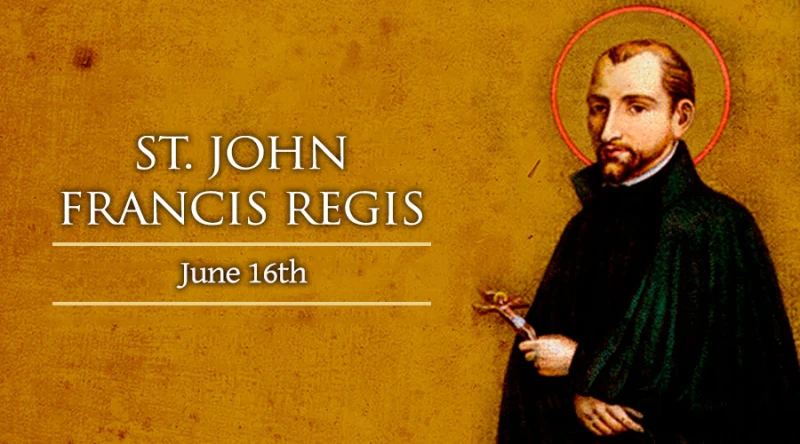
St. John Francis Regis


St. John Francis Regis

Feast date: Jun 16

On June 16 the Catholic Church celebrates the memory of Saint John Francis Regis, a 17th-century French Jesuit known for his zealous missionary efforts and his care for the poor and marginalized.

In a 1997 letter to the Bishop of Viviers, Pope St. John Paul II commemorated the fourth centenary of St. John Francis Regis’ birth, honoring him as a “lofty figure of holiness” and an example for the Church in the modern world.

“In less than 10 years of ministry, this saintly Frenchman succeeded, with God’s help, in leading back to Christ an immense crowd of men, women and children of all ages and walks of life,” the Pope recalled. He urged the faithful to imitate the saint and “put themselves in God’s hands with total trust.”

Born in 1597, John Francis Regis was the son of a wealthy merchant father and a mother descended from nobility. As a boy he was sensitive, devout, and eager to please his parents and teachers. Educated by Jesuits from the age of 14, he entered the Society of Jesus in December of 1616.

As he followed the traditional Jesuit path of teaching and extensive studies, John also became known as a skilled catechist. He was eager to enter the priesthood, and offered his first Mass in 1631. John spent much of the rest of that year caring for victims of a plague outbreak in the city of Toulouse.

In 1632, John received his assignment as a missionary to the French Protestants – known as Huguenots – as well as the country’s lapsed Catholics and others in need of evangelization. The rest of his life would be devoted to this mission, with remarkable success.

John’s missionary work spanned both a large geographical distance and a broad social spectrum. In over 50 districts of France, he preached the Gospel to children, the poor, prisoners, and others forgotten or neglected by society. His best-known work involved helping women escape prostitution.

John’s labors reaped a harvest of conversions. However, his boldness – perceived as arrogance in some cases – led to a conflict with certain other priests, a period of tension with the local bishop, and even threats of violence from those whose vices he condemned.

Against these obstacles, the priest persevered, sustained by fervent prayer and severe asceticism. His missionary work involved difficult winter journeys, and a witness at his beatification testified to John’s habit of preaching outdoors all day, then hearing confessions throughout the night.

St. John Francis Regis died at age 43, in late December of 1640. Though suffering from a lung ailment, he insisted on preaching a parish mission and hearing confessions. A penitent found him unconscious in the confessional, though he revived long enough to receive the last rites before dying.

Hailed as a confessor of the faith and a model for Jesuit missionaries, St. John Francis Regis was beatified in 1716 and canonized in 1737. Although June 16 was established as his feast day, there are differing local and particular customs, including the Jesuits’ celebration of his feast on July 2.

St. John Francis Regis Read More »