Please mind our dust!

We are currently working on revamping our website!
Thank you for your patience!

CRD Solutions

Wednesday of the Eleventh Week in Ordinary Time

Reading I 2 Kgs 2:1, 6-14

When the LORD was about to take Elijah up to heaven in a whirlwind,
he and Elisha were on their way from Gilgal.
Elijah said to Elisha, “Please stay here;
the LORD has sent me on to the Jordan.”
“As the LORD lives, and as you yourself live,
I will not leave you,” Elisha replied.
And so the two went on together.
Fifty of the guild prophets followed and
when the two stopped at the Jordan,
they stood facing them at a distance.
Elijah took his mantle, rolled it up
and struck the water, which divided,
and both crossed over on dry ground.

When they had crossed over, Elijah said to Elisha,
“Ask for whatever I may do for you, before I am taken from you.”
Elisha answered, “May I receive a double portion of your spirit.”
“You have asked something that is not easy,” Elijah replied.
“Still, if you see me taken up from you,
your wish will be granted; otherwise not.”
As they walked on conversing,
a flaming chariot and flaming horses came between them,
and Elijah went up to heaven in a whirlwind.
When Elisha saw it happen he cried out,
“My father! my father! Israel’s chariots and drivers!”
But when he could no longer see him,
Elisha gripped his own garment and tore it in two.

Then he picked up Elijah’s mantle that had fallen from him,
and went back and stood at the bank of the Jordan.
Wielding the mantle that had fallen from Elijah,
Elisha struck the water in his turn and said,
“Where is the LORD, the God of Elijah?”
When Elisha struck the water it divided and he crossed over.

Responsorial Psalm 31:20, 21, 24

R. (25) Let your hearts take comfort, all who hope in the Lord.
How great is the goodness, O LORD,
which you have in store for those who fear you,
And which, toward those who take refuge in you,
you show in the sight of the children of men.
R. Let your hearts take comfort, all who hope in the Lord.
You hide them in the shelter of your presence
from the plottings of men;
You screen them within your abode
from the strife of tongues.
R. Let your hearts take comfort, all who hope in the Lord.
Love the LORD, all you his faithful ones!
The LORD keeps those who are constant,
but more than requites those who act proudly.
R. Let your hearts take comfort, all who hope in the Lord.


Alleluia Jn 14:23

R. Alleluia, alleluia.
Whoever loves me will keep my word,
and my Father will love him
and we will come to him.
R. Alleluia, alleluia.


Gospel Mt 6:1-6, 16-18

Jesus said to his disciples:
“Take care not to perform righteous deeds
in order that people may see them;
otherwise, you will have no recompense from your heavenly Father.
When you give alms, do not blow a trumpet before you,
as the hypocrites do in the synagogues and in the streets
to win the praise of others.
Amen, I say to you, they have received their reward.
But when you give alms,
do not let your left hand know what your right is doing,
so that your almsgiving may be secret.
And your Father who sees in secret will repay you.

“When you pray, do not be like the hypocrites,
who love to stand and pray in the synagogues and on street corners
so that others may see them.
Amen, I say to you, they have received their reward.
But when you pray, go to your inner room, close the door,
and pray to your Father in secret.
And your Father who sees in secret will repay you.

“When you fast, do not look gloomy like the hypocrites.
They neglect their appearance,
so that they may appear to others to be fasting.
Amen, I say to you, they have received their reward.
But when you fast, anoint your head and wash your face,
so that you may not appear to others to be fasting,
except to your Father who is hidden.
And your Father who sees what is hidden will repay you.”

– – –

Lectionary for Mass for Use in the Dioceses of the United States, second typical edition, Copyright © 2001, 1998, 1997, 1986, 1970 Confraternity of Christian Doctrine; Psalm refrain © 1968, 1981, 1997, International Committee on English in the Liturgy, Inc. All rights reserved. Neither this work nor any part of it may be reproduced, distributed, performed or displayed in any medium, including electronic or digital, without permission in writing from the copyright owner.

Wednesday of the Eleventh Week in Ordinary Time Read More »

St. Germaine Cousin


St. Germaine Cousin

Feast date: Jun 15

June 15 is the feast day of St. Germaine Cousin, a simple and pious young girl who lived in Pibrac, France in the late 1500s. Germaine was born in 1579 to poor parents. Her father was a farmer, and her mother died when she was still an infant. She was born with a deformed right arm and hand, as well as the disease of scrofula, a tubercular condition.

Her father remarried soon after the death of her mother, but his new wife was filled with disgust by Germaine’s condition. She tormented and neglected Germaine, and taught her siblings to do so as well.

Starving and sick, Germaine was eventually kicked out of the house and forced to sleep under the stairway in the barn, on a pile of leaves and twigs, because of her stepmother’s dislike of her and disgust of her condition. She tended to the family’s flock of sheep everyday.

Despite her hardships, she lived each day full of thanksgiving and joy, and spent much of her time praying the Rosary and teaching the village children about the love of God. She was barely fed and had an emaciated figure, yet despite this she shared the little bread that she had with the poor of the village.

From her simple faith grew a deep holiness and profound trust in God. She went to Mass everyday, leaving her sheep in the care of her guardian angel, who never failed her. Germaine’s deep piety was looked upon with ridicule by the villagers, but not by the children, who were drawn to her holiness.

God protected Germaine and showered his favor upon her. It was reported that on days when the river was high, the waters would part so that she could pass through them on her way to Mass. One day in winter, when she was being chased by her stepmother who accused her of stealing bread, she opened her apron and fresh summer flowers fell out. She offered the flowers to her stepmother as a sign of forgiveness.

Eventually, the adults of the village began to realize the special holiness of this poor, crippled shepherdess. Germaine’s parents eventually offered her a place back in their house, but she chose to remain in her humble place outside.

Just as the villagers were realizing the beauty of her life, God called her to Himself. Her father found her body on her bed of leaves one morning in her 22nd year of life.

Forty-three years later, when a relative of hers was being buried, Germaine’s casket was opened and her body was found incorrupt. People in the surrounding area began praying for her intercession and obtaining miraculous cures for illnesses.

St. Germaine was canonized by Pope Pius IX in 1867 and inscribed into the canon of virgins.

St. Germaine Cousin Read More »

Tuesday of the Eleventh Week in Ordinary Time

Reading I 1 Kgs 21:17-29

After the death of Naboth the LORD said to Elijah the Tishbite:
“Start down to meet Ahab, king of Israel,
who rules in Samaria.
He will be in the vineyard of Naboth,
of which he has come to take possession.
This is what you shall tell him,
‘The LORD says: After murdering, do you also take possession?
For this, the LORD says:
In the place where the dogs licked up the blood of Naboth,
the dogs shall lick up your blood, too.’”
Ahab said to Elijah, “Have you found me out, my enemy?”
“Yes,” he answered.
“Because you have given yourself up to doing evil in the LORD’s sight,
I am bringing evil upon you: I will destroy you
and will cut off every male in Ahab’s line,
whether slave or freeman, in Israel.
I will make your house like that of Jeroboam, son of Nebat,
and like that of Baasha, son of Ahijah,
because of how you have provoked me by leading Israel into sin.”
(Against Jezebel, too, the LORD declared,
“The dogs shall devour Jezebel in the district of Jezreel.”)
“When one of Ahab’s line dies in the city,
dogs will devour him;
when one of them dies in the field,
the birds of the sky will devour him.”
Indeed, no one gave himself up to the doing of evil
in the sight of the LORD as did Ahab,
urged on by his wife Jezebel.
He became completely abominable by following idols,
just as the Amorites had done,
whom the LORD drove out before the children of Israel.

When Ahab heard these words, he tore his garments
and put on sackcloth over his bare flesh.
He fasted, slept in the sackcloth, and went about subdued.
Then the LORD said to Elijah the Tishbite,
“Have you seen that Ahab has humbled himself before me?
Since he has humbled himself before me,
I will not bring the evil in his time.
I will bring the evil upon his house during the reign of his son.”

Responsorial Psalm 51:3-4, 5-6ab, 11 and 16

R. (see 3a) Be merciful, O Lord, for we have sinned.
Have mercy on me, O God, in your goodness;
in the greatness of your compassion wipe out my offense.
Thoroughly wash me from my guilt
and of my sin cleanse me.
R. Be merciful, O Lord, for we have sinned.
For I acknowledge my offense,
and my sin is before me always:
“Against you only have I sinned,
and done what is evil in your sight.”
R. Be merciful, O Lord, for we have sinned.
Turn away your face from my sins,
and blot out all my guilt.
Free me from blood guilt, O God, my saving God;
then my tongue shall revel in your justice.
R. Be merciful, O Lord, for we have sinned.

Alleluia Jn 13:34

R. Alleluia, alleluia.
I give you a new commandment;
love one another as I have loved you.
R. Alleluia, alleluia.

Gospel Mt 5:43-48

Jesus said to his disciples:
“You have heard that it was said,
You shall love your neighbor and hate your enemy.
But I say to you, love your enemies
and pray for those who persecute you,
that you may be children of your heavenly Father,
for he makes his sun rise on the bad and the good,
and causes rain to fall on the just and the unjust.
For if you love those who love you, what recompense will you have?
Do not the tax collectors do the same?
And if you greet your brothers only,
what is unusual about that?
Do not the pagans do the same?
So be perfect, just as your heavenly Father is perfect.”

– – –

Lectionary for Mass for Use in the Dioceses of the United States, second typical edition, Copyright © 2001, 1998, 1997, 1986, 1970 Confraternity of Christian Doctrine; Psalm refrain © 1968, 1981, 1997, International Committee on English in the Liturgy, Inc. All rights reserved. Neither this work nor any part of it may be reproduced, distributed, performed or displayed in any medium, including electronic or digital, without permission in writing from the copyright owner.

Tuesday of the Eleventh Week in Ordinary Time Read More »
St. Methodius of Constantinople


St. Methodius of Constantinople

Feast date: Jun 14

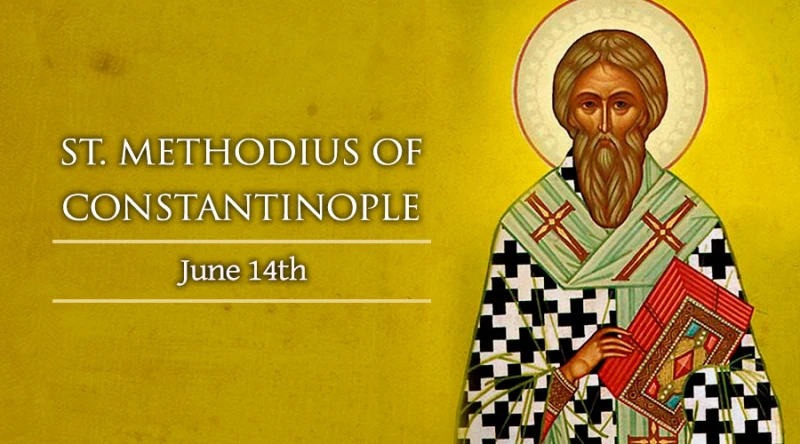
St. Methodius worked for unity and reconciliation in the Eastern Church and served as the Patriarch of Constantinople the last five years of his life.

Born in Syracuse, he first felt the call to enter religious life while in Constantinople, where he had gone to seek a position at court. He left for the island of Chinos, where he built a monastery and started a monastic community.

However, his time at the monastery was short-lived since he was summoned by the Patriarch of Constantinople to help govern the diocese and create unity after a debate broke out on the use of icons in worship. While in Rome seeking the Pope’s help, he was exiled for seven years. He returned as patriarch in 842 and continued to work for unity.

St. Methodius of Constantinople Read More »

St. Anthony of Padua


St. Anthony of Padua

Feast date: Jun 13

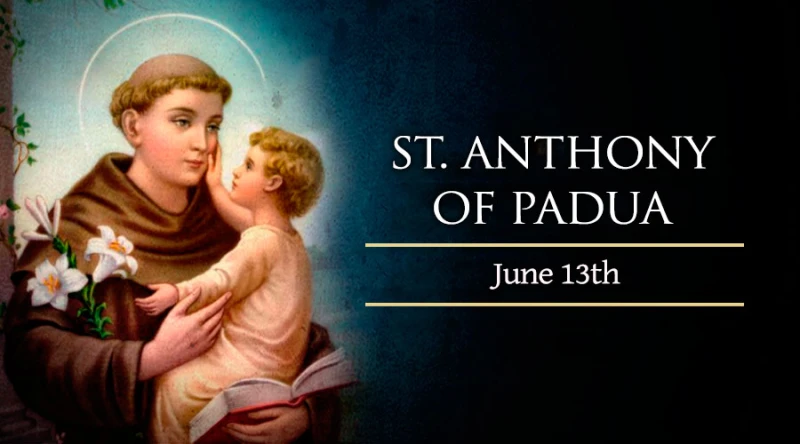
On June 13, Catholics honor the memory of the Franciscan priest St. Anthony of Padua. Although he is popularly invoked today by those who have trouble finding lost objects, he was known in his own day as the “Hammer of Heretics” due to the powerful witness of his life and preaching.

The saint known to the Church as Anthony of Padua was not born in the Italian city of Padua, nor was he originally named Anthony. He was born as Ferdinand in Lisbon, Portugal during 1195, the son of an army officer named Martin and a virtuous woman named Mary. They had Ferdinand educated by a group of priests, and the young man made his own decision to enter religious life at age 15.

Ferdinand initially lived in a monastery of the Augustinian order outside of Lisbon. But he disliked the distraction of constant visits from his friends, and moved to a more remote house of the same order. There, he concentrated on reading the Bible and the Church Fathers, while living a life of asceticism and heartfelt devotion to God.

Eight years later, in 1220, Ferdinand learned the news about five Franciscan friars who had recently died for their faith in Morocco. When their bodies were brought to Portugal for veneration, Ferdinand developed a passionate desire to imitate their commitment to the Gospel. When a group of Franciscans visited his monastery, Ferdinand told them he wanted to adopt their poor and humble way of life.

Some of the Augustinian monks criticized and mocked Ferdinand’s interest in the Franciscans, which had been established only recently, in 1209. But prayer confirmed his desire to follow the example of St. Francis, who was still living at the time.

He eventually obtained permission to leave the Augustinians and join a small Franciscan monastery in 1221. At that time he took the name Anthony, after the fourth-century desert monk St. Anthony of Egypt.

Anthony wanted to imitate the Franciscan martyrs who had died trying to convert the Muslims of Morocco. He traveled on a ship to Africa for this purpose, but became seriously ill and could not carry out his intention. The ship that was supposed to take him to Spain for treatment was blown off course, and ended up in Italy.

Through this series of mishaps, Anthony ended up near Assisi, where St. Francis was holding a major meeting for the members of his order. Despite his poor health, Anthony resolved to stay in Italy in order to be closer to St. Francis himself. He deliberately concealed his deep knowledge of theology and Scripture, and offered to serve in the kitchen among the brothers.

At the time, no one realized that the future “Hammer of Heretics” was anything other than a kitchen assistant and obedient Franciscan priest. Around 1224, however, Anthony was forced to deliver an improvised speech before an assembly of Dominicans and Franciscans, none of whom had prepared any remarks.

His eloquence stunned the crowd, and St. Francis himself soon learned what kind of man the dishwashing priest really was. In 1224 he gave Anthony permission to teach theology in the Franciscan order –  “provided, however, that as the Rule prescribes, the spirit of prayer and devotion may not be extinguished.”

Anthony taught theology in several French and Italian cities, while strictly following his Franciscan vows and preaching regularly to the people. Later, he dedicated himself entirely to the work of preaching as a missionary in France, Italy and Spain, teaching an authentic love for God to many people – whether peasants or princes – who had fallen away from Catholic faith and morality.

Known for his bold preaching and austere lifestyle, Anthony also had a reputation as a worker of miracles, which often came about in the course of his disputes with heretics.

His biographers mention a horse, which refused to eat for three days, and accepted food only after it had placed itself in adoration before the Eucharist that Anthony brought in his hands. Another miracle involved a poisoned meal, which Anthony ate without any harm after making the sign of the Cross over it. And a final often recounted miracle of St. Anthony’s involved a group of fish, who rose out of the sea to hear his preaching when heretical residents of a city refused to listen.

After Lent in 1231, Anthony’s health was in decline. Following the example of his patron – the earlier St. Anthony, who had lived as a hermit – he retreated to a remote location, taking two companions to help him. When his worsening health forced him to be carried back to the Franciscan monastery in Padua, crowds of people converged on the group in hopes of paying their homage to the holy priest.

The commotion surrounding his transport forced his attendants to stop short of their destination. After receiving the last rites, Anthony prayed the Church’s seven traditional penitential psalms, sung a hymn to the Virgin Mary, and died on June 13 at the age of 36.

St. Anthony’s well-established holiness, combined with the many miracles he had worked during his lifetime, moved Pope Gregory IX – who knew the saint personally – to canonize him one year after his death.

“St. Anthony, residing now in heaven, is honored on earth by many miracles daily seen at his tomb, of which we are certified by authentic writings,” proclaimed the 13th-century Pope.

St. Anthony of Padua Read More »