Please mind our dust!

We are currently working on revamping our website!
Thank you for your patience!

CRD Solutions

Memorial of Saint Anthony of Padua, Priest and Doctor of the Church

Reading I 1 Kgs 21:1-16

Naboth the Jezreelite had a vineyard in Jezreel
next to the palace of Ahab, king of Samaria.
Ahab said to Naboth, “Give me your vineyard to be my vegetable garden,
since it is close by, next to my house.
I will give you a better vineyard in exchange, or,
if you prefer, I will give you its value in money.”
Naboth answered him, “The LORD forbid
that I should give you my ancestral heritage.”
Ahab went home disturbed and angry at the answer
Naboth the Jezreelite had made to him:
“I will not give you my ancestral heritage.”
Lying down on his bed, he turned away from food and would not eat.

His wife Jezebel came to him and said to him,
“Why are you so angry that you will not eat?”
He answered her, “Because I spoke to Naboth the Jezreelite
and said to him, ‘Sell me your vineyard, or,
if you prefer, I will give you a vineyard in exchange.’
But he refused to let me have his vineyard.”
His wife Jezebel said to him,
“A fine ruler over Israel you are indeed!
Get up.
Eat and be cheerful.
I will obtain the vineyard of Naboth the Jezreelite for you.”

So she wrote letters in Ahab’s name and,
having sealed them with his seal,
sent them to the elders and to the nobles
who lived in the same city with Naboth.
This is what she wrote in the letters:
“Proclaim a fast and set Naboth at the head of the people.
Next, get two scoundrels to face him
and accuse him of having cursed God and king.
Then take him out and stone him to death.”
His fellow citizens—the elders and nobles who dwelt in his city—
did as Jezebel had ordered them in writing,
through the letters she had sent them.
They proclaimed a fast and placed Naboth at the head of the people.
Two scoundrels came in and confronted him with the accusation,
“Naboth has cursed God and king.”
And they led him out of the city and stoned him to death.
Then they sent the information to Jezebel
that Naboth had been stoned to death.

When Jezebel learned that Naboth had been stoned to death,
she said to Ahab,
“Go on, take possession of the vineyard
of Naboth the Jezreelite that he refused to sell you,
because Naboth is not alive, but dead.”
On hearing that Naboth was dead, Ahab started off on his way
down to the vineyard of Naboth the Jezreelite,
to take possession of it.
 

Responsorial Psalm 5:2-3ab, 4b-6a, 6b-7

R. (2b) Lord, listen to my groaning.
Hearken to my words, O LORD,
attend to my sighing.
Heed my call for help,
my king and my God!
R. Lord, listen to my groaning.
At dawn I bring my plea expectantly before you.
For you, O God, delight not in wickedness;
no evil man remains with you;
the arrogant may not stand in your sight.
R. Lord, listen to my groaning.
You hate all evildoers.
You destroy all who speak falsehood;
The bloodthirsty and the deceitful
the LORD abhors.
R. Lord, listen to my groaning.

Alleluia Ps 119:105

R. Alleluia, alleluia.
A lamp to my feet is your word,
a light to my path.
R. Alleluia, alleluia.

Gospel Mt 5:38-42

Jesus said to his disciples:
“You have heard that it was said,
An eye for an eye and a tooth for a tooth.
But I say to you, offer no resistance to one who is evil.
When someone strikes you on your right cheek,
turn the other one to him as well.
If anyone wants to go to law with you over your tunic,
hand him your cloak as well.
Should anyone press you into service for one mile,
go with him for two miles.
Give to the one who asks of you,
and do not turn your back on one who wants to borrow.”

– – –

Lectionary for Mass for Use in the Dioceses of the United States, second typical edition, Copyright © 2001, 1998, 1997, 1986, 1970 Confraternity of Christian Doctrine; Psalm refrain © 1968, 1981, 1997, International Committee on English in the Liturgy, Inc. All rights reserved. Neither this work nor any part of it may be reproduced, distributed, performed or displayed in any medium, including electronic or digital, without permission in writing from the copyright owner.

Memorial of Saint Anthony of Padua, Priest and Doctor of the Church Read More »
The Solemnity of the Most Holy Trinity

Reading I Prv 8:22-31

            Thus says the wisdom of God:
            “The LORD possessed me, the beginning of his ways,
                        the forerunner of his prodigies of long ago;
            from of old I was poured forth,
                        at the first, before the earth.
            When there were no depths I was brought forth,
                        when there were no fountains or springs of water;
            before the mountains were settled into place,
                        before the hills, I was brought forth;
            while as yet the earth and fields were not made,
                        nor the first clods of the world.

            “When the Lord established the heavens I was there,
                        when he marked out the vault over the face of the deep;
            when he made firm the skies above,
                        when he fixed fast the foundations of the earth;
            when he set for the sea its limit,
                        so that the waters should not transgress his command;
            then was I beside him as his craftsman,
                        and I was his delight day by day,
            playing before him all the while,
                        playing on the surface of his earth;
                        and I found delight in the human race.”

Responsorial Psalm Ps 8:4-5, 6-7, 8-9

R (2a)  O Lord, our God, how wonderful your name in all the earth!
When I behold your heavens, the work of your fingers,
            the moon and the stars which you set in place —
What is man that you should be mindful of him,
            or the son of man that you should care for him?
R O Lord, our God, how wonderful your name in all the earth!
You have made him little less than the angels,
            and crowned him with glory and honor.
You have given him rule over the works of your hands,
            putting all things under his feet:
R O Lord, our God, how wonderful your name in all the earth!
All sheep and oxen,
            yes, and the beasts of the field,
The birds of the air, the fishes of the sea,
            and whatever swims the paths of the seas.
R O Lord, our God, how wonderful your name in all the earth!

Reading II Rom 5:1-5

Brothers and sisters:
Therefore, since we have been justified by faith,
we have peace with God through our Lord Jesus Christ,
through whom we have gained access by faith
to this grace in which we stand,
and we boast in hope of the glory of God.
Not only that, but we even boast of our afflictions,
knowing that affliction produces endurance,
and endurance, proven character,
and proven character, hope,
and hope does not disappoint,
because the love of God has been poured out into our hearts
through the Holy Spirit that has been given to us.


Alleluia Cf. Rv 1:8

R. Alleluia, alleluia.
Glory to the Father, the Son, and the Holy Spirit;
to God who is, who was, and who is to come.

R. Alleluia, alleluia.

Gospel Jn 16:12-15

Jesus said to his disciples:
“I have much more to tell you, but you cannot bear it now.
But when he comes, the Spirit of truth,
he will guide you to all truth.
He will not speak on his own,
but he will speak what he hears,
and will declare to you the things that are coming.
He will glorify me,
because he will take from what is mine and declare it to you.
Everything that the Father has is mine;
for this reason I told you that he will take from what is mine
and declare it to you.”

– – –

Lectionary for Mass for Use in the Dioceses of the United States, second typical edition, Copyright © 2001, 1998, 1997, 1986, 1970 Confraternity of Christian Doctrine; Psalm refrain © 1968, 1981, 1997, International Committee on English in the Liturgy, Inc. All rights reserved. Neither this work nor any part of it may be reproduced, distributed, performed or displayed in any medium, including electronic or digital, without permission in writing from the copyright owner.

The Solemnity of the Most Holy Trinity Read More »

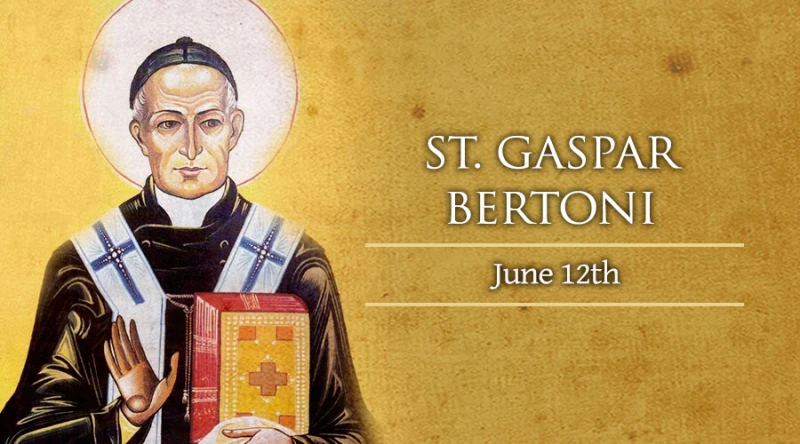
St. Gaspar Bertoni


St. Gaspar Bertoni

Feast date: Jun 12

St. Gasper was born in Verona, Italy in 1777. He was baptized the day after. It is known that he was from an affluent family, and that his family’s faith-life was also quite notable.

Gasper was an only child as his baby sister passed away. He had the benefit of an excellent education both at home and at St. Sebastian’s school which was run by Jesuits.

From the grace of his first Holy Communion at age 11, Gaspar Bertoni was called to a life of mystical union. His vocation to the priesthood matured, and at 18, he entered the seminary. In frequenting the theological course as an extern student, he found in his professor of moral theology, Fr. Nicholas Galvani, an excellent spiritual director.

He was known to have helped the sick and hurt during the invasion of French armies in 1796, the beginning of a 20 year period of upheaval during which he tended to those in need. He took over the spiritual direction of a community founded then by St. Magdalena of Canossa at St. Joseph’s Convent (May 1808).

On November 4, 1816, with two companions, he moved into a small house, adjacent to a suppressed Church, that bore the title of “the Sacred Stigmata of St. Francis (from this, the name of his community was eventually adapted; in this small church, he also worked to spread the devotion to the Passion and the wounds of Christ). In a very unostentatious manner, the new community opened a tuition-free school, offering this and other gratuitous services to the Church and society. The men lived together a common life of strict observance and penance. An intense life of contemplation was joined to a broad apostolate, including the Christian education of the youth, the formation of the clergy and missionary preaching, in perfect availability to the requests of the bishop.

Right after an ecstasy that he experienced praying before a Crucifix (on May 30, 1812), he suffered a first attack of “miliary fever” that brought him to the very threshold of death. Almost miraculously, he did recover but for the rest of his 41 years of life he remained in poor health, all this while giving a wonderful example of patience and heroic confident abandonment to God.Even from his sick-bed, suffering indescribable discomfort, he became the “angel of counsel” for countless persons who sought him out.

His Congregation of the Sacred Stigmata of Our Lord Jesus Christ, enriched by so many sufferings, gradually spread beyond Verona, to other cities in Italy, and then to the United States, to Brazil (where it presently has 6 Bishops), to Chile, to the Philippines and to mission territories: South Africa, the Ivory Coast, Tanzania, Thailand.

St. Gaspar Bertoni Read More »

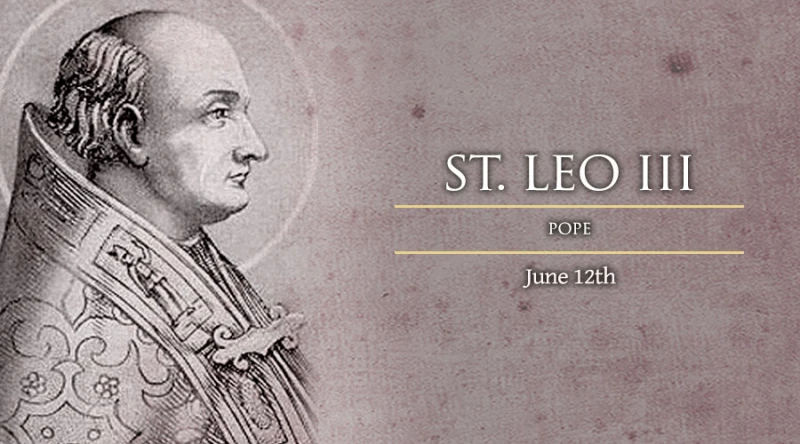
St. Leo III, Pope


St. Leo III, Pope

Feast date: Jun 12

(December 26, 795 – June 12, 816)

Leo came from a modest family in southern Italy. He was elected to the office of St. Peter unanimously by the clergy of Rome following the death of Pope Hadrian. The papacy had dramatically changed over the 8th century, and many Pope’s had separated themselves from the protection the Byzantine emperors and their governors in Ravenna. Pope Stephen II had, in 754, sought the support of the Frankish king Pepin to defeat the invading Lombards. The pope would receive from Pepin the lands formally conquered by the Lombards, therefore creating the Papal States. The Lombards remained, and Leo soon found that he had other enemies within Rome, many of the aristocratic families of the city including relatives of the late Pope Hadrian who accused the pope of perjury and adultery.

On April 25, 799, Leo was attacked while riding in a procession by a gang who sought to cut out his eyes and tongue. While Leo survived the attack, he was arrested by his enemies, deposed as pope and imprisoned in a monastery. Leo managed to escape north to the Franks, who refused to accept the deposition. Leo was escorted back to Rome where the Franks began an investigation both of the charges against the pope and the attack upon his person. The emperor Charlemagne arrived in Rome in November 800 to review the charges in solemn council. The emperor stated that no one on earth could judge the Apostolic See, but he accepted the pope’s statement of innocence after Leo took an oath purging himself of all charges on December 23rd.

At Christmas mass at St. Peters some two days later, Leo crowned Charlemagne as Holy Roman Emperor, giving Charlemagne equal status with the Byzantine emperors in Constantinople. This relationship provided protection for the Holy See and allowed Leo to administer the Papal States, bestowed several decades earlier by Pepin. However Charlemagne extracted a high price for his support, often interfering in the work of the church and expecting Leo’s tacit approval in all things. Leo began a building program in Rome, restoring and embellishing churches. A great apse was added to Santa Susanna and a magnificent Byzantine mosaic was installed in the apse, depicting both Leo and Charlemagne. Leo died on June 12, 816 and was buried in the old Constantinian basilica of St. Peter. Leo is listed as a saint based on the miracle of his restored eyes and tongue, following the attack on his person in 799, his feast day is June 12.

St. Leo III, Pope Read More »

Memorial of Saint Barnabas, Apostle

Reading I Acts 11:21b-26; 13:1-3

In those days a great number who believed turned to the Lord.
The news about them reached the ears of the Church in Jerusalem,
and they sent Barnabas to go to Antioch.
When he arrived and saw the grace of God,
he rejoiced and encouraged them all
to remain faithful to the Lord in firmness of heart,
for he was a good man, filled with the Holy Spirit and faith.
And a large number of people was added to the Lord.
Then he went to Tarsus to look for Saul,
and when he had found him he brought him to Antioch.
For a whole year they met with the Church
and taught a large number of people,
and it was in Antioch that the disciples
were first called Christians.

Now there were in the Church at Antioch prophets and teachers:
Barnabas, Symeon who was called Niger,
Lucius of Cyrene,
Manaen who was a close friend of Herod the tetrarch, and Saul.
While they were worshiping the Lord and fasting, the Holy Spirit said,
“Set apart for me Barnabas and Saul
for the work to which I have called them.”
Then, completing their fasting and prayer,
they laid hands on them and sent them off.

Responsorial Psalm 98:1, 2-3ab, 3cd-4, 5-6

R.        (see 2b)  The Lord has revealed to the nations his saving power.
Sing to the LORD a new song,
            for he has done wondrous deeds;
His right hand has won victory for him,
            his holy arm.
R.        The Lord has revealed to the nations his saving power.
The LORD has made his salvation known:
            in the sight of the nations he has revealed his justice.
He has remembered his kindness and his faithfulness
            toward the house of Israel.
R.        The Lord has revealed to the nations his saving power.
All the ends of the earth have seen
            the salvation by our God.
Sing joyfully to the LORD, all you lands;
            break into song; sing praise.
R.        The Lord has revealed to the nations his saving power.
Sing praise to the LORD with the harp,
            with the harp and melodious song.
With trumpets and the sound of the horn
            sing joyfully before the King, the LORD.
R.        The Lord has revealed to the nations his saving power.

Alleluia Ps 119:36a, 29b

R. Alleluia, alleluia.
Incline my heart, O God, to your decrees;
and favor me with your law.
R. Alleluia, alleluia.

Gospel Mt 5:33-37

Jesus said to his disciples:
“You have heard that it was said to your ancestors,
Do not take a false oath,
but make good to the Lord all that you vow.

But I say to you, do not swear at all;
not by heaven, for it is God’s throne;
nor by the earth, for it is his footstool;
nor by Jerusalem, for it is the city of the great King.
Do not swear by your head,
for you cannot make a single hair white or black.
Let your ‘Yes’ mean ‘Yes,’ and your ‘No’ mean ‘No.’
Anything more is from the Evil One.”


– – –

Lectionary for Mass for Use in the Dioceses of the United States, second typical edition, Copyright © 2001, 1998, 1997, 1986, 1970 Confraternity of Christian Doctrine; Psalm refrain © 1968, 1981, 1997, International Committee on English in the Liturgy, Inc. All rights reserved. Neither this work nor any part of it may be reproduced, distributed, performed or displayed in any medium, including electronic or digital, without permission in writing from the copyright owner.

Memorial of Saint Barnabas, Apostle Read More »