Please mind our dust!

We are currently working on revamping our website!
Thank you for your patience!

CRD Solutions

St. Barnabas, apostle
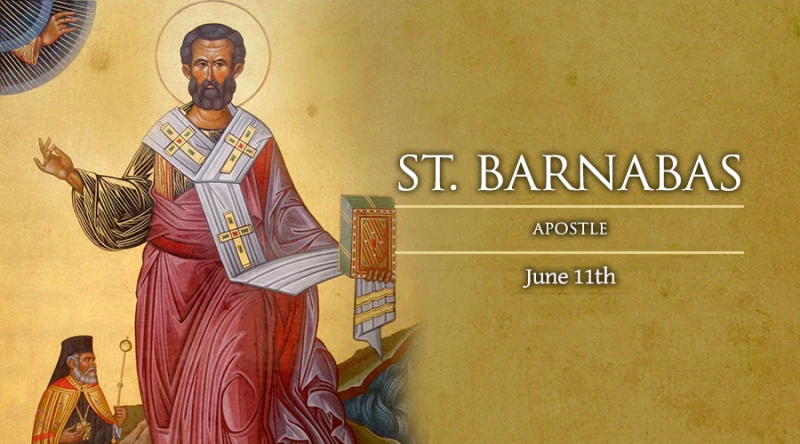

St. Barnabas, apostle

Feast date: Jun 11

Catholics celebrate the memory of St. Barnabas on June 11. The apostle and missionary was among Christ’s earliest followers and was responsible for welcoming St. Paul into the Church. Though not one of the 12 apostles chosen by the Lord, Jesus, he is traditionally regarded as one of the 72 disciples of Christ and most respected man in the first century Church after the Apostles themselves.

St. Barnabas was born to wealthy Jewish parents on the Greek-speaking island of Cyprus, probably around the time of Christ’s own birth. Traditional accounts hold that his parents sent him to study in Jerusalem, where he studied at the school of Gamaliel (who also taught St. Paul). Later on, when Christ’s public ministry began, Barnabas may have been among those who heard him preach in person. At some point, either during Christ’s ministry or after his death and resurrection, Barnabas decided to commit himself in the most radical way to the teachings he had received. He sold the large estate he had inherited, contributed the proceeds entirely to the Church, and joined Christ’s other apostles in holding all of their possessions in common. Saul of Tarsus, the future St. Paul, approached Barnabas after the miraculous events surrounding his conversion, and was first introduced to St. Peter through him. About five years later, Barnabas and Paul spent a year in Antioch, building up the Church community whose members were the first to go by the name of “Christians.” Both Paul and Barnabas received a calling from God to become the “Apostles of the Gentiles,” although the title is more often associated with St. Paul. The reference to the “laying-on of hands” in Acts, chapter 13, suggests that Paul and Barnabas may have been consecrated as bishops on this occasion.

Barnabas and Paul left Antioch along with Barnabas’ cousin John Mark, who would later compose the most concise account of Christ’s life and be canonized as St. Mark. The group’s first forays into the pagan world met with some success, but Mark became discouraged and returned to Jerusalem. The question of Mark’s dedication to the mission would arise again later, and cause a significant personal disagreement between Paul and Barnabas. For many years prior to this, however, the two apostles traveled and preached among the Gentiles, suffering persecution and hardships for the sake of establishing Christianity among those of a non-Jewish background. The remarkable success of Barnabas and Paul led to one of the earliest controversies in Church history, regarding the question of whether Christian converts would have to observe Jewish rites. During the landmark Council of Jerusalem, recorded in the book of Acts, the assembled apostles confirmed St. Peter’s earlier proclamation that the laws of the Old Testament would not be mandatory for Christians.

Barnabas and Paul finally separated in their ministries, while remaining apostles of the one Catholic Church, over Paul’s insistence that Mark not travel with them again. In death, however, the “Apostles to the Gentiles” were reunited. Mark is said to have buried Barnabas after he was killed by a mob in Cyprus around the year 62. St. Paul and St. Mark were, in turn, reconciled before St. Paul’s martyrdom five years later. He is said to have been stoned to death in Salamis in the year 61. St. Luke described Barnabas as ‘a good man, full of the Holy Spirit and of faith’ (Acts 6:24), and he was known for his exceptional kindliness and personal sanctity, and his openness to pagans.

St. Barnabas, apostle Read More »
Blessed Edward Poppe


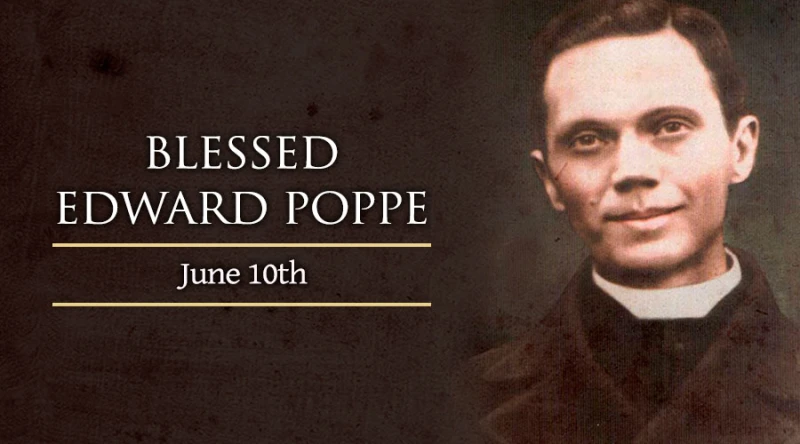
Blessed Edward Poppe

Feast date: Jun 10

Blessed Edward Poppe is a contemporary saint. He died at the young age of 33.

He was an energetic child and an excellent student. His mischievousness saw him often knock things over even putting himself at risk of being harmed. He was also quite stubborn and never left his sisters alone though his sisters would often get back at him and would muss up his hair when he was caught combing in front of the mirror. He was also a big eater and liked to devour treats from his father’s store. But in 1902 he received his First Communion and Confirmation and this made him more serious which meant jokes and teasing became rarer.

In spring 1904 his father introduced him to his business plans and had hoped to see his son begin a baking apprenticeship though Poppe remained silent at first though his resolution to become a priest led him to tell his father as much. Not long after a priest friend to his parents gave a favorable opinion of Poppe’s vocation to which his father told his mother: “Let’s not be selfish. God has not given us our children for ourselves”.

He was one of 11 children born to a modest, pious family in Belgium. One of his brothers had become a priest, and five of his sisters became nuns. He felt a call to the priesthood at a young age, but he only entered the seminary on his mother’s insistence. His father had died when he was 16 years old and Edward thought he should take on the family business.

He was drafted to the military in 1910 and served as a battlefield nurse during World War I. His prayers to St. Joseph during that time led to the miraculous freeing of several prisoners of war.

He was finally ordained in 1916 at the age of 25 and served as associate pastor, focusing his ministry to the poor, children and the dying. He also taught catechism and founded Eucharistic associations.

Always a man with a weak constitution, he was transferred to rural Belgium. In 1919, he suffered a heart attack. During his convalescence, he spent most of his time studying, praying and producing thousands of writings against Marxism and secularization.

He also developed a devotion to St. Therese of Lisieux and adopted her spirituality. He had another heart attack in January 1924, and died of a stroke only six months later. He was beatified by Pope John Paul II in 1999.

Blessed Edward Poppe Read More »

Friday of the Tenth Week in Ordinary Time

Reading I 1 Kgs 19:9a, 11-16

At the mountain of God, Horeb,
Elijah came to a cave, where he took shelter.
But the word of the LORD came to him,
“Go outside and stand on the mountain before the LORD;
the LORD will be passing by.”
A strong and heavy wind was rending the mountains
and crushing rocks before the LORD—
but the LORD was not in the wind.
After the wind there was an earthquake—
but the LORD was not in the earthquake.
After the earthquake there was fire—
but the LORD was not in the fire.
After the fire there was a tiny whispering sound.
When he heard this,
Elijah hid his face in his cloak
and went and stood at the entrance of the cave.
A voice said to him, “Elijah, why are you here?”
He replied, “I have been most zealous for the LORD,
the God of hosts.
But the children of Israel have forsaken your covenant,
torn down your altars,
and put your prophets to the sword.
I alone am left, and they seek to take my life.”
The LORD said to him,
“Go, take the road back to the desert near Damascus.
When you arrive, you shall anoint Hazael as king of Aram.
Then you shall anoint Jehu, son of Nimshi, as king of Israel,
and Elisha, son of Shaphat of Abel-meholah,
as prophet to succeed you.”


Responsorial Psalm 27:7-8a, 8b-9abc, 13-14

R. (8b) I long to see your face, O Lord.
Hear, O LORD, the sound of my call;
have pity on me, and answer me.
Of you my heart speaks; you my glance seeks.
R. I long to see your face, O Lord.
Your presence, O LORD, I seek.
Hide not your face from me;
do not in anger repel your servant.
You are my helper: cast me not off.
R. I long to see your face, O Lord.
I believe that I shall see the bounty of the LORD
in the land of the living.
Wait for the LORD with courage;
be stouthearted, and wait for the LORD.
R. I long to see your face, O Lord.


Alleluia Phil 2:15d, 16a

R. Alleluia, alleluia.
Shine like lights in the world,
as you hold on to the word of life.
R. Alleluia, alleluia.

Gospel Mt 5:27-32

Jesus said to his disciples:
“You have heard that it was said, You shall not commit adultery.
But I say to you,
everyone who looks at a woman with lust
has already committed adultery with her in his heart.
If your right eye causes you to sin,
tear it out and throw it away.
It is better for you to lose one of your members
than to have your whole body thrown into Gehenna.
And if your right hand causes you to sin,
cut it off and throw it away.
It is better for you to lose one of your members
than to have your whole body go into Gehenna.

“It was also said,
Whoever divorces his wife must give her a bill of divorce.
But I say to you,
whoever divorces his wife (unless the marriage is unlawful)
causes her to commit adultery,
and whoever marries a divorced woman commits adultery.”
 

– – –

Lectionary for Mass for Use in the Dioceses of the United States, second typical edition, Copyright © 2001, 1998, 1997, 1986, 1970 Confraternity of Christian Doctrine; Psalm refrain © 1968, 1981, 1997, International Committee on English in the Liturgy, Inc. All rights reserved. Neither this work nor any part of it may be reproduced, distributed, performed or displayed in any medium, including electronic or digital, without permission in writing from the copyright owner.

Friday of the Tenth Week in Ordinary Time Read More »

Thursday of the Tenth Week in Ordinary Time

Reading I 1 Kgs 18:41-46

Elijah said to Ahab, “Go up, eat and drink,
for there is the sound of a heavy rain.”
So Ahab went up to eat and drink,
while Elijah climbed to the top of Carmel,
crouched down to the earth,
and put his head between his knees.
“Climb up and look out to sea,” he directed his servant,
who went up and looked, but reported, “There is nothing.”
Seven times he said, “Go, look again!”
And the seventh time the youth reported,
“There is a cloud as small as a man’s hand rising from the sea.”
Elijah said, “Go and say to Ahab,
‘Harness up and leave the mountain before the rain stops you.’”
In a trice the sky grew dark with clouds and wind,
and a heavy rain fell.
Ahab mounted his chariot and made for Jezreel.
But the hand of the LORD was on Elijah,
who girded up his clothing and ran before Ahab
as far as the approaches to Jezreel.

Responsorial Psalm 65:10, 11, 12-13

R. (2a) It is right to praise you in Zion, O God.
You have visited the land and watered it;
greatly have you enriched it.
God’s watercourses are filled;
you have prepared the grain.
R. It is right to praise you in Zion, O God.
Thus have you prepared the land:
drenching its furrows, breaking up its clods,
Softening it with showers,
blessing its yield.
R. It is right to praise you in Zion, O God.
You have crowned the year with your bounty,
and your paths overflow with a rich harvest;
The untilled meadows overflow with it,
and rejoicing clothes the hills.
R. It is right to praise you in Zion, O God.

Alleluia Jn 13:34

R. Alleluia, alleluia.
I give you a new commandment:
love one another as I have loved you.
R. Alleluia, alleluia.

Gospel Mt 5:20-26

Jesus said to his disciples:
“I tell you, unless your righteousness surpasses that
of the scribes and Pharisees,
you will not enter into the Kingdom of heaven.

“You have heard that it was said to your ancestors,
You shall not kill; and whoever kills will be liable to judgment.
But I say to you, whoever is angry with his brother
will be liable to judgment,
and whoever says to his brother, Raqa,
will be answerable to the Sanhedrin,
and whoever says, ‘You fool,’ will be liable to fiery Gehenna.
Therefore, if you bring your gift to the altar,
and there recall that your brother
has anything against you,
leave your gift there at the altar,
go first and be reconciled with your brother,
and then come and offer your gift.
Settle with your opponent quickly while on the way to court with him.
Otherwise your opponent will hand you over to the judge,
and the judge will hand you over to the guard,
and you will be thrown into prison.
Amen, I say to you,
you will not be released until you have paid the last penny.”
 

– – –

Lectionary for Mass for Use in the Dioceses of the United States, second typical edition, Copyright © 2001, 1998, 1997, 1986, 1970 Confraternity of Christian Doctrine; Psalm refrain © 1968, 1981, 1997, International Committee on English in the Liturgy, Inc. All rights reserved. Neither this work nor any part of it may be reproduced, distributed, performed or displayed in any medium, including electronic or digital, without permission in writing from the copyright owner.

Thursday of the Tenth Week in Ordinary Time Read More »

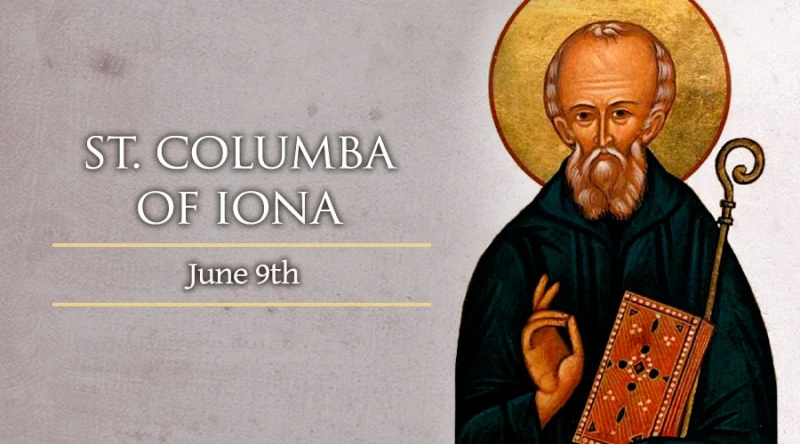
St. Columba of Iona


St. Columba of Iona

Feast date: Jun 09

On June 9, the Catholic Church commemorates the sixth-century Irish monk and missionary Saint Columba of Iona, also known as St. Columcille.

One of Ireland’s three patron saints (together with Saint Patrick and Saint Brigid), he is also sometimes called the “Apostle of the Picts” for his evangelization of Scotland.

He should not be confused with St. Columbanus (or Columban), a different Irish monk and missionary who lived slightly later and ended up in Italy.

Columba was born during 521, descended from royalty through his father. He was taught and mentored by the priest who baptized him, and later attended a monastic school founded by Saint Finnian of Moville. His own life as a monk began at the school, where he was also ordained a deacon.

The deacon went on to spend time in a different monastery and school run by another Finnian, Saint Finnian of Clonard. Columba became a priest during this period, and along with eleven others from this same institution, he would become known as one of the “Twelve Apostles of Ireland.”

Columba also studied with Saint Mobhi of Glasnevin, before a disease epidemic forced him to return to his ancestral homeland of Ulster during 544. He spent the next 15 years traveling, preaching, and founding monasteries.

It is not clear why, in 563, Columba left Ireland. By some accounts he was simply going to preach the word of God. Others claim that he had become involved in a battle between warring tribes, before repenting and taking on foreign missionary work as a penance.

On the island of Iona, located on Scotland’s northwest coast, Columba and his group of companions built simple monastic quarters and a church for themselves. The priest-monk’s first missionary work was in the region of Dalriada, whose Celtic Christian inhabitants were lacking solid religious instruction.

His next effort was to convert the Picts of northern Scotland, a task that would take up most of the rest of his life. He began by gaining entrance to the castle of King Brude, where the locked gates are said to have miraculously opened when the sign of the Cross was made. The king welcomed the missionaries, believed the Gospel, and was baptized.

Columba’s evangelization of northern Scotland continued over the next three decades. He and his companions met with some resistance from the native pagan Druids, but on the whole they found remarkable success in spreading the Catholic faith and building up a network of churches and monasteries.

The island monastery at Iona remained his home base, and it drew pilgrims looking to benefit from the priest-monk’s wisdom and his prayers. He remained in touch with the Irish Church, making many trips back until he became too weak to travel. Even in old age, Columba maintained an intense routine of prayer, fasting, and study.

After giving a final blessing to his monastery on June 8, 597, he died sometime in the early hours of the following day.

St. Columba of Iona Read More »