
Please mind our dust!

We are currently working on revamping our website!
Thank you for your patience!

CRD Solutions

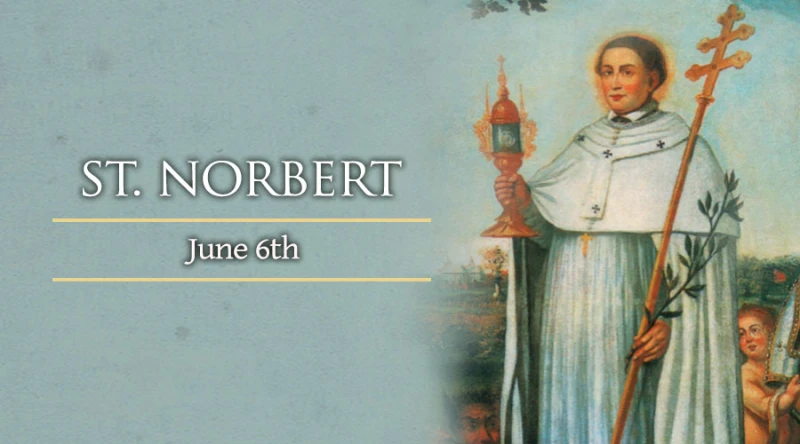
St. Norbert


St. Norbert

Feast date: Jun 06

On June 6 the Catholic Church honors Saint Norbert of Xanten – who started out as a frivolous and worldly cleric, but was changed by God’s grace into a powerful preacher and an important reformer of the Church during the early 12th century.

He is the founder of the Norbertine order.

Born around the year 1075 in the German town of Xanten, Norbert belonged to a high-ranking family with ties to the imperial court. As a young man he showed a high degree of intelligence and sophistication – which marked him out as a contender for offices within the Church, the state, or both. None of this, however, was any guarantee of a holy life. On the contrary, Norbert’s gifts and advantages would prove to be a source of temptation even after he joined the ranks of the clergy.

Norbert was ordained as a subdeacon, and enrolled with a group of clerics in his town, before moving on to an appointment with the powerful Archbishop of Cologne. He went on to serve the German Emperor Henry V, in a position which involved the distribution of aid to the poor. In all of this, however, Norbert displayed no particular piety or personal seriousness, living a rather pleasurable and luxurious life.

Change would come from a brush with death, in approximately 1112: while riding on horseback near Xanten, he was caught in a storm and nearly killed by a lightning bolt. The frightened horse threw Norbert off, and he lay unconscious for some time. Sobered by the experience, he left his imperial post and began a period of prayer and discernment in a monastery. At age 35, he heard God calling him to the priesthood.

Radically converted to the ideals of the Gospel, Norbert was now set against the worldly attitude he had once embodied. This made him unpopular with local clerics, who responded with insults and condemnation. But Norbert was not turning back. He gave all of his wealth to the poor, reducing himself to a barefoot and begging pilgrim who possessed nothing except the means to celebrate Mass.

Pope Gelasius II gave Norbert permission to live as an itinerant preacher, and he was asked to found a religious order so that others might live after his example. He settled in the northern French region of Aisne, along with a small group of disciples who were to live according to the Rule of St. Augustine. On December 25, 1121, they were established as the Canons Regular of Premontre, also known as the Premonstratensians or Norbertines.

Their founder also established a women’s branch of the order, before returning to Germany for a successful preaching tour. He founded a lay branch of the Premonstratensians (the Third Order of St. Norbert), and went on to Belgium, where he preached against a sect that denied the power of the sacraments. His order was invited into many Northern European dioceses, and there was talk of making Norbert a bishop.

Though he avoided an earlier attempt to make him the Bishop of Wurzburg, Norbert was eventually chosen to become the Archbishop of Magdeburg in Germany. The archdiocese was in serious moral and financial trouble, and the new archbishop worked hard to reform it. His efforts were partly successful, but not universally accepted: Norbert was the target of three failed assassination attempts, made by opponents of his reforms.  

When a dispute arose over the papal succession in 1130, Norbert traveled to Rome to support the legitimate Pope Innocent II. Afterward he returned to Germany and became a close adviser to its Emperor Lothar. In a sense, his life seems to have come full-circle: the first hints of his conversion had come on a trip to Rome two decades earlier, when he accompanied a previous emperor. This time, however, Norbert was seeking God’s will, not his own advancement.

With his health failing, Norbert was brought back to Magdeburg. He died there on June 6, 1134. Pope Gregory XIII canonized St. Norbert in 1582.
St. Norbert Read More »

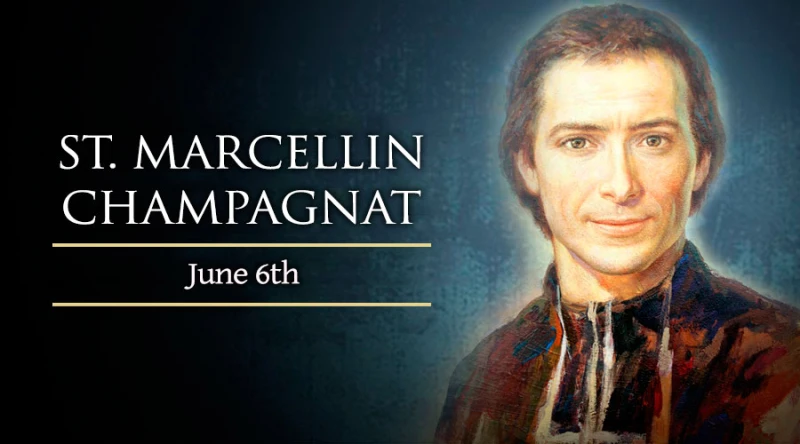
St. Marcellin Champagnat


St. Marcellin Champagnat

Feast date: Jun 06

“All to Jesus through Mary, and all to Mary for Jesus.”St. Marcellin Champagnat

Marcellin Champagnat was born on May 20, 1789, the year of the French Revolution, and died on June 6, 1840.  He was a priest of the Society of Mary and the founder of the Little Brothers of Mary, a congregation of brothers devoted to the education of the young.

He was the ninth child of a very pious catholic family and develpoed a very deep devotion to Mary as a young boy, which he learned from an aunt who was a religious.  He also had a great capacity for work, which he learned from his father.

Champagnat left school at the age of seven, and when, at the age of 14, he discovered through the help of a priest his own vocation to the priesthood, he had to begin to study again almost from scratch.

Aware of his limitations, and against the advice of those around him, he entered the minor seminary and struggled to learn the fundaments of schooling. However, never losing sight of the will of God for him, he struggled through these difficult years with his eyes fixed on the horizon of God’s call.

In the major seminary he became friends with the future Curé of Ars, Jean-Marie Vianney.  He was ordained with his companions on July 22, 1816, the feast of St. Mary Magdalen.

One of his desires was to found a congregarion devoted to the name of Mary in order to re-evangelize French society in the wake of the French Revolution. He saw his main task as the Christian education of the young, and this inclination was quickened and solidified upon encountering a dying young boy who had nearly no knowledge of the faith.

He foudned the Little Brothers of Mary on January 2, 1817, when two young men decided to join him in his mission. He set about at once, in addition to his parish ministry, to educate uncultured young boys and turn them into ardent apostles of Jesus Christ, all the while living in abject poverty and trusting totally in the will of God, and the solicitous protection of the Virgin Mary, to whom he gave all, for the sake of the Lord Jesus.

Marcellin Champagnat died at the age of 51, his health having been worn out by his immense workload and an illness.

At his canonization in 1999 by Pope JohnPaul II, the Holy Father said of him,“St Marcellin proclaimed the Gospel with a burning heart. He was sensitive to the spiritual and educational needs of his time, especially to religious ignorance and the situations of neglect experienced in a particular way by the young.”

St. Marcellin Champagnat Read More »

Memorial of the Blessed Virgin Mary, Mother of the Church

Reading I Gn 3:9-15, 20

After Adam had eaten of the tree,
            the LORD God called to him and asked him, “Where are you?”
He answered, “I heard you in the garden;
            but I was afraid, because I was naked,
            so I hid myself.”
Then he asked, “Who told you that you were naked?
You have eaten, then,
            from the tree of which I had forbidden you to eat!”
The man replied, “The woman whom you put here with me—
            she gave me fruit from the tree, and so I ate it.”
The LORD God then asked the woman,
            “Why did you do such a thing?”
The woman answered, “The serpent tricked me into it, so I ate it.”

Then the LORD God said to the serpent:
            “Because you have done this, you shall be banned
                        from all the animals
                        and from all the wild creatures;
            On your belly shall you crawl,
                        and dirt shall you eat
                        all the days of your life.
            I will put enmity between you and the woman,
                        and between your offspring and hers;
            He will strike at your head,
                        while you strike at his heel.”
The man called his wife Eve,
            because she became the mother of all the living.

OR:

Acts 1:12-14

After Jesus had been taken up to heaven,
            the Apostles returned to Jerusalem
            from the mount called Olivet, which is near Jerusalem,
            a sabbath day’s journey away.

When they entered the city
            they went to the upper room where they were staying,
            Peter and John and James and Andrew,
            Philip and Thomas, Bartholomew and Matthew,
            James son of Alphaeus, Simon the Zealot,
            and Judas son of James.
All these devoted themselves with one accord to prayer,
            together with some women,
            and Mary the mother of Jesus, and his brothers.
 

Responsorial Psalm 87:1-2, 3 and 5, 6-7

R. (3) Glorious things are told of you, O city of God.
His foundation upon the holy mountains
            the
LORD loves:
The gates of Zion,
            more than any dwelling of Jacob.
R. Glorious things are told of you, O city of God.
Glorious things are said of you,
            O city of God!
And of Zion they shall say:
            “One and all were born in her;
And he who has established her
            is the Most High
LORD.”
R. Glorious things are told of you, O city of God.
They shall note, when the peoples are enrolled:
            “This man was born there.”
And all shall sing, in their festive dance:
            “My home is within you.”

R. Glorious things are told of you, O city of God.

Alleluia

R. Alleluia, alleluia.
O happy Virgin, you gave birth to the Lord;
O blessed mother of the Church,
you warm our hearts with the Spirit of your Son Jesus Christ.

R. Alleluia, alleluia.

Gospel Jn 19:25-34

Standing by the cross of Jesus were his mother
            and his mother’s sister, Mary the wife of Clopas,
            and Mary of Magdala.
When Jesus saw his mother and the disciple there whom he loved,
            he said to his mother, “Woman, behold, your son.”
Then he said to the disciple,
            “Behold, your mother.”
And from that hour the disciple took her into his home.
After this, aware that everything was now finished,
            in order that the Scripture might be fulfilled,
            Jesus said, “I thirst.”
There was a vessel filled with common wine.
So they put a sponge soaked in wine on a sprig of hyssop
            and put it up to his mouth.
When Jesus had taken the wine, he said,
            “It is finished.”
And bowing his head, he handed over the spirit.

Now since it was preparation day,
            in order that the bodies might not remain on the cross on the sabbath,
            for the sabbath day of that week was a solemn one,
            the Jews asked Pilate that their legs be broken
            and they be taken down.
So the soldiers came and broke the legs of the first
            and then of the other one who was crucified with Jesus.
But when they came to Jesus and saw that he was already dead,
            they did not break his legs,
            but one soldier thrust his lance into his side,
            and immediately Blood and water flowed out.

– – –

Lectionary for Mass for Use in the Dioceses of the United States, second typical edition, Copyright © 2001, 1998, 1997, 1986, 1970 Confraternity of Christian Doctrine; Psalm refrain © 1968, 1981, 1997, International Committee on English in the Liturgy, Inc. All rights reserved. Neither this work nor any part of it may be reproduced, distributed, performed or displayed in any medium, including electronic or digital, without permission in writing from the copyright owner.

Memorial of the Blessed Virgin Mary, Mother of the Church Read More »

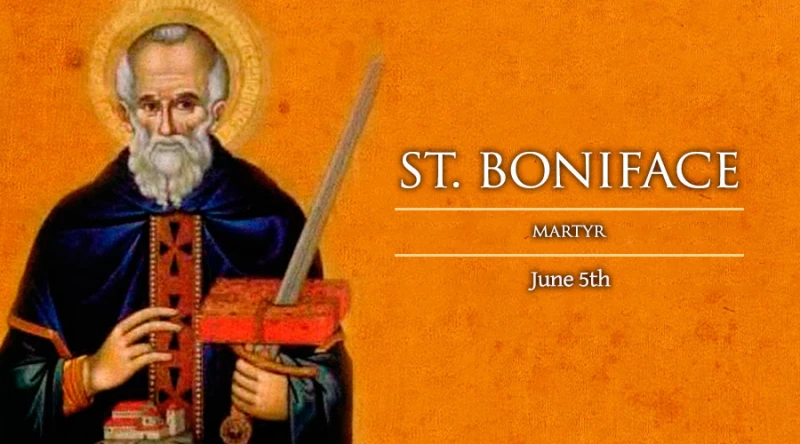
St. Boniface


St. Boniface

Feast date: Jun 05

St. Boniface was very bold in his faith and was well known for being very good at using the local customs and culture of the day to bring people to Christ. He was born in Devonshire, England, in the seventh century. He was educated at a Benedictine monastery and became a monk, and was sent as a missionary to Germany in 719 instead of becoming abbot for his monastery.

There, he destroyed idols and pagan temples, and built churches on the sites. He was eventually made archbishop of Mainz, where he reformed churches and built religious houses on those sites.

He was martyred on June 5, 754 while on mission in Holland, where a troop of pagans attacked and killed him and his 52 companions.

One story about St. Boniface tells about when he met a tribe in Saxony that was worshipping a Norse deity in the form of a huge oak tree. Boniface walked up to the tree, removed his shirt, took an ax, and without a word, chopped it down. Then he stood on the trunk, and asked: “How stands your mighty god? My God is stronger than he.”

St. Boniface Read More »

Saturday of the Seventh Week of Easter

Reading I Acts 28:16-20, 30-31

When he entered Rome, Paul was allowed to live by himself,
with the soldier who was guarding him.

Three days later he called together the leaders of the Jews.
When they had gathered he said to them, “My brothers,
although I had done nothing against our people
or our ancestral customs,
I was handed over to the Romans as a prisoner from Jerusalem.
After trying my case the Romans wanted to release me,
because they found nothing against me deserving the death penalty.
But when the Jews objected, I was obliged to appeal to Caesar,
even though I had no accusation to make against my own nation.
This is the reason, then, I have requested to see you
and to speak with you, for it is on account of the hope of Israel
that I wear these chains.”

He remained for two full years in his lodgings.
He received all who came to him, and with complete assurance
and without hindrance he proclaimed the Kingdom of God
and taught about the Lord Jesus Christ.

Responsorial Psalm 11:4, 5 and 7

R.        (see 7b)  The just will gaze on your face, O Lord.
or:
R.        Alleluia.
The LORD is in his holy temple;
            the LORD’s throne is in heaven.
His eyes behold,
            his searching glance is on mankind.
R.        The just will gaze on your face, O Lord.
or:
R.        Alleluia.
The LORD searches the just and the wicked;
            the lover of violence he hates.
For the LORD is just, he loves just deeds;
            the upright shall see his face.
R.        The just will gaze on your face, O Lord.
or:
R.        Alleluia.

Alleluia Jn 16:7, 13

R. Alleluia, alleluia.
I will send to you the Spirit of truth, says the Lord;
he will guide you to all truth.

R. Alleluia, alleluia.

Gospel Jn 21:20-25

Peter turned and saw the disciple following whom Jesus loved,
the one who had also reclined upon his chest during the supper
and had said, “Master, who is the one who will betray you?”
When Peter saw him, he said to Jesus, “Lord, what about him?”
Jesus said to him, “What if I want him to remain until I come?
What concern is it of yours? 
You follow me.”
So the word spread among the brothers that that disciple would not die.
But Jesus had not told him that he would not die,
just “What if I want him to remain until I come?
What concern is it of yours?”

It is this disciple who testifies to these things
and has written them, and we know that his testimony is true.
There are also many other things that Jesus did,
but if these were to be described individually,
I do not think the whole world would contain the books
that would be written.
 

– – –

Lectionary for Mass for Use in the Dioceses of the United States, second typical edition, Copyright © 2001, 1998, 1997, 1986, 1970 Confraternity of Christian Doctrine; Psalm refrain © 1968, 1981, 1997, International Committee on English in the Liturgy, Inc. All rights reserved. Neither this work nor any part of it may be reproduced, distributed, performed or displayed in any medium, including electronic or digital, without permission in writing from the copyright owner.

Saturday of the Seventh Week of Easter Read More »