Please mind our dust!

We are currently working on revamping our website!
Thank you for your patience!

CRD Solutions

Thursday of the Seventh Week of Easter

Reading I Acts 22:30; 23:6-11

Wishing to determine the truth
about why Paul was being accused by the Jews,
the commander freed him
and ordered the chief priests and the whole Sanhedrin to convene.
Then he brought Paul down and made him stand before them.

Paul was aware that some were Sadducees and some Pharisees,
so he called out before the Sanhedrin,
“My brothers, I am a Pharisee, the son of Pharisees;
I am on trial for hope in the resurrection of the dead.”
When he said this,
a dispute broke out between the Pharisees and Sadducees,
and the group became divided.
For the Sadducees say that there is no resurrection
or angels or spirits,
while the Pharisees acknowledge all three.
A great uproar occurred,
and some scribes belonging to the Pharisee party
stood up and sharply argued,
“We find nothing wrong with this man.
Suppose a spirit or an angel has spoken to him?”
The dispute was so serious that the commander,
afraid that Paul would be torn to pieces by them,
ordered his troops to go down and rescue Paul from their midst
and take him into the compound.
The following night the Lord stood by him and said, “Take courage.
For just as you have borne witness to my cause in Jerusalem,
so you must also bear witness in Rome.”
 

Responsorial Psalm 16:1-2a and 5, 7-8, 9-10, 11

R.        (1)  Keep me safe, O God; you are my hope.
or:
R.        Alleluia.
Keep me, O God, for in you I take refuge;
            I say to the LORD, “My Lord are you.”
O LORD, my allotted portion and my cup,
            you it is who hold fast my lot.
R.        Keep me safe, O God; you are my hope.
or:
R.        Alleluia.
I bless the LORD who counsels me;
            even in the night my heart exhorts me.
I set the LORD ever before me;
            with him at my right hand I shall not be disturbed.
R.        Keep me safe, O God; you are my hope.
or:
R.        Alleluia.
Therefore my heart is glad and my soul rejoices,
            my body, too, abides in confidence;
Because you will not abandon my soul to the nether world,
            nor will you suffer your faithful one to undergo corruption.
R.        Keep me safe, O God; you are my hope.
or:
R.        Alleluia.
You will show me the path to life,
            fullness of joys in your presence,
            the delights at your right hand forever.
R.        Keep me safe, O God; you are my hope.
or:
R.        Alleluia.

Alleluia Jn 17:21

R. Alleluia, alleluia.
May they all be one as you, Father, are in me and I in you,
that the world may believe that you sent me, says the Lord.

R. Alleluia, alleluia.

Gospel Jn 17:20-26

Lifting up his eyes to heaven, Jesus prayed saying:
“I pray not only for these,
but also for those who will believe in me through their word,
so that they may all be one,
as you, Father, are in me and I in you,
that they also may be in us,
that the world may believe that you sent me.
And I have given them the glory you gave me,
so that they may be one, as we are one,
I in them and you in me,
that they may be brought to perfection as one,
that the world may know that you sent me,
and that you loved them even as you loved me.
Father, they are your gift to me.
I wish that where I am they also may be with me,
that they may see my glory that you gave me,
because you loved me before the foundation of the world.
Righteous Father, the world also does not know you,
but I know you, and they know that you sent me.
I made known to them your name and I will make it known,
that the love with which you loved me
may be in them and I in them.”

– – –

Lectionary for Mass for Use in the Dioceses of the United States, second typical edition, Copyright © 2001, 1998, 1997, 1986, 1970 Confraternity of Christian Doctrine; Psalm refrain © 1968, 1981, 1997, International Committee on English in the Liturgy, Inc. All rights reserved. Neither this work nor any part of it may be reproduced, distributed, performed or displayed in any medium, including electronic or digital, without permission in writing from the copyright owner.

Thursday of the Seventh Week of Easter Read More »
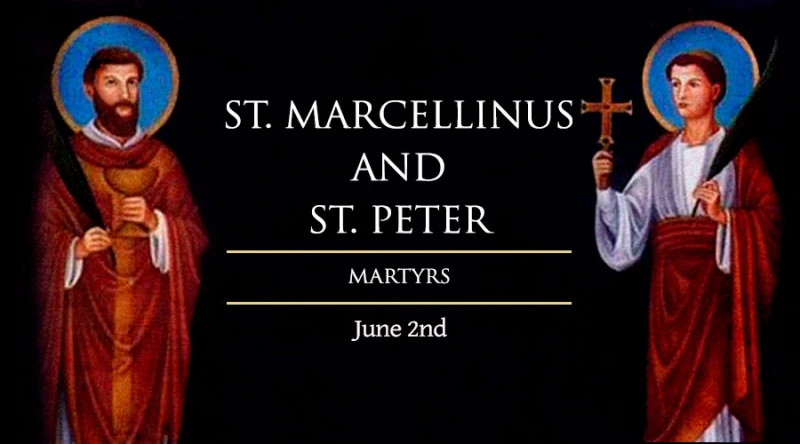
Sts. Marcellinus and Peter


Sts. Marcellinus and Peter

Feast date: Jun 02

On June 2, the Catholic Church remembers two fourth-century martyrs, Saints Marcellinus and Peter, who were highly venerated after the discovery of their tomb and the conversion of their executioner.

Although the biographical details of the two martyrs are largely unknown, it is known that they lived and died during the reign of the Roman Emperor Diocletian. In 302, the ruler changed his tolerant stance and pursued a policy intended to eliminate the Church from the empire.

Diocletian and his subordinate ordered the burning of Catholic churches and their sacred texts, as well as the imprisonment and torture of clergy and laypersons. The goal was to force Christians to submit to the Roman pagan religion, including the worship of the emperor himself as divine.

It was at the mid-point of this persecution, around 303, that a Roman exorcist by the name of Peter was imprisoned for his faith. While in prison, tradition holds that Peter freed Paulina, the daughter of the prison-keeper Artemius, from demonic influence by his prayers.

This demonstration of Christ’s power over demons is said to have brought about the conversion of Paulina, Artemius, his wife, and the entire household, all of whom were baptized by the Roman priest Marcellinus.

After this, both Marcellinus and Peter were called before a judge who was determined to enforce the emperor’s decree against the Church. When Marcellinus testified courageously to his faith in Christ, he was beaten, stripped of his clothes, and deprived of food in a dark cell filled with broken glass shards.

Peter, too, was returned to his confinement. But neither man would deny Christ, and both preferred death over submission to the cult of pagan worship.

It was arranged for the two men to be executed secretly, in order to prevent the faithful from gathering in prayer and veneration at the place of their burial. Their executioner forced them to clear away a tangle of thorns and briars, which the two men did cheerfully, accepting their death with joy.

Both men were beheaded in the forest and buried in the clearing they had made. The location of the saints’ bodies remained unknown for some time, until a devout woman named Lucilla received a revelation informing her where the priest and exorcist lay.

With the assistance of another woman, Firmina, Lucilla recovered the two saints’ bodies and had them re-interred in the Roman Catacombs. Sts. Marcellinus and Peter are among the saints named in the Western Church’s most traditional Eucharistic prayer, the Roman Canon.

Pope St. Damasus I, who was himself a great devotee of the Church’s saints during his life, composed an epitaph to mark the tombs of the two martyrs. The source of his knowledge, he said, was the executioner himself, who had subsequently repented and joined the Catholic Church.

Sts. Marcellinus and Peter Read More »

Memorial of Saint Justin, Martyr

Reading I Acts 20:28-38

At Miletus, Paul spoke to the presbyters of the Church of Ephesus:
“Keep watch over yourselves and over the whole flock
of which the Holy Spirit has appointed you overseers,
in which you tend the Church of God
that he acquired with his own Blood.
I know that after my departure savage wolves will come among you,
and they will not spare the flock.
And from your own group, men will come forward perverting the truth
to draw the disciples away after them.
So be vigilant and remember that for three years, night and day,
I unceasingly admonished each of you with tears.
And now I commend you to God
and to that gracious word of his that can build you up
and give you the inheritance among all who are consecrated.
I have never wanted anyone’s silver or gold or clothing.
You know well that these very hands
have served my needs and my companions.
In every way I have shown you that by hard work of that sort
we must help the weak,
and keep in mind the words of the Lord Jesus who himself said,
‘It is more blessed to give than to receive.’”

When he had finished speaking
he knelt down and prayed with them all.
They were all weeping loudly
as they threw their arms around Paul and kissed him,
for they were deeply distressed that he had said
that they would never see his face again.
Then they escorted him to the ship.
 

Responsorial Psalm 68:29-30, 33-35a, 35bc-36ab

R.        (33a)  Sing to God, O kingdoms of the earth.
or:
R.        Alleluia.
Show forth, O God, your power
            the power, O God, with which you took our part;
For your temple in Jerusalem
            let the kings bring you gifts.
R.        Sing to God, O kingdoms of the earth.
or:
R.        Alleluia.
You kingdoms of the earth, sing to God,
            chant praise to the Lord
            who rides on the heights of the ancient heavens.
Behold, his voice resounds, the voice of power:
            “Confess the power of God!”
R.        Sing to God, O kingdoms of the earth.
or:
R.        Alleluia.
Over Israel is his majesty;
            his power is in the skies.
Awesome in his sanctuary is God, the God of Israel;
            he gives power and strength to his people.
R.        Sing to God, O kingdoms of the earth.
or:
R.        Alleluia.

Alleluia See Jn 17:17b, 17a

R. Alleluia, alleluia.
Your word, O Lord, is truth;
consecrate us in the truth.

R. Alleluia, alleluia.

Gospel Jn 17:11b-19

Lifting up his eyes to heaven, Jesus prayed, saying:
“Holy Father, keep them in your name
that you have given me,
so that they may be one just as we are one.
When I was with them I protected them in your name that you gave me,
and I guarded them, and none of them was lost
except the son of destruction,
in order that the Scripture might be fulfilled.
But now I am coming to you.
I speak this in the world
so that they may share my joy completely.
I gave them your word, and the world hated them,
because they do not belong to the world
any more than I belong to the world.
I do not ask that you take them out of the world
but that you keep them from the Evil One.
They do not belong to the world
any more than I belong to the world.
Consecrate them in the truth.
Your word is truth.
As you sent me into the world,
so I sent them into the world.
And I consecrate myself for them,
so that they also may be consecrated in truth.”

– – –

Lectionary for Mass for Use in the Dioceses of the United States, second typical edition, Copyright © 2001, 1998, 1997, 1986, 1970 Confraternity of Christian Doctrine; Psalm refrain © 1968, 1981, 1997, International Committee on English in the Liturgy, Inc. All rights reserved. Neither this work nor any part of it may be reproduced, distributed, performed or displayed in any medium, including electronic or digital, without permission in writing from the copyright owner.

Memorial of Saint Justin, Martyr Read More »

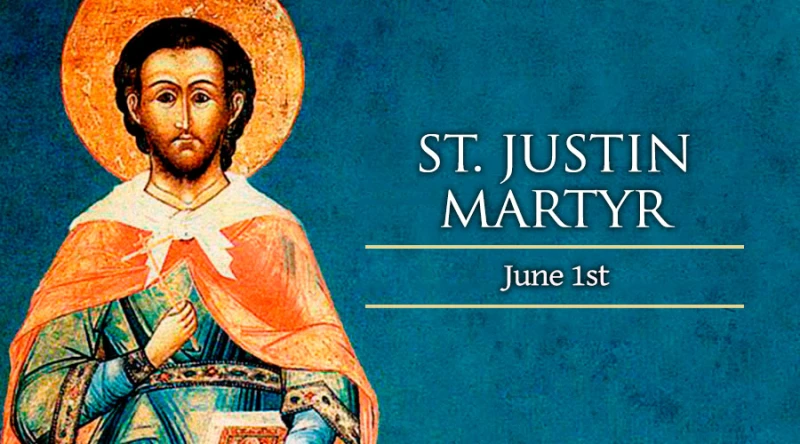
St. Justin Martyr


St. Justin Martyr

Feast date: Jun 01

“We are slain with the sword, but we increase and multiply; the more we are persecuted and destroyed, the more are deaf to our numbers. As a vine, by being pruned and cut close, shoots forth new suckers, and bears a greater abundance of fruit; so is it with us.” – St. Justin Martyr

Justin was born around the year 100 in the Palestinian province of Samaria, the son of Greek-speaking parents whose ancestors were sent as colonists to that area of the Roman Empire. Justin’s father followed the Greek pagan religion and raised his son to do the same, but he also provided Justin with an excellent education in literature and history.

Justin was an avid lover of truth, and as a young man, became interested in philosophy and searched for truth in the various schools of thought that had spread throughout the empire. But he became frustrated with the professional philosophers’ intellectual conceits and limitations, as well as their apparent indifference to God.

After several years of study, Justin had a life-changing encounter with an old man who questioned him about his beliefs and especially about the sufficiency of philosophy as a means of attaining truth. He urged him to study the Jewish prophets and told Justin that these authors had not only spoken by God’s inspiration, but also predicted the coming of Christ and the foundation of his Church.

“Above all things, pray that the gates of life may be opened to you,” the old man told Justin, “for these are not things to be discerned, unless God and Christ grant to a man the knowledge of them.” Justin had always admired Christians from a distance because of the beauty of their moral lives. As he writes in his Apologies: “When I was a disciple of Plato, hearing the accusations made against the Christians and seeing them intrepid in the face of death and of all that men fear, I said to myself that it was impossible that they should be living in evil and in the love of pleasure.” The aspiring philosopher eventually decided to be baptized around the age of 30.

After his conversion, Justin continued to wear the type of cloak that Greek culture associated with the philosophers. Inspired by the dedicated example of other Catholics whom he had seen put to death for their faith, he embraced a simple and austere lifestyle even after moving to Rome.

Justin was most likely ordained a deacon, since he preached, did not marry, and gave religious instruction in his home. He is best known as the author of early apologetic works which argued for the Catholic faith against the claims of Jews, pagans, and non-Christian philosophers.

Several of these works were written to Roman officials, for the purpose of refuting lies that had been told about the Church. Justin sought to convince the rulers of the Roman Empire that they had nothing to gain, and much to lose, by persecuting the Christians. His two most famous apologetical treatises were “Apologies” and “Dialogue with Tryphon.”

In order to fulfill this task, Justin gave explicit written descriptions of the early Church’s beliefs and its mode of worship. In modern times, scholars have noted that Justin’s descriptions correspond to the traditions of the Catholic Church on every essential point.

Justin describes the weekly Sunday liturgy as a sacrifice, and speaks of the Eucharist as the true body and blood of Christ. He further states that only baptized persons who believe the Church’s teachings, and are free of serious sin, may receive it.

Justin also explains in his writings that the Church regards celibacy as a sacred calling, condemns the common practice of killing infants, and looks down on the accumulation of excessive wealth and property.

His first defense of the faith, written to Emperor Antonius Pius around 150, convinced the emperor to regard the Church with tolerance. In 167, however, persecution began again under Emperor Marcus Aurelius.

During that year Justin wrote to the emperor, who was himself a philosopher and the author of the well-known “Meditations.” He tried to demonstrate the injustice of the persecutions, and the superiority of the Catholic faith over Greek philosophy. Justin emphasized the strength of his convictions by stating that he expected to be put to death for expressing them

He was, indeed, seized along with a group of other believers, and brought before Rusticus, prefect of Rome. A surviving eyewitness account shows how Justin the philosopher became known as “St. Justin Martyr.”

The prefect made it clear how Justin might save his life: “Obey the gods, and comply with the edicts of the emperors.” Justin responded that “no one can be justly blamed or condemned for obeying the commands of our Savior Jesus Christ.”

Rusticus briefly questioned Justin and his companions regarding their beliefs about Christ and their manner of worshiping God. Then he laid down the law.

“Hear me,” he said, “you who are noted for your eloquence, who think that you make a profession of the right philosophy. If I cause you to be scourged from head to foot, do you think you shall go to heaven?”

“If I suffer what you mention,” Justin replied, “I hope to receive the reward which those have already received, who have obeyed the precepts of Jesus Christ.”

“There is nothing which we more earnestly desire, than to endure torments for the sake of our Lord Jesus Christ,” he explained. “We are Christians, and will never sacrifice to idols.” Justin was scourged and beheaded along with six companions who joined him in his confession of faith.

St. Justin Martyr has been regarded as a saint since the earliest centuries of the Church. Eastern Catholics and Eastern Orthodox Christians also celebrate his feast day on June 1.


St. Justin Martyr Read More »

Feast of the Visitation of the Blessed Virgin Mary

Reading I Zep 3:14-18a

Shout for joy, O daughter Zion!
            Sing joyfully, O Israel!
Be glad and exult with all your heart,
            O daughter Jerusalem!
The LORD has removed the judgment against you,
            he has turned away your enemies;
The King of Israel, the LORD, is in your midst,
            you have no further misfortune to fear.
On that day, it shall be said to Jerusalem:
            Fear not, O Zion, be not discouraged!
The LORD, your God, is in your midst,
            a mighty savior;
He will rejoice over you with gladness,
            and renew you in his love,
He will sing joyfully because of you,
            as one sings at festivals.

Or      

Rom 12:9-16

Brothers and sisters:
Let love be sincere;
hate what is evil,
hold on to what is good;
love one another with mutual affection;
anticipate one another in showing honor.
Do not grow slack in zeal,
be fervent in spirit,
serve the Lord.
Rejoice in hope,
endure in affliction,
persevere in prayer.
Contribute to the needs of the holy ones,
exercise hospitality.
Bless those who persecute you,
bless and do not curse them.
Rejoice with those who rejoice,
weep with those who weep.
Have the same regard for one another;
do not be haughty but associate with the lowly;
do not be wise in your own estimation.
 

Responsorial Psalm Isaiah 12:2-3, 4bcd, 5-6

R.        (6)  Among you is the great and Holy One of Israel.
God indeed is my savior;
            I am confident and unafraid.
My strength and my courage is the LORD,
            and he has been my savior.
With joy you will draw water
            at the fountain of salvation.
R.        Among you is the great and Holy One of Israel.
Give thanks to the LORD, acclaim his name;
            among the nations make known his deeds,
            proclaim how exalted is his name.
R.        Among you is the great and Holy One of Israel.
Sing praise to the LORD for his glorious achievement;
            let this be known throughout all the earth.
Shout with exultation, O city of Zion,
            for great in your midst
            is the Holy One of Israel!
R.        Among you is the great and Holy One of Israel.

Alleluia See Lk 1:45

R. Alleluia, alleluia.
Blessed are you, O Virgin Mary, who believed
that what was spoken to you by the Lord would be fulfilled.
R. Alleluia, alleluia.

Gospel Lk 1:39-56

Mary set out
and traveled to the hill country in haste
to a town of Judah,
where she entered the house of Zechariah
and greeted Elizabeth.
When Elizabeth heard Mary’s greeting,
the infant leaped in her womb,
and Elizabeth, filled with the Holy Spirit,
cried out in a loud voice and said,
“Most blessed are you among women,
and blessed is the fruit of your womb.
And how does this happen to me,
that the mother of my Lord should come to me?
For at the moment the sound of your greeting reached my ears,
the infant in my womb leaped for joy.
Blessed are you who believed
that what was spoken to you by the Lord
would be fulfilled.”

And Mary said:
 “My soul proclaims the greatness of the Lord;
            my spirit rejoices in God my Savior,
            for he has looked with favor on his lowly servant.
From this day all generations will call me blessed:
            the Almighty has done great things for me,
            and holy is his Name.

He has mercy on those who fear him
            in every generation.
He has shown the strength of his arm,
            he has scattered the proud in their conceit.
He has cast down the mighty from their thrones,
            and has lifted up the lowly.
He has filled the hungry with good things,
            and the rich he has sent away empty.
He has come to the help of his servant Israel
            for he has remembered his promise of mercy,
            the promise he made to our fathers,
            to Abraham and his children for ever.”

Mary remained with her about three months
and then returned to her home.
 

– – –

Lectionary for Mass for Use in the Dioceses of the United States, second typical edition, Copyright © 2001, 1998, 1997, 1986, 1970 Confraternity of Christian Doctrine; Psalm refrain © 1968, 1981, 1997, International Committee on English in the Liturgy, Inc. All rights reserved. Neither this work nor any part of it may be reproduced, distributed, performed or displayed in any medium, including electronic or digital, without permission in writing from the copyright owner.

Feast of the Visitation of the Blessed Virgin Mary Read More »