Please mind our dust!

We are currently working on revamping our website!
Thank you for your patience!

CRD Solutions

Feast of the Visitation of the Virgin Mary
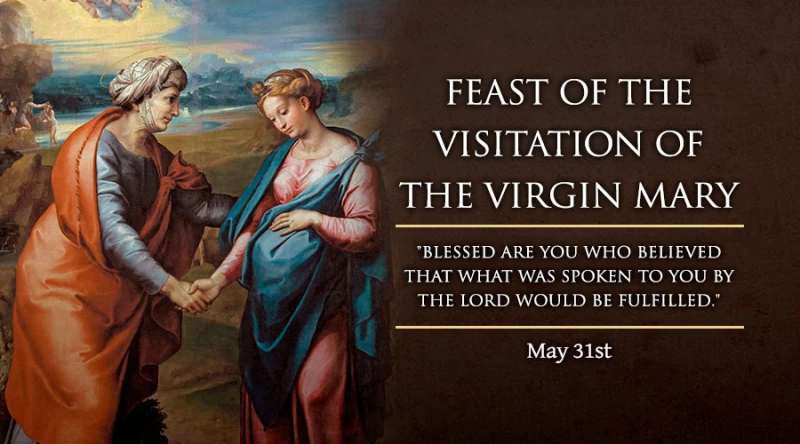

Feast of the Visitation of the Virgin Mary

Feast date: May 31

Assuming that the Annunciation and the Incarnation took place around the time of the vernal equinox, Mary left Nazareth at the end of March and went over the mountains to Hebron, south of Jerusalem, to wait upon her cousin Elizabeth. Because Mary’s presence, and even more the presence of the Divine Child in her womb, according to the will of God, was to be the source of very great graces to the Blessed John, Christ’s Forerunner. (Lk1:39-57).

Feeling the presence of his Divine Saviour, John, upon the arrival of Mary, leaped for joy in the womb of his mother; at that moment he was cleansed from original sin and filled with the grace of God. Our Lady now, for the first time, exercised the office which belonged to the Mother of God made man: that He might, by her mediation, sanctify and glorify us. St. Joseph probably accompanied Mary, returned to Nazareth, and when, after three months, he came again to Hebron to take his wife home, the apparition of the angel, mentioned in Mt 1:19-25, may have taken place to end the tormenting doubts of Joseph regarding Mary’s maternity.

The earliest evidence of the existence of the feast is its adoption by the Franciscan Chapter in 1263, upon the advice of St. Bonaventure. The list of feasts in the “Statuta Synodalia eccl. Cenomanensis”, according to which this feast was kept July 2 at Le Mans in 1247, may not be genuine. With the Franciscan Breviary this feast spread to many churches, but was celebrated at various dates-at Prague and Ratisbon, April 28, in Paris June 27, and at Reims and Geneva, on July 8. It was extended to the entire Church by Urban VI on April 6, 1389 (Decree published by Boniface IX, 9 Nov., 1389), with the hope that Christ and His Mother would visit the Church and put an end to the Great Schism which rent the seamless garment of Christ.

The feast, with a vigil and an octave, was assigned to July 2, the day after the octave of St. John, about the time when Mary returned to Nazareth. The Office was drawn up by an Englishman, Adam Cardinal Easton, Benedictine monk and Bishop of Lincoln. Dreves has published this rhythmical office with nine other offices for the same feast, found in the Breviaries of the fourteenth and fifteenth centuries.

Since, during the Schism, many bishops of the opposing obedience would not adopt the new feast, it was confirmed by the Council of Basle, in 1441. Pius V abolished the rhythmical office, the vigil, and the octave. The present office was compiled by order of Clement VIII by the Minorite Ruiz. Pius IX, on May 13, 1850, raised the feast to the rank of a double of the second class.

Many religious orders — the Carmelites, Dominicans, Cistercians, Mercedarians, Servites, and others — as well as Siena, Pisa, Loreto, Vercelli, Cologne, and other dioceses have retained the octave. In Bohemia the feast is kept on the first Sunday of July as a double of the first class with an octave.

Feast of the Visitation of the Virgin Mary Read More »
Monday of the Seventh Week of Easter

Reading I Acts 19:1-8

While Apollos was in Corinth,
Paul traveled through the interior of the country
and down to Ephesus where he found some disciples.
He said to them,
“Did you receive the Holy Spirit when you became believers?”
They answered him,
“We have never even heard that there is a Holy Spirit.”
He said, “How were you baptized?”
They replied, “With the baptism of John.”
Paul then said, “John baptized with a baptism of repentance,
telling the people to believe in the one who was to come after him,
that is, in Jesus.”
When they heard this,
they were baptized in the name of the Lord Jesus.
And when Paul laid his hands on them,
the Holy Spirit came upon them,
and they spoke in tongues and prophesied.
Altogether there were about twelve men.

He entered the synagogue, and for three months debated boldly
with persuasive arguments about the Kingdom of God.
 

Responsorial Psalm 68:2-3ab, 4-5acd, 6-7ab

R.        (33a)  Sing to God, O kingdoms of the earth.
or:
R.        Alleluia.
God arises; his enemies are scattered,
            and those who hate him flee before him.
As smoke is driven away, so are they driven;
            as wax melts before the fire.
R.        Sing to God, O kingdoms of the earth.
or:
R.        Alleluia.
But the just rejoice and exult before God;
            they are glad and rejoice.
Sing to God, chant praise to his name;
            whose name is the LORD.
R.        Sing to God, O kingdoms of the earth.
or:
R.        Alleluia.
The father of orphans and the defender of widows
            is God in his holy dwelling.
God gives a home to the forsaken;
            he leads forth prisoners to prosperity.
R.        Sing to God, O kingdoms of the earth.
or:
R.        Alleluia.

Alleluia Col 3:1

R. Alleluia, alleluia.
If then you were raised with Christ,
seek what is above,
where Christ is seated at the right hand of God.

R. Alleluia, alleluia.

Gospel Jn 16:29-33

The disciples said to Jesus,
“Now you are talking plainly, and not in any figure of speech.
Now we realize that you know everything
and that you do not need to have anyone question you.
Because of this we believe that you came from God.”
Jesus answered them, “Do you believe now?
Behold, the hour is coming and has arrived
when each of you will be scattered to his own home
and you will leave me alone.
But I am not alone, because the Father is with me.
I have told you this so that you might have peace in me.
In the world you will have trouble,
but take courage, I have conquered the world.”

– – –

Lectionary for Mass for Use in the Dioceses of the United States, second typical edition, Copyright © 2001, 1998, 1997, 1986, 1970 Confraternity of Christian Doctrine; Psalm refrain © 1968, 1981, 1997, International Committee on English in the Liturgy, Inc. All rights reserved. Neither this work nor any part of it may be reproduced, distributed, performed or displayed in any medium, including electronic or digital, without permission in writing from the copyright owner.

Monday of the Seventh Week of Easter Read More »

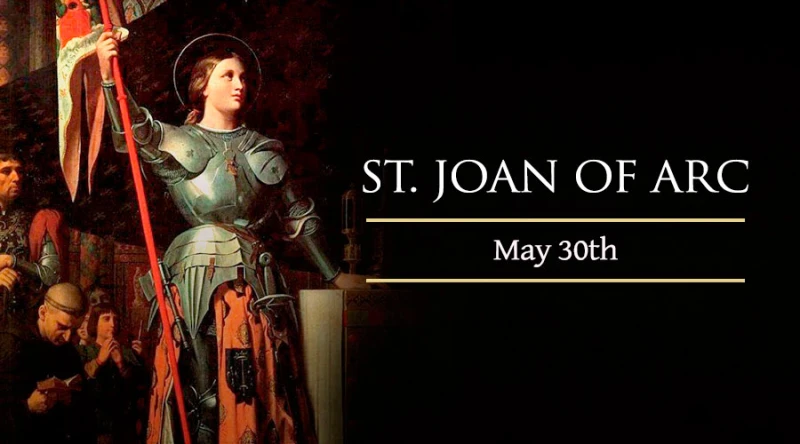
St. Joan of Arc


St. Joan of Arc

Feast date: May 30

Today is the feast of St. Joan of Arc, the patroness of France. Joan was born to a peasant family in Champagne, France in the early 15th century.

From a young age she heard the voices of St. Michael, St. Catherine, and St. Margaret speaking to her. Then, in 1428, when she was 13 years old, she received a vision telling her to go to the King of France and help him reconquer his kingdom from the invading forces of England and Burgundy.

Overcoming opposition and convincing members of the court and of the Church, she was given a small army. She charged into battle bearing a banner which bore the names “Jesus” and “Mary” as well as a symbol of the Holy Spirit.

Due to her leadership and trust in God, she was able to raise the siege of Orleans in 1429. Joan and her army went on to win a series of battles. Because of her efforts, the king was able to enter Rheims. He was crowned with Joan at his side.

Eventually, Joan was captured by the forces of Burgundy in May of 1430. When her own king and army did nothing to save her, she was sold to the English. She was imprisoned for a time and then put on trial. Bishop Peter Cauchon of Beauvais presided over her trial. His hope was that in being harsh with Joan, the English would help him become archbishop.

Joan was condemned to death on counts of heresy, witchcraft, and adultery. On May 30, 1431, she was burned at the stake in Rouen, France. She was 19 years old.

Thirty years after her death, her case was retried and she was exonerated. In 1920, she was canonized by Pope Benedict XV. She is the patroness of France, captives, soldiers, and those ridiculed for their piety.

St. Joan of Arc Read More »

Seventh Sunday of Easter – Ascension

Seventh Sunday of Easter

Ascension of the Lord

– – –

Lectionary for Mass for Use in the Dioceses of the United States, second typical edition, Copyright © 2001, 1998, 1997, 1986, 1970 Confraternity of Christian Doctrine; Psalm refrain © 1968, 1981, 1997, International Committee on English in the Liturgy, Inc. All rights reserved. Neither this work nor any part of it may be reproduced, distributed, performed or displayed in any medium, including electronic or digital, without permission in writing from the copyright owner.

Seventh Sunday of Easter – Ascension Read More »

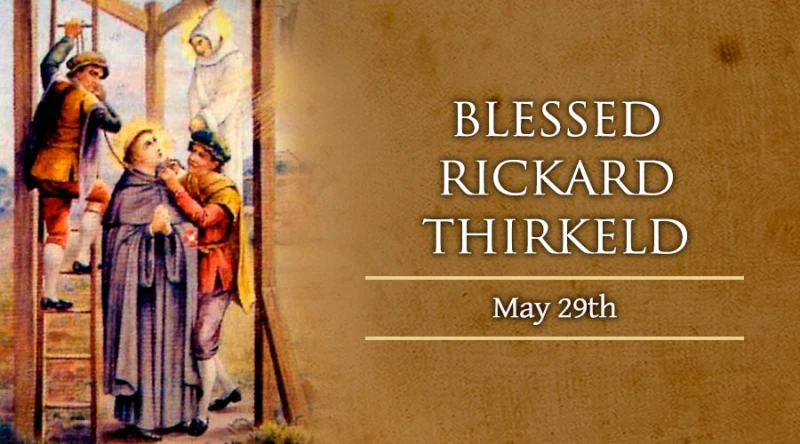
Blessed Rickard Thirkeld


Blessed Rickard Thirkeld

Feast date: May 29

Richard Thirkeld was ordained a priest in France in April of 1579, and returned to his homeland of York, England, soon after to serve as a home missionary. There he was arrested on the eve of the Annunciation in 1538 for the crime of being a priest.

He was imprisoned for two months before being brought to court on May 27, 1583 for hearing confessions and bringing lapsed Catholics back to the Church. He was arrested while hearing a confession in jail. The next day his trial took place, at which he managed to appear in cassock and biretta. He was sentenced to death the following day, May 29, was executed in York. He used his short time in jail to minister to the other prisoners, especially those sentenced to death.

He was executed secretly because authorities feared that his public execution would have caused a public demonstration.

He was beatified by Pope Leo XIII in 1886.

Blessed Rickard Thirkeld Read More »