
Please mind our dust!

We are currently working on revamping our website!
Thank you for your patience!

CRD Solutions

St. Augustine of Canterbury
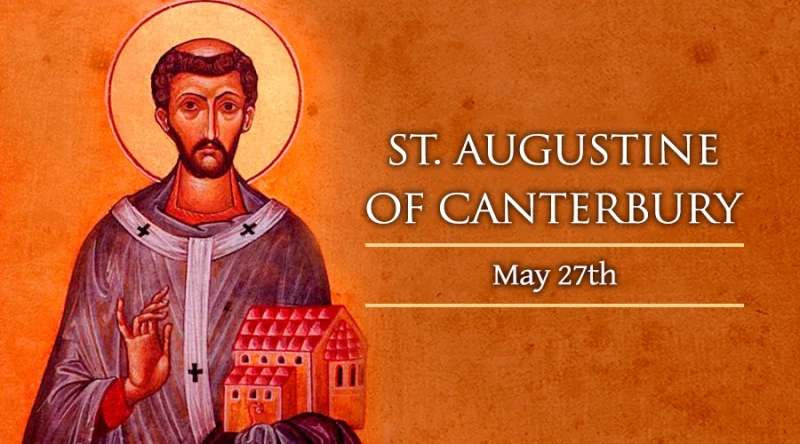

St. Augustine of Canterbury

Feast date: May 27

An Italian Benedictine monk who became the “Apostle of the English,” Saint Augustine of Canterbury is honored by the Catholic Church on May 27.

Under the direction of Pope Saint Gregory the Great, Augustine founded the famous See of Canterbury and preached the Catholic faith to the country’s Anglo-Saxon pagans during the late sixth and early seventh centuries.

He is not be confused with the earlier St. Augustine of Hippo, the famous author of the “Confessions” and “City of God.”

Augustine’s date of birth cannot be established, nor are any details of his early life known. Most likely born in Rome to a noble family, he entered monastic life as a young man. The community he joined had been recently founded by a Benedictine monk named Gregory, who would go on to become Pope and eventually be known as St. Gregory the Great. The friendship between Gregory and Augustine had great historical consequences, as it was the Pope who would eventually send his fellow monk to evangelize England.

Around 595, five years into his 14-year pontificate, Pope Gregory set to work on a plan for the conversion of the English people. The Catholic faith had already been preached and accepted among England’s original Celtic inhabitants in earlier times, but from the mid-fifth century onward, the country was dominated by Anglo-Saxon invaders who did not accept Christianity, and were not converted by the small number of isolated Celtic Christian holdouts. Thus, England largely had to be evangelized anew.

For this task the Pope chose a group of around forty monks – including Augustine, who was to represent the delegation and communicate on its behalf. Though he was not explicitly chosen as its leader at that time, that was the role he ended up taking on with Gregory’s support. The group left for England in June 596, but some of the missionaries lost their nerve after hearing fearsome reports about the Anglo-Saxons. Augustine ended up returning to Rome, where he got further advice and support from the Pope.

Persuaded to continue on their way, the missionary-monks reached their port of departure and set sail for England in spring of 597. After arriving they gained an audience with King Ethelbert of Kent, a pagan ruler whose Frankish wife Queen Bertha was a Christian. Speaking with the king through an interpreter, Augustine gave a powerful and straightforward presentation of the Gospel message, speaking of Christ’s redemption of the world and his offer of eternal life.

Ethelbert would later convert, and eventually even be canonized as a Saint. But his initial response to Augustine’s preaching was only mildly positive: he would receive the missionaries with hospitality, and permit them to evangelize without any restriction. Despite his early ambivalence, however, the king became a generous patron of the monks. They made their home in Canterbury, after dramatically entering the city in procession with the Cross and an image of Christ.

The Canterbury community lived according to the Rule of St. Benedict, as they had in Italy, but they also preached in the surrounding area in accordance with their mission. Augustine and his companions succeeded in converting King Ethelbert himself, while Queen Bertha also became more zealous in her practice of the faith after her husband’s baptism. Augustine traveled to Gaul, where he was consecrated as a bishop for the English Church. By Christmas of 597, over ten thousand people were actively seeking baptism from the missionaries.

Through his written correspondence, Pope Gregory continued to guide the work of Augustine – the first Archbishop of Canterbury – and the other Catholic missionaries. The great Pope, and the “Apostle of England,” would both die during the same year, 604.

Though Augustine had not managed to sort out some disagreements with the native Celtic bishops, he had given the faith a firm foothold among the Anglo-Saxons. Canterbury would continue on for centuries as the ranking see of English Catholicism, until its fall into schism during the 16th century.

St. Augustine of Canterbury Read More »
The Ascension of the Lord

Reading I Acts 1:1-11

In the first book, Theophilus,
I dealt with all that Jesus did and taught
until the day he was taken up,
after giving instructions through the Holy Spirit
to the apostles whom he had chosen.
He presented himself alive to them
by many proofs after he had suffered,
appearing to them during forty days
and speaking about the kingdom of God.
While meeting with them,
he enjoined them not to depart from Jerusalem,
but to wait for “the promise of the Father
about which you have heard me speak;
for John baptized with water,
but in a few days you will be baptized with the Holy Spirit.”

When they had gathered together they asked him,
“Lord, are you at this time going to restore the kingdom to Israel?”
He answered them, “It is not for you to know the times or seasons
that the Father has established by his own authority.
But you will receive power when the Holy Spirit comes upon you,
and you will be my witnesses in Jerusalem,
throughout Judea and Samaria,
and to the ends of the earth.”
When he had said this, as they were looking on,
he was lifted up, and a cloud took him from their sight.
While they were looking intently at the sky as he was going,
suddenly two men dressed in white garments stood beside them.
They said, “Men of Galilee,
why are you standing there looking at the sky?
This Jesus who has been taken up from you into heaven
will return in the same way as you have seen him going into heaven.”

Responsorial Psalm Ps 47:2-3, 6-7, 8-9

R (6) God mounts his throne to shouts of joy: a blare of trumpets for the Lord.
or:
R Alleluia.
All you peoples, clap your hands,
            shout to God with cries of gladness,
For the LORD, the Most High, the awesome,
            is the great king over all the earth.
R God mounts his throne to shouts of joy:  a blare of trumpets for the Lord.
or:
R Alleluia.
God mounts his throne amid shouts of joy;
            the LORD, amid trumpet blasts.
Sing praise to God, sing praise;
            sing praise to our king, sing praise.
R God mounts his throne to shouts of joy:  a blare of trumpets for the Lord.
or:
R Alleluia.
For king of all the earth is God;
            sing hymns of praise.
God reigns over the nations,
            God sits upon his holy throne.
R God mounts his throne to shouts of joy:  a blare of trumpets for the Lord.
or:
R Alleluia.

Reading II Eph 1:17-23

Brothers and sisters:
May the God of our Lord Jesus Christ, the Father of glory,
give you a Spirit of wisdom and revelation
resulting in knowledge of him.
May the eyes of your hearts be enlightened,
that you may know what is the hope that belongs to his call,
what are the riches of glory
in his inheritance among the holy ones,
and what is the surpassing greatness of his power
for us who believe,
in accord with the exercise of his great might:
which he worked in Christ,
raising him from the dead
and seating him at his right hand in the heavens,
far above every principality, authority, power, and dominion,
and every name that is named
not only in this age but also in the one to come.
And he put all things beneath his feet
and gave him as head over all things to the church,
which is his body,
the fullness of the one who fills all things in every way.

OR:

Heb 9:24-28; 10:19-23

Christ did not enter into a sanctuary made by hands,
a copy of the true one, but heaven itself,
that he might now appear before God on our behalf.
Not that he might offer himself repeatedly,
as the high priest enters each year into the sanctuary
with blood that is not his own;
if that were so, he would have had to suffer repeatedly
from the foundation of the world.
But now once for all he has appeared at the end of the ages
to take away sin by his sacrifice.
Just as it is appointed that men and women die once,
and after this the judgment, so also Christ,
offered once to take away the sins of many,
will appear a second time, not to take away sin
but to bring salvation to those who eagerly await him.

Therefore, brothers and sisters, since through the blood of Jesus
we have confidence of entrance into the sanctuary
by the new and living way he opened for us through the veil,
that is, his flesh,
and since we have a great priest over the house of God,”
let us approach with a sincere heart and in absolute trust,
with our hearts sprinkled clean from an evil conscience
and our bodies washed in pure water.
Let us hold unwaveringly to our confession that gives us hope,
for he who made the promise is trustworthy.

Alleluia Mt 28:19a, 20b

R. Alleluia, alleluia.
Go and teach all nations, says the Lord;
I am with you always, until the end of the world.
R. Alleluia, alleluia.

Gospel Lk 24:46-53

Jesus said to his disciples:
“Thus it is written that the Christ would suffer
and rise from the dead on the third day
and that repentance, for the forgiveness of sins,
would be preached in his name
to all the nations, beginning from Jerusalem.
You are witnesses of these things.
And behold I am sending the promise of my Father upon you;
but stay in the city
until you are clothed with power from on high.”

Then he led them out as far as Bethany,
raised his hands, and blessed them.
As he blessed them he parted from them
and was taken up to heaven.
They did him homage
and then returned to Jerusalem with great joy,
and they were continually in the temple praising God.

– – –

Lectionary for Mass for Use in the Dioceses of the United States, second typical edition, Copyright © 2001, 1998, 1997, 1986, 1970 Confraternity of Christian Doctrine; Psalm refrain © 1968, 1981, 1997, International Committee on English in the Liturgy, Inc. All rights reserved. Neither this work nor any part of it may be reproduced, distributed, performed or displayed in any medium, including electronic or digital, without permission in writing from the copyright owner.

The Ascension of the Lord Read More »

Thursday of the Sixth Week of Easter

Ascension

Weekday (Saint Philip Neri)

– – –

Lectionary for Mass for Use in the Dioceses of the United States, second typical edition, Copyright © 2001, 1998, 1997, 1986, 1970 Confraternity of Christian Doctrine; Psalm refrain © 1968, 1981, 1997, International Committee on English in the Liturgy, Inc. All rights reserved. Neither this work nor any part of it may be reproduced, distributed, performed or displayed in any medium, including electronic or digital, without permission in writing from the copyright owner.

Thursday of the Sixth Week of Easter Read More »

Memorial of Saint Philip Neri, Priest

Reading I Acts 18:1-8

Paul left Athens and went to Corinth.
There he met a Jew named Aquila, a native of Pontus,
who had recently come from Italy with his wife Priscilla
because Claudius had ordered all the Jews to leave Rome.
He went to visit them and, because he practiced the same trade,
stayed with them and worked, for they were tentmakers by trade.
Every sabbath, he entered into discussions in the synagogue,
attempting to convince both Jews and Greeks.

When Silas and Timothy came down from Macedonia,
Paul began to occupy himself totally with preaching the word,
testifying to the Jews that the Christ was Jesus.
When they opposed him and reviled him,
he shook out his garments and said to them,
“Your blood be on your heads!
I am clear of responsibility.
From now on I will go to the Gentiles.”
So he left there and went to a house
belonging to a man named Titus Justus, a worshiper of God;
his house was next to a synagogue.
Crispus, the synagogue official, came to believe in the Lord
along with his entire household, and many of the Corinthians
who heard believed and were baptized.

Responsorial Psalm 98:1, 2-3ab, 3cd-4

R.        (see 2b)  The Lord has revealed to the nations his saving power.
or:       
R.        Alleluia.
Sing to the LORD a new song,
            for he has done wondrous deeds;
His right hand has won victory for him,
            his holy arm.
R.        The Lord has revealed to the nations his saving power.
or:
R.        Alleluia.
The LORD has made his salvation known:
            in the sight of the nations he has revealed his justice.
He has remembered his kindness and his faithfulness
            toward the house of Israel.
R.        The Lord has revealed to the nations his saving power.
or:
R.        Alleluia.
All the ends of the earth have seen
            the salvation by our God.
Sing joyfully to the LORD, all you lands;
            break into song; sing praise.
R.        The Lord has revealed to the nations his saving power.
or:
R.        Alleluia.

Alleluia See Jn 14:18

R. Alleluia, alleluia.
I will not leave you orphans, says the Lord;
I will come back to you, and your hearts will rejoice.

R. Alleluia, alleluia.

Gospel Jn 16:16-20

Jesus said to his disciples:
“A little while and you will no longer see me,
and again a little while later and you will see me.”
So some of his disciples said to one another,
“What does this mean that he is saying to us,
‘A little while and you will not see me,
and again a little while and you will see me,’
and ‘Because I am going to the Father’?”
So they said, “What is this ‘little while’ of which he speaks?
We do not know what he means.”
Jesus knew that they wanted to ask him, so he said to them,
“Are you discussing with one another what I said,
‘A little while and you will not see me,
and again a little while and you will see me’?
Amen, amen, I say to you,
you will weep and mourn, while the world rejoices;
you will grieve, but your grief will become joy.”

– – –

Lectionary for Mass for Use in the Dioceses of the United States, second typical edition, Copyright © 2001, 1998, 1997, 1986, 1970 Confraternity of Christian Doctrine; Psalm refrain © 1968, 1981, 1997, International Committee on English in the Liturgy, Inc. All rights reserved. Neither this work nor any part of it may be reproduced, distributed, performed or displayed in any medium, including electronic or digital, without permission in writing from the copyright owner.

Memorial of Saint Philip Neri, Priest Read More »

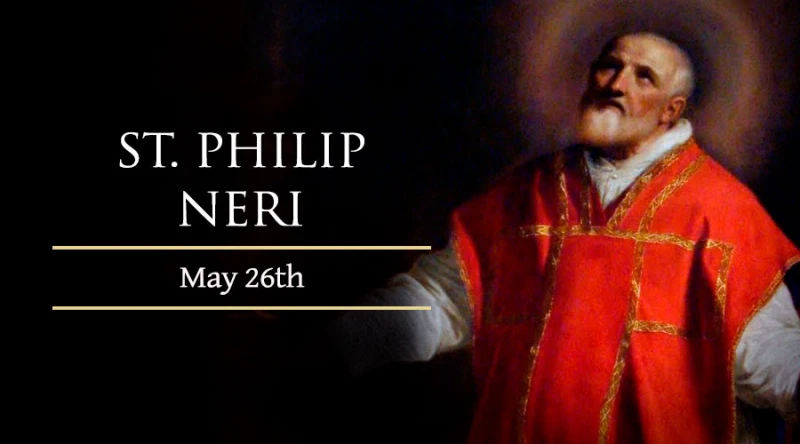
St. Philip Neri


St. Philip Neri

Feast date: May 26

Philip Neri was born in Florence, Italy, in 1515. At the age of 18, Philip was sent to his uncle, Romolo, a wealthy merchant at San Germano, a Neapolitan town near the base of Monte Cassino, to assist him in his business, and with the hope that he might inherit his uncle’s fortune. He gained Romolo’s confidence and affection, but soon after coming to San Germano Philip had a religious conversion. From then onward, he no longer cared for things of the world, and decided in 1533 to live in Rome.

While in Rome, he studied philosphy and theology, and tutored young boys. Eventually Philip became bored of learning, so he sold all of his books, gave the money he received from them to the poor, and visited the sick under the guidance of the Augustinians.

Later, he co-founded the Confraternity of the Most Holy Trinity and began to preach, and many people converted thanks to Philip’s preaching and example. He was ordained in 1551.

Many people came to him for confession. He also began to work with youth. Pope Gregory XIV wanted to make Philip a cardinal, but the priest declined.

He then founded the Congregation of the Oratory, also known as the Oratorians, dedicated to preaching and teaching, and they still exist today.

He died May 27, 1595, and was canonized by Pope Gregory XV in 1622. He is the patron of Rome and the U.S. Army Special Forces.

St. Philip Neri Read More »