Please mind our dust!

We are currently working on revamping our website!
Thank you for your patience!

CRD Solutions

Wednesday of the Sixth Week of Easter

Reading I Acts 17:15, 22—18:1

After Paul’s escorts had taken him to Athens,
they came away with instructions for Silas and Timothy
to join him as soon as possible.

Then Paul stood up at the Areopagus and said:
“You Athenians, I see that in every respect
you are very religious.
For as I walked around looking carefully at your shrines,
I even discovered an altar inscribed, ‘To an Unknown God.’
What therefore you unknowingly worship, I proclaim to you.
The God who made the world and all that is in it,
the Lord of heaven and earth,
does not dwell in sanctuaries made by human hands,
nor is he served by human hands because he needs anything.
Rather it is he who gives to everyone life and breath and everything.
He made from one the whole human race
to dwell on the entire surface of the earth,
and he fixed the ordered seasons and the boundaries of their regions,
so that people might seek God,
even perhaps grope for him and find him,
though indeed he is not far from any one of us.
For ‘In him we live and move and have our being,’
as even some of your poets have said,
‘For we too are his offspring.’
Since therefore we are the offspring of God,
we ought not to think that the divinity is like an image
fashioned from gold, silver, or stone by human art and imagination.
God has overlooked the times of ignorance,
but now he demands that all people everywhere repent
because he has established a day on which he will ‘judge the world
with justice’ through a man he has appointed,
and he has provided confirmation for all
by raising him from the dead.”

When they heard about resurrection of the dead,
some began to scoff, but others said,
“We should like to hear you on this some other time.”
And so Paul left them.
But some did join him, and became believers.
Among them were Dionysius,
a member of the Court of the Areopagus,
a woman named Damaris, and others with them.

After this he left Athens and went to Corinth.
 

Responsorial Psalm 148:1-2, 11-12, 13, 14

R.        Heaven and earth are full of your glory.
or:
R.        Alleluia.
Praise the LORD from the heavens;
            praise him in the heights.
Praise him, all you his angels;
            praise him, all you his hosts.
R.        Heaven and earth are full of your glory.
or:
R.        Alleluia.
Let the kings of the earth and all peoples,
            the princes and all the judges of the earth,
Young men too, and maidens,
            old men and boys.
R.        Heaven and earth are full of your glory.
or:
R.        Alleluia.
Praise the name of the LORD,
            for his name alone is exalted;
His majesty is above earth and heaven.
R.        Heaven and earth are full of your glory.
or:
R.        Alleluia.
He has lifted up the horn of his people;
Be this his praise from all his faithful ones,
            from the children of Israel, the people close to him.
            Alleluia.
R.        Heaven and earth are full of your glory.
or:
R.        Alleluia.

Alleluia Jn 14:16

R. Alleluia, alleluia.
I will ask the Father
and he will give you another Advocate
to be with you always.

R. Alleluia, alleluia.

Gospel Jn 16:12-15

Jesus said to his disciples:
“I have much more to tell you, but you cannot bear it now.
But when he comes, the Spirit of truth,
he will guide you to all truth.
He will not speak on his own,
but he will speak what he hears,
and will declare to you the things that are coming.
He will glorify me,
because he will take from what is mine and declare it to you.
Everything that the Father has is mine;
for this reason I told you that he will take from what is mine
and declare it to you.”

– – –

Lectionary for Mass for Use in the Dioceses of the United States, second typical edition, Copyright © 2001, 1998, 1997, 1986, 1970 Confraternity of Christian Doctrine; Psalm refrain © 1968, 1981, 1997, International Committee on English in the Liturgy, Inc. All rights reserved. Neither this work nor any part of it may be reproduced, distributed, performed or displayed in any medium, including electronic or digital, without permission in writing from the copyright owner.

Wednesday of the Sixth Week of Easter Read More »
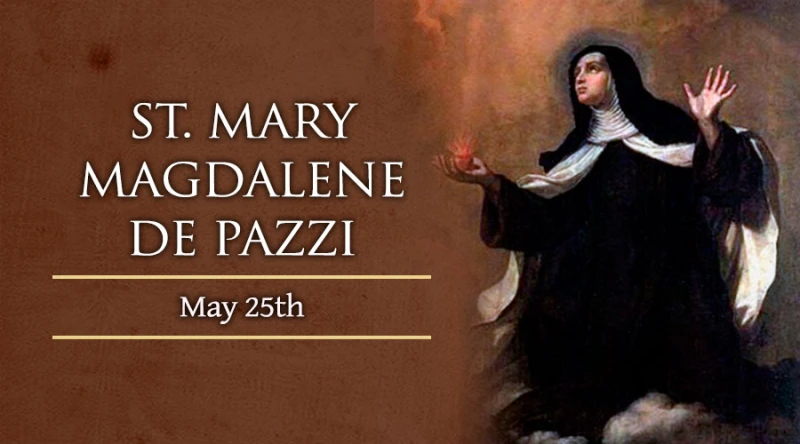
St. Mary Magdalene de Pazzi


St. Mary Magdalene de Pazzi

Feast date: May 25

On May 25, the Catholic Church celebrates Saint Mary Magdalene de Pazzi, an Italian noblewoman of the sixteenth and early seventeenth centuries who became a Carmelite nun distinguished for her intense prayer life and devotion to frequent Holy Communion.

In 2007, Pope Benedict XVI marked the 400th anniversary of St. Mary Magdalene de Pazzi’s death in a letter to the Archbishop of Florence, her birthplace. He described her as “a symbolic figure of a living love that recalls the essential mystical dimension of every Christian life.”

“May the great mystic,” the Pope wrote, “still make her voice heard in all the Church, spreading to every human creature the proclamation to love God.”

Born on April 2, 1566, the future “Mary Magdalene” was given the name of Caterina at the time of her birth. She was the only daughter of her parents, who both came from prominent families. Caterina was drawn to the Holy Eucharist from a young age, and she resolved to serve God as a consecrated virgin shortly after receiving her First Communion at age 10.

Late in the year 1582 she entered a strictly traditional Carmelite monastery, where Holy Communion was – unusually for the time period – administered daily. Receiving her religious habit the next year, she took the name of Mary Magdalene.

From March to May of 1584, Mary became seriously ill and was thought to be in danger of death. On May 27 of that year she made her religious vows while lying sick upon a pallet. Her recovery marked the start of an extended mystical experience, which lasted 40 days and involved extraordinary experiences taken down by her religious sisters in a set of manuscripts.

Mary served the monastery in a series of teaching and supervisory positions, while also contributing to her community through manual work. Her fellow Carmelites respected her strict sense of discipline, which was accompanied by profound charity and practical wisdom. Her experiences of suffering and temptation helped her to guide and inspire others.

Extraordinary spiritual occurrences were a frequent feature of this Carmelite nun’s life, to a much greater degree than is typical in the tradition of Catholic mysticism. Many of her experiences of God were documented by others in her community, although Mary herself disliked the attention and would seemingly have preferred for these events to remain private.

She did wish, however, to call attention to God’s love, which she saw as tragically underappreciated and unreciprocated by mankind. Mary Magdalene de Pazzi is remembered for making dramatic gestures – running through the halls of her monastery, or ringing its bells at night – while proclaiming the urgent need for all people to awaken to God’s love, and respond in kind.

Her earthly life came to an end on May 25, 1607, after an excruciating illness lasting nearly three years. Pope Clement IX canonized St. Mary Magdalene de Pazzi in 1669.

St. Mary Magdalene de Pazzi Read More »

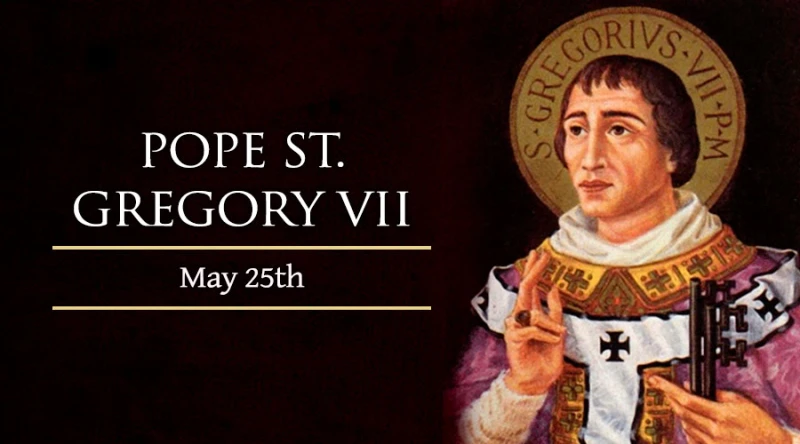
Pope St. Gregory VII


Pope St. Gregory VII

Feast date: May 25

On May 25 the Catholic Church celebrates Pope St. Gregory VII, who sought to reform the Church and secure its freedom against the intrusion of civil rulers during his 11th century pontificate.

Born in the Italian region of Tuscany sometime between 1020 and 1025, the future Pope Gregory VII was originally named Hildebrand. His father Bonzio is thought to have been a carpenter or peasant farmer, while his mother’s name is unknown. His uncle Laurentius was abbot of a monastery in Rome.

Sent to the school run by his uncle’s monastery, Hildebrand entered a world of discipline and fervent devotion. After his primary education, he entered religious life as a monk. Hildebrand served as chaplain to his mentor John Gratian who had a brief and turbulent reign as Pope Gregory VI.

In 1046 Hildebrand left Rome for Cologne along with Gratian, who was forced to leave Rome and resign from the Papacy. After the former Pope’s death in 1047, Hildebrand left for France and spent more than a year in the monastery at Cluny.

During 1049 he made the acquaintance of Bruno of Toul, who would soon become Pope Leo IX. Under his reign, Hildebrand was put in charge of a historic monastery, which he rescued from structural and administrative ruin through a series of reforms.

Hildebrand served Leo IX as an adviser and legate until the Pope’s death in 1054. While others considered him a possible successor to Leo, Hildebrand did not wish to be elected, though he continued his work as an influential and respected cardinal during several subsequent pontificates.

In April 1073, Hildebrand was finally elected as Pope Gregory VII. Though he still did not want the office, his electors praised him as “a devout man … mighty in human and divine knowledge, a distinguished lover of equity and justice, a man firm in adversity and temperate in prosperity.”

Overwhelming challenges confronted the new Pope – including scandalous corruption among the clergy, a hardening schism between the churches of Rome and Constantinople, and a struggle against civil rulers who claimed a right to choose the Church’s clergy and control its properties.

In March of 1074 Gregory promulgated a sweeping set of reforming decrees. These met with widespread opposition, but the Pope stood his ground. The resulting standoff pitted him against the German Emperor Henry IV, who sought to depose the Pope when threatened with excommunication.

The Pope carried out his threat and declared that the emperor’s subjects were no longer bound to obey him as their ruler. The emperor was forced, in 1077, to come before the Pope as a penitent, spending three days waiting in the snow before he was received and given the conditions of his reconciliation.

Though temporarily reconciled, Henry was excommunicated for later attacks, which included supporting a rival Pope and invading Rome. Gregory never gave up his pontificate, but was forced to flee the city in 1084.

“I have loved justice and hated iniquity, therefore I die in exile,” he proclaimed, just before his death in Salerno on May 25, 1085. Remembered as a champion of the Church’s freedom against state intrusion, St. Gregory VII was canonized by Benedict XIII in 1728. 

Pope St. Gregory VII Read More »

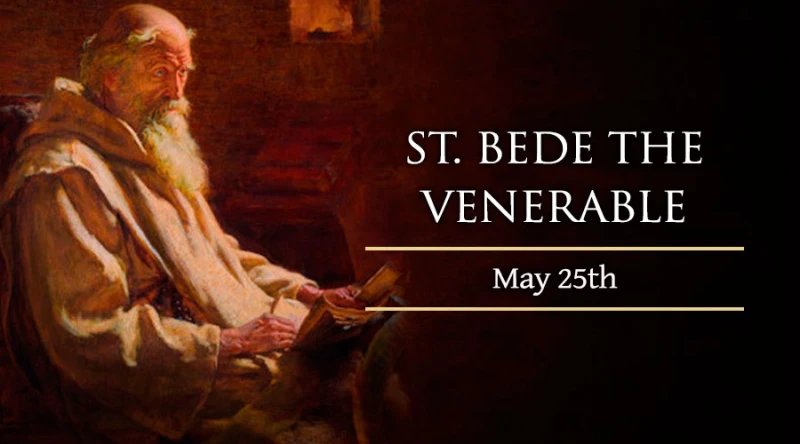
St. Bede the Venerable


St. Bede the Venerable

Feast date: May 25

The Catholic Church will celebrate the feast of St. Bede on May 25. The English priest, monk, and scholar is sometimes known as “the Venerable Bede” for his combination of personal holiness and intellectual brilliance.

Bede was born during 673 near the English town of Jarrow. His parents sent him at a young age to study at a monastery founded by a Benedictine abbot who would later be canonized in his own right as St. Benedict Biscop. The abbot’s extensive library may have sparked an early curiosity in the boy, who would grow up to be a voracious reader and prolific writer.

Later, Bede returned to Jarrow and continued his studies with an abbot named Ceolfrid, who was a companion of St. Benedict Biscop. The abbot and a group of other monks instructed Bede not only in scripture and theology, but also in sacred music, poetry and the Greek language.

Bede’s tutors could see that his life demonstrated a remarkable devotion to prayer and study, and Ceolfrid made the decision to have him ordained a deacon when he was 19. Another Benedictine monk and future saint, the bishop John of Beverley, ordained Bede in 691.

He studied for 11 more years before entering the priesthood at the age of 30, around the beginning of the eighth century. Afterward, Bede took on the responsibility of celebrating daily Mass for the members of his Benedictine community, while also working on farming, baking, and other works of the monastery.

As a monk, Bede gave absolute priority to prayer, fasting and charitable hospitality. He regarded all other works as valueless without the love of God and one’s neighbor. However, Bede also possessed astounding intellectual gifts, which he used to survey and master a wide range of subjects according to an all-encompassing vision of Christian scholarship.

Bede declined a request to become abbot of his monastery. Instead, he concentrated on writing, and produced more than 45 books –  primarily about theology and the Bible, but also on science, literature, and history. He also taught hundreds of students at the monastery and its school, which became renowned throughout Britain.

During Bede’s own lifetime, his spiritual and intellectual gifts garnered wide recognition. His writings on scripture were considered so authoritative that a Church council ordered them to be publicly read in English churches. Some of the most illustrious members of English society made pilgrimages to his monastery to seek his guidance, and he was personally invited to Rome by Pope Sergius.

Bede, however, was unfazed by these honors. Perhaps inspired by the Benedictine monastic ethos, which emphasizes one’s absolute commitment to the monastic community, he chose not to visit Rome, or to travel any significant distance beyond the Monastery of Sts. Peter and Paul in Jarrow, during his entire adult life.

Instead, the world came to him – through the visitors he received, according to the Benedictine tradition of hospitality, and through his voluminous reading. And Bede, in turn, reached the world without leaving his monastery, writing books that were copied with reverence for centuries and still read today. He is one of the last Western Christian writers to be numbered among the Church Fathers.

But Bede understood that love, rather than learning, was his life’s purpose. “It is better,” he famously said, “to be a stupid and uneducated brother who, working at the good things he knows, merits life in heaven, than to be one who –  though being distinguished for his learning in the Scriptures, or even holding the place of a teacher – lacks the bread of love.”

Bede died on the vigil of the feast of the Ascension of Christ in 735, shortly after finishing an Anglo-Saxon translation of the Gospel of John. Pope Leo XIII declared him a Doctor of the Church in 1899.


St. Bede the Venerable Read More »

Tuesday of the Sixth Week of Easter

Reading I Acts 16:22-34

The crowd in Philippi joined in the attack on Paul and Silas,
and the magistrates had them stripped
and ordered them to be beaten with rods.
After inflicting many blows on them,
they threw them into prison
and instructed the jailer to guard them securely.
When he received these instructions, he put them in the innermost cell
and secured their feet to a stake.

About midnight, while Paul and Silas were praying
and singing hymns to God as the prisoners listened,
there was suddenly such a severe earthquake
that the foundations of the jail shook;
all the doors flew open, and the chains of all were pulled loose.
When the jailer woke up and saw the prison doors wide open,
he drew his sword and was about to kill himself,
thinking that the prisoners had escaped.
But Paul shouted out in a loud voice,
“Do no harm to yourself; we are all here.”
He asked for a light and rushed in and,
trembling with fear, he fell down before Paul and Silas.
Then he brought them out and said,
“Sirs, what must I do to be saved?”
And they said, “Believe in the Lord Jesus
and you and your household will be saved.”
So they spoke the word of the Lord to him and to everyone in his house.
He took them in at that hour of the night and bathed their wounds;
then he and all his family were baptized at once.
He brought them up into his house and provided a meal
and with his household rejoiced at having come to faith in God.

Responsorial Psalm 138:1-2ab, 2cde-3, 7c-8

R.        (7c)  Your right hand saves me, O Lord.
or:
R.        Alleluia.
I will give thanks to you, O LORD, with all my heart,
            for you have heard the words of my mouth;
            in the presence of the angels I will sing your praise;
I will worship at your holy temple,
            and give thanks to your name.
R.        Your right hand saves me, O Lord.
or:
R.        Alleluia.
Because of your kindness and your truth,
            you have made great above all things
            your name and your promise.
When I called, you answered me;
            you built up strength within me.
R.        Your right hand saves me, O Lord.
or:
R.        Alleluia.
Your right hand saves me.
The LORD will complete what he has done for me;
            your kindness, O LORD, endures forever;
            forsake not the work of your hands.
R.        Your right hand saves me, O Lord.
or:
R.        Alleluia.

Alleluia See Jn 16:7, 13

R. Alleluia, alleluia.
I will send to you the Spirit of truth, says the Lord;
he will guide you to all truth.

R. Alleluia, alleluia.

Gospel Jn 16:5-11

Jesus said to his disciples:
“Now I am going to the one who sent me,
and not one of you asks me, ‘Where are you going?’
But because I told you this, grief has filled your hearts.
But I tell you the truth, it is better for you that I go.
For if I do not go, the Advocate will not come to you.
But if I go, I will send him to you.
And when he comes he will convict the world
in regard to sin and righteousness and condemnation:
sin, because they do not believe in me;
righteousness, because I am going to the Father
and you will no longer see me;
condemnation, because the ruler of this world has been condemned.”

– – –

Lectionary for Mass for Use in the Dioceses of the United States, second typical edition, Copyright © 2001, 1998, 1997, 1986, 1970 Confraternity of Christian Doctrine; Psalm refrain © 1968, 1981, 1997, International Committee on English in the Liturgy, Inc. All rights reserved. Neither this work nor any part of it may be reproduced, distributed, performed or displayed in any medium, including electronic or digital, without permission in writing from the copyright owner.

Tuesday of the Sixth Week of Easter Read More »