Please mind our dust!

We are currently working on revamping our website!
Thank you for your patience!

CRD Solutions

Sts. Donatian and Rogatian
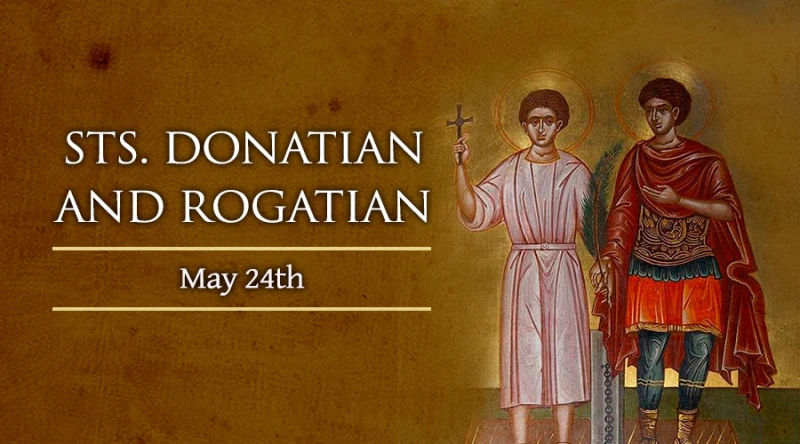

Sts. Donatian and Rogatian

Feast date: May 24

Donatian and Rogatian were brothers who were martyred for their faith in the third century.

Donatian was the first to convert to Christianity, becoming an ardent witness to the faith after receiving baptism.  His witness was said to be so inspiring that his brother, Rogatian, who had been indifferent at first, was moved by his example to convert.

However, the persecution of Diocletian was heavily underway at this time.

Both of the brothers were arrested before the bishop was able to baptize Rogatian. The brothers spent the night in jail together in prayer. The next day, after refusing to deny their faith, they were tortured on the rack, and then beheaded. Thus the baptism of Rogatian was a baptism of desire, that is, by the blood of martyrdom.

In the fifth century a church was built over the tomb where they were buried together. In 1145, the bishop transferred their relics to the Cathedral of Ostia.

Sts. Donatian and Rogatian Read More »
Feast of the Ascension


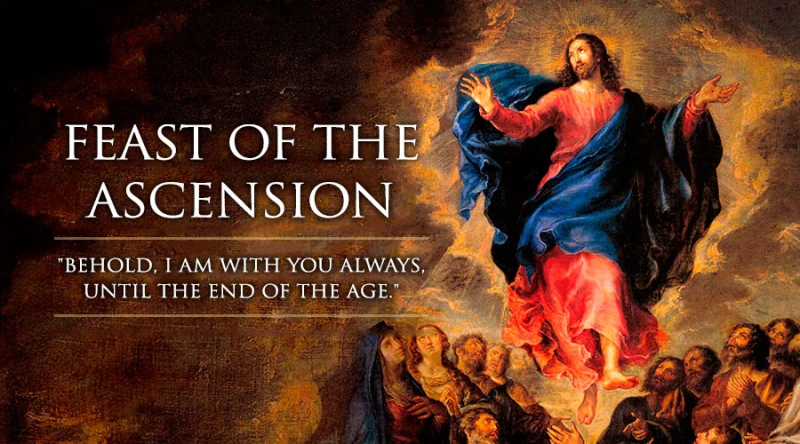
Feast of the Ascension

Feast date: May 24

The Feast of the Ascension is the fortieth day after Easter Sunday, which commemorates the Ascension of Christ into heaven, according to Mark 16:19, Luke 24:51, and Acts 1:2.

In the Eastern Church this feast was known as analepsis, “the taking up”, and also as the episozomene, the salvation, denoting that by ascending into His glory, Christ completed the work of our redemption. The terms used in the West, ascensio and, occasionally, ascensa, signify that Christ was raised up by His own powers. Tradition designates Mount Olivet near Bethany as the place where Christ left the earth. The feast falls on Thursday. It is one of the Ecumenical feasts ranking with the feasts of the Passion, of Easter and of Pentecost among the most solemn in the calendar. The feast has a vigil and, since the fifteenth century, an octave which is set apart for a novena of preparation for Pentecost, in accordance with the directions of Leo XIII.

Feast of the Ascension Read More »

Monday of the Sixth Week of Easter

Reading I Acts 16:11-15

We set sail from Troas, making a straight run for Samothrace,
and on the next day to Neapolis, and from there to Philippi,
a leading city in that district of Macedonia and a Roman colony.
We spent some time in that city.
On the sabbath we went outside the city gate along the river
where we thought there would be a place of prayer.
We sat and spoke with the women who had gathered there.
One of them, a woman named Lydia, a dealer in purple cloth,
from the city of Thyatira, a worshiper of God, listened,
and the Lord opened her heart to pay attention
to what Paul was saying.
After she and her household had been baptized,
she offered us an invitation,
“If you consider me a believer in the Lord,
come and stay at my home,” and she prevailed on us.

Responsorial Psalm 149:1b-2, 3-4, 5-6a and 9b

R.        (see 4a)  The Lord takes delight in his people.
or:
R.        Alleluia.
Sing to the LORD a new song
            of praise in the assembly of the faithful.
Let Israel be glad in their maker,
            let the children of Zion rejoice in their king.
R.        The Lord takes delight in his people.
or:
R.        Alleluia.
Let them praise his name in the festive dance,
            let them sing praise to him with timbrel and harp.
For the LORD loves his people,
            and he adorns the lowly with victory.
R.        The Lord takes delight in his people.
or:
R.        Alleluia.
Let the faithful exult in glory;
            let them sing for joy upon their couches.
Let the high praises of God be in their throats.
            This is the glory of all his faithful. Alleluia.
R.        The Lord takes delight in his people.
or:
R.        Alleluia.

Alleluia Jn 15:26b, 27a

R. Alleluia, alleluia.
The Spirit of truth will testify to me, says the Lord,
and you also will testify.

R. Alleluia, alleluia.

Gospel Jn 15:26—16:4a

Jesus said to his disciples:
“When the Advocate comes whom I will send you from the Father,
the Spirit of truth who proceeds from the Father,
he will testify to me.
And you also testify,
because you have been with me from the beginning.

“I have told you this so that you may not fall away.
They will expel you from the synagogues;
in fact, the hour is coming when everyone who kills you
will think he is offering worship to God.
They will do this because they have not known either the Father or me.
I have told you this so that when their hour comes
you may remember that I told you.”

– – –

Lectionary for Mass for Use in the Dioceses of the United States, second typical edition, Copyright © 2001, 1998, 1997, 1986, 1970 Confraternity of Christian Doctrine; Psalm refrain © 1968, 1981, 1997, International Committee on English in the Liturgy, Inc. All rights reserved. Neither this work nor any part of it may be reproduced, distributed, performed or displayed in any medium, including electronic or digital, without permission in writing from the copyright owner.

Monday of the Sixth Week of Easter Read More »

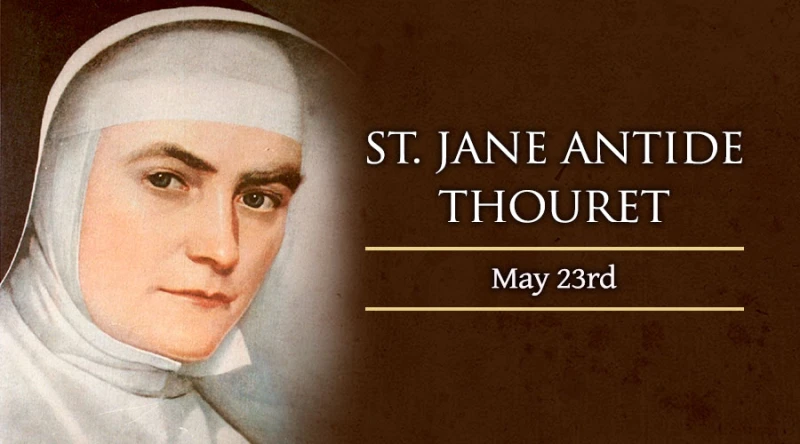
St. Jane Antide Thouret


St. Jane Antide Thouret

Feast date: May 23

On May 23 the universal Church celebrates the feast day of St. Jane Antide (Jeanne-Antide) Thouret, a Sister of Charity who worked tirelessly for the faith amidst persecution during the French Revolution.

Jane was born in Sancey, France, in 1765 to a poor family. Her mother died when she was 16 years old. The Saint took on many family responsibilities until she joined the Vincentian Sisters in Paris at the age of 22, working among the sick in various hospitals.

On 15 August 1797 she returned to France in Besançon where she founded a school for poor girls. On 11 April 1799 she founded a new congregation in Besançon known as the Thouret sisters.

During the French Revolution, when many religious and priests were killed, she was ordered to return home to a secular life. Jane refused, and when she tried to escape the authorities, she was badly beaten.

St. Jane Antide Thouret finally returned to Sancey, where she cared for the sick and opened a small school for girls until she was forced to flee to Switzerland. She fled to Germany before returning again to Switzerland to found a school and hospital in 1799 and a congregation called the Institute of the Daughters of St. Vincent de Paul. The community eventually expanded into France and Italy.

She died 30 years after the founding of her community, in 1828 of natural causes.

In 1934, she was canonized by Pope Puis XI.

St. Jane Antide Thouret Read More »

St. Euphrosyne of Polatsk

Feast date: May 23

St. Euphrosyne was born in Polacak, Belorussia, in 1110, and died 1173.

Pradslava, the only East Slav virgin saint, was the granddaughter of Prince Polacak Usiaslau, from whom she inherited a strong will and a determined spirit. As proof of this and of her determination to devote her life to God, she refused all marriage proposals and, finally ran away to join her aunt’s convent, Holy Wisdom. There she took the veil and the name Euphrosyne, and the money Euphrosyne earned by copying books, she distributed to the poor.

Later she founded and ruled her own convent, Holy Savior, as well as a monastery. In trying to convince her father, Prince Sviataslau, to allow her sister Hardzislava join her at the convent, she argued that in joining,. Hardzislava would learn to read and write. She was also joined there by two nieces and a cousin.

Euphrosyne commissioned the making of a beautiful, gem-studded cross, which she gave to Holy Savior Church in 1161. It disappeared without a trace during World War II. Late in life, Euphrosyne made a pilgrimage to the Holy Land, where she died. After the conquest of Jerusalem by Saladin in 1187, her relics were transferred to the Monastery of the Caves in Kiev, Ukraine.

In 1910, they were returned to Polacak (Nadson).

St. Euphrosyne of Polatsk Read More »