Please mind our dust!

We are currently working on revamping our website!
Thank you for your patience!

CRD Solutions

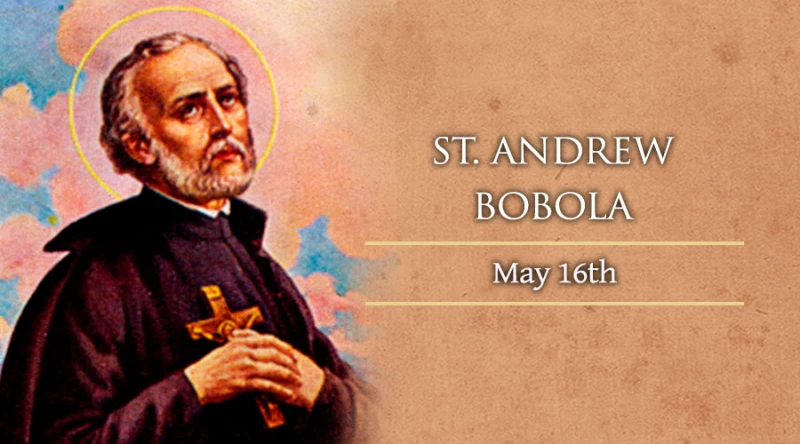
St. Andrew Bobola


St. Andrew Bobola

Feast date: May 16

Andrew Bobola is a Polish-born martyr. He was born in Sandormir, Poland, in 1591 to a noble family. He was ordained a Jesuit in 1622 and three years later became a parish priest in Vilna, Lithuania, the town in which he had studied. He also served as superior of the Jesuit community for a time. He worked extensively with the sick and made and even stronger efforts to help them during a plague outbreak, but he is best known as a successful missionary to the Orthodox. He did this for almost 20 years, preaching along the roads and converting whole villages to Catholicism.

However, he was captured after Mass on May 10, 1657 by the Cossacks and brutally tortured. Six days later, he died a martyr, refusing to denounce his Catholic faith.

His tomb was opened in 1719 and his body was found incorrupt. He is now entombed in a Jesuit church in Krakow, Poland.

He was canonized by Pope Pius XI in 1938.

St. Andrew Bobola Read More »

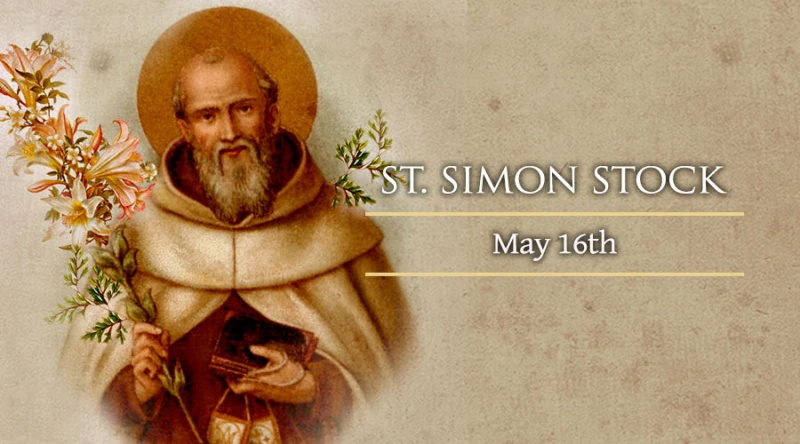
St. Simon Stock


St. Simon Stock

Feast date: May 16

On May 16, the Catholic Church remembers Saint Simon Stock, a twelfth- and thirteenth-century Carmelite monk whose vision of the Virgin Mary is the source of the Brown Scapular devotion.

Simon was born during 1165 in the English county of Kent. He is said to have been strongly devoted to God from his youth, to the point that he left home at age 12 to live in the forest as a hermit. Following the customs of the earliest monks, he lived on fruit and water and spent his time in prayer and meditation.

After two decades of solitary life in the wilderness, he returned to society to acquire an education in theology and become a priest. Afterwards, he returned to his hermitage until the year 1212, when his calling to join the Carmelite Order – which had only recently entered England – was revealed to him.

During the early 13th century, a group of monks in the Holy Land sought formal recognition as a religious order. Their origins were mysterious, and by some accounts extended back to the time before Christ, originating in the ministry of the Biblical Prophet Elijah.

The Carmelites’ ascetic, contemplative lifestyle was combined with ardent devotion to the Blessed Virgin Mary. It is she who is said to have appeared to Simon Stock, telling him to leave his hermitage and join the order that would soon be arriving with the return of two English Crusaders.

Impressed by the Carmelites’ rigorous monasticism, Simon joined in 1212 and was sent to complete a course of studies at Oxford. Not long after his return to the order, he was appointed its vicar general in 1215. He defended the Carmelites in a dispute over their legitimacy, later resolved by the Popes.

In 1237, Simon took part in a general chapter of the Carmelites in the Holy Land. Facing persecution from Muslims, a majority of the monks there decided to make their home in Europe – including Simon’s native England, where the order would go on to prosper for several centuries

After becoming the general superior of the Carmelites in 1247, Simon worked to establish the order in many of Europe’s centers of learning, including Cambridge, Oxford, and Paris.

Late in his life, Simon Stock reportedly received a private revelation about the Brown Scapular, a monastic garment worn by Carmelites.

“To him,” an early chronicle states, “appeared the Blessed Virgin with a multitude of angels, holding the Scapular of the Order in her blessed hands, and saying: ‘This will be a privilege for you and for all Carmelites, that he who dies in this will not suffer eternal fire.’”

This vision was the source of the Brown Scapular devotion – a tradition which involves the wearing of an adapted version of the garment, along with certain spiritual commitments, by lay Catholics as well as priests and religious.

St. Simon Stock died in France in 1265, 100 years after his birth. He has been publicly venerated since the 15th century.

St. Simon Stock Read More »

Fifth Sunday of Easter

Reading I Acts 14:21-27

After Paul and Barnabas had proclaimed the good news
to that city
and made a considerable number of disciples,
they returned to Lystra and to Iconium and to Antioch.
They strengthened the spirits of the disciples
and exhorted them to persevere in the faith, saying,
“It is necessary for us to undergo many hardships
to enter the kingdom of God.”
They appointed elders for them in each church and,
with prayer and fasting, commended them to the Lord
in whom they had put their faith.
Then they traveled through Pisidia and reached Pamphylia.
After proclaiming the word at Perga they went down to Attalia.
From there they sailed to Antioch,
where they had been commended to the grace of God
for the work they had now accomplished.
And when they arrived, they called the church together
and reported what God had done with them
and how he had opened the door of faith to the Gentiles.

Responsorial Psalm Ps 145:8-9, 10-11, 12-13

R (cf. 1) I will praise your name for ever, my king and my God.
or:
R Alleluia.
The LORD is gracious and merciful,
            slow to anger and of great kindness.
The LORD is good to all
            and compassionate toward all his works.
R I will praise your name for ever, my king and my God.
or:
R Alleluia.
Let all your works give you thanks, O LORD,
            and let your faithful ones bless you.
Let them discourse of the glory of your kingdom
            and speak of your might.
R I will praise your name for ever, my king and my God.
or:
R Alleluia.
Let them make known your might to the children of Adam,
            and the glorious splendor of your kingdom.
Your kingdom is a kingdom for all ages,
            and your dominion endures through all generations.
R I will praise your name for ever, my king and my God.
or:
R Alleluia.

Reading II Rev 21:1-5a

Then I, John, saw a new heaven and a new earth.
The former heaven and the former earth had passed away,
and the sea was no more.
I also saw the holy city, a new Jerusalem,
coming down out of heaven from God,
prepared as a bride adorned for her husband.
I heard a loud voice from the throne saying,
“Behold, God’s dwelling is with the human race.
He will dwell with them and they will be his people
and God himself will always be with them as their God.
He will wipe every tear from their eyes,
and there shall be no more death or mourning, wailing or pain,
for the old order has passed away.”

The One who sat on the throne said,
“Behold, I make all things new.”
 

Alleluia Jn 13:34

R. Alleluia, alleluia.
I give you a new commandment, says the Lord:
love one another as I have loved you.

R. Alleluia, alleluia.

Gospel Jn 13:31-33a, 34-35

When Judas had left them, Jesus said,
“Now is the Son of Man glorified, and God is glorified in him.
If God is glorified in him,
God will also glorify him in himself,
and God will glorify him at once.
My children, I will be with you only a little while longer.
I give you a new commandment: love one another.
As I have loved you, so you also should love one another.
This is how all will know that you are my disciples,
if you have love for one another.”


– – –

Lectionary for Mass for Use in the Dioceses of the United States, second typical edition, Copyright © 2001, 1998, 1997, 1986, 1970 Confraternity of Christian Doctrine; Psalm refrain © 1968, 1981, 1997, International Committee on English in the Liturgy, Inc. All rights reserved. Neither this work nor any part of it may be reproduced, distributed, performed or displayed in any medium, including electronic or digital, without permission in writing from the copyright owner.

Fifth Sunday of Easter Read More »

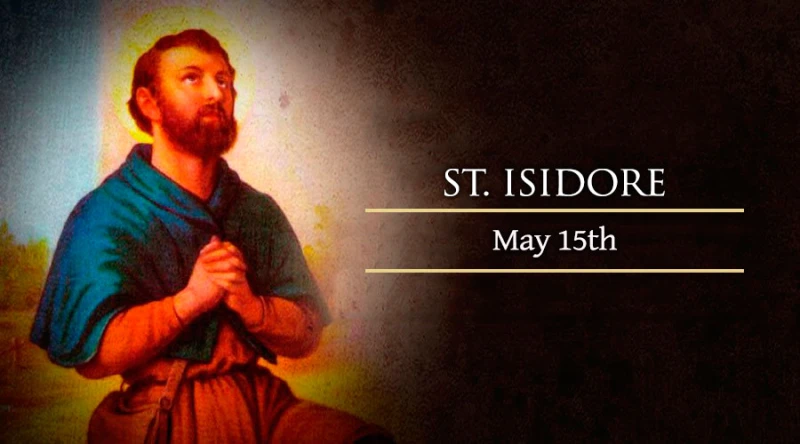
St. Isidore


St. Isidore

Feast date: May 15

Isidore was born in 1070 in Madrid, Spain. His family was poor, and he labored as a farmer on the land owned by a rich man named John de Vergas. He was very pious and such a good worker that de Vergas allowed him to worship daily in the chapel on his property, and because of thes he was often accused by his fellow workers of neglecting his duties because he made prayer a higher priority.

Isidore eventually married a woman named Mary, and together they had a son. However their son died while still very young, and through this they realized that it was the will of God for them not have children, so they lived together chastely the rest of their lives, doing good works.

Although he remained poor, he gave whatever he could spare to the poor. One tale says that as he walked to the mill one day, he stopped and gave half of the corn in his sack to the hungry birds. By the time he got to the mill, his sack had miraculously filled up again. He died in 1130 of natural causes.

Many miracles and cures have been reported at his grave, in which his body remains incorruptible. His wife, too, was canonized—Saint Mary de la Cabeza.

He is the patron saint of agricultural workers and the United States National Rural Life Conference.

St. Isidore Read More »

Feast of Saint Matthias, Apostle

Reading I Acts 1:15-17, 20-26

Peter stood up in the midst of the brothers and sisters
(there was a group of about one hundred and twenty persons
in the one place).
He said, “My brothers and sisters,
the Scripture had to be fulfilled
which the Holy Spirit spoke beforehand
through the mouth of David, concerning Judas,
who was the guide for those who arrested Jesus.
Judas was numbered among us
and was allotted a share in this ministry.
For it is written in the Book of Psalms:
            Let his encampment become desolate,
                        and may no one dwell in it.
and:
            May another take his office.

Therefore, it is necessary that one of the men
who accompanied us the whole time
the Lord Jesus came and went among us,
beginning from the baptism of John
until the day on which he was taken up from us,
become with us a witness to his resurrection.”
So they proposed two, Joseph called Barsabbas,
who was also known as Justus, and Matthias.
Then they prayed,
“You, Lord, who know the hearts of all,
show which one of these two you have chosen
to take the place in this apostolic ministry
from which Judas turned away to go to his own place.”
Then they gave lots to them, and the lot fell upon Matthias,
and he was counted with the Eleven Apostles.

Responsorial Psalm 113:1-2, 3-4, 5-6, 7-8

R.        (8)  The Lord will give him a seat with the leaders of his people.
or:
R.        Alleluia.
Praise, you servants of the LORD,
            praise the name of the LORD.
Blessed be the name of the LORD
            both now and forever.
R.        The Lord will give him a seat with the leaders of his people.
or:
R.        Alleluia.
From the rising to the setting of the sun
            is the name of the LORD to be praised.
High above all nations is the LORD;
            above the heavens is his glory.
R.        The Lord will give him a seat with the leaders of his people.
or:
R.        Alleluia.
Who is like the LORD, our God, who is enthroned on high
            and looks upon the heavens and the earth below?
R.        The Lord will give him a seat with the leaders of his people.
or:
R.        Alleluia.
He raises up the lowly from the dust;
            from the dunghill he lifts up the poor
To seat them with princes,
            with the princes of his own people.
R.        The Lord will give him a seat with the leaders of his people.
or:
R.        Alleluia.

Alleluia See Jn 15:16

R. Alleluia, alleluia.
I chose you from the world,
to go and bear fruit that will last, says the Lord.

R. Alleluia, alleluia.

Gospel Jn 15:9-17

Jesus said to his disciples:
“As the Father loves me, so I also love you.
Remain in my love.
If you keep my commandments, you will remain in my love,
just as I have kept my Father’s commandments
and remain in his love.

“I have told you this so that my joy might be in you
and your joy might be complete.
This is my commandment: love one another as I love you.
No one has greater love than this,
to lay down one’s life for one’s friends.
You are my friends if you do what I command you.
I no longer call you slaves,
because a slave does not know what his master is doing.
I have called you friends,
because I have told you everything I have heard from my Father.
It was not you who chose me, but I who chose you
and appointed you to go and bear fruit that will remain,
so that whatever you ask the Father in my name he may give you.
This I command you:  love one another.”


– – –

Lectionary for Mass for Use in the Dioceses of the United States, second typical edition, Copyright © 2001, 1998, 1997, 1986, 1970 Confraternity of Christian Doctrine; Psalm refrain © 1968, 1981, 1997, International Committee on English in the Liturgy, Inc. All rights reserved. Neither this work nor any part of it may be reproduced, distributed, performed or displayed in any medium, including electronic or digital, without permission in writing from the copyright owner.

Feast of Saint Matthias, Apostle Read More »