Please mind our dust!

We are currently working on revamping our website!
Thank you for your patience!

CRD Solutions

St. Matthias, Apostle


St. Matthias, Apostle

Feast date: May 14

Matthias, whose name means “gift of God”,  was the disciple chosen to replace Judas as one of the twelve Apostles. The Acts of the Apostles state that he was also one of the 72 disciples that the Lord Jesus sent out to preach the good news. Matthias was with the Lord since His Baptism, and was “a witness to Christ’s Resurrection,” according to St. Peter in Acts. He remained with Jesus until His Ascension.

According to various traditions, Matthias preached in Cappadocia, Jerusalem, the shores of the Caspian Sea (in modern day Turkey) and Ethiopia.  He is said to have met his death by crucifixion in Colchis or by stoning in Jerusalem.

There is evidence cited in some of the early Church fathers that there was a Gospel according to Matthias in circulation, but it has since been lost, and was declared apocryphal by Pope Gelasius.

He is invoked for assistance against alcoholism, and for support by recovered alcoholics.

St. Matthias, Apostle Read More »

Friday of the Fourth Week of Easter

Reading I Acts 13:26-33

When Paul came to Antioch in Pisidia, he said in the synagogue:
 “My brothers, children of the family of Abraham,
and those others among you who are God-fearing,
to us this word of salvation has been sent.
The inhabitants of Jerusalem and their leaders failed to recognize him,
and by condemning him they fulfilled the oracles of the prophets
that are read sabbath after sabbath.
For even though they found no grounds for a death sentence,
they asked Pilate to have him put to death,
and when they had accomplished all that was written about him,
they took him down from the tree and placed him in a tomb.
But God raised him from the dead,
and for many days he appeared to those
who had come up with him from Galilee to Jerusalem.
These are now his witnesses before the people.
We ourselves are proclaiming this good news to you
that what God promised our fathers
he has brought to fulfillment for us, their children, by raising up Jesus,
as it is written in the second psalm,
     You are my Son; this day I have begotten you.

Responsorial Psalm 2:6-7, 8-9, 10-11ab

R.        (7bc)  You are my Son; this day I have begotten you.
or:
R.        Alleluia.
“I myself have set up my king
            on Zion, my holy mountain.”
I will proclaim the decree of the LORD:
            The LORD said to me, “You are my Son;
            this day I have begotten you.”
R.        You are my Son; this day I have begotten you.
or:
R.        Alleluia.
“Ask of me and I will give you
            the nations for an inheritance
            and the ends of the earth for your possession.
You shall rule them with an iron rod;
            you shall shatter them like an earthen dish.”
R.        You are my Son; this day I have begotten you.
or:
R.        Alleluia.
And now, O kings, give heed;
            take warning, you rulers of the earth.
Serve the LORD with fear, and rejoice before him;
            with trembling rejoice.
R.        You are my Son; this day I have begotten you.
or:
R.        Alleluia.

Alleluia Jn 14:6

R. Alleluia, alleluia.
I am the way and the truth and the life, says the Lord;
no one comes to the Father except through me.

R. Alleluia, alleluia.

Gospel Jn 14:1-6

Jesus said to his disciples:
“Do not let your hearts be troubled.
You have faith in God; have faith also in me.
In my Father’s house there are many dwelling places.
If there were not,
would I have told you that I am going to prepare a place for you?
And if I go and prepare a place for you,
I will come back again and take you to myself,
so that where I am you also may be.
Where I am going you know the way.”
Thomas said to him,
“Master, we do not know where you are going;
how can we know the way?”
Jesus said to him, “I am the way and the truth and the life.
No one comes to the Father except through me.”


– – –

Lectionary for Mass for Use in the Dioceses of the United States, second typical edition, Copyright © 2001, 1998, 1997, 1986, 1970 Confraternity of Christian Doctrine; Psalm refrain © 1968, 1981, 1997, International Committee on English in the Liturgy, Inc. All rights reserved. Neither this work nor any part of it may be reproduced, distributed, performed or displayed in any medium, including electronic or digital, without permission in writing from the copyright owner.

Friday of the Fourth Week of Easter Read More »

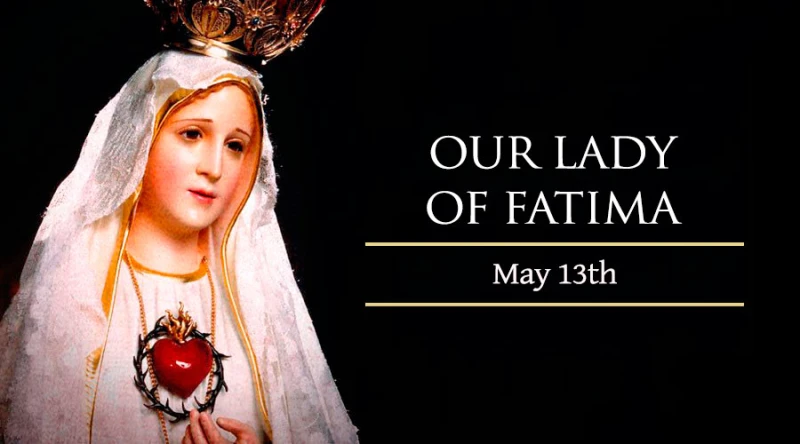
Our Lady of Fatima


Our Lady of Fatima

Feast date: May 13

May 13 is the anniversary of the apparition of Our Lady to three shepherd children in the small village of Fatima in Portugal in 1917.  She appeared six times to Lucia, 9, and her cousins Francisco, 8, and his sister Jacinta, 6, between May 13, 1917 and October 13, 1917.

The story of Fatima begins in 1916, when, against the backdrop of the First World War which had introduced Europe to the most horrific and powerful forms of warfare yet seen, and a year before the Communist revolution would plunge Russia and later Eastern Europe into six decades of oppression under militant atheistic governments, a resplendent figure appeared to the three children who were in the field tending the family sheep. “I am the Angel of Peace,” said the figure, who appeared to them two more times that year exhorting them to accept the sufferings that the Lord allowed them to undergo as an act of reparation for the sins which offend Him, and to pray constantly for the conversion of sinners.

Then, on the 13th day of the month of Our Lady, May 1917, an apparition of ‘a woman all in white, more brilliant than the sun’ presented itself to the three children saying “Please don’t be afraid of me, I’m not going to harm you.” Lucia asked her where she came from and she responded,  “I come from Heaven.”  The woman wore a white mantle edged with gold and held a rosary in her hand. The woman asked them to pray and devote themselves to the Holy Trinity and to “say the Rosary every day, to bring peace to the world and an end to the war.”

She also revealed that the children would suffer, especially from the unbelief of their friends and families, and that the two younger children, Francisco and Jacinta would be taken to Heaven very soon but Lucia would live longer in order to spread her message and devotion to the Immaculate Heart.

In the last apparition the woman revealed her name in response to Lucia’s question:   “I am the Lady of the Rosary.”

That same day, 70,000 people had turned out to witness the apparition, following a promise by the woman that she would show the people that the apparitions were true. They saw the sun make three circles and move around the sky in an incredible zigzag movement in a manner which left no doubt in their minds about the veracity of the apparitions.  By 1930 the Bishop had approved of the apparitions and they have been approved by the Church as authentic.

The messages Our Lady imparted during the apparitions to the children concerned the violent trials that would afflict the world by means of war, starvation, and the persecution of the Church and the Holy Father in the twentieth century if the world did not make reparation for sins. She exhorted the Church to pray and offer sacrifices to God in order that peace may come upon the world, and that the trials may be averted.

Our Lady of Fatima revealed three prophetic “secrets,” the first two of which were revealed earlier and refer to the vision of hell and the souls languishing there, the request for an ardent devotion to the Immaculate Heart of Mary, the prediction of the Second World War, and finally the prediction of the immense damage that Russia would do to humanity by abandoning the Christian faith and embracing Communist totalitarianism.  The third “secret” was not revealed until the year 2000, and referred to the persecutions that humanity would undergo in the last century: “The good will be martyred; the Holy Father will have much to suffer; various nations will be annihilated’”.  The suffering of the popes of the 20th century has been interpreted to include the assassination attempt on Pope John Paul II in 1981, which took place on May 13, the 64th anniversary of the apparitions. The Holy Father attributed his escape from certain death to the intervention of Our Lady: “… it was a mother’s hand that guided the bullet’s path and in his throes the Pope halted at the threshold of death.”

What is the central meaning of the message of Fatima? Nothing different from what the Church has always taught: it is, as Cardinal Ratzinger, now Pope Benedict the XVI,  has put it, “the exhortation to prayer as the path of “salvation for souls” and, likewise, the summons to penance and conversion.”

Perhaps the most well known utterance of the apparition of Our Lady at Fatima was her confident decalaration that  “My Immaculate Heart will triumph”. Cardinal Ratzinger has interpreted this utterance as follows: “The Heart open to God, purified by contemplation of God, is stronger than guns and weapons of every kind. The fiat of Mary, the word of her heart, has changed the history of the world, because it brought the Saviour into the world—because, thanks to her Yes, God could become man in our world and remains so for all time. The Evil One has power in this world, as we see and experience continually; he has power because our freedom continually lets itself be led away from God. But since God himself took a human heart and has thus steered human freedom towards what is good, the freedom to choose evil no longer has the last word. From that time forth, the word that prevails is this: “In the world you will have tribulation, but take heart; I have overcome the world” (Jn 16:33). The message of Fatima invites us to trust in this promise.

Our Lady of Fatima Read More »

Thursday of the Fourth Week of Easter

Reading I Acts 13:13-25

From Paphos, Paul and his companions
set sail and arrived at Perga in Pamphylia.
But John left them and returned to Jerusalem.
They continued on from Perga and reached Antioch in Pisidia.
On the sabbath they entered into the synagogue and took their seats.
After the reading of the law and the prophets,
the synagogue officials sent word to them,
“My brothers, if one of you has a word of exhortation
for the people, please speak.”

So Paul got up, motioned with his hand, and said,
“Fellow children of Israel and you others who are God-fearing, listen.
The God of this people Israel chose our ancestors
and exalted the people during their sojourn in the land of Egypt.
With uplifted arm he led them out,
and for about forty years he put up with them in the desert.
When he had destroyed seven nations in the land of Canaan,
he gave them their land as an inheritance
at the end of about four hundred and fifty years.
After these things he provided judges up to Samuel the prophet.
Then they asked for a king.
God gave them Saul, son of Kish,
a man from the tribe of Benjamin, for forty years.
Then he removed him and raised up David as their king;
of him he testified,
I have found David, son of Jesse, a man after my own heart;
he will carry out my every wish.

From this man’s descendants God, according to his promise,
has brought to Israel a savior, Jesus.
John heralded his coming by proclaiming a baptism of repentance
to all the people of Israel;
and as John was completing his course, he would say,
‘What do you suppose that I am? I am not he.
Behold, one is coming after me;
I am not worthy to unfasten the sandals of his feet.’”
 

Responsorial Psalm 89:2-3, 21-22, 25 and 27

R.        (2)  For ever I will sing the goodness of the Lord.
or:
R.        Alleluia.
The favors of the LORD I will sing forever;
            through all generations my mouth shall proclaim your faithfulness.
For you have said, “My kindness is established forever”;
            in heaven you have confirmed your faithfulness.
R.        For ever I will sing the goodness of the Lord.
or:
R.        Alleluia.
“I have found David, my servant;
            with my holy oil I have anointed him,
That my hand may be always with him,
            and that my arm may make him strong.”
R.        For ever I will sing the goodness of the Lord.
or:
R.        Alleluia.
“My faithfulness and my mercy shall be with him,
            and through my name shall his horn be exalted.
He shall say of me, ‘You are my father,
            my God, the Rock, my savior.’”
R.        For ever I will sing the goodness of the Lord.
or:
R.        Alleluia.


Alleluia See Rv 1:5ab

R. Alleluia, alleluia.
Jesus Christ, you are the faithful witness,
the firstborn of the dead,
you have loved us and freed us from our sins by your Blood.

R. Alleluia, alleluia.

Gospel Jn 13:16-20

When Jesus had washed the disciples’ feet, he said to them:
“Amen, amen, I say to you, no slave is greater than his master
nor any messenger greater than the one who sent him.
If you understand this, blessed are you if you do it.
I am not speaking of all of you.
I know those whom I have chosen.
But so that the Scripture might be fulfilled,
The one who ate my food has raised his heel against me.
From now on I am telling you before it happens,
so that when it happens you may believe that I AM.
Amen, amen, I say to you, whoever receives the one I send
receives me, and whoever receives me receives the one who sent me.”

– – –

Lectionary for Mass for Use in the Dioceses of the United States, second typical edition, Copyright © 2001, 1998, 1997, 1986, 1970 Confraternity of Christian Doctrine; Psalm refrain © 1968, 1981, 1997, International Committee on English in the Liturgy, Inc. All rights reserved. Neither this work nor any part of it may be reproduced, distributed, performed or displayed in any medium, including electronic or digital, without permission in writing from the copyright owner.

Thursday of the Fourth Week of Easter Read More »

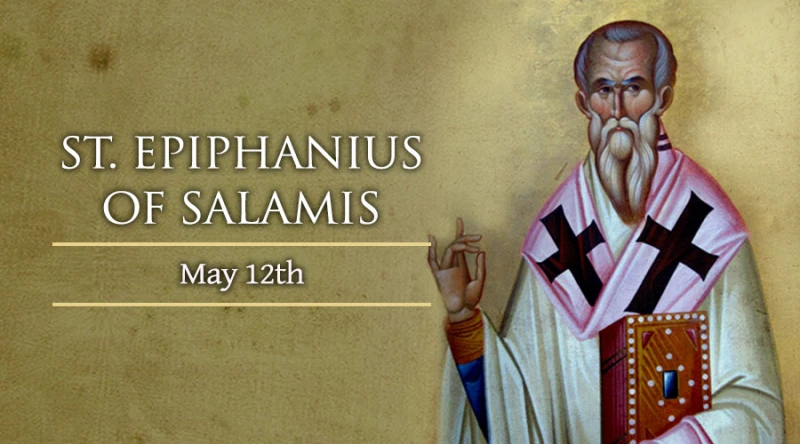
St. Epiphanius of Salamis


St. Epiphanius of Salamis

Feast date: May 12

On May 12 the Catholic Church honors Saint Epiphanius of Salamis, an early monk, bishop and Church Father known for his extensive learning and defense of Catholic teachings in the fourth century.

During a 2007 visit with the Orthodox Archbishop of Cyprus, Pope Benedict XVI praised Epiphanius as “a good pastor” who “pointed out to the flock entrusted to him by Christ, the truth in which to believe, the way to take and the pitfalls to avoid.”

“At the beginning of this third millennium,” the Pope reflected during the visit, “the Church finds herself facing challenges and problems not at all unlike those which Bishop Epiphanius had to tackle.”

Epiphanius was born in Palestine around 310 or 315, the son of Greek-speaking Jewish parents. He is said to have been drawn to the Church after seeing a monk give away his clothing to a person in need. Not long after his conversion, he became a monk himself, spending time in the Egyptian deserts.

Around 333 he returned to the Holy Land and built a monastery near his birthplace in Judea. Epiphanius showed great dedication to the rigors of monasticism, which some of his contemporaries considered excessive, although he insisted he was only seeking to work faithfully for God’s kingdom.

The devoted monk was also a man of extraordinary learning, versed in the Hebrew, Egyptian, Syrian, Greek, and Latin languages and literature. For over two decades, until 356, Epiphanius was a disciple and close companion of Saint Hilarion the Great, a monk known for his wisdom and miracles.

The spiritual bond between them remained unbroken after Hilarion left Palestine around 356. Hilarion’s influence within the Church of Salamis, in present-day Cyprus, led to its choice of Epiphanius as bishop in 367.

During his years in Palestine, Epiphanius had frequently offered guidance and help in the Church’s struggle against Arianism, the heresy which denied Jesus’ eternal existence as God. As a bishop, he went on to write several works arguing for orthodox teaching on subjects like the Trinity and the Resurrection.

Determined to protect the Church from error, Epiphanius became involved in various controversies and was known as a strong voice for orthodoxy. In some instances, however, his zeal was misguided or uninformed, as when he inadvertently became involved in a plot against Saint John Chrysostom.

Likewise, some of Epiphanius’ apologetic works are regarded today as inaccurate or flawed on certain points. Nonetheless, he is revered among the early Church Fathers, and his writings – which contain important formulations of orthodox belief – are cited in the Catechism of the Catholic Church.

St. Epiphanius of Salamis died in 403, while returning from Constantinople after distancing himself from the attempt to depose St. John Chrysostom. Sensing the approach of death, he gave his disciples two final pieces of advice: to keep God’s commandments, and guard their thoughts against temptation.

He was buried on May 12, after his ship’s return to Salamis. The Seventh Ecumenical Council, in 787, confirmed his reputation as a Church Father worthy of veneration.

St. Epiphanius of Salamis Read More »