Please mind our dust!

We are currently working on revamping our website!
Thank you for your patience!

CRD Solutions

Sts. Nereus and Achilleus; St. Pancras

Feast date: May 12

Nereus and Achilleus were Roman soldiers of the Praetorian Guard (the emperor’s bodyguards) who were martyred at the end of the first century, and were said to have been baptized by St. Peter himself.  When they became Christians they gave up their posts which they saw as immoral and were exiled and then killed under the reign of the emperor Trajan.

An epitaph written by Pope Damasus says the following: “Nereus and Achilleus the martyrs joined the army and carried out the cruel orders of the tyrant, obeying his will continually out of fear. Then came a miracle of faith. They suddenly gave up their savagery, they were converted, they fled the camp of their evil leader, throwing away their shields, armor, and bloody spears. Professing the faith of Christ, they are happy to witness to its triumph. From these words of Damasus understand what great deeds can be brought about by Christ’s glory.”

St. Pancras, or Pancratius, was a Syrian boy of pagan origin who went to Rome and was converted to Christianity. He was beheaded in 304 at the age of 14 during the persecution of the Emperor Diocletian.  He is buried on the Via Aurelia in Rome and the church of St. Pancratius, which still stands today, was built on his grave in the fourth century.

Saints Nereus, Achilleus and Pancras have been honored together on May 12 since the fourth century.

Sts. Nereus and Achilleus; St. Pancras Read More »

Wednesday of the Fourth Week of Easter

Reading I Acts 12:24—13:5a

The word of God continued to spread and grow.

After Barnabas and Saul completed their relief mission,
they returned to Jerusalem,
taking with them John, who is called Mark.

Now there were in the Church at Antioch prophets and teachers:
Barnabas, Symeon who was called Niger, Lucius of Cyrene,
Manaen who was a close friend of Herod the tetrarch, and Saul.
While they were worshiping the Lord and fasting, the Holy Spirit said,
“Set apart for me Barnabas and Saul
for the work to which I have called them.”
Then, completing their fasting and prayer,
they laid hands on them and sent them off.

So they, sent forth by the Holy Spirit,
went down to Seleucia
and from there sailed to Cyprus.
When they arrived in Salamis,
they proclaimed the word of God in the Jewish synagogues.
 

Responsorial Psalm 67:2-3, 5, 6 and 8

R.        (4)  O God, let all the nations praise you!
or:
R.        Alleluia.
May God have pity on us and bless us;
            may he let his face shine upon us.
So may your way be known upon earth;
            among all nations, your salvation.
R.        O God, let all the nations praise you!
or:
R.        Alleluia.
May the nations be glad and exult
            because you rule the peoples in equity;
            the nations on the earth you guide.
R.        O God, let all the nations praise you!
or:
R.        Alleluia.
May the peoples praise you, O God;
            may all the peoples praise you!
May God bless us,
            and may all the ends of the earth fear him!
R.        O God, let all the nations praise you!
or:
R.        Alleluia.

Alleluia Jn 8:12

R. Alleluia, alleluia.
I am the light of the world, says the Lord;
whoever follows me will have the light of life.

R. Alleluia, alleluia.

Gospel Jn 12:44-50

Jesus cried out and said,
“Whoever believes in me believes not only in me
but also in the one who sent me,
and whoever sees me sees the one who sent me.
I came into the world as light,
so that everyone who believes in me might not remain in darkness.
And if anyone hears my words and does not observe them,
I do not condemn him,
for I did not come to condemn the world but to save the world.
Whoever rejects me and does not accept my words
has something to judge him: the word that I spoke,
it will condemn him on the last day,
because I did not speak on my own,
but the Father who sent me commanded me what to say and speak.
And I know that his commandment is eternal life.
So what I say, I say as the Father told me.”

– – –

Lectionary for Mass for Use in the Dioceses of the United States, second typical edition, Copyright © 2001, 1998, 1997, 1986, 1970 Confraternity of Christian Doctrine; Psalm refrain © 1968, 1981, 1997, International Committee on English in the Liturgy, Inc. All rights reserved. Neither this work nor any part of it may be reproduced, distributed, performed or displayed in any medium, including electronic or digital, without permission in writing from the copyright owner.

Wednesday of the Fourth Week of Easter Read More »

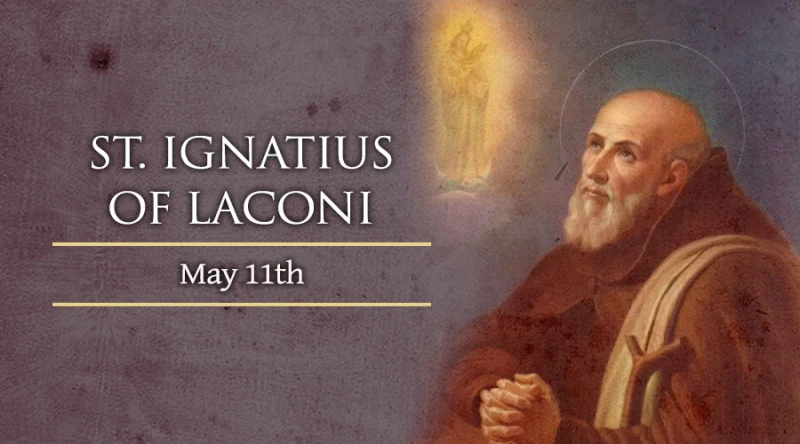
St. Ignatius of Laconi


St. Ignatius of Laconi

Feast date: May 11

St. Ignatius of Laconi was a Capuchin Friar. He was born in 1701 and died in 1781. He was canonized 1951 by Pius XII.

Born the second of seven children in a poor farming family, Francis Ignatius Vincent Peis was so named because his safe delivery through a difficult pregnancy was achieved through the intercession of St. Francis of Assisi.  His mother promised the saint that she would name her unborn baby Francis and that he would join the Capuchins as an adult.

Since his early childhood, Francis demonstrated a capacity for hard work in the fields and a strong piety.  He would often be seen in prayer and was known to wait at the church doors every morning in prayer until they were opened.

He wanted to join the Capuchins as a teenager, but his father would not allow him to because the family depended on his labour to survive. However, on surviving a riding accident through God’s intervention at the age of 20, he decided to enter the Capuchin monastery at once, and took his vows a year later, taking his second name, Ignatius, as his religious name.

Ignatius spent his first 15 years as a Capuchin doing various menial jobs around the monastery and for the last 40 years of his life he was appointed questor, or offical beggar, for the monastery.  He would travel around the town collecting food and donations for the friars.

He was particularly well loved by the poor and by children, and was often given alms by those who barely had anything to give.  He refused them from the very poor, saying that it was better for them to keep it for themselves.  He tended to the sick and to street children everyday on his rounds through town, and many miracles of healing were said to have occurred through his intercession.

St. Ignatius of Laconi Read More »

Tuesday of the Fourth Week of Easter

Reading I Acts 11:19-26

Those who had been scattered by the persecution
that arose because of Stephen
went as far as Phoenicia, Cyprus, and Antioch,
preaching the word to no one but Jews.
There were some Cypriots and Cyrenians among them, however,
who came to Antioch and began to speak to the Greeks as well,
proclaiming the Lord Jesus.
The hand of the Lord was with them
and a great number who believed turned to the Lord.
The news about them reached the ears of the Church in Jerusalem,
and they sent Barnabas to go to Antioch.
When he arrived and saw the grace of God,
he rejoiced and encouraged them all
to remain faithful to the Lord in firmness of heart,
for he was a good man, filled with the Holy Spirit and faith.
And a large number of people was added to the Lord.
Then he went to Tarsus to look for Saul,
and when he had found him he brought him to Antioch.
For a whole year they met with the Church
and taught a large number of people,
and it was in Antioch that the disciples
were first called Christians.

Responsorial Psalm 87:1b-3, 4-5, 6-7

R.        (117:1a)  All you nations, praise the Lord.
or:
R.        Alleluia.
His foundation upon the holy mountains
            the LORD loves:
The gates of Zion,
            more than any dwelling of Jacob.
Glorious things are said of you,
            O city of God!
R.        All you nations, praise the Lord.
or:
R.        Alleluia.
I tell of Egypt and Babylon
            among those who know the LORD;
Of Philistia, Tyre, Ethiopia:
            “This man was born there.”
And of Zion they shall say:
            “One and all were born in her;
And he who has established her
            is the Most High LORD.”
R.        All you nations, praise the Lord.
or:
R.        Alleluia.
They shall note, when the peoples are enrolled:
            “This man was born there.”
And all shall sing, in their festive dance:
            “My home is within you.”
R.        All you nations, praise the Lord.
or:
R.        Alleluia.

Alleluia Jn 10:27

R. Alleluia, alleluia.
My sheep hear my voice, says the Lord;
I know them, and they follow me.

R. Alleluia, alleluia.

Gospel Jn 10:22-30

The feast of the Dedication was taking place in Jerusalem.
It was winter.
And Jesus walked about in the temple area on the Portico of Solomon.
So the Jews gathered around him and said to him,
“How long are you going to keep us in suspense?
If you are the Christ, tell us plainly.”
Jesus answered them, “I told you and you do not believe.
The works I do in my Father’s name testify to me.
But you do not believe, because you are not among my sheep.
My sheep hear my voice;
I know them, and they follow me.
I give them eternal life, and they shall never perish.
No one can take them out of my hand.
My Father, who has given them to me, is greater than all,
and no one can take them out of the Father’s hand.
The Father and I are one.”

– – –

Lectionary for Mass for Use in the Dioceses of the United States, second typical edition, Copyright © 2001, 1998, 1997, 1986, 1970 Confraternity of Christian Doctrine; Psalm refrain © 1968, 1981, 1997, International Committee on English in the Liturgy, Inc. All rights reserved. Neither this work nor any part of it may be reproduced, distributed, performed or displayed in any medium, including electronic or digital, without permission in writing from the copyright owner.

Tuesday of the Fourth Week of Easter Read More »

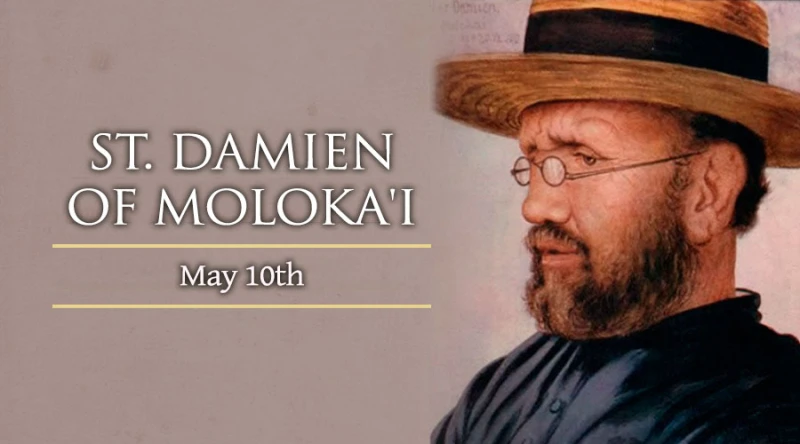
St. Damien of Moloka’i


St. Damien of Moloka’i

Feast date: May 10

The Catholic Church remembers St. Damien of Molokai on May 10. The Belgian priest sacrificed his life and health to become a spiritual father to the victims of leprosy quarantined on a Hawaiian island.

Joseph de Veuser, who later took the name Damien in religious life, was born into a farming family in the Belgian town of Tremlo in 1840. During his youth he felt a calling to become a Catholic missionary, an urge that prompted him to join the Congregation of the Sacred Hearts of Jesus and Mary.

Damien’s final vows to the congregation involved a dramatic ceremony in which his superiors draped him in the cloth that would be used to cover his coffin after death. The custom was meant to symbolize the young man’s solemn commitment, and his identification with Christ’s own death. For Damien, the event would become more significant, as he would go on to lay down his life for the lepers of Molokai.

His superiors originally intended to send Damien’s brother, a member of the same congregation, to Hawaii. But he became sick, and Damien arranged to take his place. Damien arrived in Honolulu in 1864, less than a century after Europeans had begun to establish a presence in Hawaii. He was ordained a priest the same year.

During his ninth year of the priesthood, Father Damien responded to his bishop’s call for priests to serve on the leper colony of Molokai. A lack of previous exposure to leprosy, which had no treatment at the time, made the Hawaiian natives especially susceptible to the infection. Molokai became a quarantine center for the victims, who became disfigured and debilitated as the disease progressed.

The island had become a wasteland in human terms, despite its natural beauty. The leprosy victims of Molokai faced hopeless conditions and extreme deprivation, sometimes lacking not only basic palliative care but even the means of survival.

Inwardly, Fr. Damien was terrified by the prospect of contracting leprosy himself. However, he knew that he would have to set aside this fear in order to convey God’s love to the lepers in the most authentic way. Other missionaries had kept the lepers at arms’ length, but Fr. Damien chose to immerse himself in their common life and leave the outcome to God.

The inhabitants of Molokai saw the difference in the new priest’s approach, and embraced his efforts to improve their living conditions. A strong man, accustomed to physical labor, he performed the Church’s traditional works of mercy – such as feeding the hungry, sheltering the homeless, and giving proper burial to the dead – in the face of suffering that others could hardly even bear to see.

Fr. Damien’s work helped to raise the lepers up from their physical sufferings, while also making them aware of their worth as beloved children of God. Although he could not take away the constant presence of death in the leper colony, he could change its meaning and inspire hope. The death-sentence of leprosy could, and often did, become a painful yet redemptive path toward eternal life.

The priest’s devotion to his people, and his activism on their behalf, sometimes alienated him from officials of the Hawaiian kingdom and from his religious superiors in Europe. His mission was not only fateful, but also lonely. He drew strength from Eucharistic adoration and the celebration of the Mass, but longed for another priest to arrive so that he could receive the sacrament of confession regularly.

In December of 1884, Fr. Damien discovered that he had lost all feeling in his feet. It was an early, but unmistakable sign that he had contracted leprosy. The priest knew that his time was short. He undertook to finish whatever accomplishments he could, on behalf of his fellow colony residents, before the diseased robbed him of his eyesight, speech and mobility.

Fr. Damien suffered humiliations and personal trials during his final years. An American Protestant minister accused him of scandalous behavior, based on the contemporary belief that leprosy was a sexually transmitted disease. He ran into disagreements with his religious superiors, and felt psychologically tormented by the notion that his work had been a failure.

In the end, priests of his congregation arrived to administer the last sacraments to the dying priest. During the Spring of 1889, Fr. Damien told his friends that he believed it was God’s will for him to spend the upcoming Easter not on Molokai, but in heaven. He died of leprosy during Holy Week, on April 15, 1889.

St. Damien of Molokai was beatified in 1995. Pope Benedict XVI canonized him in 2009.
St. Damien of Moloka’i Read More »