
Please mind our dust!

We are currently working on revamping our website!
Thank you for your patience!

CRD Solutions

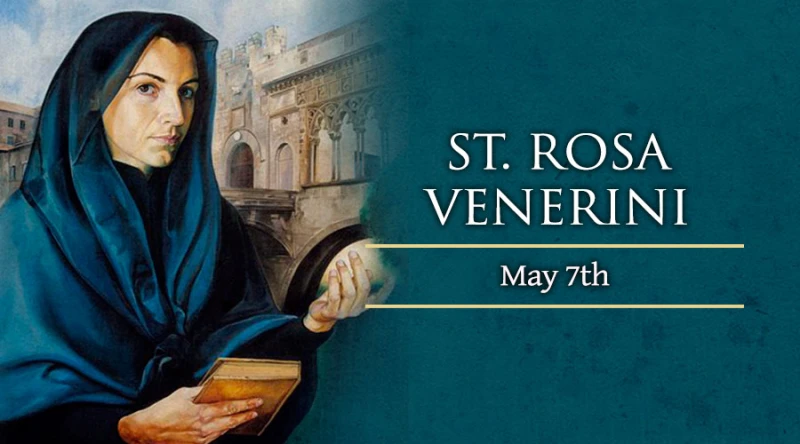
St. Rosa Venerini


St. Rosa Venerini

Feast date: May 07

On May 7, the Church celebrates the recently-canonized Italian educator Saint Rosa Venerini, who founded Catholic schools for girls and young women during the late 17th and early 18th centuries.

Her work is continued today by the “Venerini Sisters.”

St. Rosa (also known as St. Rose) was declared a saint in 2006 by Pope Benedict XVI, who spoke in his canonization homily of her courageous work for “the spiritual elevation and authentic emancipation of the young women of her time.”

He noted that St. Venerini “did not content herself with providing the girls an adequate education, but she was concerned with assuring their complete formation, with sound references to the Church’s doctrinal teaching.”

Born in the central Italian city of Viterbo on February 9, 1656, Rosa Venerini was the daughter of an accomplished doctor, Goffredo, who raised four children with his wife Marzia. At a young age, Rosa vowed to consecrate her life to God, though this resolution was tested during her adolescence.

Rosa briefly joined a Dominican women’s community during 1676, but returned home to comfort her mother after Goffredo’s unexpected death. One of Rosa’s brothers, Domenico, also died at age 27. Marzia was heartbroken and died within months.

In the wake of these family crises, Rosa invited local women to her home to pray the Rosary in a group. However, she was soon dismayed by the deficiencies she saw in their education and religious formation. This eye-opening experience shaped Rosa’s future, pointing her toward her ultimate vocation in the field of teaching.

In 1685, with the help of two friends and the approval of her local bishop, Rosa opened Italy’s first public school for girls. It was supported by some Church and state officials, though others resisted an educational model that was, for its time, unconventional.

Many of these critics were silenced by the school’s clear success in uplifting the character of young women. Rosa left Viterbo and founded ten schools in the Diocese of Montefiascone between 1692 and 1694. She also trained a local successor, the future Saint Lucia Filippini.

Only after several years, and one disappointing failed attempt, did Rosa manage to start a school in Rome, during 1713. Three years later, Pope Clement XI paid a visit accompanied by eight cardinals. Witnessing the work of Rosa Venerini’s teachers, the Pope personally thanked her, declaring: “With these schools you will sanctify Rome.”

The acceptance of Rosa’s work also increased her daily responsibilities. She undertook difficult journeys for the sake of her work, while maintaining a strong prayer life that kept her oriented toward God’s will in all of her undertakings. Spiritual direction from Jesuit priests helped her to combine an active apostolate with a life of contemplative prayer. She cultivated a close daily relationship to God while working to found over 40 schools.

St. Rosa Venerini’s last illness came to an end during the evening of May 7, 1728. Her religious congregation, known in Italian as the “Maistre pie Venerini,” maintains an international presence.
St. Rosa Venerini Read More »

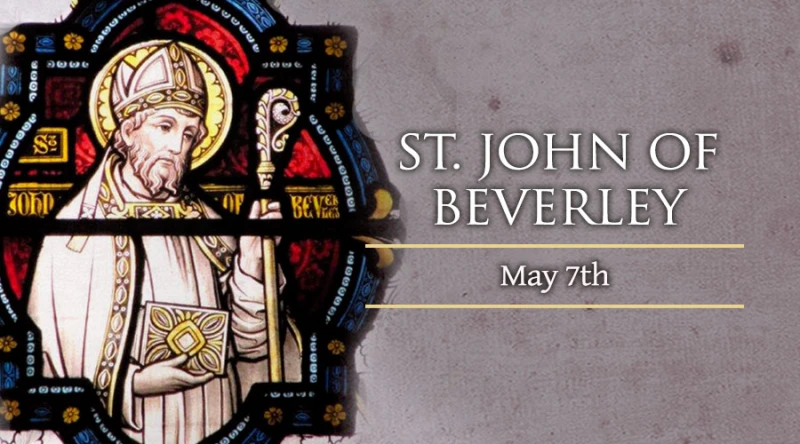
St. John of Beverley


St. John of Beverley

Feast date: May 07

St. John of Beverley was the Bishop of Hexham, and later of York. He was born in Harpham, Yorkshire, and died in Beverley on May 7, 721.

As a youth, John manifested a strong desire to devote his life to God, and eventually left his native Yorkshire and traveled Kent where he studied at the famous ecclesiastical school of St. Theodore, archbishop of Canterbury.

He returned toYorkshire upon the completion of his studies, and joined a Benedictine monastery where he devoted himself to contemplation. He was called out of his monastic seclusion to be consecrated as bishop of Hexham in 687, a see he occupied for 18 years while still managing to devote time to contemplation and the study of Scripture.

With the death of St. Bosa, archbishop of York, John was transferred to York and served there until his retirement from ill health in 717.  He spent his last four years in a monastery that he built at Beverley.

John was renowned for the miracles that he performed, both during his life and those that took place after his death. Most famously, he cured a young man who was dumb and had reportedly never spoken a word in his life, and obtained from him the ability to speak. He took the young man under his wing and patiently taught him the alphabet and the fundaments of the language.

After his death in 721, owing to the many miracles that occurred through his intercession, his burial site at Beverley became one of the most popular pilgrimage sites in England. He was canonized by Pope Benedict IX in 1037.

The renowned English mystic, Julian of Norwich, and the martyred bishop, St. John Fisher, who was from Beverley, had a great devotion to St. John.

St. John of Beverley Read More »

Friday of the Third Week of Easter

Reading I Acts 9:1-20

Saul, still breathing murderous threats against the disciples of the Lord,
went to the high priest and asked him
for letters to the synagogues in Damascus, that,
if he should find any men or women who belonged to the Way,
he might bring them back to Jerusalem in chains.
On his journey, as he was nearing Damascus,
a light from the sky suddenly flashed around him.
He fell to the ground and heard a voice saying to him,
“Saul, Saul, why are you persecuting me?”
He said, “Who are you, sir?”
The reply came, “I am Jesus, whom you are persecuting.
Now get up and go into the city and you will be told what you must do.”
The men who were traveling with him stood speechless,
for they heard the voice but could see no one.
Saul got up from the ground,
but when he opened his eyes he could see nothing;
so they led him by the hand and brought him to Damascus.
For three days he was unable to see, and he neither ate nor drank.

There was a disciple in Damascus named Ananias,
and the Lord said to him in a vision, “Ananias.”
He answered, “Here I am, Lord.”
The Lord said to him, “Get up and go to the street called Straight
and ask at the house of Judas for a man from Tarsus named Saul.
He is there praying,
and in a vision he has seen a man named Ananias
come in and lay his hands on him,
that he may regain his sight.”
But Ananias replied,
“Lord, I have heard from many sources about this man,
what evil things he has done to your holy ones in Jerusalem.
And here he has authority from the chief priests
to imprison all who call upon your name.”
But the Lord said to him,
“Go, for this man is a chosen instrument of mine
to carry my name before Gentiles, kings, and children of Israel,
and I will show him what he will have to suffer for my name.”
So Ananias went and entered the house;
laying his hands on him, he said,
“Saul, my brother, the Lord has sent me,
Jesus who appeared to you on the way by which you came,
that you may regain your sight and be filled with the Holy Spirit.”
Immediately things like scales fell from his eyes
and he regained his sight.
He got up and was baptized,
and when he had eaten, he recovered his strength.

He stayed some days with the disciples in Damascus,
and he began at once to proclaim Jesus in the synagogues,
that he is the Son of God.

Responsorial Psalm 117:1bc, 2

R.        (Mark 16:15)  Go out to all the world and tell the Good News.
or:
R.        Alleluia.
Praise the LORD, all you nations;
            glorify him, all you peoples!
R.        Go out to all the world and tell the Good News.
or:
R.        Alleluia.
For steadfast is his kindness toward us,
            and the fidelity of the LORD endures forever.
R.        Go out to all the world and tell the Good News.
or:
R.        Alleluia.

Alleluia Jn 6:56

R. Alleluia, alleluia.
Whoever eats my Flesh and drinks my Blood,
remains in me and I in him, says the Lord.

R. Alleluia, alleluia.

Gospel Jn 6:52-59

The Jews quarreled among themselves, saying,
“How can this man give us his Flesh to eat?”
Jesus said to them,
“Amen, amen, I say to you,
unless you eat the Flesh of the Son of Man and drink his Blood,
you do not have life within you.
Whoever eats my Flesh and drinks my Blood
has eternal life,
and I will raise him on the last day.
For my Flesh is true food,
and my Blood is true drink.
Whoever eats my Flesh and drinks my Blood
remains in me and I in him.
Just as the living Father sent me
and I have life because of the Father,
so also the one who feeds on me will have life because of me.
This is the bread that came down from heaven.
Unlike your ancestors who ate and still died,
whoever eats this bread will live forever.”
These things he said while teaching in the synagogue in Capernaum.

– – –

Lectionary for Mass for Use in the Dioceses of the United States, second typical edition, Copyright © 2001, 1998, 1997, 1986, 1970 Confraternity of Christian Doctrine; Psalm refrain © 1968, 1981, 1997, International Committee on English in the Liturgy, Inc. All rights reserved. Neither this work nor any part of it may be reproduced, distributed, performed or displayed in any medium, including electronic or digital, without permission in writing from the copyright owner.

Friday of the Third Week of Easter Read More »

St. Evodius of Antioch


St. Evodius of Antioch

Feast date: May 06

Evodius was one of the 72 disciples of Christ, and Catholic tradition has always held that he was the first bishop of Antioch after St. Peter. However, we are not sure in what year he assumed the position.

As bishop of Antioch, he was the first to coin the word “Christian” to refer to the disciples of Jesus. He probably died between the years 64-67, when he was then succeeded by St. Ignatius of Antioch.

St. Evodius of Antioch Read More »

Thursday of the Third Week of Easter

Reading I Acts 8:26-40

The angel of the Lord spoke to Philip,
“Get up and head south on the road
that goes down from Jerusalem to Gaza, the desert route.”
So he got up and set out.
Now there was an Ethiopian eunuch,
a court official of the Candace,
that is, the queen of the Ethiopians,
in charge of her entire treasury,
who had come to Jerusalem to worship, and was returning home.
Seated in his chariot, he was reading the prophet Isaiah.
The Spirit said to Philip,
“Go and join up with that chariot.”
Philip ran up and heard him reading Isaiah the prophet and said,
“Do you understand what you are reading?”
He replied,
“How can I, unless someone instructs me?”
So he invited Philip to get in and sit with him.
This was the Scripture passage he was reading:

            Like a sheep he was led to the slaughter,
                        and as a lamb before its shearer is silent,
                                    so he opened not his mouth.
            In his humiliation justice was denied him.
                        Who will tell of his posterity?
                                    For his life is taken from the earth.

Then the eunuch said to Philip in reply,
“I beg you, about whom is the prophet saying this?
About himself, or about someone else?”
Then Philip opened his mouth and, beginning with this Scripture passage,
he proclaimed Jesus to him.
As they traveled along the road
they came to some water,
and the eunuch said, “Look, there is water.
What is to prevent my being baptized?”
Then he ordered the chariot to stop,
and Philip and the eunuch both went down into the water,
and he baptized him.
When they came out of the water,
the Spirit of the Lord snatched Philip away,
and the eunuch saw him no more,
but continued on his way rejoicing.
Philip came to Azotus, and went about proclaiming the good news
to all the towns until he reached Caesarea.

Responsorial Psalm 66:8-9, 16-17, 20

R.        (1)  Let all the earth cry out to God with joy.
or:
R.        Alleluia.
Bless our God, you peoples,
            loudly sound his praise;
He has given life to our souls,
            and has not let our feet slip.
R.        Let all the earth cry out to God with joy.
or:
R.        Alleluia.
Hear now, all you who fear God, while I declare
            what he has done for me.
When I appealed to him in words,
            praise was on the tip of my tongue.
R.        Let all the earth cry out to God with joy.
or:
R.        Alleluia.
Blessed be God who refused me not
            my prayer or his kindness!
R.        Let all the earth cry out to God with joy.
or:
R.        Alleluia.

Alleluia Jn 6:51

R. Alleluia, alleluia.
I am the living bread that came down from heaven, says the Lord;
whoever eats this bread will live forever.

R. Alleluia, alleluia.

Gospel Jn 6:44-51

Jesus said to the crowds:
“No one can come to me unless the Father who sent me draw him,
and I will raise him on the last day.
It is written in the prophets:

            They shall all be taught by God.

Everyone who listens to my Father and learns from him comes to me.
Not that anyone has seen the Father
except the one who is from God;
he has seen the Father.
Amen, amen, I say to you,
whoever believes has eternal life.
I am the bread of life.
Your ancestors ate the manna in the desert, but they died;
this is the bread that comes down from heaven
so that one may eat it and not die.
I am the living bread that came down from heaven;
whoever eats this bread will live forever;
and the bread that I will give
is my Flesh for the life of the world.”

– – –

Lectionary for Mass for Use in the Dioceses of the United States, second typical edition, Copyright © 2001, 1998, 1997, 1986, 1970 Confraternity of Christian Doctrine; Psalm refrain © 1968, 1981, 1997, International Committee on English in the Liturgy, Inc. All rights reserved. Neither this work nor any part of it may be reproduced, distributed, performed or displayed in any medium, including electronic or digital, without permission in writing from the copyright owner.

Thursday of the Third Week of Easter Read More »