Please mind our dust!

We are currently working on revamping our website!
Thank you for your patience!

CRD Solutions

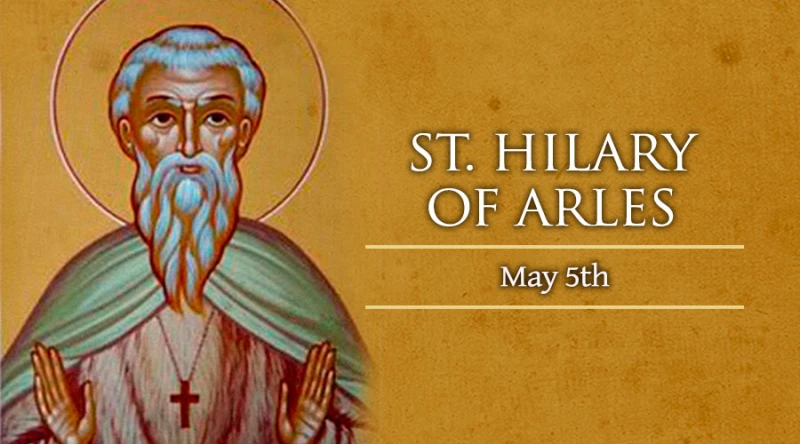
St. Hilary of Arles


St. Hilary of Arles

Feast date: May 05

On May 5, Catholics celebrate Saint Hilary of Arles, a fifth-century bishop who gave up wealth and privilege in favor of austerity and sacrifice for the sake of the Church.

Hilary was born during the year 401, most likely in the present-day French region of Loraine. He came from a wealthy background and received a traditional aristocratic education in philosophy and rhetoric, which he expected to put to use in a secular career.

One of Hilary’s relatives, Honoratus, had founded a monastery in Lerins and given his life to the service of the Church. Honoratus was deeply concerned for Hilary’s salvation, and urged him with tears to abandon worldly pursuits for the sake of following Christ.

“On one side,” Hilary later recalled, “I saw the Lord calling me; on the other the world offering me its seducing charms and pleasures. How often did I embrace and reject, will and not will the same thing!”

“But in the end Jesus Christ triumphed in me. And three days after Honoratus had left me, the mercy of God, solicited by his prayers, subdued my rebellious soul.”

Hilary returned to his relative, humbling himself as Honoratus’ disciple and embracing his life of prayer, asceticism, and Scripture study. He sold his property, gave the proceeds to the poor, and wholeheartedly embraced the monastic life of the community in Lerins.

In 426, Honoratus became the Archbishop of Arles. Hilary initially followed him, but soon returned to the monastery at Lerins. Honoratus, however, insisted on having the assistance of his relative and disciple, and traveled to Lerins himself to retrieve him.

When Honoratus died in 429, Hilary again attempted to leave Arles and return to his monastery. But the faithful of the city sent out a search party and had him brought back, so that he could be consecrated as Honoratus’ successor.

Though he was not yet 30 years old, the new archbishop was well-prepared by his years in religious life and the time spent assisting his predecessor. As archbishop, he maintained the simplicity of a monk. He owned few possessions, put the poor ahead of himself, and continued to do manual labor.

Known for his kindness and charity, the archbishop was also remembered for publicly rebuking a government official who brought shame on the Church. He also warned lukewarm believers that they would “not so easily get out of hell, if you are once unhappily fallen into its dungeons.”

Hilary helped to establish monasteries in his diocese, and strengthened the discipline and orthodoxy of the local Church through a series of councils. He sold Church property in order to pay the ransoms of those who had been kidnapped, and is said to have worked miracles during his lifetime.

St. Hilary of Arles died on May 5, 449. Although his life was marked by some canonical disputes with Pope St. Leo I, the Pope himself praised the late Archbishop of Arles in a letter to his successor, honoring him as “Hilary of holy memory.”

St. Hilary of Arles Read More »
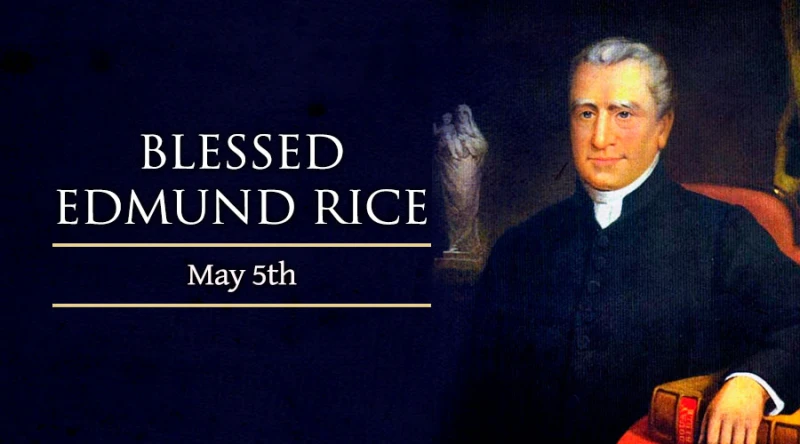
Blessed Edmund Rice


Blessed Edmund Rice

Feast date: May 05

May 5 is the feast of Blessed Edmund Rice, an Irish businessman who was so moved by the plight of children in the port city where he worked that he founded schools and eventually a religious order to serve them.

Edmund was born in 1762 in Callan, Ireland. As a young man, he moved to Waterford and began to work for his uncle in the shipping business. He became quite wealthy, and when his uncle died, he took over as head of the company.

When his wife passed away and his daughter grew up, Edmund began to contemplate the next direction he should take in life. He thought about leaving everything behind and joining a monastery. However, one day, as he was talking about his vocation and his future with a friend, a ragged group of poor boys walked by on the street. Inspired by the sight, his friend exclaimed: “What! Would you bury yourself in a cell on the continent rather than devote your wealth and your life to the spiritual and material interest of these poor youths?”

Edmund took the conversation as a sign from God. He took on the mission of improving the lives of poor children through education. He founded his first school in Waterford, Ireland in 1802 with the intention of helping poor boys to “become good Catholics and good citizens.”

Selling his business, he immersed himself fully in this mission, and in 1808, he founded the Presentations Brothers, an order of men dedicated to education, and the first order of men to be founded in Ireland. The rule of the community was approved in 1821 by the Pope, and the name was changed to the Christian Brothers. By 1825, Edmund and his 30 Christian Brothers were providing free education, clothing, and food to about 5,500 boys in 12 different towns.

Edmund served as the superior general of the community from its inception until 1838, when he retired at the age of 76. He died in 1844, and was beatified in 1996 by Pope John Paul II, who called him “an outstanding model of a true lay apostle.”

Blessed Edmund Rice Read More »

Wednesday of the Third Week of Easter

Reading I Acts 8:1b-8

There broke out a severe persecution of the Church in Jerusalem,
and all were scattered
throughout the countryside of Judea and Samaria,
except the Apostles.
Devout men buried Stephen and made a loud lament over him.
Saul, meanwhile, was trying to destroy the Church;
entering house after house and dragging out men and women,
he handed them over for imprisonment.

Now those who had been scattered went about preaching the word.
Thus Philip went down to the city of Samaria
and proclaimed the Christ to them.
With one accord, the crowds paid attention to what was said by Philip
when they heard it and saw the signs he was doing.
For unclean spirits, crying out in a loud voice,
came out of many possessed people,
and many paralyzed and crippled people were cured.
There was great joy in that city.

Responsorial Psalm 66:1-3a, 4-5, 6-7a

R.        (1)  Let all the earth cry out to God with joy.
or:
R.        Alleluia.
Shout joyfully to God, all the earth,
            sing praise to the glory of his name;
            proclaim his glorious praise.
Say to God, “How tremendous are your deeds!”
R.        Let all the earth cry out to God with joy.
or:
R.        Alleluia.
“Let all on earth worship and sing praise to you,
            sing praise to your name!”
Come and see the works of God,
            his tremendous deeds among the children of Adam.
R.        Let all the earth cry out to God with joy.
or:
R.        Alleluia.
He has changed the sea into dry land;
            through the river they passed on foot;
            therefore let us rejoice in him.
He rules by his might forever.
R.        Let all the earth cry out to God with joy.
or:
R.        Alleluia.

Alleluia See Jn 6:40

R. Alleluia, alleluia.
Everyone who believes in the Son has eternal life,
and I shall raise him up on the last day, says the Lord.

R. Alleluia, alleluia.

Gospel Jn 6:35-40

Jesus said to the crowds,
“I am the bread of life;
whoever comes to me will never hunger,
and whoever believes in me will never thirst.
But I told you that although you have seen me,
you do not believe.
Everything that the Father gives me will come to me,
and I will not reject anyone who comes to me,
because I came down from heaven not to do my own will
but the will of the one who sent me.
And this is the will of the one who sent me,
that I should not lose anything of what he gave me,
but that I should raise it on the last day.
For this is the will of my Father,
that everyone who sees the Son and believes in him
may have eternal life,
and I shall raise him on the last day.”

– – –

Lectionary for Mass for Use in the Dioceses of the United States, second typical edition, Copyright © 2001, 1998, 1997, 1986, 1970 Confraternity of Christian Doctrine; Psalm refrain © 1968, 1981, 1997, International Committee on English in the Liturgy, Inc. All rights reserved. Neither this work nor any part of it may be reproduced, distributed, performed or displayed in any medium, including electronic or digital, without permission in writing from the copyright owner.

Wednesday of the Third Week of Easter Read More »

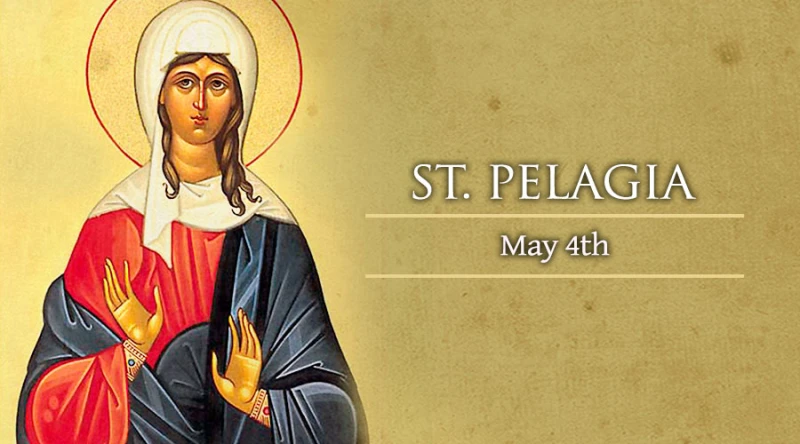
St. Pelagia


St. Pelagia

Feast date: May 04

Pelagia (originally Margarita) was born as the beautiful daughter of pagan parents, and was said to have caught the eye of the Emperor Diocletian’s son. However, she had no desire to marry. One day, she attended mass, given by the bishop. She was so inspired by his sermon that she anonymously sought counsel through writing on wax tablets. He asked her to come in person.

Under his inspiration, Pelagia was baptized. As a result of this, the emperor’s son turned against her, as did her mother. Together they reported her to the emperor in hopes that her faith would weaken under torture. Diocletian interviewed her, but he failed to persuade her to change her mind and heart about being a Christian.

She ran from home, giving away all of her possessions and setting her slaves free, and lived as a hermit within the mountains. She was called “the beardless hermit,” and went by the name of “Pelagius.” She then died three or four years later, apparently as a result of extreme asceticism, which had emaciated her to the point she could no longer be recognized.

St. Pelagia Read More »

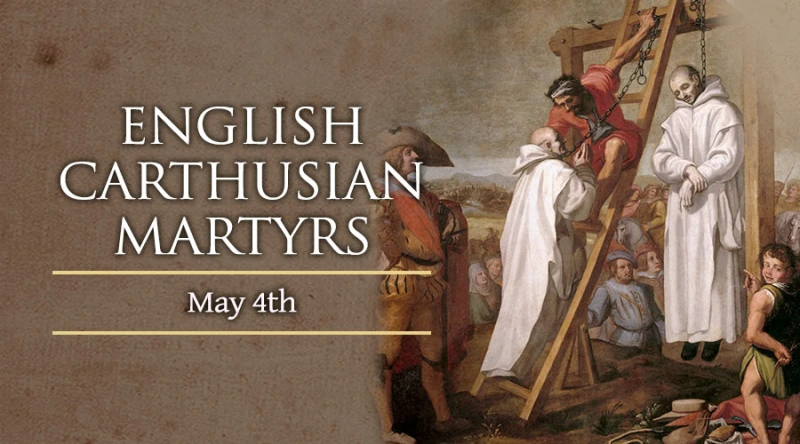
English Carthusian Martyrs


English Carthusian Martyrs

Feast date: May 04

These 18 Carthusian monks were put to death in England under King Henry VIII between 1535-1540 for maintaining their allegiance to the Pope.


The Carthusians, founded by St. Bruno in 1054, are the strictest and most austere monastic order in the western Church.  They live an austere hermitic life, their ‘monastery’ actually being a number of hermitages built next to each other.

When Henry VIII issued his “Act of Supremacy” declaring that all who refused to take an oath recognizing him as head of the Church of England committed an act of high treason, these 18 Carthusians refused and were sentenced to death.


The first to die were the Carthusian prior of London, John Houghton, and two of his brothers, Robert Lawrence and Augustine Webster, who were hanged, drawn and quartered, on May 4, 1535. The prior is said to have declared his fidelity to the Catholic Church and forgiven his executioners before dying. 


The Carthusians were the first martyrs to die under the reign of Henry VIII. Two more were killed on June 19 of that year and by August 4, 1540, all 18 had been tortured and killed for refusing to place their allegiance to the king before their allegiance to the Pope.


They were beatified in 1886 by Pope Leo XIII, and John Houghton, Robert Lawrence, and Augustine Webster, were canonized by Pope Paul VI in 1970.

English Carthusian Martyrs Read More »