Please mind our dust!

We are currently working on revamping our website!
Thank you for your patience!

CRD Solutions

Feast of Saints Philip and James, Apostles

Reading I 1 Cor 15:1-8

I am reminding you, brothers and sisters,
of the Gospel I preached to you,
which you indeed received and in which you also stand.
Through it you are also being saved,
if you hold fast to the word I preached to you,
unless you believed in vain.
For I handed on to you as of first importance what I also received:
that Christ died for our sins
in accordance with the Scriptures;
that he was buried;
that he was raised on the third day
in accordance with the Scriptures;
that he appeared to Cephas, then to the Twelve.
After that, he appeared to more
than five hundred brothers and sisters at once,
most of whom are still living,
though some have fallen asleep.
After that he appeared to James,
then to all the Apostles.
Last of all, as to one born abnormally,
he appeared to me.

Responsorial Psalm 19:2-3, 4-5

R.        (5)  Their message goes out through all the earth.
or:
R.        Alleluia.
The heavens declare the glory of God;
            and the firmament proclaims his handiwork.
Day pours out the word to day;
            and night to night imparts knowledge.
R.        Their message goes out through all the earth.
or:
R.        Alleluia.
Not a word nor a discourse
            whose voice is not heard;
Through all the earth their voice resounds,
            and to the ends of the world, their message.
R.        Their message goes out through all the earth.
or:
R.        Alleluia.

Alleluia Jn 14:6b, 9c

R. Alleluia, alleluia.
I am the way, the truth, and the life, says the Lord;
Philip, whoever has seen me has seen the Father.

R. Alleluia, alleluia.

Gospel Jn 14:6-14

Jesus said to Thomas, “I am the way and the truth and the life.
No one comes to the Father except through me.
If you know me, then you will also know my Father.
From now on you do know him and have seen him.”
Philip said to him,
“Master, show us the Father, and that will be enough for us.”
Jesus said to him, “Have I been with you for so long a time
and you still do not know me, Philip?
Whoever has seen me has seen the Father.
How can you say, ‘Show us the Father’?
Do you not believe that I am in the Father and the Father is in me?
The words that I speak to you I do not speak on my own.
The Father who dwells in me is doing his works.
Believe me that I am in the Father and the Father is in me,
or else, believe because of the works themselves.
Amen, amen, I say to you,
whoever believes in me will do the works that I do,
and will do greater ones than these,
because I am going to the Father.
And whatever you ask in my name, I will do,
so that the Father may be glorified in the Son.
If you ask anything of me in my name, I will do it.”

– – –

Lectionary for Mass for Use in the Dioceses of the United States, second typical edition, Copyright © 2001, 1998, 1997, 1986, 1970 Confraternity of Christian Doctrine; Psalm refrain © 1968, 1981, 1997, International Committee on English in the Liturgy, Inc. All rights reserved. Neither this work nor any part of it may be reproduced, distributed, performed or displayed in any medium, including electronic or digital, without permission in writing from the copyright owner.

Feast of Saints Philip and James, Apostles Read More »
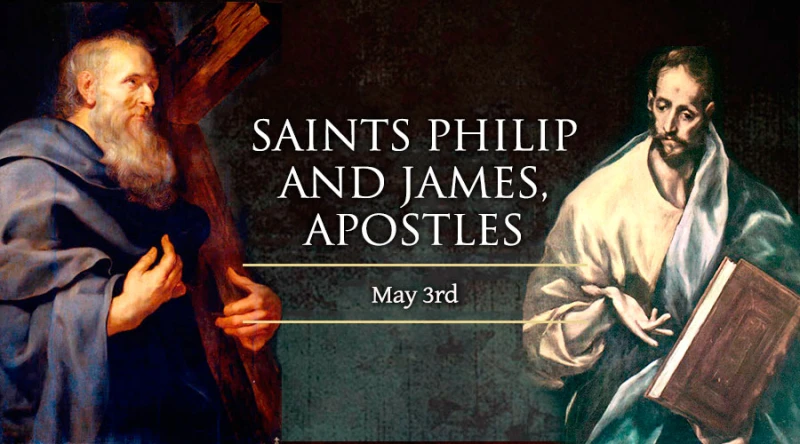
Sts. Philip and James the Less, Apostles


Sts. Philip and James the Less, Apostles

Feast date: May 03

Philip was born in Bethsaida in Galilee and was one of the 12 Apostles that Jesus called. Immediately, Philip began to convert others, finding his friend Nathaniel and telling him that Jesus was the one whom Moses and the other prophets had foretold.

James the Lesser is called “Lesser” because he was younger than the other Apostle by the same name, James the Great. James the less was related in some way to Jesus, and after Jesus’ Ascension into heaven, he became the head of the Church in Jerusalem. He was martyred in the year 62.

Sts. Philip and James the Less, Apostles Read More »

Memorial of Saint Athanasius, Bishop and Doctor of the Church

Reading I Acts 6:8-15

Stephen, filled with grace and power,
was working great wonders and signs among the people.
Certain members of the so-called Synagogue of Freedmen,
Cyreneans, and Alexandrians,
and people from Cilicia and Asia,
came forward and debated with Stephen,
but they could not withstand the wisdom and the Spirit with which he spoke.
Then they instigated some men to say,
“We have heard him speaking blasphemous words
against Moses and God.”
They stirred up the people, the elders, and the scribes,
accosted him, seized him,
and brought him before the Sanhedrin.
They presented false witnesses who testified,
“This man never stops saying things against this holy place and the law.
For we have heard him claim
that this Jesus the Nazorean will destroy this place
and change the customs that Moses handed down to us.”
All those who sat in the Sanhedrin looked intently at him
and saw that his face was like the face of an angel.

Responsorial Psalm 119:23-24, 26-27, 29-30

R.        (1ab)  Blessed are they who follow the law of the Lord!
or:
R.        Alleluia.
Though princes meet and talk against me,
            your servant meditates on your statutes.
Yes, your decrees are my delight;
            they are my counselors.
R.        Blessed are they who follow the law of the Lord!
or:
R.        Alleluia.
I declared my ways, and you answered me;
            teach me your statutes.
Make me understand the way of your precepts,
            and I will meditate on your wondrous deeds.
R.        Blessed are they who follow the law of the Lord!
or:
R.        Alleluia.
Remove from me the way of falsehood,
            and favor me with your law.
The way of truth I have chosen;
            I have set your ordinances before me.
R.        Blessed are they who follow the law of the Lord!
or:
R.        Alleluia.

Alleluia Mt 4:4b

R. Alleluia, alleluia.
One does not live on bread alone
but on every word that comes forth from the mouth of God.

R. Alleluia, alleluia.

Gospel Jn 6:22-29

[After Jesus had fed the five thousand men, his disciples saw him walking on the sea.]
The next day, the crowd that remained across the sea
saw that there had been only one boat there,
and that Jesus had not gone along with his disciples in the boat,
but only his disciples had left.
Other boats came from Tiberias
near the place where they had eaten the bread
when the Lord gave thanks.
When the crowd saw that neither Jesus nor his disciples were there,
they themselves got into boats
and came to Capernaum looking for Jesus.
And when they found him across the sea they said to him,
“Rabbi, when did you get here?”
Jesus answered them and said,
“Amen, amen, I say to you, you are looking for me
not because you saw signs
but because you ate the loaves and were filled.
Do not work for food that perishes
but for the food that endures for eternal life,
which the Son of Man will give you.
For on him the Father, God, has set his seal.”
So they said to him,
“What can we do to accomplish the works of God?”
Jesus answered and said to them,
“This is the work of God, that you believe in the one he sent.”

– – –

Lectionary for Mass for Use in the Dioceses of the United States, second typical edition, Copyright © 2001, 1998, 1997, 1986, 1970 Confraternity of Christian Doctrine; Psalm refrain © 1968, 1981, 1997, International Committee on English in the Liturgy, Inc. All rights reserved. Neither this work nor any part of it may be reproduced, distributed, performed or displayed in any medium, including electronic or digital, without permission in writing from the copyright owner.

Memorial of Saint Athanasius, Bishop and Doctor of the Church Read More »

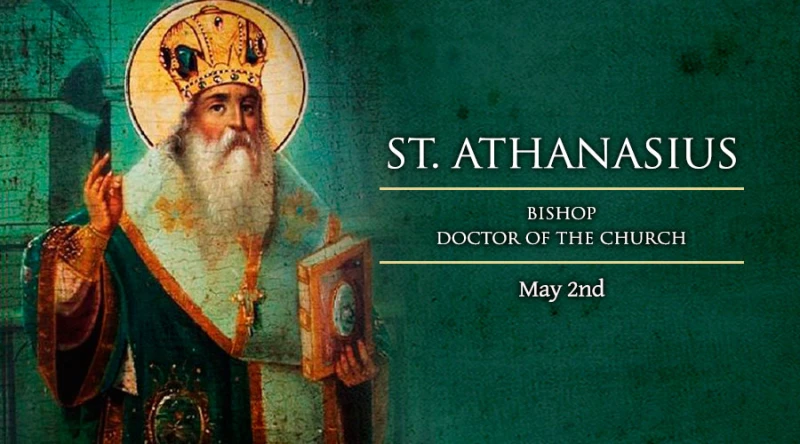
St. Athanasius, doctor of the Church


St. Athanasius, doctor of the Church

Feast date: May 02

Catholics honor St. Athanasius on May 2. The fourth century bishop is known as “the father of orthodoxy” for his absolute dedication to the doctrine of Christ’s divinity.

St. Athanasius was born to Christian parents living in the Egyptian city of Alexandria in 296. His parents took great care to have their son educated, and his talents came to the attention of a local priest who was later canonized as St. Alexander of Alexandria. The priest and future saint tutored Athanasius in theology, and eventually appointed him as an assistant.

Around the age of 19, Athanasius spent a formative period in the Egyptian desert as a disciple of St. Anthony in his monastic community. Returning to Alexandria, he was ordained a deacon in 319, and resumed his assistance to Alexander who had become a bishop. The Catholic Church, newly recognized by the Roman Empire, was already encountering a new series of dangers from within.

The most serious threat to the fourth-century Church came from a priest named Arius, who taught that Jesus could not have existed eternally as God prior to his historical incarnation as a man. According to Arius, Jesus was the highest of created beings, and could be considered “divine” only by analogy. Arians professed a belief in Jesus’ “divinity,” but meant only that he was God’s greatest creature.

Opponents of Arianism brought forth numerous scriptures which taught Christ’s eternal pre-existence and his identity as God. Nonetheless, many Greek-speaking Christians found it intellectually easier to believe in Jesus as a created demi-god, than to accept the mystery of a  Father-Son relationship within the Godhead. By 325, the controversy was dividing the Church and unsettling the Roman Empire.

In that year, Athanasius attended the First Ecumenical Council, held at Nicea to examine and judge Arius’ doctrine in light of apostolic tradition. It reaffirmed the Church’s perennial teaching on Christ’s full deity, and established the Nicene Creed as an authoritative statement of faith. The remainder of Athanasius’ life was a constant struggle to uphold the council’s teaching about Christ.

Near the end of St. Alexander’s life, he insisted that Athanasius succeed him as the Bishop of Alexandria. Athanasius took on the position just as the Emperor Constantine, despite having convoked the Council of Nicea, decided to relax its condemnation of Arius and his supporters. Athanasius continually refused to admit Arius to communion, however, despite the urgings of the emperor.

A number of Arians spent the next several decades attempting to manipulate bishops, emperors and Popes to move against Athanasius, particularly through the use of false accusations. Athanasius was accused of theft, murder, assault, and even of causing a famine by interfering with food shipments.

Arius became ill and died gruesomely in 336, but his heresy continued to live. Under the rule of the three emperors that followed Constantine, and particularly under the rule of the strongly Arian Constantius, Athanasius was driven into exile at least five times for insisting on the Nicene Creed as the Church’s authoritative rule of faith. 

Athanasius received the support of several Popes, and spent a portion of his exile in Rome. However, the Emperor Constantius did succeed in coercing one Pope, Liberius, into condemning Athanasius by having him kidnapped, threatened with death, and sent away from Rome for two years. The Pope eventually managed to return to Rome, where he again proclaimed Athanasius’ orthodoxy.

Constantius went so far as to send troops to attack his clergy and congregations. Neither these measures, nor direct attempts to assassinate the bishop, succeeding in silencing him. However, they frequently made it difficult for him to remain in his diocese. He enjoyed some respite after Constantius’ death in 361, but was later persecuted by Emperor Julian the Apostate, who sought to revive paganism.

In 369, Athanasius managed to convene an assembly of 90 bishops in Alexandria, for the sake of warning the Church in Africa against the continuing threat of Arianism. He died in 373, and was vindicated by a more comprehensive rejection of Arianism at the Second Ecumenical Council, held in 381 at Constantinople.

St. Gregory Nazianzen, who presided over part of that council, described St. Athanasius as “the true pillar of the church,” whose “life and conduct were the rule of bishops, and his doctrine the rule of the orthodox faith.”

St. Athanasius, doctor of the Church Read More »

Third Sunday of Easter

Reading I Acts 5:27-32, 40b-41

When the captain and the court officers had brought the apostles in
and made them stand before the Sanhedrin,
the high priest questioned them,
“We gave you strict orders, did we not,
to stop teaching in that name?
Yet you have filled Jerusalem with your teaching
and want to bring this man’s blood upon us.”
But Peter and the apostles said in reply,
“We must obey God rather than men.
The God of our ancestors raised Jesus,
though you had him killed by hanging him on a tree.
God exalted him at his right hand as leader and savior
to grant Israel repentance and forgiveness of sins.
We are witnesses of these things,
as is the Holy Spirit whom God has given to those who obey him.”

The Sanhedrin ordered the apostles
to stop speaking in the name of Jesus, and dismissed them.
So they left the presence of the Sanhedrin,
rejoicing that they had been found worthy
to suffer dishonor for the sake of the name.

Responsorial Psalm Ps 30:2, 4, 5-6, 11-12, 13

R  (2a) I will praise you, Lord, for you have rescued me.
or:
R  Alleluia.
I will extol you, O LORD, for you drew me clear
            and did not let my enemies rejoice over me.
O LORD, you brought me up from the netherworld;
            you preserved me from among those going down into the pit.
R  I will praise you, Lord, for you have rescued me.
or:
R  Alleluia.
Sing praise to the LORD, you his faithful ones,
            and give thanks to his holy name.
For his anger lasts but a moment;
            a lifetime, his good will.
At nightfall, weeping enters in,
            but with the dawn, rejoicing.
R  I will praise you, Lord, for you have rescued me.
or:
R  Alleluia.
Hear, O LORD, and have pity on me;
            O LORD, be my helper.
You changed my mourning into dancing;
            O LORD, my God, forever will I give you thanks.
R  I will praise you, Lord, for you have rescued me.
or:
R  Alleluia.

Reading II Rev 5:11-14

I, John, looked and heard the voices of many angels
who surrounded the throne
and the living creatures and the elders.
They were countless in number, and they cried out in a loud voice:
            “Worthy is the Lamb that was slain
                        to receive power and riches, wisdom and strength,
                        honor and glory and blessing.”
Then I heard every creature in heaven and on earth
and under the earth and in the sea,
everything in the universe, cry out:
            “To the one who sits on the throne and to the Lamb
                        be blessing and honor, glory and might,
                        forever and ever.”
The four living creatures answered, “Amen, “
and the elders fell down and worshiped.

Alleluia

R. Alleluia, alleluia.
Christ is risen, creator of all;
he has shown pity on all people.
R. Alleluia, alleluia.

Gospel Jn 21:1-19 or 21:1-14

At that time, Jesus revealed himself again to his disciples at the Sea of Tiberias.
He revealed himself in this way.
Together were Simon Peter, Thomas called Didymus,
Nathanael from Cana in Galilee,
Zebedee’s sons, and two others of his disciples.
Simon Peter said to them, “I am going fishing.”
They said to him, “We also will come with you.”
So they went out and got into the boat,
but that night they caught nothing.
When it was already dawn, Jesus was standing on the shore;
but the disciples did not realize that it was Jesus.
Jesus said to them, “Children, have you caught anything to eat?”
They answered him, “No.”
So he said to them, “Cast the net over the right side of the boat
and you will find something.”
So they cast it, and were not able to pull it in
because of the number of fish.
So the disciple whom Jesus loved said to Peter, “It is the Lord.”
When Simon Peter heard that it was the Lord,
he tucked in his garment, for he was lightly clad,
and jumped into the sea.
The other disciples came in the boat,
for they were not far from shore, only about a hundred yards,
dragging the net with the fish.
When they climbed out on shore,
they saw a charcoal fire with fish on it and bread.
Jesus said to them, “Bring some of the fish you just caught.”
So Simon Peter went over and dragged the net ashore
full of one hundred fifty-three large fish.
Even though there were so many, the net was not torn.
Jesus said to them, “Come, have breakfast.”
And none of the disciples dared to ask him, “Who are you?”
because they realized it was the Lord.
Jesus came over and took the bread and gave it to them,
and in like manner the fish.
This was now the third time Jesus was revealed to his disciples
after being raised from the dead.

When they had finished breakfast, Jesus said to Simon Peter,
“Simon, son of John, do you love me more than these?”
Simon Peter answered him, “Yes, Lord, you know that I love you.”
Jesus said to him, “Feed my lambs.”
He then said to Simon Peter a second time,
“Simon, son of John, do you love me?”
Simon Peter answered him, “Yes, Lord, you know that I love you.”
Jesus said to him, “Tend my sheep.”
Jesus said to him the third time,
“Simon, son of John, do you love me?”
Peter was distressed that Jesus had said to him a third time,
“Do you love me?” and he said to him,
“Lord, you know everything; you know that I love you.”
Jesus said to him, “Feed my sheep.
Amen, amen, I say to you, when you were younger,
you used to dress yourself and go where you wanted;
but when you grow old, you will stretch out your hands,
and someone else will dress you
and lead you where you do not want to go.”
He said this signifying by what kind of death he would glorify God.
And when he had said this, he said to him, “Follow me.”

OR

At that time, Jesus revealed himself to his disciples at the Sea of Tiberias.
He revealed himself in this way.
Together were Simon Peter, Thomas called Didymus,
Nathanael from Cana in Galilee,
Zebedee’s sons, and two others of his disciples.
Simon Peter said to them, “I am going fishing.”
They said to him, “We also will come with you.”
So they went out and got into the boat,
but that night they caught nothing.
When it was already dawn, Jesus was standing on the shore;
but the disciples did not realize that it was Jesus.
Jesus said to them, “Children, have you caught anything to eat?”
They answered him, “No.”
So he said to them, “Cast the net over the right side of the boat
and you will find something.”
So they cast it, and were not able to pull it in
because of the number of fish.
So the disciple whom Jesus loved said to Peter, “It is the Lord.”
When Simon Peter heard that it was the Lord,
he tucked in his garment, for he was lightly clad,
and jumped into the sea.
The other disciples came in the boat,
for they were not far from shore, only about a hundred yards,
dragging the net with the fish.
When they climbed out on shore,
they saw a charcoal fire with fish on it and bread.
Jesus said to them, “Bring some of the fish you just caught.”
So Simon Peter went over and dragged the net ashore
full of one hundred fifty-three large fish.
Even though there were so many, the net was not torn.
Jesus said to them, “Come, have breakfast.”
And none of the disciples dared to ask him, “Who are you?”
because they realized it was the Lord.
Jesus came over and took the bread and gave it to them,
and in like manner the fish.
This was now the third time Jesus was revealed to his disciples
after being raised from the dead.


– – –

Lectionary for Mass for Use in the Dioceses of the United States, second typical edition, Copyright © 2001, 1998, 1997, 1986, 1970 Confraternity of Christian Doctrine; Psalm refrain © 1968, 1981, 1997, International Committee on English in the Liturgy, Inc. All rights reserved. Neither this work nor any part of it may be reproduced, distributed, performed or displayed in any medium, including electronic or digital, without permission in writing from the copyright owner.

Third Sunday of Easter Read More »