Please mind our dust!

We are currently working on revamping our website!
Thank you for your patience!

CRD Solutions

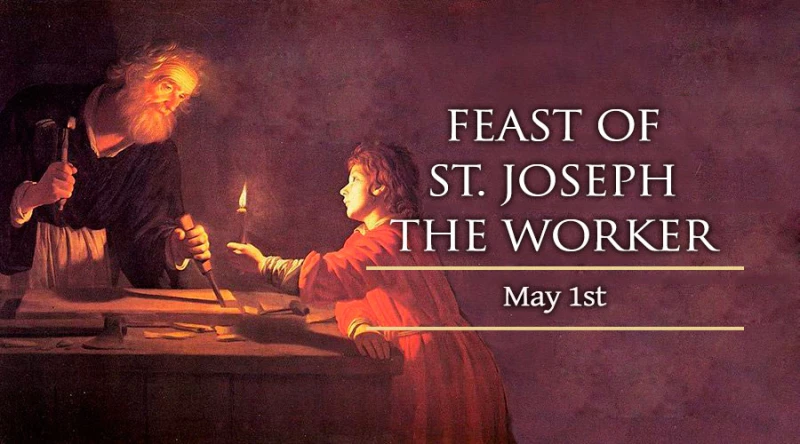
Feast of St. Joseph the Worker


Feast of St. Joseph the Worker

Feast date: May 01

St. Joseph has two feast days on the liturgical calendar. The first is March 19—Joseph, the Husband of Mary. The second is May 1—Joseph, the Worker.

“Saint Joseph is a man of great spirit. He is great in faith, not because he speaks his own words, but above all because he listens to the words of the Living God. He listens in silence. And his heart ceaselessly perseveres in the readiness to accept the Truth contained in the word of the Living God,” Pope John Paul II had once said.

There is very little about the life of Joseph in Scripture but still, we know that he was the chaste husband of Mary, the foster father of Jesus, a carpenter and  a man who was not wealthy. We also know that he came from the royal lineage of King David.

We can see from his actions in scripture that Joseph was a compassionate man, and obedient to the will of God. He also loved Mary and Jesus and wanted to protect and provide for them.

Since Joseph does not appear in Jesus’ public life, at his death, or resurrection, many historians believe Joseph had probably died before Jesus entered public ministry.

Joseph is the patron of many things, including the universal Church, fathers, the dying and social justice.

Feast of St. Joseph the Worker Read More »

Saturday of the Second Week of Easter

Reading I Acts 6:1-7

As the number of disciples continued to grow,
the Hellenists complained against the Hebrews
because their widows
were being neglected in the daily distribution.
So the Twelve called together the community of the disciples and said,
“It is not right for us to neglect the word of God to serve at table.
Brothers, select from among you seven reputable men,
filled with the Spirit and wisdom,
whom we shall appoint to this task,
whereas we shall devote ourselves to prayer
and to the ministry of the word.”
The proposal was acceptable to the whole community,
so they chose Stephen, a man filled with faith and the Holy Spirit,
also Philip, Prochorus, Nicanor, Timon, Parmenas,
and Nicholas of Antioch, a convert to Judaism.
They presented these men to the Apostles
who prayed and laid hands on them.
The word of God continued to spread,
and the number of the disciples in Jerusalem increased greatly;
even a large group of priests were becoming obedient to the faith.

Responsorial Psalm 33:1-2, 4-5, 18-19

R.        (22)  Lord, let your mercy be on us, as we place our trust in you.
or:
R.        Alleluia.
Exult, you just, in the LORD;
            praise from the upright is fitting.
Give thanks to the LORD on the harp;
            with the ten-stringed lyre chant his praises.
R.        Lord, let your mercy be on us, as we place our trust in you.
or:
R.        Alleluia.
Upright is the word of the LORD,
            and all his works are trustworthy.
He loves justice and right;
            of the kindness of the LORD the earth is full.
R.        Lord, let your mercy be on us, as we place our trust in you.
or:
R.        Alleluia.
See, the eyes of the LORD are upon those who fear him,
            upon those who hope for his kindness,
To deliver them from death
            and preserve them in spite of famine.
R.        Lord, let your mercy be on us, as we place our trust in you.
or:
R.        Alleluia.

Alleluia

R. Alleluia, alleluia.
Christ is risen, who made all things;
he has shown mercy on all people.

R. Alleluia, alleluia.

Gospel Jn 6:16-21

When it was evening, the disciples of Jesus went down to the sea,
embarked in a boat, and went across the sea to Capernaum.
It had already grown dark, and Jesus had not yet come to them.
The sea was stirred up because a strong wind was blowing.
When they had rowed about three or four miles,
they saw Jesus walking on the sea and coming near the boat,
and they began to be afraid.
But he said to them, “It is I. Do not be afraid.”
They wanted to take him into the boat,
but the boat immediately arrived at the shore
to which they were heading.

– – –

Lectionary for Mass for Use in the Dioceses of the United States, second typical edition, Copyright © 2001, 1998, 1997, 1986, 1970 Confraternity of Christian Doctrine; Psalm refrain © 1968, 1981, 1997, International Committee on English in the Liturgy, Inc. All rights reserved. Neither this work nor any part of it may be reproduced, distributed, performed or displayed in any medium, including electronic or digital, without permission in writing from the copyright owner.

Saturday of the Second Week of Easter Read More »

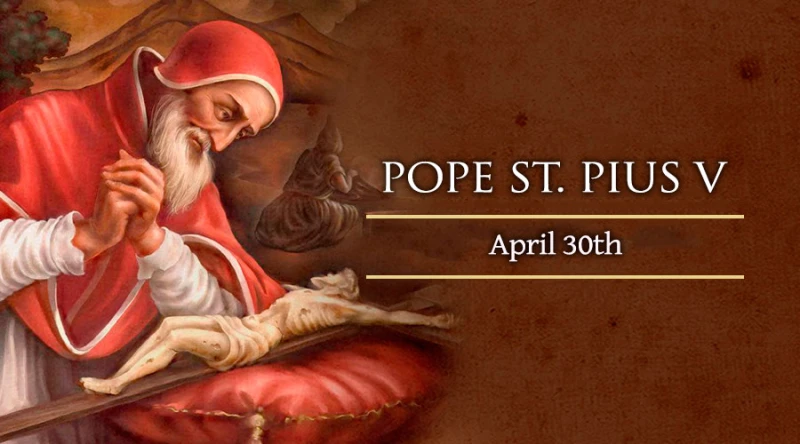
Saint Pius V, Pope


Saint Pius V, Pope

Feast date: Apr 30

St. Pius V was born Michele Ghislieri in 1504 to poor parents of noble lineage at Bosco, near Alexandria, Lombardy on January 17, 1504. He worked as a shepherd until the age of 14 when he encountered two Dominicans who recognized his intelligence and virtue. He joined the Dominicans and was ordained a priest at 24. He taught philosophy and theology for 16 years during which he was elected prior of many houses. He was known for his austere penances, his long hours of prayer and fasting, and the holiness of his speech.

He was elected Bishop of Sutri in 1556, and served as an inquisitor in Milan and Lombardi, and then as inquisitor general of the Church and a cardinal in 1557. He was known in this capacity as an able, yet unflinching man who rigorously fought heresy and corruption wherever he encountered it.

He was elected Pope on January 7, 1566, with the influential backing of his friend St. Charles Borromeo, and took the name Pius V.  He immediately put into action his vast program of reform by getting rid of many of the extravagant luxuries then prevalent in his court. He gave the money usually invested in these luxuries to the poor whom he personally cared for, washing their feet, consoling those near death, and tending to lepers and the very sick. He spent long hours before the Blessed Sacrament despite his heavy workload.

His pontificate was dedicated to applying the reforms of the Council of Trent, raising the standard of morality and reforming the clergy, and strongly supporting foreign missions. The Catechism of the Council of Trent was completed during his reign, and he revised the Roman Breviary and Missal, which remained in use until the reforms of Vatican II.

His six year pontificate saw him constantly at war with two massive enemy forces; the Protestant heretics and the spread of their doctrines in the West, and the Turkish armies who were advancing from the East. He encouraged efforts to battle Protestantism by education and preaching, and giving strong support to the newly formed Society of Jesus, founded by St. Ignatius of Loyola. He excommunicated Queen Elizabeth I, and supported Catholics who were oppressed and intimidated by Protestant princes, especially in Germany.

He worked hard to unite the Christian armies against the Turks, and perhaps the most famous success of his papacy was the miraculous victory of the Christian fleet in the battle of Lepanto on October 7, 1571. The island of Malta was attacked by the Turkish fleet, and nearly every man defending the fortress was killed in battle. The Pope sent out a fleet to meet the enemy, requesting that each man on board pray the Rosary and receive communion. Meanwhile, he called on all of Europe to recite the Rosary and ordered a 40 hour devotion in Rome during which time the battle took place. The Christian fleet, vastly outnumbered by the Turks, inflicted an impossible defeat on the Turkish navy, demolishing the entire fleet.

In memory of the triumph, he declared the day the Feast of Our Lady of the Rosary because of her intercession in answering the mass recitation of the Rosary and obtaining the victory. He has also been called ‘the Pope of the Rosary’ for this reason.

Pope Pius V died seven months later on May 1, 1572, of a painful disease, uttering “O Lord, increase my sufferings and my patience!” He is enshrined at Santa Maria Maggiore in Rome, and was beatified by Clement X in 1672. He was canonized by Clement XI in 1712.

Saint Pius V, Pope Read More »

Memorial of Saint Catherine of Siena, Virgin and Doctor of the Church

Reading I Acts 5:34-42

A Pharisee in the Sanhedrin named Gamaliel,
a teacher of the law, respected by all the people,
stood up, ordered the Apostles to be put outside for a short time,
and said to the Sanhedrin, “Fellow children of Israel,
be careful what you are about to do to these men.
Some time ago, Theudas appeared, claiming to be someone important,
and about four hundred men joined him, but he was killed,
and all those who were loyal to him
were disbanded and came to nothing.
After him came Judas the Galilean at the time of the census.
He also drew people after him,
but he too perished and all who were loyal to him were scattered.
So now I tell you,
have nothing to do with these men, and let them go.
For if this endeavor or this activity is of human origin,
it will destroy itself.
But if it comes from God, you will not be able to destroy them;
you may even find yourselves fighting against God.”
They were persuaded by him.
After recalling the Apostles, they had them flogged,
ordered them to stop speaking in the name of Jesus,
and dismissed them.
So they left the presence of the Sanhedrin,
rejoicing that they had been found worthy
to suffer dishonor for the sake of the name.
And all day long, both at the temple and in their homes,
they did not stop teaching and proclaiming the Christ, Jesus.

Responsorial Psalm 27:1, 4, 13-14

R.        (see 4abc)  One thing I seek: to dwell in the house of the Lord.
or:
R.        Alleluia.
The LORD is my light and my salvation;
            whom should I fear?
The LORD is my life’s refuge;
            of whom should I be afraid?
R.        One thing I seek: to dwell in the house of the Lord.
or:
R.        Alleluia.
One thing I ask of the LORD
            this I seek:
To dwell in the house of the LORD
            all the days of my life,
That I may gaze on the loveliness of the LORD
            and contemplate his temple.
R.        One thing I seek: to dwell in the house of the Lord.
or:
R.        Alleluia.
I believe that I shall see the bounty of the LORD
            in the land of the living.
Wait for the LORD with courage;
            be stouthearted, and wait for the LORD.
R.        One thing I seek: to dwell in the house of the Lord.
or:
R.        Alleluia.

Alleluia Mt 4:4b

R. Alleluia, alleluia.
One does not live on bread alone,
but on every word that comes forth from the mouth of God.

R. Alleluia, alleluia.

Gospel Jn 6:1-15

Jesus went across the Sea of Galilee.
A large crowd followed him,
because they saw the signs he was performing on the sick.
Jesus went up on the mountain,
and there he sat down with his disciples.
The Jewish feast of Passover was near.
When Jesus raised his eyes and saw that a large crowd was coming to him,
he said to Philip, “Where can we buy enough food for them to eat?”
He said this to test him,
because he himself knew what he was going to do.
Philip answered him,
“Two hundred days’ wages worth of food would not be enough
for each of them to have a little.”
One of his disciples,
Andrew, the brother of Simon Peter, said to him,
“There is a boy here who has five barley loaves and two fish;
but what good are these for so many?”
Jesus said, “Have the people recline.”
Now there was a great deal of grass in that place.
So the men reclined, about five thousand in number.
Then Jesus took the loaves, gave thanks,
and distributed them to those who were reclining,
and also as much of the fish as they wanted.
When they had had their fill, he said to his disciples,
“Gather the fragments left over,
so that nothing will be wasted.”
So they collected them,
and filled twelve wicker baskets with fragments
from the five barley loaves that had been more than they could eat.
When the people saw the sign he had done, they said,
“This is truly the Prophet, the one who is to come into the world.”
Since Jesus knew that they were going to come and carry him off
to make him king,
he withdrew again to the mountain alone.

– – –

Lectionary for Mass for Use in the Dioceses of the United States, second typical edition, Copyright © 2001, 1998, 1997, 1986, 1970 Confraternity of Christian Doctrine; Psalm refrain © 1968, 1981, 1997, International Committee on English in the Liturgy, Inc. All rights reserved. Neither this work nor any part of it may be reproduced, distributed, performed or displayed in any medium, including electronic or digital, without permission in writing from the copyright owner.

Memorial of Saint Catherine of Siena, Virgin and Doctor of the Church Read More »

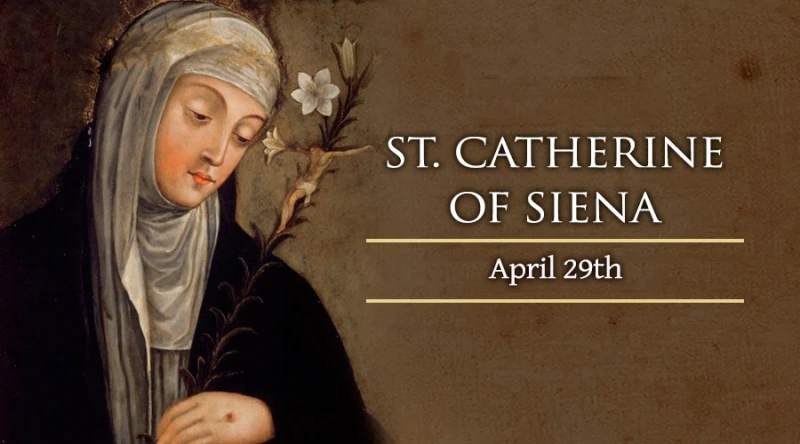
St. Catherine of Siena


St. Catherine of Siena

Feast date: Apr 29

St. Catherine was a third-order Dominican, peacemaker and counselor to the Pope. She singlehandedly ended the Avignon exile of the successors of Peter in the 14th century.

She is the co-patron of Italy and of Europe.

Born in Siena, on the feast of the Annunciation, March 25, 1347, Catherine was the 23rd of Jacopo and Lapa Benincasa’s 25 children. Her twin sister died in infancy.

She exhibited an unusually independent character as a child and an exceptionally intense prayer life. When she was seven years old she had the first of her mystical visions, in which she saw Jesus surrounded by saints and seated in glory. In the same year she vowed to consecrate her virginity to Christ. When, at the age of 16, her parents decided that she should marry, she cut off her hair to make herself less appealing, and her father, realizing that he couldn’t contend with her resolve, let her have her way. 

She joined the Dominican Tertiaries and lived a deep and solitary life of prayer and meditation for the next three years in which she had constant mystical experiences, capped, by the end of the three years with an extraordinary union with God granted to only a few mystics, known as ‘mystical marriage.’

St. Catherine suffered many intense periods of desolation alongside her mystical ecstasies, often feeling totally abandoned by God.

She ended her solitude at this point and began tending to the sick, poor, and marginalized, especially lepers. As her reputation for holiness and remarkable personality became known throughout Siena, she attracted a band of disciples, two of whom became her confessors and biographers, and together they served Christ in the poor with even greater ardor.

The Lord called her to a more public life while she was still in her 20s, and she established correspondences with many influential figures, advising and admonishing them and exhorting them to holiness, including the Pope himself who she never hesitated to rebuke when she saw fit.

Great political acts which are attributed to her include achieving peace between the Holy See and Florence who were at war, to convince the Pope to return from his Avignon exile, which he did in 1376, and to heal the great schism between the followers of the legitimate Pope, Urban VI, and those who opposed him in 1380. She achieved this while on her deathbed.

Her Dialogues, one of the classics of Italian literature, are the record of her mystical visions which she dictated in a state of mystical ecstasy.

In 1375, while visiting Pisa, she received the stigmata, even though they never appeared on her body during her lifetime, owing to her request to God. They appeared only on her incorruptible body after her death.

She died in Rome on April 29, 1380, at the age of 33.

St. Catherine of Siena Read More »