
Please mind our dust!

We are currently working on revamping our website!
Thank you for your patience!

CRD Solutions

Thursday of the Second Week of Easter

Reading I Acts 5:27-33

When the court officers had brought the Apostles in
and made them stand before the Sanhedrin,
the high priest questioned them,
“We gave you strict orders did we not,
to stop teaching in that name.
Yet you have filled Jerusalem with your teaching
and want to bring this man’s blood upon us.”
But Peter and the Apostles said in reply,
“We must obey God rather than men.
The God of our ancestors raised Jesus,
though you had him killed by hanging him on a tree.
God exalted him at his right hand as leader and savior
to grant Israel repentance and forgiveness of sins.
We are witnesses of these things,
as is the Holy Spirit whom God has given to those who obey him.”

When they heard this,
they became infuriated and wanted to put them to death.

Responsorial Psalm 34:2 and 9, 17-18, 19-20

R.        (7a) The Lord hears the cry of the poor.
or:
R.        Alleluia.
I will bless the LORD at all times;
            his praise shall be ever in my mouth.
Taste and see how good the LORD is;
            blessed the man who takes refuge in him.
R.        The Lord hears the cry of the poor.
or:
R.        Alleluia.
The LORD confronts the evildoers,
            to destroy remembrance of them from the earth.
When the just cry out, the LORD hears them,
            and from all their distress he rescues them.
R.        The Lord hears the cry of the poor.
or:
R.        Alleluia.
The LORD is close to the brokenhearted;
            and those who are crushed in spirit he saves.
Many are the troubles of the just man,
            but out of them all the LORD delivers him.
R.        The Lord hears the cry of the poor.
or:
R.        Alleluia.

Alleluia Jn 20:29

R. Alleluia, alleluia.
You believe in me, Thomas, because you have seen me, says the Lord;
blessed are those who have not seen, but still believe!

R. Alleluia, alleluia.

Gospel Jn 3:31-36

The one who comes from above is above all.
The one who is of the earth is earthly and speaks of earthly things.
But the one who comes from heaven is above all.
He testifies to what he has seen and heard,
but no one accepts his testimony.
Whoever does accept his testimony certifies that God is trustworthy.
For the one whom God sent speaks the words of God.
He does not ration his gift of the Spirit.
The Father loves the Son and has given everything over to him.
Whoever believes in the Son has eternal life,
but whoever disobeys the Son will not see life,
but the wrath of God remains upon him.

– – –

Lectionary for Mass for Use in the Dioceses of the United States, second typical edition, Copyright © 2001, 1998, 1997, 1986, 1970 Confraternity of Christian Doctrine; Psalm refrain © 1968, 1981, 1997, International Committee on English in the Liturgy, Inc. All rights reserved. Neither this work nor any part of it may be reproduced, distributed, performed or displayed in any medium, including electronic or digital, without permission in writing from the copyright owner.

Thursday of the Second Week of Easter Read More »
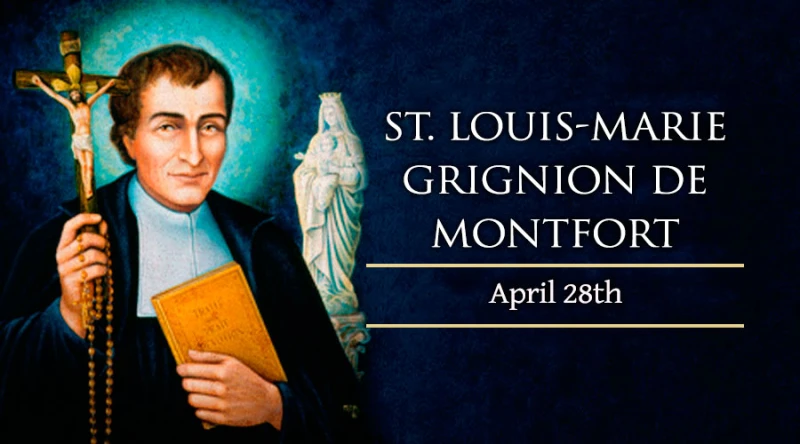
St. Louis-Marie Grignion de Montfort


St. Louis-Marie Grignion de Montfort

Feast date: Apr 28

On April 28, the universal Church celebrates the feast day of Louis-Marie de Monfort, a 17th century saint who is revered for his intense devotion to the Blessed Virgin Mary.

St. Louis-Marie is perhaps most famously known for his prayer of entrustment to Our Lady, “Totus Tuus ego sum,” which means, “I am all yours.” The late-Pope John Paul II took the phrase “Totus Tuus” as his episcopal motto.

Born in Montfort, Brittany, on January 31, 1673, St. Louis-Marie possessed a strong devotion to the Blessed Sacrament as a child, and was also intimately devoted to the Blessed Virgin, especially through the Rosary. He took the name Marie at his confirmation.

The saint manifested a love for the poor while he was at school and joined a society of young men who ministered to the poor and the sick on school holidays. When he was 19, he walked 130 miles to Paris to study theology, gave all he had to the poor that he met along the way and made a vow to live only on alms. After his ordination at 27, he served as a hospital chaplain until the management of the hospital resented his reorganization of the staff and sent him away.

St. Louis-Marie discovered his great gift for preaching at the age of 32, and committed himself to it for the rest of his life. He met with such great success that he often drew crowds of thousands to hear his sermons in which he encouraged frequent communion and devotion to Mary.

But he also met with opposition, especially from the Jansenists, a heretical movement within the Church that believed in absolute Predestination, in which only a chosen few are saved, and the rest damned. Much of France was influenced by Jansenism, including many bishops, who banished St. Loius-Marie from preaching in their dioceses. He was even poisoned by Jansenists in La Rochelle, but survived, though he suffered ill health after.

While recuperating from the effects of the poisoning, he wrote the masterpiece of Marian piety, “True Devotion to the Blessed Virgin,” which he correctly prophesied would be hidden by the devil for a time. His seminal work was discovered 200 years after his death.

One year before he died, St. Louis-Marie founded two congregations: the Daughters of Divine Wisdom – which tended to the sick in hospitals and the education of poor girls, and the Company of Mary, missionaries devoted to preaching and to spreading devotion to Mary.

St. Louis-Marie Grignion de Montfort Read More »

Wednesday of the Second Week of Easter

Reading I Acts 5:17-26

The high priest rose up and all his companions,
that is, the party of the Sadducees,
and, filled with jealousy,
laid hands upon the Apostles and put them in the public jail.
But during the night, the angel of the Lord opened the doors of the prison,
led them out, and said,
“Go and take your place in the temple area,
and tell the people everything about this life.”
When they heard this,
they went to the temple early in the morning and taught.
When the high priest and his companions arrived,
they convened the Sanhedrin,
the full senate of the children of Israel,
and sent to the jail to have them brought in.
But the court officers who went did not find them in the prison,
so they came back and reported,
“We found the jail securely locked
and the guards stationed outside the doors,
but when we opened them, we found no one inside.”
When the captain of the temple guard and the chief priests heard this report,
they were at a loss about them,
as to what this would come to.
Then someone came in and reported to them,
“The men whom you put in prison are in the temple area
and are teaching the people.”
Then the captain and the court officers went and brought them,
but without force,
because they were afraid of being stoned by the people.

Responsorial Psalm 34:2-3, 4-5, 6-7, 8-9

R.        (7a) The Lord hears the cry of the poor.
or:
R.        Alleluia.
I will bless the LORD at all times;
            his praise shall be ever in my mouth.
Let my soul glory in the LORD;
            the lowly will hear me and be glad.
R.        The Lord hears the cry of the poor.
or:
R.        Alleluia.
Glorify the LORD with me,
            let us together extol his name.
I sought the LORD, and he answered me
            and delivered me from all my fears.
R.        The Lord hears the cry of the poor.
or:
R.        Alleluia.
Look to him that you may be radiant with joy,
            and your faces may not blush with shame.
When the poor one called out, the LORD heard,
            and from all his distress he saved him.
R.        The Lord hears the cry of the poor.
or:
R.        Alleluia.
The angel of the LORD encamps
            around those who fear him, and delivers them.
Taste and see how good the LORD is;
            blessed the man who takes refuge in him.
R.        The Lord hears the cry of the poor.
or:
R.        Alleluia.

Alleluia Jn 3:16

R. Alleluia, alleluia.
God so love the world that he gave his only-begotten Son,
so that everyone who believes in him might have eternal life.

R. Alleluia, alleluia.

Gospel Jn 3:16-21

God so loved the world that he gave his only-begotten Son,
so that everyone who believes in him might not perish
but might have eternal life.
For God did not send his Son into the world to condemn the world,
but that the world might be saved through him.
Whoever believes in him will not be condemned,
but whoever does not believe has already been condemned,
because he has not believed in the name of the only-begotten Son of God.
And this is the verdict,
that the light came into the world,
but people preferred darkness to light,
because their works were evil.
For everyone who does wicked things hates the light
and does not come toward the light,
so that his works might not be exposed.
But whoever lives the truth comes to the light,
so that his works may be clearly seen as done in God.

– – –

Lectionary for Mass for Use in the Dioceses of the United States, second typical edition, Copyright © 2001, 1998, 1997, 1986, 1970 Confraternity of Christian Doctrine; Psalm refrain © 1968, 1981, 1997, International Committee on English in the Liturgy, Inc. All rights reserved. Neither this work nor any part of it may be reproduced, distributed, performed or displayed in any medium, including electronic or digital, without permission in writing from the copyright owner.

Wednesday of the Second Week of Easter Read More »
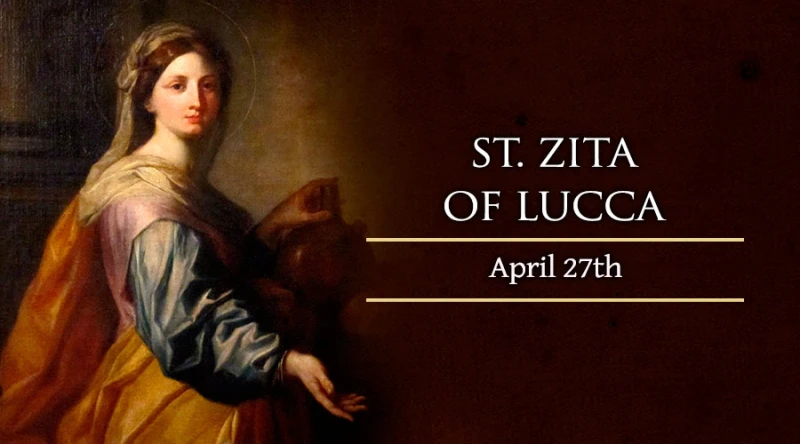
St. Zita of Lucca


St. Zita of Lucca

Feast date: Apr 27

On April 27 the Catholic Church honors Saint Zita, a 13th century Italian woman whose humble and patient service to God has made her a patron saint of maids and other domestic workers.

Born into poverty during the early 1200s, Zita was taught by her mother from an early age to seek God’s will in all circumstances. She had already developed a strong prayer life by the time she was sent, at age 12, to work in the home of the Fatinelli family in Lucca.

Zita’s employers lived near a church where she managed – by waking up extremely early in the morning – to attend daily Mass. She looked upon her work primarily as a means of serving God, and kept herself mindful of his presence during long hours of exhausting tasks.

Her presence in the Fatinelli household, however, was inexplicably unwelcome and met with harsh treatment for a number of years. Zita suffered hostility and abuse from her employers, including fits of rage and beatings.

The young woman faced these trials with patience and inner strength developed through a life of prayer. In time, the members of the household came to value her service, and appreciate the virtues she had acquired through God’s grace.

Zita maintained her humility when she was promoted to a position of responsibility within the Fatinelli home. She continued to view her earthly responsibilities as a service to God, and to seek his presence through prayer and fasting. She also refused to hold a grudge against those who once mistreated her.

Within her new household role, Zita was faithful to Christ’s admonition that superiors should conduct themselves as the servants of all. She was kind to those under her direction, and mindful of the poor through frequent almsgiving to the point of personal sacrifice.

Throughout her life, Zita found a source of strength and consolation in the Mass and Holy Communion, which frequently moved her to tears. Despite her many responsibilities, she frequently set aside time to recall God’s presence through contemplative prayer in the course of the day.

One anecdote relates a story of Zita giving her own food or that of her master to the poor. On one morning, Zita left her chore of baking bread to tend to someone in need. Some of the other servants made sure the Fatinelli family was aware of what happened; when they went to investigate, they claimed to have found angels in the Fatinelli kitchen, baking the bread for her.

After foretelling her own death and spiritually preparing for it, Saint Zita died in Lucca on April 27, 1271. Many residents regarded her as a saint and began to seek her intercession, to which a large number of miracles were attributed. Some writers even began referring to the city of Lucca as “Santa Zita” in her honor.

The Fatinelli family, which had once caused St. Zita such extreme suffering, eventually contributed to the cause of her canonization. The earliest account of her life was found in a manuscript belonging to the family, and published in 1688.

The Church’s liturgical veneration of St. Zita was introduced in the early 1500s, and confirmed by Pope Innocent XII in 1696. In 1580, her body was exhumed and found to be miraculously incorrupt, but it has since been mummified. It is venerated today in the Basilica of St. Frediano, where she attended Mass during her life.

St. Zita of Lucca Read More »

Tuesday of the Second Week of Easter

Reading I Acts 4:32-37

The community of believers was of one heart and mind,
and no one claimed that any of his possessions was his own,
but they had everything in common.
With great power the Apostles bore witness
to the resurrection of the Lord Jesus,
and great favor was accorded them all.
There was no needy person among them,
for those who owned property or houses would sell them,
bring the proceeds of the sale,
and put them at the feet of the Apostles,
and they were distributed to each according to need.

Thus Joseph, also named by the Apostles Barnabas
(which is translated Ason of encouragement”),
a Levite, a Cypriot by birth,
sold a piece of property that he owned,
then brought the money and put it at the feet of the Apostles.

Responsorial Psalm 93:1ab, 1cd-2, 5

R.        (1a)  The Lord is king; he is robed in majesty.
or:
R.        Alleluia.
The LORD is king, in splendor robed;
            robed is the LORD and girt about with strength.
R.        The Lord is king; he is robed in majesty.
or:
R.        Alleluia.
And he has made the world firm,
            not to be moved.
Your throne stands firm from of old;
            from everlasting you are, O LORD.
R.        The Lord is king; he is robed in majesty.
or:
R.        Alleluia.
Your decrees are worthy of trust indeed:
            holiness befits your house,
            O LORD, for length of days.
R.        The Lord is king; he is robed in majesty.
or:
R.        Alleluia.

Alleluia Jn 3:14-15

R. Alleluia, alleluia.
The Son of Man must be lifted up,
so that everyone who believes in him
may have eternal life.
R. Alleluia, alleluia.

Gospel Jn 3:7b-15

Jesus said to Nicodemus:
“‘You must be born from above.’
The wind blows where it wills, and you can hear the sound it makes,
but you do not know where it comes from or where it goes;
so it is with everyone who is born of the Spirit.”
Nicodemus answered and said to him,
‘How can this happen?”
Jesus answered and said to him,
“You are the teacher of Israel and you do not understand this?
Amen, amen, I say to you,
we speak of what we know and we testify to what we have seen,
but you people do not accept our testimony.
If I tell you about earthly things and you do not believe,
how will you believe if I tell you about heavenly things?
No one has gone up to heaven
except the one who has come down from heaven, the Son of Man.
And just as Moses lifted up the serpent in the desert,
so must the Son of Man be lifted up,
so that everyone who believes in him may have eternal life.”

– – –

Lectionary for Mass for Use in the Dioceses of the United States, second typical edition, Copyright © 2001, 1998, 1997, 1986, 1970 Confraternity of Christian Doctrine; Psalm refrain © 1968, 1981, 1997, International Committee on English in the Liturgy, Inc. All rights reserved. Neither this work nor any part of it may be reproduced, distributed, performed or displayed in any medium, including electronic or digital, without permission in writing from the copyright owner.

Tuesday of the Second Week of Easter Read More »