Please mind our dust!

We are currently working on revamping our website!
Thank you for your patience!

CRD Solutions

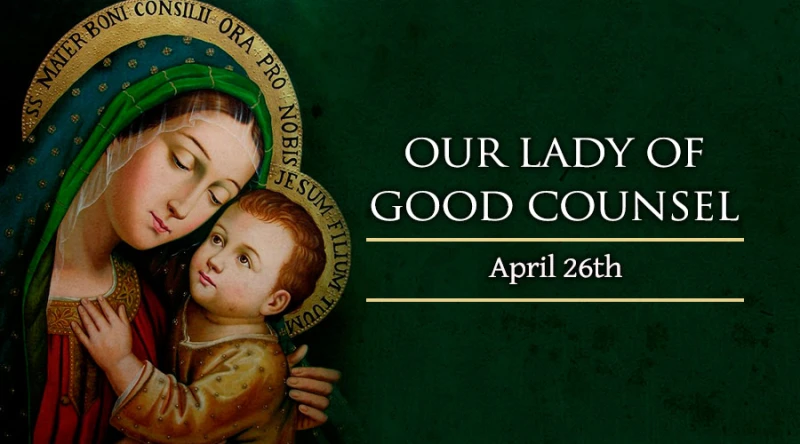
Our Lady of Good Counsel


Our Lady of Good Counsel

Feast date: Apr 26

On the Feast of St. Mark, April 25, 1467, at the close of a festival in Genazzano, Italy, a cloud descended upon an ancient 5th-century deteriorated church, dedicated to Our Lady of Good Counsel. When the cloud disappeared, the festive crowd found a small, fragile image of the Blessed Virgin and Child on a thin sheet of plaster. The painting is said to have hung in mid-air, suspended without support, floating, on a small ledge. This particular fresco is said to date to the time of the Apostles. It had long been venerated in Albania’s capital city, Scutari.

Much of the church of Our Lady of Good Counsel was destroyed in World War II, but the image remained intact and in place. The miraculous image is still there today after more than 500 years. Countless miracles have been attributed to the prayerful intercession of Our Lady of Good Counsel.

Many pilgrims visit the church in Genazzano, and take part in the annual spring celebration, observed on April 25. Elsewhere in the world, the feast is celebrated April 26.

Our Lady of Good Counsel Read More »

Feast of Saint Mark, evangelist

Reading I 1 Pt 5:5b-14

Beloved:         
Clothe yourselves with humility
in your dealings with one another, for:

            God opposes the proud
                        but bestows favor on the humble.

So humble yourselves under the mighty hand of God,
that he may exalt you in due time.
Cast all your worries upon him because he cares for you.

Be sober and vigilant.
Your opponent the Devil is prowling around like a roaring lion
looking for someone to devour.
Resist him, steadfast in faith,
knowing that your brothers and sisters throughout the world
undergo the same sufferings.
The God of all grace
who called you to his eternal glory through Christ Jesus
will himself restore, confirm, strengthen, and establish you
after you have suffered a little.
To him be dominion forever.  Amen.

I write you this briefly through Silvanus,
whom I consider a faithful brother,
exhorting you and testifying that this is the true grace of God.
Remain firm in it.
The chosen one at Babylon sends you greeting, as does Mark, my son.
Greet one another with a loving kiss.
Peace to all of you who are in Christ.

Responsorial Psalm 89:2-3, 6-7, 16-17

R.        (2)  For ever I will sing the goodness of the Lord.
or:
R.        Alleluia.
The favors of the LORD I will sing forever;
            through all generations my mouth shall proclaim your faithfulness.
For you have said, “My kindness is established forever”;
            in heaven you have confirmed your faithfulness.
R.        For ever I will sing the goodness of the Lord.
or:
R.        Alleluia.
The heavens proclaim your wonders, O LORD,
            and your faithfulness, in the assembly of the holy ones.
For who in the skies can rank with the LORD?
            Who is like the LORD among the sons of God?
R.        For ever I will sing the goodness of the Lord.
or:
R.        Alleluia.
Blessed the people who know the joyful shout;
            in the light of your countenance, O LORD, they walk.
At your name they rejoice all the day,
            and through your justice they are exalted.
R.        For ever I will sing the goodness of the Lord.
or:
R.        Alleluia.

Alleluia 1 Cor 1:23a-24b

R. Alleluia, alleluia.
We proclaim Christ crucified;
he is the power of God and the wisdom of God.

R. Alleluia, alleluia.

Gospel Mk 16:15-20

Jesus appeared to the Eleven and said to them:
“Go into the whole world
and proclaim the Gospel to every creature.
Whoever believes and is baptized will be saved;
whoever does not believe will be condemned.
These signs will accompany those who believe:
in my name they will drive out demons,
they will speak new languages.
They will pick up serpents with their hands,
and if they drink any deadly thing, it will not harm them.
They will lay hands on the sick, and they will recover.”

Then the Lord Jesus, after he spoke to them,
was taken up into heaven
and took his seat at the right hand of God.
But they went forth and preached everywhere,
while the Lord worked with them
and confirmed the word through accompanying signs.

– – –

Lectionary for Mass for Use in the Dioceses of the United States, second typical edition, Copyright © 2001, 1998, 1997, 1986, 1970 Confraternity of Christian Doctrine; Psalm refrain © 1968, 1981, 1997, International Committee on English in the Liturgy, Inc. All rights reserved. Neither this work nor any part of it may be reproduced, distributed, performed or displayed in any medium, including electronic or digital, without permission in writing from the copyright owner.

Feast of Saint Mark, evangelist Read More »

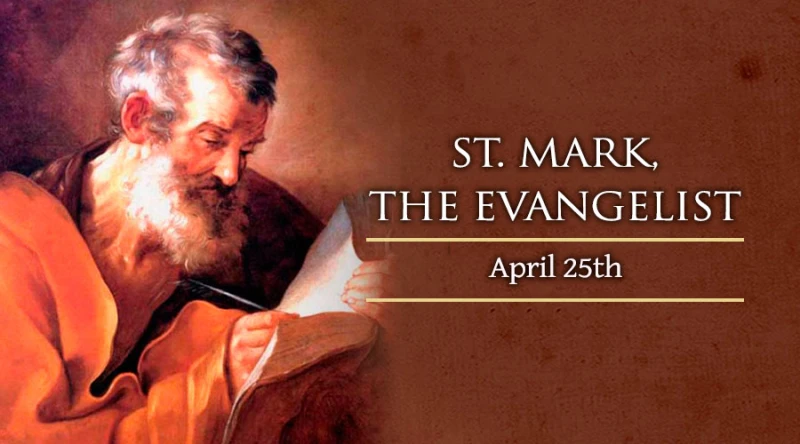
St. Mark, the Evangelist


St. Mark, the Evangelist

Feast date: Apr 25

St. Mark, the Evangelist, is the author of the second Gospel and the patron saint of notaries. He wrote the Gospel in Greek for the Gentile converts to Christianity. Tradition says the Romans asked St. Mark to record the teachings of St. Peter about Jesus. St. Mark is often depicted as a winged lion in religious art.

St. Mark is also said to have traveled with St. Paul and St. Barnabas, who was Mark’s cousin, on their missionary journey through Cyprus. Mark is said to have founded the Church in Alexandria.

St. Mark is sometimes called John Mark in the New Testament. Both he and his mother, Mary, were highly esteemed in the early Church, and his mother’s house in Jerusalem served as a meeting place for Christians.

St. Mark, the Evangelist Read More »

Second Sunday of Easter

Reading I Acts 5:12-16

Many signs and wonders were done among the people
at the hands of the apostles.
They were all together in Solomon’s portico.
None of the others dared to join them, but the people esteemed them.
Yet more than ever, believers in the Lord,
great numbers of men and women, were added to them.
Thus they even carried the sick out into the streets
and laid them on cots and mats
so that when Peter came by,
at least his shadow might fall on one or another of them.
A large number of people from the towns
in the vicinity of Jerusalem also gathered,
bringing the sick and those disturbed by unclean spirits,
and they were all cured.

Responsorial Psalm Ps 118:2-4, 13-15, 22-24

R  (1) Give thanks to the Lord for he is good, his love is everlasting.
or:
R  Alleluia.
Let the house of Israel say,
            “His mercy endures forever.”
Let the house of Aaron say,
            “His mercy endures forever.”
Let those who fear the LORD say,
            “His mercy endures forever.”
R  Give thanks to the Lord for he is good, his love is everlasting.
or:
R  Alleluia.
I was hard pressed and was falling,
            but the LORD helped me.
My strength and my courage is the LORD,
            and he has been my savior.
The joyful shout of victory
            in the tents of the just:
R  Give thanks to the Lord for he is good, his love is everlasting.
or:
R  Alleluia.
The stone which the builders rejected
            has become the cornerstone.
By the LORD has this been done;
            it is wonderful in our eyes.
This is the day the LORD has made;
            let us be glad and rejoice in it.
R  Give thanks to the Lord for he is good, his love is everlasting.
or:
R  Alleluia.

Reading II Rev 1:9-11a, 12-13, 17-19

I, John, your brother, who share with you
the distress, the kingdom, and the endurance we have in Jesus,
found myself on the island called Patmos
because I proclaimed God’s word and gave testimony to Jesus.
I was caught up in spirit on the Lord’s day
and heard behind me a voice as loud as a trumpet, which said,
“Write on a scroll what you see.”
Then I turned to see whose voice it was that spoke to me,
and when I turned, I saw seven gold lampstands
and in the midst of the lampstands one like a son of man,
wearing an ankle-length robe, with a gold sash around his chest.

When I caught sight of him, I fell down at his feet as though dead.
He touched me with his right hand and said, “Do not be afraid.
I am the first and the last, the one who lives.
Once I was dead, but now I am alive forever and ever.
I hold the keys to death and the netherworld.
Write down, therefore, what you have seen,
and what is happening, and what will happen afterwards.”

Alleluia Jn 20:29

R. Alleluia, alleluia.
You believe in me, Thomas, because you have seen me, says the Lord;
blessed are those who have not seen me, but still believe!

R. Alleluia, alleluia.

Gospel Jn 20:19-31

On the evening of that first day of the week,
when the doors were locked, where the disciples were,
for fear of the Jews,
Jesus came and stood in their midst
and said to them, “Peace be with you.”
When he had said this, he showed them his hands and his side.
The disciples rejoiced when they saw the Lord.
Jesus said to them again, “Peace be with you.
As the Father has sent me, so I send you.”
And when he had said this, he breathed on them and said to them,
“Receive the Holy Spirit.
Whose sins you forgive are forgiven them,
and whose sins you retain are retained.”

Thomas, called Didymus, one of the Twelve,
was not with them when Jesus came.
So the other disciples said to him, “We have seen the Lord.”
But he said to them,
“Unless I see the mark of the nails in his hands
and put my finger into the nailmarks
and put my hand into his side, I will not believe.”

Now a week later his disciples were again inside
and Thomas was with them.
Jesus came, although the doors were locked,
and stood in their midst and said, “Peace be with you.”
Then he said to Thomas, “Put your finger here and see my hands,
and bring your hand and put it into my side,
and do not be unbelieving, but believe.”
Thomas answered and said to him, “My Lord and my God!”
Jesus said to him, “Have you come to believe because you have seen me?
Blessed are those who have not seen and have believed.”

Now Jesus did many other signs in the presence of his disciples
that are not written in this book.
But these are written that you may come to believe
that Jesus is the Christ, the Son of God,
and that through this belief you may have life in his name.

– – –

Lectionary for Mass for Use in the Dioceses of the United States, second typical edition, Copyright © 2001, 1998, 1997, 1986, 1970 Confraternity of Christian Doctrine; Psalm refrain © 1968, 1981, 1997, International Committee on English in the Liturgy, Inc. All rights reserved. Neither this work nor any part of it may be reproduced, distributed, performed or displayed in any medium, including electronic or digital, without permission in writing from the copyright owner.

Second Sunday of Easter Read More »

St. Fidelis of Sigmaringen


St. Fidelis of Sigmaringen

Feast date: Apr 24

A former lawyer who left his profession to become a Capuchin Franciscan priest, Saint Fidelis of Sigmaringen has his liturgical memorial on April 24.

Fidelis’ life bridged the sixteenth and seventeenth centuries, a time of religious conflict in Western Europe. He died at the hands of a mob while preaching in Switzerland, where he had gone to combat the Calvinist heresy.

The future “Fidelis” received the name of Mark Rey at the time of his birth, during 1577 in present-day Germany. Mark studied at the University of Freiburg, and worked for a time as a private tutor. Eventually he went back to the university and earned his law degree around 1611.

Though he had already shown signs of devotion to God and studied canon law alongside civil law, Mark opted for a secular career as an attorney. Within a year he was known as “the poor man’s lawyer” because of his concern for the needy. Just as quickly, he became disgusted with the corrupt ways of his chosen field .

Leaving his legal practice behind, Mark decided to give his life directly to the service of Christ and the Church. In short order he received ordination as a priest, and joined the Capuchin Franciscans in Freiburg.

With his entry into the order he received the name “Fidelis,” meaning “faithful” — after the words of Jesus Christ in the Book of Revelation, “Remain faithful until death, and I will give you the crown of life.” As he embraced radical poverty and simplicity, the attorney-turned-Franciscan left his inheritance to a scholarship fund for poor seminarians, who also received his books.

Fidelis showed his love for God through prayer and fasting, while caring for his neighbors through preaching, writing, and the celebration of the sacraments. He showed particular care for the poor and sick, and was especially revered for his work among Austrian soldiers who were suffering from a plague epidemic.

During 1614 a Swiss Catholic bishop had sought help from the Capuchins, to restore the faith and counteract the spread of Calvinist Protestantism. In 1621, Fidelis was sent on the mission. He brought just four items: a Bible, a prayer book, a crucifix and a copy of the Capuchin rule.

The winter of 1621-22 was a busy period of preaching, instruction and theological disputation for the Franciscan priest. He preached not only in the pulpits of Catholic churches, but also in public places, and even in the meeting-places of the Calvinists themselves. Some Swiss Protestants responded with hostility, but many others were also brought back to the Church.

Like many cases of religious persecution during this time, Fidelis’ treatment at the hands of the Calvinists did not stem exclusively from doctrinal disagreement. National and cultural tensions also contributed, with many Swiss Protestants suspecting that the Catholic mission was part of an Austrian plot against their nation.

This volatile situation boiled over on April 24, 1622, when Fidelis’ preaching provoked a riot at a church in the village of Seewis. Some Austrian soldiers were killed in the uproar, and a would-be assassin shot at the priest.

After declining an offer of help from a Protestant, Fidelis was confronted outside the church by a mob, and told to choose between his Catholic beliefs and his life. Fidelis was defiant: “The Catholic religion is the faith of all ages. I fear not death.”

St. Fidelis was beaten and stabbed to death. The sight of his martyrdom, however, is said to have converted one of the Protestant preachers who led the mob. A succession of attested miracles led to his canonization in 1746.

St. Fidelis of Sigmaringen Read More »