Please mind our dust!

We are currently working on revamping our website!
Thank you for your patience!

CRD Solutions

Saturday in the Octave of Easter

Reading I Acts 4:13-21

Observing the boldness of Peter and John
and perceiving them to be uneducated, ordinary men,
the leaders, elders, and scribes were amazed,
and they recognized them as the companions of Jesus.
Then when they saw the man who had been cured standing there with them,
they could say nothing in reply.
So they ordered them to leave the Sanhedrin,
and conferred with one another, saying,
“What are we to do with these men?
Everyone living in Jerusalem knows that a remarkable sign
was done through them, and we cannot deny it.
But so that it may not be spread any further among the people,
let us give them a stern warning
never again to speak to anyone in this name.”

So they called them back
and ordered them not to speak or teach at all in the name of Jesus.
Peter and John, however, said to them in reply,
“Whether it is right in the sight of God
for us to obey you rather than God, you be the judges.
It is impossible for us not to speak about what we have seen and heard.”
After threatening them further,
they released them,
finding no way to punish them,
on account of the people who were all praising God
for what had happened.

Responsorial Psalm 118:1 and 14-15ab, 16-18, 19-21

R.        (21a) I will give thanks to you, for you have answered me.
or:
R.        Alleluia.
Give thanks to the LORD, for he is good,
            for his mercy endures forever.
My strength and my courage is the LORD,
            and he has been my savior.
The joyful shout of victory
            in the tents of the just.
R.        I will give thanks to you, for you have answered me.
or:
R.        Alleluia.
“The right hand of the LORD is exalted;
            the right hand of the LORD has struck with power.”
I shall not die, but live,
            and declare the works of the LORD.
Though the LORD has indeed chastised me,
            yet he has not delivered me to death.
R.        I will give thanks to you, for you have answered me.
or:
R.        Alleluia.
Open to me the gates of justice;
            I will enter them and give thanks to the LORD.
This is the gate of the LORD;
            the just shall enter it.
I will give thanks to you, for you have answered me
            and have been my savior.
R.        I will give thanks to you, for you have answered me.
or:
R.        Alleluia.

Alleluia Ps 118:24

R. Alleluia, alleluia.
This is the day the LORD has made;
let us be glad and rejoice in it.

R. Alleluia, alleluia.
 

Gospel Mk 16:9-15

When Jesus had risen, early on the first day of the week,
he appeared first to Mary Magdalene,
out of whom he had driven seven demons.
She went and told his companions who were mourning and weeping.
When they heard that he was alive
and had been seen by her, they did not believe.

After this he appeared in another form
to two of them walking along on their way to the country.
They returned and told the others;
but they did not believe them either.

But later, as the Eleven were at table, he appeared to them
and rebuked them for their unbelief and hardness of heart
because they had not believed those
who saw him after he had been raised.
He said to them, “Go into the whole world
and proclaim the Gospel to every creature.”

– – –

Lectionary for Mass for Use in the Dioceses of the United States, second typical edition, Copyright © 2001, 1998, 1997, 1986, 1970 Confraternity of Christian Doctrine; Psalm refrain © 1968, 1981, 1997, International Committee on English in the Liturgy, Inc. All rights reserved. Neither this work nor any part of it may be reproduced, distributed, performed or displayed in any medium, including electronic or digital, without permission in writing from the copyright owner.

Saturday in the Octave of Easter Read More »
St. Adalbert of Prague


St. Adalbert of Prague

Feast date: Apr 23

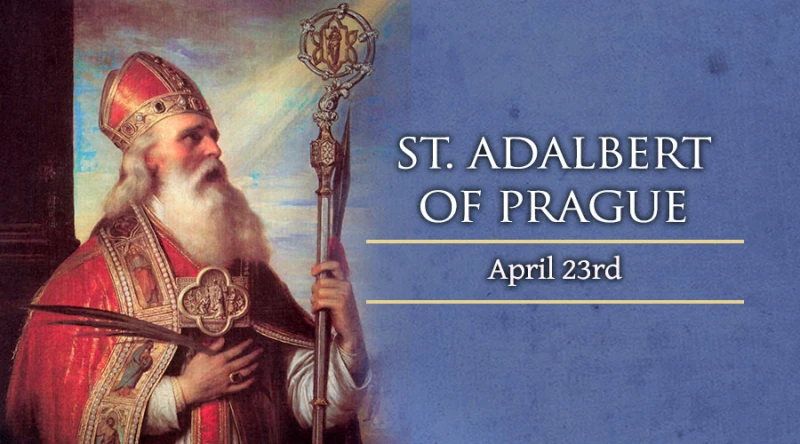
Originally given the name of Wojtech, the boy who would be known as St. Adalbert was born to a family of nobility in the Central European region of Bohemia during the mid-900s. When Wojtech became seriously ill during his childhood, his parents resolved that they would offer their son to God as a priest if their prayers for his survival were granted.
 
Wojtech survived the illness, and his parents sent him to study with Archbishop Adalbert of Magdeburg, a Benedictine missionary who would later be canonized in his own right. The archbishop gave the young student his own name at confirmation, setting an example that the boy would follow in his own life as a bishop, missionary and monk.
 
The young Adalbert was 25 when his mentor died in 981. He returned to his native Bohemia, where Bishop Deitmar of Prague ordained him a priest two years later.
 
However, the end of Bishop Deitmar’s life provided the young priest with a cautionary example that would remain with him until the end of his life. During his last illness, the bishop became terrified of his impending judgment, confessing that he had neglected his spiritual duties in favor of wealth, honors and pleasure.
 
After watching his bishop die on the verge of despair, Adalbert immediately resolved to live his own life in a more penitential spirit than before. He began wearing a hair-shirt and distributing his money to the poor. Soon, he would be chosen to replace the bishop whose agonizing death had shown him the gravity of spiritual leadership.
 
Adalbert was consecrated as the Bishop of Prague just months after becoming a priest. “It is an easy thing to wear the mitre and a cross,” Adalbert reflected, “but it is a most dreadful circumstance to have an account to give of a bishopric to the judge of the living and the dead.”
 
The bishop took steps to reform the finances of his diocese, ensuring that his own expenses made up only a small portion of the budget. Meanwhile, he slept on the floor, fasted regularly, gave sermons almost daily, and visited poor neighborhoods and prisons.
 
But in six years of constant prayer, fasting, and preaching, Bishop Adalbert made little headway among the Bohemians. The low point came when he unsuccessfully attempted to shield a woman convicted of adultery from a mob that sought to kill her. He responded by excommunicating the murderers, but the public seemed to favor them rather than the bishop.

Frustrated and dejected, Adalbert journeyed to Rome and asked Pope John XV for permission to retire from his diocese in 989. He joined a Roman monastery and purposely took on its most undesirable tasks of work and maintenance.
 
Five years after Adalbert’s departure, the Archbishop of Mentz – who had consecrated him as a bishop – asked the Pope to send him back to the diocese of Prague. Pope John did so, but made it clear that Adalbert was free to leave if the residents of his diocese continued to resist him.
 
When their former bishop returned, the residents of Prague welcomed him warmly and promised to change their ways. Sadly, however, this promise proved false, and Adalbert came to fear that he might be driven to despair by the rebellious locals. In keeping with the Pope’s provision, he left and became a missionary to the Hungarians.
 
In the course of his Hungarian missions, Adalbert taught – among many others – King Stephen I, who would later be canonized as St. Stephen of Hungary. Afterward, he returned to the Roman monastery of St. Boniface, where he served in the office of prior. But Adalbert’s consecrator remained insistent that he should return to Prague yet again.
 
Pope Gregory V finally ordered Adalbert to resume his duties as the Bishop of Prague. This time, however, the citizens defied him openly. A Bohemian prince named Boleslaus went so far as to kill several of Adalbert’s relatives and burn their homes, to make it clear how unwelcome his presence would be.
 
Nonetheless, Adalbert attempted to obey the Pope’s charge, and sent a message asking whether the other residents of Prague might allow him to return. The response he received indicated he should not come back, and would be in danger if he chose to do so.

Rejected by his own people, Adalbert decided to begin a mission to the pagan tribes in Poland and northeastern Germany. He successfully converted many of them, but eventually encountered the same hostility that had driven him from his diocese. This was partly because he denounced the native practices of tree-worship and human sacrifice, but also because he was suspected of being a Polish spy.

A pagan priest eventually captured Adalbert and his two companions, binding them and taking them hostage while they slept. Adalbert prayed aloud, offering his own life to God and begging forgiveness for his attackers.

“You had it always in your mouth that it was your desire to die for Christ,” he heard the pagan priest say, as he stabbed Adalbert in the chest with a lance. Six others proceeded to stab him, and he died of his wounds on April 23, 997.

A Polish prince ransomed back St. Adalbert’s body from the pagans, exchanging his remains for their weight in gold. His relics were transferred to the Polish city of Gniezno, and kept in the church known as Cathedral Basilica of the Assumption of the Blessed Virgin Mary and St. Adalbert.

St. Adalbert of Prague Read More »

St. George


St. George

Feast date: Apr 23

St. George was a soldier of the Roman army who was tortured and beheaded for his Christian faith in the year 303, in Lydda (in modern day Palestine).  He was likely born in Cappadocia, of a Cappadocian father and a Palestinian mother of noble rank. At the death of his father (possibly martyrdom) he moved to Palestine with his mother where he joined the military and apparently served with some distinction, meriting several promotions in rank.

One account of the martyrdom of St. George is Eusebius´ Ecclesiastical History, which relates that when the emperor Diocletian issued an edict “to tear down the churches to the foundations and to destroy the Sacred Scriptures by fire…a certain man, of no mean origin, but highly esteemed for his temporal dignities, stimulated by a divine zeal, and excited by an ardent faith, took it as it was openly placed and posted up for public inspection, and tore it to shreds as a most profane and wicked act.”  This act of instransigence and holy audacity enraged the emperor who had the man tortured and killed. This man “of no mean origin”, i.e. of nobility, has been identified by more than one ancient source, including Eusebius, as St. George, though most modern historians of the period state that this is unlikely.

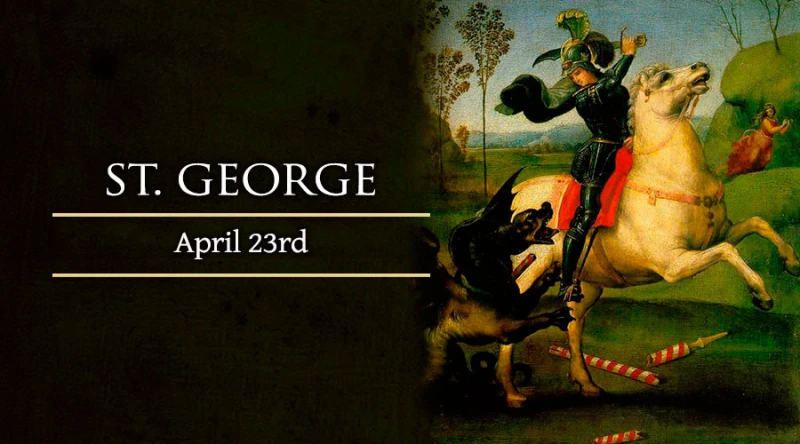
St. George is usually depicted in Christian art as a soldier on horseback killing a dragon with a lance. This image is a representation of a popular legend of St. George which first appears in 1265 in a romance titled “The Golden Legend,” in which he saved a town terrorized by a dragon with one blow of his lance. The image, however, is also, and more significantly, a powerful symbol of the victory of Christian faith over evil (sometimes interpreted more contextually in the early Church as “paganism”), personified by the devil who is symbolized by the dragon according to the imagery in Revelations.

St. George is invoked as a patron of military causes, not only because he was a soldier, but also, and primarily, due to his appearance to the Christian armies before the battle of Antioch, in which they were victorious, and to King Richard the Lionheart of England during his crusade against the Saracens.

The cult of St.George, while universal, remains strongest in the Eastern Church where he is venerated as “The Great Martyr.” Accounts of early pilgrims identify the seat of the cult of St.George at his burial site in Lydda. The cult has been in existence since the 4th century, soon after his death.

St. George is the patron of soldiers and the patron of many nations, including Palestine; Lebanon; England; Georgia; Malta. He is also the patron of Palestinian Christians and of Boy Scouts.  He is invoked by sufferers of herpes, skin diseases, skin rashes, syphilis, and snakebites.

St. George Read More »

Friday in the Octave of Easter

Reading I Acts 4:1-12

After the crippled man had been cured,
while Peter and John were still speaking to the people,
the priests, the captain of the temple guard,
and the Sadducees confronted them,
disturbed that they were teaching the people
and proclaiming in Jesus the resurrection of the dead.
They laid hands on Peter and John
and put them in custody until the next day,
since it was already evening.
But many of those who heard the word came to believe
and the number of men grew to about five thousand.

On the next day, their leaders, elders, and scribes
were assembled in Jerusalem, with Annas the high priest,
Caiaphas, John, Alexander,
and all who were of the high-priestly class.
They brought them into their presence and questioned them,
“By what power or by what name have you done this?”
Then Peter, filled with the Holy Spirit, answered them,
“Leaders of the people and elders:
If we are being examined today
about a good deed done to a cripple,
namely, by what means he was saved,
then all of you and all the people of Israel should know
that it was in the name of Jesus Christ the Nazorean
whom you crucified, whom God raised from the dead;
in his name this man stands before you healed.
He is the stone rejected by you, the builders,
which has become the cornerstone.

There is no salvation through anyone else,
nor is there any other name under heaven
given to the human race by which we are to be saved.”
 

Responsorial Psalm 118:1-2 and 4, 22-24, 25-27a

R.        (22)  The stone rejected by the builders has become the cornerstone.
or:
R.        Alleluia.
Give thanks to the LORD, for he is good,
            for his mercy endures forever.
Let the house of Israel say,
            “His mercy endures forever.”
Let those who fear the LORD say,
            “His mercy endures forever.”
R.        The stone rejected by the builders has become the cornerstone.
or:
R.        Alleluia.
The stone which the builders rejected
            has become the cornerstone.
By the LORD has this been done;
            it is wonderful in our eyes.
This is the day the LORD has made;
            let us be glad and rejoice in it.
R.        The stone rejected by the builders has become the cornerstone.
or:
R.        Alleluia.
O LORD, grant salvation!
            O LORD, grant prosperity!
Blessed is he who comes in the name of the LORD;
            we bless you from the house of the LORD.
            The LORD is God, and he has given us light.
R.        The stone rejected by the builders has become the cornerstone.
or:
R.        Alleluia.

Alleluia Ps 118:24

R. Alleluia, alleluia.
This is the day the LORD has made;
let us be glad and rejoice in it.

R. Alleluia, alleluia.

Gospel Jn 21:1-14

Jesus revealed himself again to his disciples at the Sea of Tiberias.
He revealed himself in this way.
Together were Simon Peter, Thomas called Didymus,
Nathanael from Cana in Galilee,
Zebedee’s sons, and two others of his disciples.
Simon Peter said to them, “I am going fishing.”
They said to him, “We also will come with you.”
So they went out and got into the boat,
but that night they caught nothing.
When it was already dawn, Jesus was standing on the shore;
but the disciples did not realize that it was Jesus.
Jesus said to them, “Children, have you caught anything to eat?”
They answered him, “No.”
So he said to them, “Cast the net over the right side of the boat
and you will find something.”
So they cast it, and were not able to pull it in
because of the number of fish.
So the disciple whom Jesus loved said to Peter, “It is the Lord.”
When Simon Peter heard that it was the Lord,
he tucked in his garment, for he was lightly clad,
and jumped into the sea.
The other disciples came in the boat,
for they were not far from shore, only about a hundred yards,
dragging the net with the fish.
When they climbed out on shore,
they saw a charcoal fire with fish on it and bread.
Jesus said to them, “Bring some of the fish you just caught.”
So Simon Peter went over and dragged the net ashore
full of one hundred fifty-three large fish.
Even though there were so many, the net was not torn.
Jesus said to them, “Come, have breakfast.”
And none of the disciples dared to ask him, “Who are you?”
because they realized it was the Lord.
Jesus came over and took the bread and gave it to them,
and in like manner the fish.
This was now the third time Jesus was revealed to his disciples
after being raised from the dead.

– – –

Lectionary for Mass for Use in the Dioceses of the United States, second typical edition, Copyright © 2001, 1998, 1997, 1986, 1970 Confraternity of Christian Doctrine; Psalm refrain © 1968, 1981, 1997, International Committee on English in the Liturgy, Inc. All rights reserved. Neither this work nor any part of it may be reproduced, distributed, performed or displayed in any medium, including electronic or digital, without permission in writing from the copyright owner.

Friday in the Octave of Easter Read More »
Sts. Caius and Soter


Sts. Caius and Soter

Feast date: Apr 22

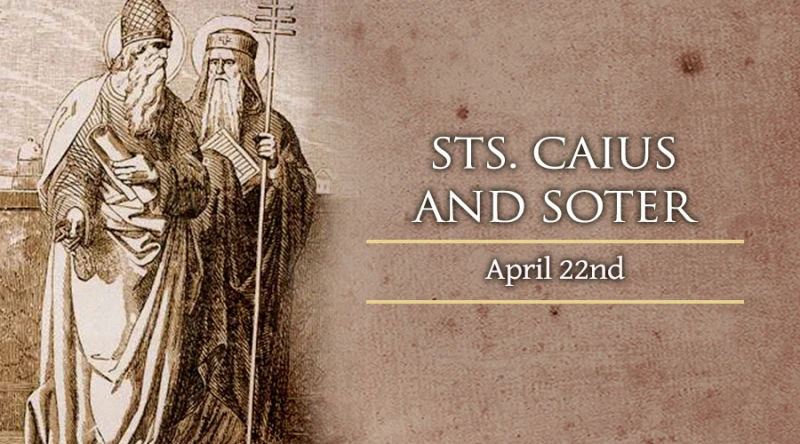
Cauis and Soter, Popes of the early Church, are both venerated in tradition as martyrs, though no reliable account of their martyrdom survives today.

St. Soter was born in Fundi, in Italy. The date of his birth is unknown but we know that he was Pope for eight years from 166 until his death in 174.

Soter´s papacy was an example of what seems to have been the remarkable tradition of generosity exercised by the bishop of Rome. This tradition and Soter´s personal charity and paternal love for his universal flock can be evidenced from a letter to Pope Soter by Bishop St. Dionysus of Corinth, quoted in the 4th century “Ecclesiastical History of Eusebius”:

“This has been your custom from the beginning, to do good in manifold ways to all Christians, and to send contributions to the many churches in every city, in some places relieving the poverty of the needy and ministering to the Christians in the mines, by the contribution which you have sent from the beginning, preserving the ancestral custom of the Romans, true Romans as you are. Your blessed bishop Soter has not only carried on the habit but has even increased it, by administering the bounty distributed to the saints and by exhorting with his blessed words the brethren who come to Rome, as a loving father would his children.” (IV, xxiii, 9- 15)

In the same letter of Dionysus we learn that Pope Soter had written a letter to the Corinthians which was read in the Church alongside the epistle of St. Clement and was held in high esteem.

Though his kindness extended to all persons, he was a fierce opponent of heresy, having been said to have written an encyclical against Montanism – the teachings of a heretical sect which believed that a Christian who had sinned gravely could never be redeemed.

Pope St. Caius reigned for 13 years from 283 until his death in 296 just before the Diocletian persecution. He was a relative of the Emperor Diocletian – instigator of one of the last great persecution of Christians in the early years of the Church. Early in his papacy Caius decreed that a man must be a priest before he could be ordained a bishop.

He is said to have been driven into hiding in the catacombs for eight years whence he died a confessor, however the source from which this information is gleaned is considered unreliable by most historians.

Both St. Soter and St. Caius are buried in the cemetery of St. Calixtus and are venerated on the date of the death of Pope St. Caius.

Sts. Caius and Soter Read More »