Please mind our dust!

We are currently working on revamping our website!
Thank you for your patience!

CRD Solutions

Thursday in the Octave of Easter

Reading I Acts 3:11-26

As the crippled man who had been cured clung to Peter and John,
all the people hurried in amazement toward them
in the portico called “Solomon’s Portico.”
When Peter saw this, he addressed the people,
“You children of Israel, why are you amazed at this,
and why do you look so intently at us
as if we had made him walk by our own power or piety?
The God of Abraham, the God of Isaac, and the God of Jacob,
the God of our fathers, has glorified his servant Jesus
whom you handed over and denied in Pilate’s presence,
when he had decided to release him.
You denied the Holy and Righteous One
and asked that a murderer be released to you.
The author of life you put to death,
but God raised him from the dead; of this we are witnesses.
And by faith in his name,
this man, whom you see and know, his name has made strong,
and the faith that comes through it
has given him this perfect health,
in the presence of all of you.
Now I know, brothers and sisters,
that you acted out of ignorance, just as your leaders did;
but God has thus brought to fulfillment
what he had announced beforehand
through the mouth of all the prophets,
that his Christ would suffer.
Repent, therefore, and be converted, that your sins may be wiped away,
and that the Lord may grant you times of refreshment
and send you the Christ already appointed for you, Jesus,
whom heaven must receive until the times of universal restoration
of which God spoke through the mouth
of his holy prophets from of old.
For Moses said:
            A prophet like me will the Lord, your God, raise up for you
                        from among your own kin;
            to him you shall listen in all that he may say to you.
            Everyone who does not listen to that prophet
                        will be cut off from the people.          

“Moreover, all the prophets who spoke,
from Samuel and those afterwards, also announced these days.
You are the children of the prophets
and of the covenant that God made with your ancestors
when he said to Abraham,
In your offspring all the families of the earth shall be blessed.
For you first, God raised up his servant and sent him to bless you
by turning each of you from your evil ways.”

Responsorial Psalm 8:2ab and 5, 6-7, 8-9

R.        (2ab)  O Lord, our God, how wonderful your name in all the earth!
or:
R.        Alleluia.
O LORD, our Lord,
            how glorious is your name over all the earth!
What is man that you should be mindful of him,
            or the son of man that you should care for him?
R.        O Lord, our God, how wonderful your name in all the earth!
or:
R.        Alleluia.
You have made him little less than the angels,
            and crowned him with glory and honor.
You have given him rule over the works of your hands,
            putting all things under his feet.
R.        O Lord, our God, how wonderful your name in all the earth!
or:
R.        Alleluia.
All sheep and oxen,
            yes, and the beasts of the field,
The birds of the air, the fishes of the sea,
            and whatever swims the paths of the seas.
R.        O Lord, our God, how wonderful your name in all the earth!
or:
R.        Alleluia.

Alleluia Ps 118:24

R. Alleluia, alleluia.
This is the day the LORD has made;
let us be glad and rejoice in it.
R. Alleluia, alleluia.

Gospel Lk 24:35-48

The disciples of Jesus recounted what had taken place along the way,
and how they had come to recognize him in the breaking of bread.

While they were still speaking about this,
he stood in their midst and said to them,
“Peace be with you.”
But they were startled and terrified
and thought that they were seeing a ghost.
Then he said to them, “Why are you troubled?
And why do questions arise in your hearts?
Look at my hands and my feet, that it is I myself.
Touch me and see, because a ghost does not have flesh and bones
as you can see I have.”
And as he said this,
he showed them his hands and his feet.
While they were still incredulous for joy and were amazed,
he asked them, “Have you anything here to eat?”
They gave him a piece of baked fish;
he took it and ate it in front of them.

He said to them,
“These are my words that I spoke to you while I was still with you,
that everything written about me in the law of Moses
and in the prophets and psalms must be fulfilled.”
Then he opened their minds to understand the Scriptures.
And he said to them,
“Thus it is written that the Christ would suffer
and rise from the dead on the third day
and that repentance, for the forgiveness of sins,
would be preached in his name
to all the nations, beginning from Jerusalem.
You are witnesses of these things.”
 

– – –

Lectionary for Mass for Use in the Dioceses of the United States, second typical edition, Copyright © 2001, 1998, 1997, 1986, 1970 Confraternity of Christian Doctrine; Psalm refrain © 1968, 1981, 1997, International Committee on English in the Liturgy, Inc. All rights reserved. Neither this work nor any part of it may be reproduced, distributed, performed or displayed in any medium, including electronic or digital, without permission in writing from the copyright owner.

Thursday in the Octave of Easter Read More »
St. Anselm


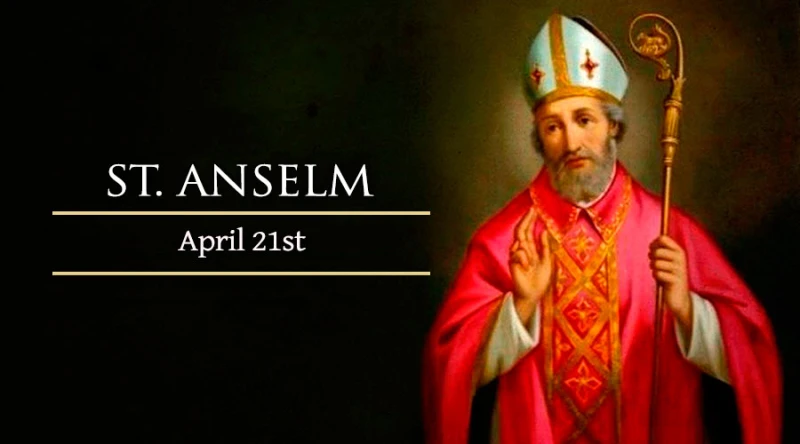
St. Anselm

Feast date: Apr 21

On April 21, the Catholic Church honors Saint Anselm, the 11th and 12th-century Benedictine monk and archbishop best known for his writings on Christ’s atonement and the existence of God.

In a general audience given on Sept. 23, 2009, Pope Benedict XVI remembered St. Anselm as “a monk with an intense spiritual life, an excellent teacher of the young, a theologian with an extraordinary capacity for speculation, a wise man of governance and an intransigent defender of the Church’s freedom.”

St. Anselm, the Pope said, stands out as “one of the eminent figures of the Middle Ages who was able to harmonize all these qualities, thanks to the profound mystical experience that always guided his thought and his action.”

Anselm was born in Aosta, part of the Piedmont region of present-day Italy, around 1033. While his father provided little in the way of moral or religious influence, his mother was a notably devout woman and chose to send Anselm to a school run by the Benedictine order.

The boy felt a profound religious calling during these years, spurred in part by a dream in which he met and conversed with God. His father, however, prevented him from becoming a monk at age 15. This disappointment was followed by a period of severe illness, as well as his mother’s early death.

Unable to join the monks, and tired of mistreatment by his father, Anselm left home and wandered throughout parts of France and Italy for three years. His life regained its direction in Normandy, where he met the Benedictine prior Lanfranc of Pavia and became his disciple.

Lanfranc recognized his pupil’s intellectual gifts and encouraged his vocation to religious life. Accepted into the order and ordained a priest at age 27, Anselm succeeded his teacher as prior in1063 when Lanfranc was called to become abbot of another monastery.

Anselm became abbot of his own monastery in1079. During the previous decade the Normans had conquered England, and they sought to bring monks from Normandy to influence the Church in the country. Lanfranc became Archbishop of Canterbury, and asked Anselm to come and assist him.

The period after Lanfranc’s death, in the late 1080s, was a difficult time for the English Church. As part of his general mistreatment of the Church, King William Rufus refused to allow the appointment of a new archbishop. Anselm had gone back to his monastery, and did not want to return to England.

In 1092, however, he was persuaded to do so. The following year, the king changed his mind and allowed Anselm to become Archbishop of Canterbury. But the monk was extremely reluctant to accept the charge, which would involve him in further struggles with the English crown in subsequent years.

For a three-year period in the early 12th century, Anselm’s insistence on the self-government of the Church – against the claims of the state to its administration and property – caused him to be exiled from England. But he was successful in his struggle, and returned to his archdiocese in 1106.

In his last years, Anselm worked to reform the Church and continued his theological investigations – following the motto of “faith seeking understanding.” After his death in 1109, his influence on the subsequent course of theology led Pope Clement XI to name him a Doctor of the Church in 1720.

St. Anselm Read More »

Wednesday in the Octave of Easter

Reading I Acts 3:1-10

Peter and John were going up to the temple area
for the three o’clock hour of prayer.
And a man crippled from birth was carried
and placed at the gate of the temple called “the Beautiful Gate” every day
to beg for alms from the people who entered the temple.
When he saw Peter and John about to go into the temple,
he asked for alms.
But Peter looked intently at him, as did John,
and said, “Look at us.”
He paid attention to them, expecting to receive something from them.
Peter said, “I have neither silver nor gold,
but what I do have I give you:
in the name of Jesus Christ the Nazorean, rise and walk.”
Then Peter took him by the right hand and raised him up,
and immediately his feet and ankles grew strong.
He leaped up, stood, and walked around,
and went into the temple with them,
walking and jumping and praising God.
When all the people saw him walking and praising God,
they recognized him as the one
who used to sit begging at the Beautiful Gate of the temple,
and they were filled with amazement and astonishment
at what had happened to him.

Responsorial Psalm 105:1-2, 3-4, 6-7, 8-9

R.        (3b) Rejoice, O hearts that seek the Lord.
or:
R.        Alleluia.
Give thanks to the LORD, invoke his name;
            make known among the nations his deeds.
Sing to him, sing his praise,
            proclaim all his wondrous deeds.
R.        Rejoice, O hearts that seek the Lord.
or:
R.        Alleluia.
Glory in his holy name;
            rejoice, O hearts that seek the LORD!
Look to the LORD in his strength;
            seek to serve him constantly.
R.        Rejoice, O hearts that seek the Lord.
or:
R.        Alleluia.
You descendants of Abraham, his servants,
            sons of Jacob, his chosen ones!
He, the LORD, is our God;
            throughout the earth his judgments prevail.
R.        Rejoice, O hearts that seek the Lord.
or:
R.        Alleluia.
He remembers forever his covenant
            which he made binding for a thousand generations–

Which he entered into with Abraham
            and by his oath to Isaac.
R.        Rejoice, O hearts that seek the Lord.
or:
R.        Alleluia.

Alleluia Ps 118:24

R. Alleluia, alleluia.
This is the day the LORD has made;
let us be glad and rejoice in it.
R. Alleluia, alleluia.

Gospel Lk 24:13-35

That very day, the first day of the week,
two of Jesus’ disciples were going
to a village seven miles from Jerusalem called Emmaus,
and they were conversing about all the things that had occurred.
And it happened that while they were conversing and debating,
Jesus himself drew near and walked with them,
but their eyes were prevented from recognizing him.
He asked them,
“What are you discussing as you walk along?”
They stopped, looking downcast.
One of them, named Cleopas, said to him in reply,
“Are you the only visitor to Jerusalem
who does not know of the things
that have taken place there in these days?”
And he replied to them, “What sort of things?”
They said to him,
“The things that happened to Jesus the Nazarene,
who was a prophet mighty in deed and word
before God and all the people,
how our chief priests and rulers both handed him over
to a sentence of death and crucified him.
But we were hoping that he would be the one to redeem Israel;
and besides all this,
it is now the third day since this took place.
Some women from our group, however, have astounded us:
they were at the tomb early in the morning
and did not find his Body;
they came back and reported
that they had indeed seen a vision of angels
who announced that he was alive.
Then some of those with us went to the tomb
and found things just as the women had described,
but him they did not see.”
And he said to them, “Oh, how foolish you are!
How slow of heart to believe all that the prophets spoke!
Was it not necessary that the Christ should suffer these things
and enter into his glory?”
Then beginning with Moses and all the prophets,
he interpreted to them what referred to him
in all the Scriptures.
As they approached the village to which they were going,
he gave the impression that he was going on farther.
But they urged him, “Stay with us,
for it is nearly evening and the day is almost over.”
So he went in to stay with them.
And it happened that, while he was with them at table,
he took bread, said the blessing,
broke it, and gave it to them.
With that their eyes were opened and they recognized him,
but he vanished from their sight.
Then they said to each other,
“Were not our hearts burning within us
while he spoke to us on the way and opened the Scriptures to us?”
So they set out at once and returned to Jerusalem
where they found gathered together
the Eleven and those with them who were saying,
“The Lord has truly been raised and has appeared to Simon!”
Then the two recounted what had taken place on the way
and how he was made known to them in the breaking of the bread.

– – –

Lectionary for Mass for Use in the Dioceses of the United States, second typical edition, Copyright © 2001, 1998, 1997, 1986, 1970 Confraternity of Christian Doctrine; Psalm refrain © 1968, 1981, 1997, International Committee on English in the Liturgy, Inc. All rights reserved. Neither this work nor any part of it may be reproduced, distributed, performed or displayed in any medium, including electronic or digital, without permission in writing from the copyright owner.

Wednesday in the Octave of Easter Read More »
St. Anastasius of Sinai


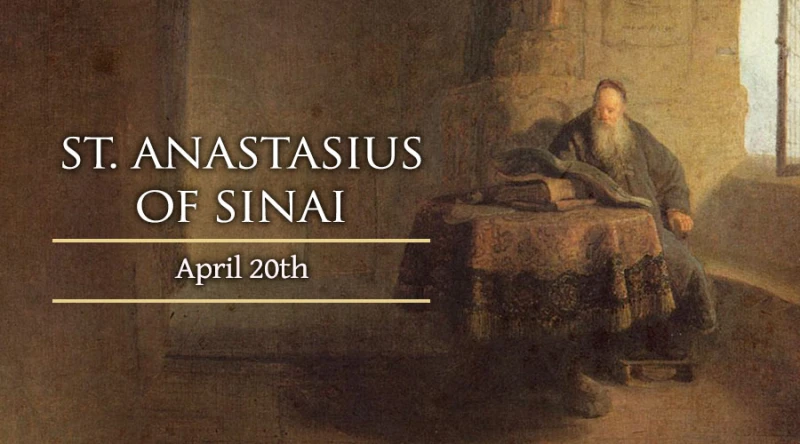
St. Anastasius of Sinai

Feast date: Apr 20

On April 20, Eastern Catholics of the Byzantine tradition honor Saint Anastasius of Sinai, a seventh-century monk and priest known for his scriptural commentaries and defenses of Church teaching.

The Roman Catholic Church has traditionally celebrated St. Anastasius on the following day, April 21, though this memorial is not widely celebrated in modern times. The Eastern Orthodox churches, meanwhile, commemorate him on the same date as their Eastern Catholic counterparts.

Even within the Eastern Christian tradition, St. Anastasius’ legacy has been somewhat obscured by the renown of other authors. In his own era, however, the Sianite’s writings were acclaimed as the work of a “new Moses.” At least one of his works, the “Hodegos” (or “Guide”), remained in use within the Greek Church for many centuries.

No extensive biography of Anastasius exists, and it is unclear whether he was born in Egypt (as some traditional accounts relate) or in Cyprus. His date of birth is also unknown.

In his own writings, Anastasius speaks of being captivated by the proclamation of the Gospel during church services, and being awestruck by Christ’s Eucharistic presence as a young man. He eventually made a pilgrimage to Jerusalem, and took up residence as a monk on Mount Sinai in Egypt around the middle of the seventh century. He eventually became the abbot of St. Catherine’s Monastery.

Anastasius’ life was outwardly uneventful in most respects, though he did leave his monastic cell to defend the Church’s teachings against heresy and error. He met or learned about many holy men in the course of his travels, and described their lives in writings that survive to this day.

Among Anastasius’ doctrinal opponents were the monophysites, who were in error regarding Jesus’ divine and human natures; and the monothelites, who professed a related error regarding Christ’s human and divine wills. Though he was not the most important opponent of either heresy, Anastasius’ contributions earned him a place among the Church Fathers in the Eastern tradition.

The monk of Sinai also defended the Christian faith against Jewish objections. In one of his major works, the “Commentary on the Six Days of Creation” (or “Hexaemeron”), he explained how the first three chapters of Genesis predicted and prefigured the coming of Jesus Christ. Other surviving writings by the saint include his homilies, and a series of “Questions and Answers” addressing pastoral matters.

St. Anastasius is said to have lived to an old age, and attained to great holiness through prayer and asceticism, by the time of his death sometime after the year 700.

Some confusion has resulted from the conjunction of his Eastern feast day, April 20, with that of another saint who was also named Anastasius and associated with Mount Sinai. But this other St. Anastasius, though celebrated on the same date, lived earlier and led the Church of Antioch.

St. Anastasius of Sinai Read More »

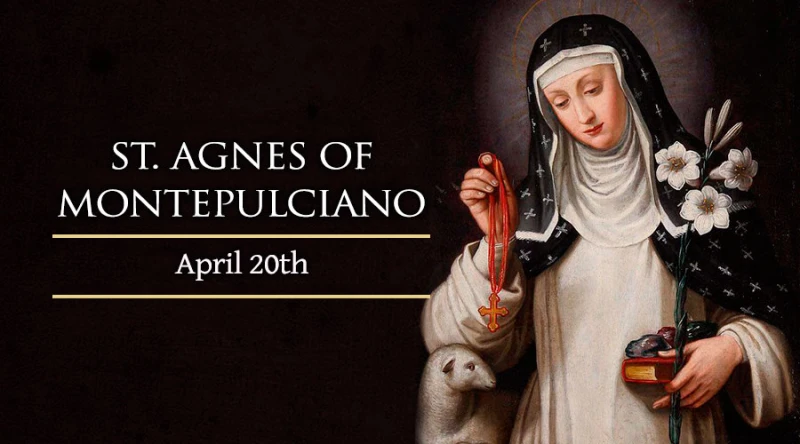
St. Agnes of Montepulciano


St. Agnes of Montepulciano

Feast date: Apr 20

St. Agnes of Montepulciano was born in 13th-century Tuscany. At the age of six, Agnes began trying to convince her parents to allow her to join a convent. She was finally admitted to the Dominican convent at Montepulciano at age nine despite it generally being against Church law to allow a child so young to join.

Agnes’ reputation for holiness attracted other sisters, and she became an abbess at the unheard of age of 15. She insisted on greater austerities in the abbey. She lived on bread and water for 15 years, slept on the ground and used a stone for a pillow.

It was said that she had visions of the Virgin Mary and that in her visions angels gave her Communion. She also had a vision in which she was holding the infant Jesus. When she awoke from her trance, she she was holding the small gold crucifix the infant Jesus was wearing.

She died in 1317. Miracles have been reported at her tomb. When her body was moved to a church years after her death, it was found incorrupt.

She was canonized in 1726.

St. Agnes of Montepulciano Read More »