Please mind our dust!

We are currently working on revamping our website!
Thank you for your patience!

CRD Solutions

Blessed Pierina Morosini

Feast date: Apr 06

Pierina Morosini is the patron saint of rape victims and a martyr to chastity. She was born into a poor family of eight children in 1931 in the Diocese of Bergamo, Italy. She was trained to be a seamstress and began to work in a factory at 15 years of age.

Pierina had made a private vow to God to live a life of chastity. She taught catechism and considered religious life, but continued to live at home to help her mother care for their family. One day, as the 26-year-old Pierina returned home from work, she was attacked by a would-be rapist, however she fought against him for the purpose of protecting her chastity, and he stoned her to death for refusing to comply with him. Pope John Paul II beatified Pierina on October 4, 1987.

Blessed Pierina Morosini Read More »

Tuesday of the Fifth Week of Lent

Reading I Nm 21:4-9

From Mount Hor the children of Israel set out on the Red Sea road,
to bypass the land of Edom.
But with their patience worn out by the journey,
the people complained against God and Moses,
“Why have you brought us up from Egypt to die in this desert,
where there is no food or water?
We are disgusted with this wretched food!”

In punishment the LORD sent among the people saraph serpents,
which bit the people so that many of them died.
Then the people came to Moses and said,
“We have sinned in complaining against the LORD and you.
Pray the LORD to take the serpents away from us.”
So Moses prayed for the people, and the LORD said to Moses,
“Make a saraph and mount it on a pole,
and whoever looks at it after being bitten will live.”
Moses accordingly made a bronze serpent and mounted it on a pole,
and whenever anyone who had been bitten by a serpent
looked at the bronze serpent, he lived.         

Responsorial Psalm 102:2-3, 16-18, 19-21

R.        (2)  O Lord, hear my prayer, and let my cry come to you.
O LORD, hear my prayer,
            and let my cry come to you.
Hide not your face from me
            in the day of my distress.
Incline your ear to me;          
            in the day when I call, answer me speedily.
R.        O Lord, hear my prayer, and let my cry come to you.
The nations shall revere your name, O LORD,
            and all the kings of the earth your glory,
When the LORD has rebuilt Zion
            and appeared in his glory;
When he has regarded the prayer of the destitute,
            and not despised their prayer.
R.        O Lord, hear my prayer, and let my cry come to you.
Let this be written for the generation to come,
            and let his future creatures praise the LORD:
“The LORD looked down from his holy height,
            from heaven he beheld the earth,
To hear the groaning of the prisoners,
            to release those doomed to die.”
R.        O Lord, hear my prayer, and let my cry come to you.

Verse Before the Gospel

The seed is the word of God, Christ is the sower;
all who come to him will live for ever.

Gospel Jn 8:21-30

Jesus said to the Pharisees:
“I am going away and you will look for me,
but you will die in your sin.
Where I am going you cannot come.”
So the Jews said,
“He is not going to kill himself, is he,
because he said, ‘Where I am going you cannot come’?”
He said to them, “You belong to what is below,
I belong to what is above.
You belong to this world,
but I do not belong to this world.
That is why I told you that you will die in your sins.
For if you do not believe that I AM,
you will die in your sins.”
So they said to him, “Who are you?”
Jesus said to them, “What I told you from the beginning.
I have much to say about you in condemnation.
But the one who sent me is true,
and what I heard from him I tell the world.”
They did not realize that he was speaking to them of the Father.
So Jesus said to them,
“When you lift up the Son of Man,
then you will realize that I AM,
and that I do nothing on my own,
but I say only what the Father taught me.
The one who sent me is with me.
He has not left me alone,
because I always do what is pleasing to him.”
Because he spoke this way, many came to believe in him.

– – –

Lectionary for Mass for Use in the Dioceses of the United States, second typical edition, Copyright © 2001, 1998, 1997, 1986, 1970 Confraternity of Christian Doctrine; Psalm refrain © 1968, 1981, 1997, International Committee on English in the Liturgy, Inc. All rights reserved. Neither this work nor any part of it may be reproduced, distributed, performed or displayed in any medium, including electronic or digital, without permission in writing from the copyright owner.

Tuesday of the Fifth Week of Lent Read More »

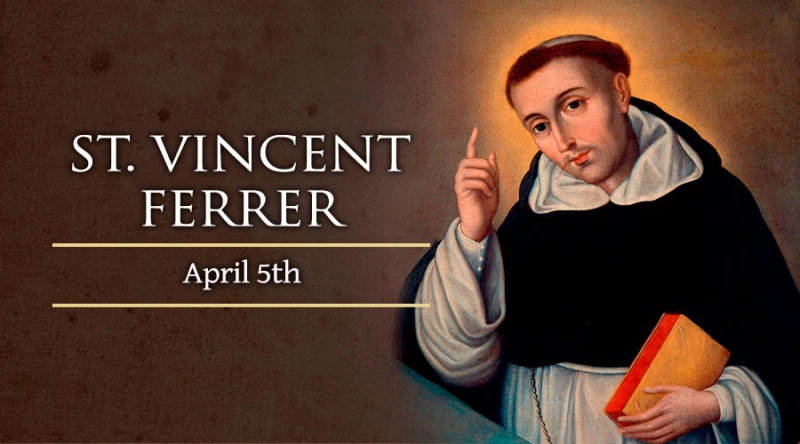
St. Vincent Ferrer


St. Vincent Ferrer

Feast date: Apr 05

Roman Catholics celebrate the missionary efforts of St. Vincent Ferrer on April 5. The Dominican preacher brought thousands of Europeans into the Catholic Church during a period of political and spiritual crisis in Western Europe.

Vincent Ferrer was born in Valencia, Spain, during 1357. His parents raised him to care deeply about his religious duties, without neglecting his education or concern for the poor. One of his siblings, Boniface, later joined the Carthusian order and became its superior general. Vincent, however, would become a Dominican, and preach the Gospel throughout Europe. He joined at age 18 in 1374.

As a member of the Dominican Order of Preachers, Vincent committed much of the Bible to memory while also studying the Church Fathers and philosophy. By age 28, he was renowned for his preaching, and also known to have a gift of prophecy. Five years later, a representative of Pope Clement VII chose Vincent to accompany him to France, where he preached extensively.

While Vincent sought to live out his order’s commitment to the preaching of the Gospel, he could not escape becoming involved in the political intrigues of the day. Two rival claimants to the papacy emerged during the late 1300s, one in Rome and another in the French city of Avignon. Each claimed the allegiance of roughly half of Western Europe.

Caught between the rival claimants, Vincent attempted to persuade the Avignon Pope Benedict XIII to negotiate an end to the schism. Benedict, who was regarded as Pope in both Spain and France, sought to honor Vincent by consecrating him as a bishop. But the Dominican friar had no interest in advancing within the Church, and regarded many bishops of his time as negligent leaders distracted by luxury.

“I blush and tremble,” he wrote in a letter, “when I consider the terrible judgment impending on ecclesiastical superiors who live at their ease in rich palaces, while so many souls redeemed by the blood of Christ are perishing. I pray without ceasing, to the Lord of the harvest, that he send good workmen into his harvest.”

Vincent not only prayed, but acted, committing himself to missionary work and resolving to preach in every town between Avignon and his hometown in Spain. In a commanding style, he denounced greed, blasphemy, sexual immorality, and popular disregard for the truths of faith. His sermons often drew crowds of thousands and prompted dramatic conversions.

Popular acclaim, however, did not distract him from a life of asceticism and poverty. He abstained completely from meat, slept on a straw mat, consumed only bread and water on Wednesdays and Fridays, and accepted no donations for himself beyond what he needed to survive. He traveled with five other Dominican friars at all times, and the men would spend hours hearing confessions.

For two decades, Vincent and his group of friars undertook preaching missions in Spain, Italy, and France. When he traveled outside these regions, into Germany and other parts of the Mediterranean, those who did not know the languages in which he preached would testify that they had understood every word he said, in the same manner as the apostles experienced at Pentecost.

Although he did not heal the temporary divisions within the Church, Vincent succeeded in strengthening large numbers of Europeans in their Catholic faith. He wrote little, although some of his works have survived, and exist in modern English translations.

St. Vincent Ferrer died on April 5, 1419 at age 62, in the city of Vannes in the French region of Brittany. He was canonized in 1455, and has more recently become the namesake of a traditional Catholic community approved by the Holy See, the Fraternity of Saint Vincent Ferrer.

St. Vincent Ferrer Read More »

Monday of the Fifth Week of Lent

Reading I Dn 13:1-9, 15-17, 19-30, 33-62 or 13:41c-62

In Babylon there lived a man named Joakim,
who married a very beautiful and God-fearing woman, Susanna,
the daughter of Hilkiah;
her pious parents had trained their daughter
according to the law of Moses.
Joakim was very rich;
he had a garden near his house,
and the Jews had recourse to him often
because he was the most respected of them all.

That year, two elders of the people were appointed judges,
of whom the Lord said, “Wickedness has come out of Babylon:
from the elders who were to govern the people as judges.”
These men, to whom all brought their cases,
frequented the house of Joakim.
When the people left at noon,
Susanna used to enter her husband’s garden for a walk.
When the old men saw her enter every day for her walk,
they began to lust for her.
They suppressed their consciences;
they would not allow their eyes to look to heaven,
and did not keep in mind just judgments.

One day, while they were waiting for the right moment,
she entered the garden as usual, with two maids only.
She decided to bathe, for the weather was warm.
Nobody else was there except the two elders,
who had hidden themselves and were watching her.
“Bring me oil and soap,” she said to the maids,
“and shut the garden doors while I bathe.”

As soon as the maids had left,
the two old men got up and hurried to her.
“Look,” they said, “the garden doors are shut, and no one can see us;
give in to our desire, and lie with us.
If you refuse, we will testify against you
that you dismissed your maids because a young man was here with you.”

“I am completely trapped,” Susanna groaned.
“If I yield, it will be my death;
if I refuse, I cannot escape your power.
Yet it is better for me to fall into your power without guilt
than to sin before the Lord.”
Then Susanna shrieked, and the old men also shouted at her,
as one of them ran to open the garden doors.
When the people in the house heard the cries from the garden,
they rushed in by the side gate to see what had happened to her.
At the accusations by the old men,
the servants felt very much ashamed,
for never had any such thing been said about Susanna.

When the people came to her husband Joakim the next day,
the two wicked elders also came,
fully determined to put Susanna to death.
Before all the people they ordered:
“Send for Susanna, the daughter of Hilkiah,
the wife of Joakim.”
When she was sent for,
she came with her parents, children and all her relatives.
All her relatives and the onlookers were weeping.

In the midst of the people the two elders rose up
and laid their hands on her head.
Through tears she looked up to heaven,
for she trusted in the Lord wholeheartedly.
The elders made this accusation:
“As we were walking in the garden alone,
this woman entered with two girls
and shut the doors of the garden, dismissing the girls.
A young man, who was hidden there, came and lay with her.
When we, in a corner of the garden, saw this crime,
we ran toward them.
We saw them lying together,
but the man we could not hold, because he was stronger than we;
he opened the doors and ran off.
Then we seized her and asked who the young man was,
but she refused to tell us.
We testify to this.”
The assembly believed them,
since they were elders and judges of the people,
and they condemned her to death.

But Susanna cried aloud:
“O eternal God, you know what is hidden
and are aware of all things before they come to be:
you know that they have testified falsely against me.
Here I am about to die,
though I have done none of the things
with which these wicked men have charged me.”

The Lord heard her prayer.
As she was being led to execution,
God stirred up the holy spirit of a young boy named Daniel,
and he cried aloud:
“I will have no part in the death of this woman.”
All the people turned and asked him, “What is this you are saying?”
He stood in their midst and continued,
“Are you such fools, O children of Israel!
To condemn a woman of Israel without examination
and without clear evidence?
Return to court, for they have testified falsely against her.”

Then all the people returned in haste.
To Daniel the elders said,
“Come, sit with us and inform us,
since God has given you the prestige of old age.”
But he replied,
“Separate these two far from each other that I may examine them.”

After they were separated one from the other,
he called one of them and said:
“How you have grown evil with age!
Now have your past sins come to term:
passing unjust sentences, condemning the innocent,
and freeing the guilty, although the Lord says,
‘The innocent and the just you shall not put to death.’
Now, then, if you were a witness,
tell me under what tree you saw them together.”
“Under a mastic tree,” he answered.
Daniel replied, “Your fine lie has cost you your head,
for the angel of God shall receive the sentence from him
and split you in two.”
Putting him to one side, he ordered the other one to be brought.
Daniel said to him,
“Offspring of Canaan, not of Judah, beauty has seduced you,
lust has subverted your conscience.
This is how you acted with the daughters of Israel,
and in their fear they yielded to you;
but a daughter of Judah did not tolerate your wickedness.
Now, then, tell me under what tree you surprised them together.”
“Under an oak,” he said.
Daniel replied, “Your fine lie has cost you also your head,
for the angel of God waits with a sword to cut you in two
so as to make an end of you both.”

The whole assembly cried aloud,
blessing God who saves those who hope in him.
They rose up against the two elders,
for by their own words Daniel had convicted them of perjury.
According to the law of Moses,
they inflicted on them
the penalty they had plotted to impose on their neighbor:
they put them to death.
Thus was innocent blood spared that day.

OR

The assembly condemned Susanna to death.

But Susanna cried aloud:
“O eternal God, you know what is hidden
and are aware of all things before they come to be:
you know that they have testified falsely against me.
Here I am about to die,
though I have done none of the things
with which these wicked men have charged me.”

The Lord heard her prayer.
As she was being led to execution,
God stirred up the holy spirit of a young boy named Daniel,
and he cried aloud:
“I will have no part in the death of this woman.”
All the people turned and asked him,
“What is this you are saying?”
He stood in their midst and continued,
“Are you such fools, O children of Israel!
To condemn a woman of Israel without examination
and without clear evidence?
Return to court, for they have testified falsely against her.”

Then all the people returned in haste.
To Daniel the elders said,
“Come, sit with us and inform us,
since God has given you the prestige of old age.”
But he replied,
“Separate these two far from each other that I may examine them.”

After they were separated one from the other,
he called one of them and said:
“How you have grown evil with age!
Now have your past sins come to term:
passing unjust sentences, condemning the innocent,
and freeing the guilty, although the Lord says,
‘The innocent and the just you shall not put to death.’
Now, then, if you were a witness,
tell me under what tree you saw them together.”
“Under a mastic tree,” he answered.
Daniel replied, “Your fine lie has cost you your head,
for the angel of God shall receive the sentence from him
and split you in two.”
Putting him to one side, he ordered the other one to be brought.
Daniel said to him, “Offspring of Canaan, not of Judah,
beauty has seduced you, lust has subverted your conscience.
This is how you acted with the daughters of Israel,
and in their fear they yielded to you;
but a daughter of Judah did not tolerate your wickedness.
Now, then, tell me under what tree you surprised them together.”
“Under an oak,” he said.
Daniel replied, “Your fine lie has cost you also your head,”
for the angel of God waits with a sword to cut you in two
so as to make an end of you both.”

The whole assembly cried aloud,
blessing God who saves those who hope in him.
They rose up against the two elders,
for by their own words Daniel had convicted them of perjury.
According to the law of Moses,
they inflicted on them
the penalty they had plotted to impose on their neighbor:
they put them to death.
Thus was innocent blood spared that day.

Responsorial Psalm 23:1-3a, 3b-4, 5, 6

R. (4ab) Even though I walk in the dark valley I fear no evil; for you are at my side.
The LORD is my shepherd; I shall not want.
In verdant pastures he gives me repose;
Beside restful waters he leads me;
he refreshes my soul.
R. Even though I walk in the dark valley I fear no evil; for you are at my side.
He guides me in right paths
for his name’s sake.
Even though I walk in the dark valley
I fear no evil; for you are at my side
With your rod and your staff
that give me courage.
R. Even though I walk in the dark valley I fear no evil; for you are at my side.
You spread the table before me
in the sight of my foes;
You anoint my head with oil;
my cup overflows.
R. Even though I walk in the dark valley I fear no evil; for you are at my side.
Only goodness and kindness follow me
all the days of my life;
And I shall dwell in the house of the LORD
for years to come.
R. Even though I walk in the dark valley I fear no evil; for you are at my side.

Verse before the Gospel Ez 33:11

I take no pleasure in the death of the wicked man, says the Lord,
but rather in his conversion, that he may live.

Gospel Jn 8:12-20

Jesus spoke to them again, saying,
“I am the light of the world.
Whoever follows me will not walk in darkness,
but will have the light of life.” 
So the Pharisees said to him,
“You testify on your own behalf,
so your testimony cannot be verified.”
Jesus answered and said to them,
“Even if I do testify on my own behalf, my testimony can be verified,     
because I know where I came from and where I am going.
But you do not know where I come from or where I am going.
You judge by appearances, but I do not judge anyone.
And even if I should judge, my judgment is valid,
because I am not alone,
but it is I and the Father who sent me.
Even in your law it is written
that the testimony of two men can be verified.
I testify on my behalf and so does the Father who sent me.”
So they said to him, “Where is your father?”
Jesus answered, “You know neither me nor my Father.
If you knew me, you would know my Father also.”
He spoke these words
while teaching in the treasury in the temple area.
But no one arrested him, because his hour had not yet come.

– – –

Lectionary for Mass for Use in the Dioceses of the United States, second typical edition, Copyright © 2001, 1998, 1997, 1986, 1970 Confraternity of Christian Doctrine; Psalm refrain © 1968, 1981, 1997, International Committee on English in the Liturgy, Inc. All rights reserved. Neither this work nor any part of it may be reproduced, distributed, performed or displayed in any medium, including electronic or digital, without permission in writing from the copyright owner.
Monday of the Fifth Week of Lent Read More »

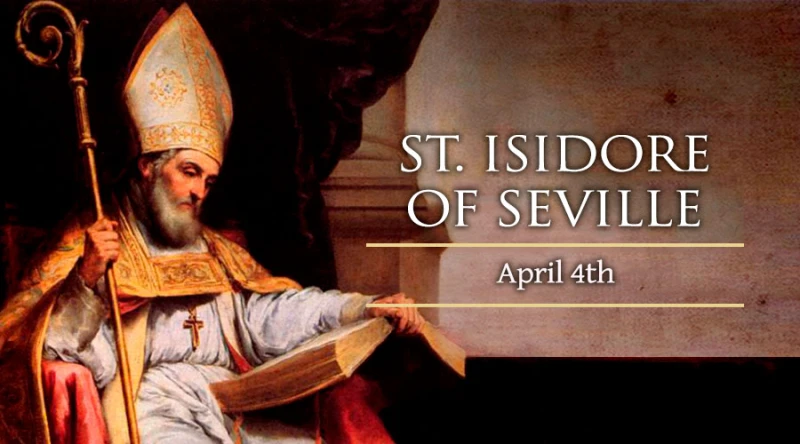
St. Isidore of Seville


St. Isidore of Seville

Feast date: Apr 04

On April 4, the Catholic Church honors Saint Isidore of Seville, a bishop and scholar who helped the Church preserve its own traditions, and the heritage of western civilization, in the early middle ages.

In 653, less than two decades after his death, a council of bishops in Spain acclaimed St. Isidore as “an illustrious teacher of our time and the glory of the Catholic Church.” He is regarded as being among the last of the early Church Fathers, who combined Christian faith and classical education.

Isidore was born in Cartagena, Spain, in approximately 560. Three of his siblings – his brothers Leander and Fulgentius, who became bishops, and his sister Florentina, a nun – were later canonized as saints along with him.

As the Archbishop of Seville, Leander was an important influence on his younger brother, helping Isidore develop a commitment to study, prayer, and intense work for the good of the Church. Isidore, in turn, joined his brother’s mission to convert the generally heretical Visigoths who had invaded Spain.

When St. Leander died around the year 600, his brother succeeded him as Seville’s archbishop. Isidore inherited his brother’s responsibility for Church affairs in an intense period of change, as the institutions of the Western Roman Empire gave way to the culture of the barbarian tribes.

For the good of the Church and civilization, Isidore was determined to preserve the wisdom and knowledge of the past, maintaining the fruitful synthesis of classical Roman culture and Christian faith. He was also intent on preventing false teachings from shattering the unity of the Church in Spain.

Responsible above all for the good of the Church, Isidore also sought the common good by encouraging study and development in areas such as law, medicine, foreign languages, and philosophy. He compiled the “Etymologiae,” the first encyclopedia written from a Catholic perspective.

Under Isidore’s leadership, a series of local councils solidified the orthodoxy of the Spanish Church against errors about Christ and the Trinity. Systematic and extensive education of the clergy was stressed as a necessary means of guarding the faithful against false doctrine.

Prolific in his writings and and diligent in governing the Church, Isidore did not neglect the service of those in need.

“Indeed, just as we must love God in contemplation, so we must love our neighbor with action,” he declared. “It is therefore impossible to live without the presence of both the one and the other form of life, nor can we live without experiencing both the one and the other.”

In the last months of his life, the Isidore offered a moving testament to these words, intensifying his charitable outreach to the poor. Crowds of people in need flocked to his residence from far and wide, as the bishop offered his final works of mercy on earth.

St. Isidore of Seville died on April 4 of the year 636. Later named a Doctor of the Church, he was more recently proposed as a patron saint of Internet users, because of his determination to use the world’s accumulated knowledge for the service of God’s glory.

St. Isidore of Seville Read More »