Please mind our dust!

We are currently working on revamping our website!
Thank you for your patience!

CRD Solutions

St. Irene of Rome


St. Irene of Rome

Feast date: Apr 03

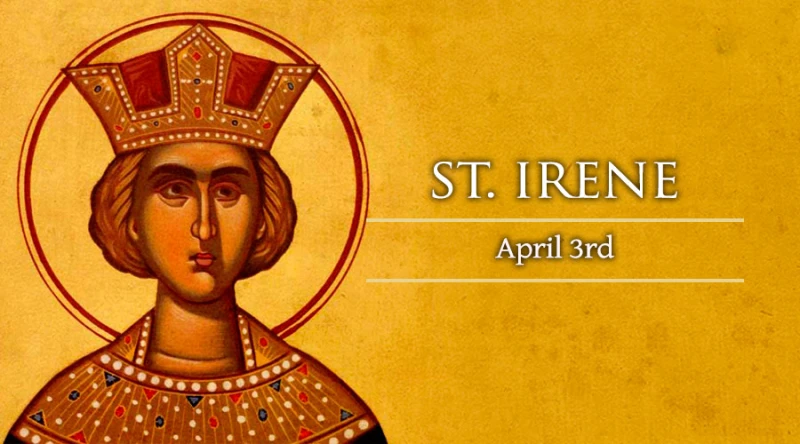
St. Irene of Rome was the widow of the martyr Saint Castulus, a Roman military officer who was killed for spreading the Christian faith in 286. She lived in the Roman Empire during the reign of Diocletian, and died in 288.

According to legend, she attended to the wounded St. Sebastian after he was shot full of arrows as depicted in the painting by artist Vicente López y Portaña.

St. Irene of Rome Read More »

Saturday of the Fourth Week of Lent

Reading I Jer 11:18-20

I knew their plot because the LORD informed me;
at that time you, O LORD, showed me their doings.

Yet I, like a trusting lamb led to slaughter,
had not realized that they were hatching plots against me:
“Let us destroy the tree in its vigor;
let us cut him off from the land of the living,
so that his name will be spoken no more.”

            But, you, O LORD of hosts, O just Judge,
                        searcher of mind and heart,
            Let me witness the vengeance you take on them,
                        for to you I have entrusted my cause!

Responsorial Psalm 7:2-3, 9bc-10, 11-12

R.        (2a) O Lord, my God, in you I take refuge.
O LORD, my God, in you I take refuge;
            save me from all my pursuers and rescue me,
Lest I become like the lion’s prey,
            to be torn to pieces, with no one to rescue me.
R.        O Lord, my God, in you I take refuge.
Do me justice, O LORD, because I am just,
            and because of the innocence that is mine.
Let the malice of the wicked come to an end,
            but sustain the just,
            O searcher of heart and soul, O just God.
R.        O Lord, my God, in you I take refuge.
A shield before me is God,
            who saves the upright of heart;
A just judge is God,
            a God who punishes day by day.
R.        O Lord, my God, in you I take refuge.

Verse Before the Gospel See Lk 8:15

Blessed are they who have kept the word with a generous heart
and yield a harvest through perseverance.

Gospel Jn 7:40-53

Some in the crowd who heard these words of Jesus said,
“This is truly the Prophet.”
Others said, “This is the Christ.”
But others said, “The Christ will not come from Galilee, will he?
Does not Scripture say that the Christ will be of David’s family
and come from Bethlehem, the village where David lived?”
So a division occurred in the crowd because of him.
Some of them even wanted to arrest him,
but no one laid hands on him.

So the guards went to the chief priests and Pharisees,
who asked them, “Why did you not bring him?”
The guards answered, “Never before has anyone spoken like this man.”
So the Pharisees answered them, “Have you also been deceived?
Have any of the authorities or the Pharisees believed in him?
But this crowd, which does not know the law, is accursed.”
Nicodemus, one of their members who had come to him earlier, said to them,
“Does our law condemn a man before it first hears him
and finds out what he is doing?”
They answered and said to him,
“You are not from Galilee also, are you?
Look and see that no prophet arises from Galilee.”

Then each went to his own house.

– – –

Lectionary for Mass for Use in the Dioceses of the United States, second typical edition, Copyright © 2001, 1998, 1997, 1986, 1970 Confraternity of Christian Doctrine; Psalm refrain © 1968, 1981, 1997, International Committee on English in the Liturgy, Inc. All rights reserved. Neither this work nor any part of it may be reproduced, distributed, performed or displayed in any medium, including electronic or digital, without permission in writing from the copyright owner.

Saturday of the Fourth Week of Lent Read More »

St. Francis of Paola


St. Francis of Paola

Feast date: Apr 02

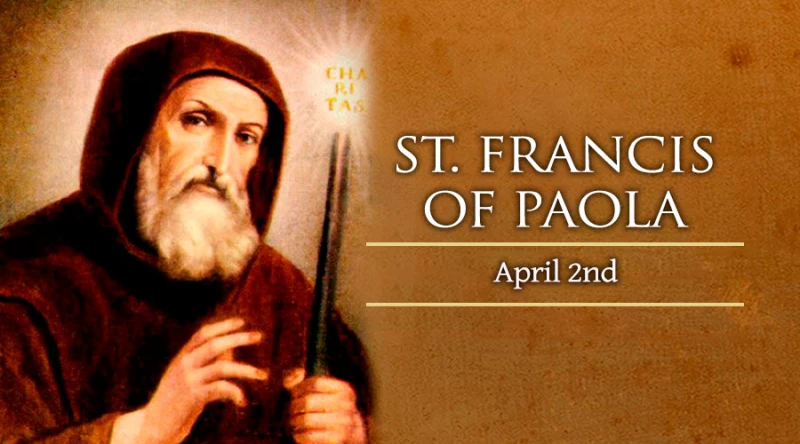
Catholics will remember St. Francis of Paola on April 2. The saint founded a religious order at a young age and sought to revive the practices of the earliest monks during a period of corruption in the Church.

Francis was born in the Southern Italian region of Calabria during 1416. His parents, who maintained a strong devotion to St. Francis of Assisi, named their son after him. The boy’s father and mother had little in the way of wealth, but they passed on a rich spiritual heritage to their son, with the hope that he would imitate his namesake.

The young Francis showed signs of a remarkable spiritual life, following his parents’ lead in accepting poverty as a path to holiness. When his father placed him in the care of a group of Franciscan friars to be educated at the age of 13, Francis made a personal decision to live strictly according to the rule of their religious order.

After a year with the friars, Francis rejoined his parents as they made a pilgrimage to Assisi, Rome,  and the historic Franciscan church known as the Portiuncula. When the family returned to their hometown of Paola, Francis – at the age of only 15 – asked his parents’ permission to live as a hermit,
in the manner of the earliest desert fathers such as St. Anthony of Egypt.

The young monk slept in a cave, and ate what he could gather in the wild, along with occasional offerings of food from his friends in the town. Within four years, two companions had joined him, and the townspeople assisted in building three individual cells for the hermits, as well as a chapel where  a priest would offer Mass.

With approval from the local archbishop, this small group continued to grow into a larger religious order, without compromising the young founder’s insistence on penitential and primitive living conditions. They were first known as the Hermits of St. Francis of Assisi, but later renamed the “Minimi” (or “Minims”), meaning “the least,” and signifying their commitment to humility.

Francis and his monks were notable not only for their austere lifestyle, but also for their strict diet, which not only eliminated meat and fish, but also excluded eggs, dairy products, and other foods derived from animals.

Abstinence from meat and other animal products became a “fourth vow” of his religious order, along with the traditional vows of poverty, chastity and obedience. Francis instituted the continual, year-round observance of this diet in an effort to revive the tradition of fasting during Lent, which many Roman Catholics had ceased to practice by the 15th century.

Ironically, Francis’ pursuit of solitary communion with God attracted attention from a range of important figures, including several European kings and other nobility along with Popes and bishops. Some of these men regarded Francis as a spiritual leader in a corrupt age, while others may have been more interested in his gifts of prophecy and miraculous healing.

Francis traveled to France at the request of Pope Sixtus IV, taking with him his nephew Nicholas, whom he had raised from the dead. There, the notoriously power-hungry King Louis XI was approaching the point of death himself, and hoped that Francis would perform a miracle and restore his health.

Francis told the king bluntly that he should not fear the end of his earthly life, but the loss of eternal life. From that time, the hermit became a close spiritual adviser to the king. He discussed the reality of death and eternity with him, and urged him to surrender his heart and soul to God before it was too late.

The king died in Francis’ arms in 1483.

Louis XI’s son and successor, Charles VIII, maintained the monk as a close adviser, in spiritual and even political affairs. Nonetheless, Francis persisted in following the monastic rule he had developed while living in his hermitage outside of Paola. He continued as superior general of the Minim order, and founded new monasteries in France.

Francis sensed that his death was approaching at the age of 91, and returned to living in complete solitude for three months to prepare himself. When he emerged, he gathered a group of the Minim brothers and gave them final instructions for the future of the order. He received Holy Communion for the last time and died on April 2, Good Friday of 1507.

Pope Leo X canonized St. Francis of Paola 12 years after his death, in 1519. Although the Minim order lost many of its monasteries in the 18th century during the French Revolution, it continues to exist, primarily in Italy.

St. Francis of Paola Read More »

Friday of the Fourth Week of Lent

Reading I Wis 2:1a, 12-22

The wicked said among themselves,
            thinking not aright:
“Let us beset the just one, because he is obnoxious to us;
            he sets himself against our doings,
Reproaches us for transgressions of the law
            and charges us with violations of our training.
He professes to have knowledge of God
            and styles himself a child of the LORD.
To us he is the censure of our thoughts;
            merely to see him is a hardship for us,
Because his life is not like that of others,
            and different are his ways.
He judges us debased;
            he holds aloof from our paths as from things impure.
He calls blest the destiny of the just
            and boasts that God is his Father.
Let us see whether his words be true;
            let us find out what will happen to him.
For if the just one be the son of God, he will defend him
            and deliver him from the hand of his foes.
With revilement and torture let us put him to the test
            that we may have proof of his gentleness
            and try his patience.
Let us condemn him to a shameful death;
            for according to his own words, God will take care of him.”
These were their thoughts, but they erred;
            for their wickedness blinded them,
and they knew not the hidden counsels of God;
            neither did they count on a recompense of holiness
            nor discern the innocent souls’ reward.

Responsorial Psalm 34:17-18, 19-20, 21 and 23

R.        (19a)  The Lord is close to the brokenhearted.
The LORD confronts the evildoers,
            to destroy remembrance of them from the earth.
When the just cry out, the LORD hears them,
            and from all their distress he rescues them.
R.        The Lord is close to the brokenhearted.
The LORD is close to the brokenhearted;
            and those who are crushed in spirit he saves.
Many are the troubles of the just man,
            but out of them all the LORD delivers him.
R.        The Lord is close to the brokenhearted.
He watches over all his bones
            not one of them shall be broken.
The LORD redeems the lives of his servants;
            no one incurs guilt who takes refuge in him.
R.        The Lord is close to the brokenhearted.

Verse before the Gospel Mt 4:4b

One does not live on bread alone,
but on every word that comes forth from the mouth of God.

Gospel Jn 7:1-2, 10, 25-30

Jesus moved about within Galilee;
he did not wish to travel in Judea,
because the Jews were trying to kill him.
But the Jewish feast of Tabernacles was near.

But when his brothers had gone up to the feast,
he himself also went up, not openly but as it were in secret.

Some of the inhabitants of Jerusalem said,
“Is he not the one they are trying to kill?
And look, he is speaking openly and they say nothing to him.
Could the authorities have realized that he is the Christ?
But we know where he is from.
When the Christ comes, no one will know where he is from.”
So Jesus cried out in the temple area as he was teaching and said,
“You know me and also know where I am from.
Yet I did not come on my own,
but the one who sent me, whom you do not know, is true.
I know him, because I am from him, and he sent me.”
So they tried to arrest him,
but no one laid a hand upon him,
because his hour had not yet come.
 

– – –

Lectionary for Mass for Use in the Dioceses of the United States, second typical edition, Copyright © 2001, 1998, 1997, 1986, 1970 Confraternity of Christian Doctrine; Psalm refrain © 1968, 1981, 1997, International Committee on English in the Liturgy, Inc. All rights reserved. Neither this work nor any part of it may be reproduced, distributed, performed or displayed in any medium, including electronic or digital, without permission in writing from the copyright owner.

Friday of the Fourth Week of Lent Read More »

St. Mary of Egypt


St. Mary of Egypt

Feast date: Apr 01

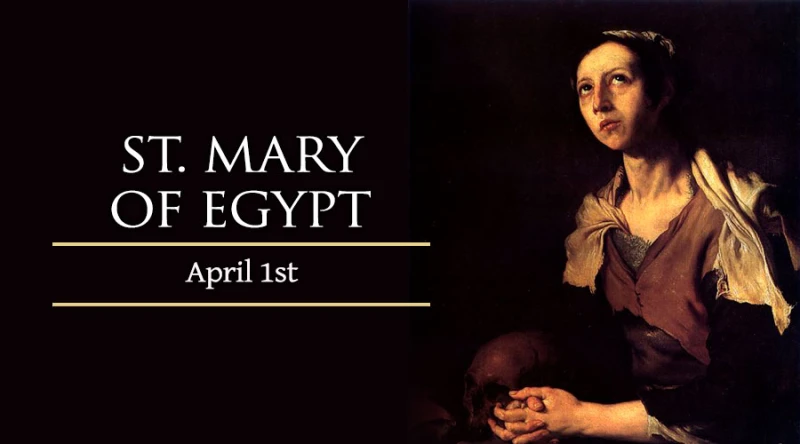
April 1 is the feast of a little-known saint whose story demonstrates the power of the Church as the home of forgiveness, redemption and mercy. St. Mary of Egypt was a prostitute for 17 years before she received the Eucharist and chose the life of a hermit.

Born in 344 A.D., Mary of Egypt moved to the city of Alexandria when she was 12 years old and worked as a prostitute. With the intention of continuing her trade, she joined a large group that was making a pilgrimage to Jerusalem for the Feast of the Exaltation of the Holy Cross.

On the feast day itself, she joined the crowd as it was headed to the church in order to venerate the relic of the True Cross, again with the intention of luring others into sin. When she got to the door of the church, she was unable to enter. A miraculous force propelled her away from the door each time she approached. After trying to get in three or four times, Mary of Egypt moved to a corner of the churchyard and began to cry tears of remorse.

Then she saw a statue of the Blessed Virgin. She prayed to the Holy Mother for permission to enter the church for the purposes of venerating the relic. She promised the Virgin Mother that if she were allowed to enter the church, she would renounce the world and its ways.

Mary of Egypt entered the church, venerated the relic and returned to the statue outside to pray for guidance. She heard a voice telling her to cross the Jordan River and find rest. She set out and in the evening, she arrived at the Jordan and received communion in a church dedicated to St. John the Baptist.

The next day, she crossed the river and went into the desert, where she lived alone for 47 years. Then, while making his Lenten retreat, a priest named Zosimus found the hermitess. She asked him to return to the banks of the Jordan on Holy Thursday of the following year and to bring her Communion. The priest was true to his word and returned bearing the Eucharist. Mary told him to come back again the next year, but to the place where he had originally met her.

When Zosimus returned in a year’s time, he found Mary’s corpse. On the ground beside it was a written request that she be buried accompanied by a statement that she had died one year ago, in 421 A.D., on the very night she had received Holy Communion.


St. Mary of Egypt Read More »