Please mind our dust!

We are currently working on revamping our website!
Thank you for your patience!

CRD Solutions

Fourth Sunday of Lent

Reading I Jos 5:9a, 10-12

The LORD said to Joshua,
“Today I have removed the reproach of Egypt from you.”

While the Israelites were encamped at Gilgal on the plains of Jericho,
they celebrated the Passover
on the evening of the fourteenth of the month.
On the day after the Passover,
they ate of the produce of the land
in the form of unleavened cakes and parched grain.
On that same day after the Passover,
on which they ate of the produce of the land, the manna ceased.
No longer was there manna for the Israelites,
who that year ate of the yield of the land of Canaan.

Responsorial Psalm Ps 34:2-3, 4-5, 6-7.

R. (9a)  Taste and see the goodness of the Lord.
I will bless the LORD at all times;
            his praise shall be ever in my mouth.
Let my soul glory in the LORD;
            the lowly will hear me and be glad.
R. Taste and see the goodness of the Lord.
Glorify the LORD with me,
            let us together extol his name.
I sought the LORD, and he answered me
            and delivered me from all my fears.
R. Taste and see the goodness of the Lord.
Look to him that you may be radiant with joy,
            and your faces may not blush with shame.
When the poor one called out, the LORD heard,
            and from all his distress he saved him.
R. Taste and see the goodness of the Lord.

Reading II 2 Cor 5:17-21

Brothers and sisters:
Whoever is in Christ is a new creation:
the old things have passed away;
behold, new things have come.
And all this is from God,
who has reconciled us to himself through Christ
and given us the ministry of reconciliation,
namely, God was reconciling the world to himself in Christ,
not counting their trespasses against them
and entrusting to us the message of reconciliation.
So we are ambassadors for Christ,
as if God were appealing through us.
We implore you on behalf of Christ,
be reconciled to God.
For our sake he made him to be sin who did not know sin,
so that we might become the righteousness of God in him.

Verse before the Gospel Lk 15:18

I will get up and go to my Father and shall say to him:
Father, I have sinned against heaven and against you.

Gospel Lk 15:1-3, 11-32

Tax collectors and sinners were all drawing near to listen to Jesus,
but the Pharisees and scribes began to complain, saying,
“This man welcomes sinners and eats with them.”
So to them Jesus addressed this parable:
“A man had two sons, and the younger son said to his father,
‘Father give me the share of your estate that should come to me.’
So the father divided the property between them.
After a few days, the younger son collected all his belongings
and set off to a distant country
where he squandered his inheritance on a life of dissipation.
When he had freely spent everything,
a severe famine struck that country,
and he found himself in dire need.
So he hired himself out to one of the local citizens
who sent him to his farm to tend the swine.
And he longed to eat his fill of the pods on which the swine fed,
but nobody gave him any.
Coming to his senses he thought,
‘How many of my father’s hired workers
have more than enough food to eat,
but here am I, dying from hunger.
I shall get up and go to my father and I shall say to him,
“Father, I have sinned against heaven and against you.
I no longer deserve to be called your son;
treat me as you would treat one of your hired workers.”’
So he got up and went back to his father.
While he was still a long way off,
his father caught sight of him, and was filled with compassion.
He ran to his son, embraced him and kissed him.
His son said to him,
‘Father, I have sinned against heaven and against you;
I no longer deserve to be called your son.’
But his father ordered his servants,
‘Quickly bring the finest robe and put it on him;
put a ring on his finger and sandals on his feet.
Take the fattened calf and slaughter it.
Then let us celebrate with a feast,
because this son of mine was dead, and has come to life again;
he was lost, and has been found.’
Then the celebration began.
Now the older son had been out in the field
and, on his way back, as he neared the house,
he heard the sound of music and dancing.
He called one of the servants and asked what this might mean.
The servant said to him,
‘Your brother has returned
and your father has slaughtered the fattened calf
because he has him back safe and sound.’
He became angry,
and when he refused to enter the house,
his father came out and pleaded with him.
He said to his father in reply,
‘Look, all these years I served you
and not once did I disobey your orders;
yet you never gave me even a young goat to feast on with my friends.
But when your son returns
who swallowed up your property with prostitutes,
for him you slaughter the fattened calf.’
He said to him,
‘My son, you are here with me always;
everything I have is yours.
But now we must celebrate and rejoice,
because your brother was dead and has come to life again;
he was lost and has been found.’”

– – –

Lectionary for Mass for Use in the Dioceses of the United States, second typical edition, Copyright © 2001, 1998, 1997, 1986, 1970 Confraternity of Christian Doctrine; Psalm refrain © 1968, 1981, 1997, International Committee on English in the Liturgy, Inc. All rights reserved. Neither this work nor any part of it may be reproduced, distributed, performed or displayed in any medium, including electronic or digital, without permission in writing from the copyright owner.

Fourth Sunday of Lent Read More »
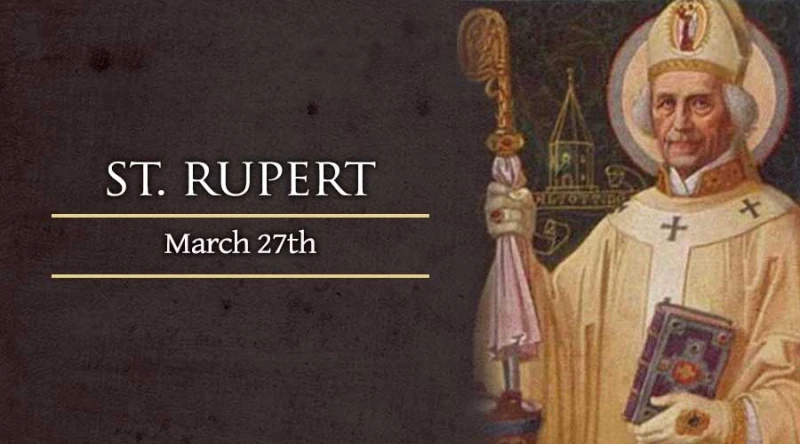
St. Rupert


St. Rupert

Feast date: Mar 27

On March 27 the Catholic Church remembers the monk and bishop Saint Rupert, whose missionary labors built up the Church in two of its historic strongholds, Austria and Bavaria.

During his lifetime, the “Apostle of Bavaria and Austria” was an energetic founder of churches and monasteries, and a remarkably successful evangelist of the regions – which include the homeland of the Bavarian native Pope Benedict XVI.

Little is known about Rupert’s early life, which is thought to have begun around 660 in the territory of Gaul in modern-day France. There is some indication that he came from the Merovignian royal line, though he embraced a life of prayer, fasting, asceticism and charity toward the poor.

This course of life led to his consecration as the Bishop of Worms in present-day Germany. Although Rupert was known as a wise and devout bishop, he eventually met with rejection from the largely pagan population, who beat him savagely and forced him to leave the city.

After this painful rejection, Rupert made a pilgrimage to Rome. Two years after his expulsion from Worms, his prayers were answered by means of a message from Duke Theodo of Bavaria, who knew of his reputation as a holy man and a sound teacher of the faith.

Bavaria, in Rupert’s day, was neither fully pagan nor solidly Catholic. Although missionaries had evangelized the region in the past, the local religion tended to mix portions of the Christian faith – often misunderstood along heretical lines – with native pagan beliefs and practices.

The Bavarian duke sought Rupert’s help to restore, correct, and spread the faith in his land. After sending messengers to report back to him on conditions in Bavaria, Rupert agreed. The bishop who had been brutally exiled from Worms was received with honor in the Bavarian city of Regensburg.

With the help of a group of priests he brought with him, Rupert undertook an extensive mission in Bavaria and parts of modern-day Austria. His missionary journeys resulted in many conversions, accompanied by numerous miracles including the healing of diseases.

In Salzburg, Rupert and his companions built a great church, which they placed under the patronage of St. Peter, and a monastery observing the Rule of St. Benedict. Rupert’s niece became the abbess of a Benedictine convent established nearby.

Rupert served as both the bishop of Salzburg and the abbot of the Benedictine monastery he established there. This traditional pairing of the two roles, also found in the Irish Church after its development of monasticism, was passed on by St. Rupert’s successors until the late 10th century.

St. Rupert died on March 27, Easter Sunday of the year 718, after preaching and celebrating Mass.

After the saint’s death, churches and monasteries began to be named after him – including Salzburg’s modern-day Cathedral of St. Rupert (also known as the “Salzburg Cathedral”), and the Church of St. Rupert which is believed to be the oldest surviving church structure in Vienna.

St. Rupert Read More »

Saturday of the Third Week of Lent

Reading I Hos 6:1-6

“Come, let us return to the LORD,
it is he who has rent, but he will heal us;
he has struck us, but he will bind our wounds.
He will revive us after two days;
on the third day he will raise us up,
to live in his presence.
Let us know, let us strive to know the LORD;
as certain as the dawn is his coming,
and his judgment shines forth like the light of day!
He will come to us like the rain,
like spring rain that waters the earth.”

What can I do with you, Ephraim?
What can I do with you, Judah?
Your piety is like a morning cloud,
like the dew that early passes away.
For this reason I smote them through the prophets,
I slew them by the words of my mouth;
For it is love that I desire, not sacrifice,
and knowledge of God rather than burnt offerings.

Responsorial Psalm 51:3-4, 18-19, 20-21ab

R.        (see Hosea 6:6)  It is mercy I desire, and not sacrifice.
Have mercy on me, O God, in your goodness;
            in the greatness of your compassion wipe out my offense.
Thoroughly wash me from my guilt
            and of my sin cleanse me.
R.        It is mercy I desire, and not sacrifice.
For you are not pleased with sacrifices;
            should I offer a burnt offering, you would not accept it.
My sacrifice, O God, is a contrite spirit;
            a heart contrite and humbled, O God, you will not spurn.
R.        It is mercy I desire, and not sacrifice.
Be bountiful, O LORD, to Zion in your kindness
            by rebuilding the walls of Jerusalem;
Then shall you be pleased with due sacrifices,
            burnt offerings and holocausts.
R.        It is mercy I desire, and not sacrifice.

Verse Before the Gospel Ps 95:8

If today you hear his voice,
harden not your hearts.

Gospel Lk 18:9-14

Jesus addressed this parable
to those who were convinced of their own righteousness
and despised everyone else.
“Two people went up to the temple area to pray;
one was a Pharisee and the other was a tax collector.
The Pharisee took up his position and spoke this prayer to himself,
‘O God, I thank you that I am not like the rest of humanity

greedy, dishonest, adulterous or even like this tax collector.
I fast twice a week,
and I pay tithes on my whole income.’
But the tax collector stood off at a distance
and would not even raise his eyes to heaven
but beat his breast and prayed,
‘O God, be merciful to me a sinner.’
I tell you, the latter went home justified, not the former;
for everyone who exalts himself will be humbled,
and the one who humbles himself will be exalted.”

– – –

Lectionary for Mass for Use in the Dioceses of the United States, second typical edition, Copyright © 2001, 1998, 1997, 1986, 1970 Confraternity of Christian Doctrine; Psalm refrain © 1968, 1981, 1997, International Committee on English in the Liturgy, Inc. All rights reserved. Neither this work nor any part of it may be reproduced, distributed, performed or displayed in any medium, including electronic or digital, without permission in writing from the copyright owner.

Saturday of the Third Week of Lent Read More »

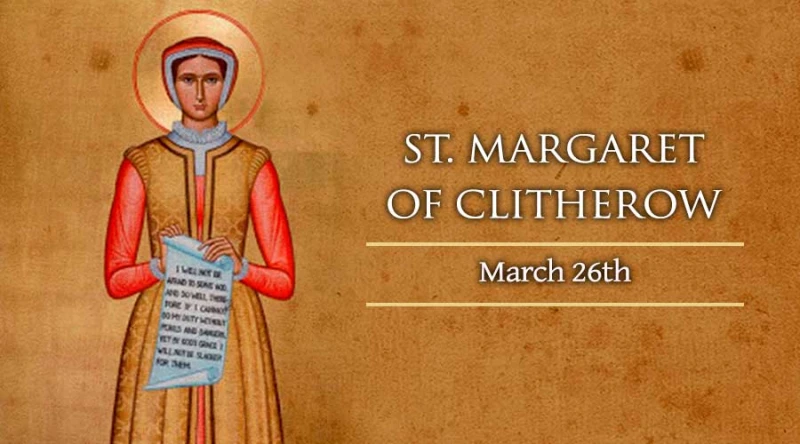
St. Margaret of Clitherow


St. Margaret of Clitherow

Feast date: Mar 26

St. Margaret Clitherow was born in Middleton, England around the year 1555 to a protestant family. Margaret was known throughout the town for her wit and good looks, and in 1571 she married John Clitherow, and together they bore two children.

Several years after her marriage to John, Margaret was introduced to the Catholic faith, and converted. She was a zealous defender of Catholicism and hid fugitive priests in her home. Eventually, Margaret was turned in to the sheriff and tried for the crime of harboring Catholic priests.

While Margaret was on trial, many efforts were made to encourage her to deny the Catholic faith, but she held firmly. Finally, Margaret was condemned to be pressed to death upon sharp rocks. She was executed on March 25, 1586.

Pope Paul VI canonized Margaret in 1970.

St. Margaret of Clitherow Read More »

St. Dismas

Feast date: Mar 25

St Dismas is the man known as the “Good Thief” who was crucified with Christ alongside another criminal on Calvary. He is described in Luke’s Gospel (29: 39-43) as repenting from his sins and asks Jesus to “remember me when you come into your kingdom.” Jesus replied to him, “Amen, I say to you, today you will be with me in Paradise.”  

St. Dismas´ feast is March 25th.


St. Dismas Read More »