Please mind our dust!

We are currently working on revamping our website!
Thank you for your patience!

CRD Solutions

St. Dismas

Feast date: Mar 25

St Dismas is the man known as the “Good Thief” who was crucified with Christ alongside another criminal on Calvary. He is described in Luke’s Gospel (29: 39-43) as repenting from his sins and asks Jesus to “remember me when you come into your kingdom.” Jesus replied to him, “Amen, I say to you, today you will be with me in Paradise.”  

St. Dismas´ feast is March 25th.


St. Dismas Read More »

Thursday of the Third Week of Lent

Reading I Jer 7:23-28

Thus says the LORD:
This is what I commanded my people:
Listen to my voice;
then I will be your God and you shall be my people.
Walk in all the ways that I command you,
so that you may prosper.

But they obeyed not, nor did they pay heed.
They walked in the hardness of their evil hearts
and turned their backs, not their faces, to me.
From the day that your fathers left the land of Egypt even to this day,
I have sent you untiringly all my servants the prophets.
Yet they have not obeyed me nor paid heed;
they have stiffened their necks and done worse than their fathers.
When you speak all these words to them,
they will not listen to you either;
when you call to them, they will not answer you.
Say to them:
This is the nation that does not listen
to the voice of the LORD, its God,
or take correction.
Faithfulness has disappeared;
the word itself is banished from their speech.

Responsorial Psalm 95:1-2, 6-7, 8-9

R.        (8) If today you hear his voice, harden not your hearts.
Come, let us sing joyfully to the LORD;
            let us acclaim the Rock of our salvation.
Let us come into his presence with thanksgiving;
            let us joyfully sing psalms to him.
R.        If today you hear his voice, harden not your hearts.
Come, let us bow down in worship;
            let us kneel before the LORD who made us.
For he is our God,
            and we are the people he shepherds, the flock he guides.
R.        If today you hear his voice, harden not your hearts.
Oh, that today you would hear his voice:
            “Harden not your hearts as at Meribah
            as in the day of Massah in the desert,
Where your fathers tempted me;
            they tested me though they had seen my works.”
R.        If today you hear his voice, harden not your hearts.

Verse before the Gospel Jl 2:12-13

Even now, says the LORD,
return to me with your whole heart,
for I am gracious and merciful.

Gospel Lk 11:14-23

Jesus was driving out a demon that was mute,
and when the demon had gone out,
the mute man spoke and the crowds were amazed.
Some of them said, “By the power of Beelzebul, the prince of demons,
he drives out demons.”
Others, to test him, asked him for a sign from heaven.
But he knew their thoughts and said to them,
“Every kingdom divided against itself will be laid waste
and house will fall against house.
And if Satan is divided against himself,
how will his kingdom stand?
For you say that it is by Beelzebul that I drive out demons.
If I, then, drive out demons by Beelzebul,
by whom do your own people drive them out?
Therefore they will be your judges.
But if it is by the finger of God that I drive out demons,
then the Kingdom of God has come upon you.
When a strong man fully armed guards his palace,
his possessions are safe.
But when one stronger than he attacks and overcomes him,
he takes away the armor on which he relied
and distributes the spoils.
Whoever is not with me is against me,
and whoever does not gather with me scatters.”

– – –

Lectionary for Mass for Use in the Dioceses of the United States, second typical edition, Copyright © 2001, 1998, 1997, 1986, 1970 Confraternity of Christian Doctrine; Psalm refrain © 1968, 1981, 1997, International Committee on English in the Liturgy, Inc. All rights reserved. Neither this work nor any part of it may be reproduced, distributed, performed or displayed in any medium, including electronic or digital, without permission in writing from the copyright owner.

Thursday of the Third Week of Lent Read More »

St. Catherine of Sweden


St. Catherine of Sweden

Feast date: Mar 24

St. Catherine was born near the beginning of the fourteenth century to parents Ulfo and St. Bridget of Sweden. At the age of seven, Catherine was sent to the Abbey at Risburgh by her parents and placed under the care of the abbess to receive an education and to build a foundation for her spiritual life.

At the age of 13, Catherine was taken from the abbey and given in marriage to Egard, a German nobleman. Upon meeting Egard, Catherine persuaded him to make a mutual vow of perpetual chastity with her. Catherine and Egard dedicated themselves to the service of God and encouraged each other in works of mortification, prayer and charity.

Around the year 1349, after the death of her father, Catherine accompanied her mother on a pilgrimage to Rome to visit the relics of the Roman Martyrs. The two spent several years living in Rome. In 1373 St. Bridget died and Catherine returned to Sweden with her mother’s body. Two years later, Catherine returned to Rome to promote the cause for her mother’s canonization and to gain approval for a Rule she had written for a group of religious women.

After gaining approval for her rule, Catherine returned to Sweden and became abbess of Vadzstena. Catherine served as abbess of Vadzstena until her death in 1381. During the final 25 years of her life, Catherine was known for her austere lifestyle and her practice of making daily use of the Sacrament of Confession.

St. Catherine was canonized in 1484 by Pope Pius II.

St. Catherine of Sweden Read More »

Wednesday of the Third Week of Lent

Reading I Dt 4:1, 5-9

Moses spoke to the people and said:
“Now, Israel, hear the statutes and decrees
which I am teaching you to observe,
that you may live, and may enter in and take possession of the land
which the LORD, the God of your fathers, is giving you.
Therefore, I teach you the statutes and decrees
as the LORD, my God, has commanded me,
that you may observe them in the land you are entering to occupy.
Observe them carefully,
for thus will you give evidence
of your wisdom and intelligence to the nations,
who will hear of all these statutes and say,
‘This great nation is truly a wise and intelligent people.’
For what great nation is there
that has gods so close to it as the LORD, our God, is to us
whenever we call upon him?
Or what great nation has statutes and decrees
that are as just as this whole law
which I am setting before you today?

“However, take care and be earnestly on your guard
not to forget the things which your own eyes have seen,
nor let them slip from your memory as long as you live,
but teach them to your children and to your children’s children.”

Responsorial Psalm 147:12-13, 15-16, 19-20

R.        (12a)  Praise the Lord, Jerusalem.
Glorify the LORD, O Jerusalem;
            praise your God, O Zion.
For he has strengthened the bars of your gates;
            he has blessed your children within you.
R.        Praise the Lord, Jerusalem.
He sends forth his command to the earth;
            swiftly runs his word!
He spreads snow like wool;
            frost he strews like ashes.
R.        Praise the Lord, Jerusalem.
He has proclaimed his word to Jacob,
            his statutes and his ordinances to Israel.
He has not done thus for any other nation;
            his ordinances he has not made known to them.
R.        Praise the Lord, Jerusalem.

Verse before the Gospel See Jn 6:63c, 68c

Your words, Lord, are Spirit and life;
you have the words of everlasting life.

Gospel Mt 5:17-19

Jesus said to his disciples:
“Do not think that I have come to abolish the law or the prophets.
I have come not to abolish but to fulfill.
Amen, I say to you, until heaven and earth pass away,
not the smallest letter or the smallest part of a letter
will pass from the law,
until all things have taken place.
Therefore, whoever breaks one of the least of these commandments
and teaches others to do so
will be called least in the Kingdom of heaven.
But whoever obeys and teaches these commandments
will be called greatest in the Kingdom of heaven.”

– – –

Lectionary for Mass for Use in the Dioceses of the United States, second typical edition, Copyright © 2001, 1998, 1997, 1986, 1970 Confraternity of Christian Doctrine; Psalm refrain © 1968, 1981, 1997, International Committee on English in the Liturgy, Inc. All rights reserved. Neither this work nor any part of it may be reproduced, distributed, performed or displayed in any medium, including electronic or digital, without permission in writing from the copyright owner.

Wednesday of the Third Week of Lent Read More »

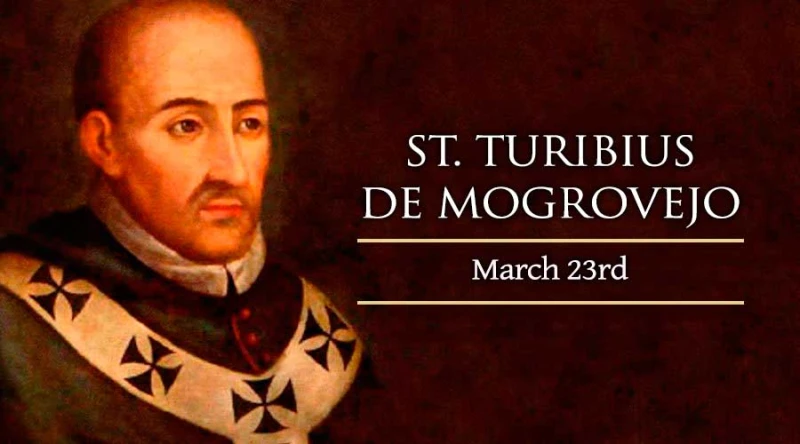
St. Turibius de Mogrovejo


St. Turibius de Mogrovejo

Feast date: Mar 23

Catholics in Latin America and throughout the world will celebrate the life and ministry of St. Turibius of Mogrovejo on March 23. The 16th century bishop upheld the rights of Peru’s indigenous peoples, and became one of the first canonized saints of the Americas.

Turibius was born in Spain during 1538, to a noble family in the kingdom of Leon. He frequently prayed, fasted, and gave to the poor even as a child, and eventually developed the daily habit of praying the Rosary along with the Little Office of the Blessed Virgin Mary.

He went on to study law at the University of Salamanca, and eventually served as a judge for five years in the territory of Granada. His judicial wisdom and diligence drew the attention of King Philip II, who wanted Turibius – who was still a layman – to be consecrated as a missionary archbishop for the Spanish colony of Peru.

Turibius became greatly dismayed, protesting to the king and Church authorities that he was not even a priest and could not possibly accept the charge. In a series of letters, he pled that he was not personally capable of serving as the Archbishop of Lima – nor, he reminded them, did canon law permit a layman to become an archbishop.

Eventually, however, he had little choice but to comply. He was consecrated as a bishop in 1581, at the age of 43, and immediately left for Lima, Peru.

The new archbishop undertook to travel throughout the rugged and mountainous diocese, where he observed many of the worst effects of colonialism – both upon the enslaved and oppressed natives, and on many of the colonists who seemed to have lost their souls in the pursuit of wealth.

He responded with constant prayer and penance, as he traveled throughout his territory administering the sacraments, teaching the Catholic faith, and establishing schools, seminaries and hospitals.

To the indigenous Peruvians, the archbishop was a herald of the Gospel who held their lives as more precious than their country’s supplies of gold and silver. But to the many colonists whose behavior showed no sign of their Catholic origins, he was a prophetic scourge – whose efforts to awaken the public conscience earned him rebukes and opposition.

Turibius ultimately managed to make three visitations of his diocese, under rugged and dangerous conditions, which occupied about half of his 25 years as Archbishop of Lima. He united the Peruvian Church at an administrative level by holding several local councils of its clergy, but was also known to spend days traveling to reach a single individual with the message of Christ.

The archbishop became seriously ill in 1606. He sensed that his death was imminent, and decreed that his possessions should be distributed to the poor. St. Turibius died on March 23, and his body was found to be incorrupt the next year. He was declared a saint in 1726, and is now regarded as the patron of native peoples’ rights and Latin American bishops.

St. Turibius de Mogrovejo Read More »