Please mind our dust!

We are currently working on revamping our website!
Thank you for your patience!

CRD Solutions

Tuesday of the Third Week of Lent

Reading I Dn 3:25, 34-43

Azariah stood up in the fire and prayed aloud:

“For your name’s sake, O Lord, do not deliver us up forever,
            or make void your covenant.
Do not take away your mercy from us,
            for the sake of Abraham, your beloved,
            Isaac your servant, and Israel your holy one,
To whom you promised to multiply their offspring
            like the stars of heaven,
            or the sand on the shore of the sea.
For we are reduced, O Lord, beyond any other nation,
            brought low everywhere in the world this day
            because of our sins.
We have in our day no prince, prophet, or leader,
            no burnt offering, sacrifice, oblation, or incense,
            no place to offer first fruits, to find favor with you.
But with contrite heart and humble spirit
            let us be received;
As though it were burnt offerings of rams and bullocks,
            or thousands of fat lambs,
So let our sacrifice be in your presence today
            as we follow you unreservedly;
            for those who trust in you cannot be put to shame.
And now we follow you with our whole heart,
            we fear you and we pray to you.
Do not let us be put to shame,
            but deal with us in your kindness and great mercy.
Deliver us by your wonders,
            and bring glory to your name, O Lord.”
 

Responsorial Psalm 25:4-5ab, 6 and 7bc, 8-9

R.        (6a)  Remember your mercies, O Lord.
Your ways, O LORD, make known to me;
            teach me your paths,
Guide me in your truth and teach me,
            for you are God my savior.
R.        Remember your mercies, O Lord.
Remember that your compassion, O LORD,
            and your kindness are from of old.
In your kindness remember me,
            because of your goodness, O LORD.
R.        Remember your mercies, O Lord.
Good and upright is the LORD;
            thus he shows sinners the way.
He guides the humble to justice,
            he teaches the humble his way.
R.        Remember your mercies, O Lord.

Verse before the Gospel Jl 2:12-13

Even now, says the LORD,
return to me with your whole heart;
for I am gracious and merciful.

Gospel Mt 18:21-35

Peter approached Jesus and asked him,
“Lord, if my brother sins against me,
how often must I forgive him?
As many as seven times?”
Jesus answered, “I say to you, not seven times but seventy-seven times.
That is why the Kingdom of heaven may be likened to a king
who decided to settle accounts with his servants.
When he began the accounting,
a debtor was brought before him who owed him a huge amount.
Since he had no way of paying it back,
his master ordered him to be sold,
along with his wife, his children, and all his property,
in payment of the debt.
At that, the servant fell down, did him homage, and said,
‘Be patient with me, and I will pay you back in full.’
Moved with compassion the master of that servant
let him go and forgave him the loan.
When that servant had left, he found one of his fellow servants
who owed him a much smaller amount.
He seized him and started to choke him, demanding,
‘Pay back what you owe.’
Falling to his knees, his fellow servant begged him,
‘Be patient with me, and I will pay you back.’
But he refused.
Instead, he had him put in prison
until he paid back the debt.
Now when his fellow servants saw what had happened,
they were deeply disturbed, and went to their master
and reported the whole affair.
His master summoned him and said to him, ‘You wicked servant!
I forgave you your entire debt because you begged me to.
Should you not have had pity on your fellow servant,
as I had pity on you?’
Then in anger his master handed him over to the torturers
until he should pay back the whole debt.
So will my heavenly Father do to you,
unless each of you forgives your brother from your heart.”

– – –

Lectionary for Mass for Use in the Dioceses of the United States, second typical edition, Copyright © 2001, 1998, 1997, 1986, 1970 Confraternity of Christian Doctrine; Psalm refrain © 1968, 1981, 1997, International Committee on English in the Liturgy, Inc. All rights reserved. Neither this work nor any part of it may be reproduced, distributed, performed or displayed in any medium, including electronic or digital, without permission in writing from the copyright owner.

Tuesday of the Third Week of Lent Read More »
St. Lea


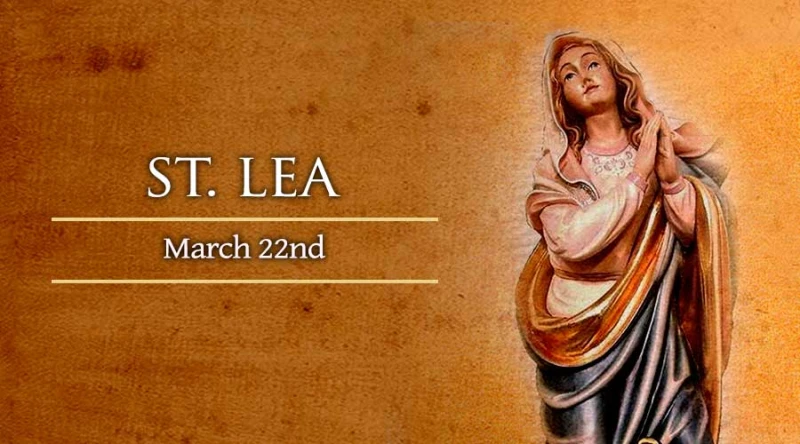
St. Lea

Feast date: Mar 22

March 22 is the liturgical memorial of Saint Lea of Rome, a fourth-century widow who left her wealth behind, entered consecrated life, and attained great holiness through asceticism and prayer.

Though not well-known as a figure of devotion in modern times, she was acknowledged as a saint on the testimony of her contemporary Saint Jerome, who wrote a brief description of Lea’s life after she had died.

Jerome, a scholarly monk best known for his Latin translation of the Bible (the Vulgate), is the Church’s only source of information on St. Lea, whose biographical details are unknown. St. Jerome eulogized her in a letter written during the year 384 to his student and spiritual directee Marcella, another Roman consecrated woman who had left her aristocratic life behind after being widowed.

It is clear from his letter that Lea was a mutual friend to both Jerome and Marcella. Jerome states that his account is written to “hail with joy the release of a soul which has trampled Satan under foot, and won for itself, at last, a crown of tranquility.” Jerome also contrasts the life of “our most saintly friend” with that of the late pagan public official Praetextatus, held up by Jerome as a cautionary example.

“Who,” Jerome begins, “can sufficiently eulogize our dear Lea’s mode of living? So complete was her conversion to the Lord that, becoming the head of a monastery, she showed herself a true mother to the virgins in it, wore coarse sackcloth instead of soft raiment, passed sleepless nights in prayer, and instructed her companions even more by example than by precept.”

Jerome describes how Lea, in her great humility, “was accounted the servant of all … She was careless of her dress, neglected her hair, and ate only the coarsest food. Still, in all that she did, she avoided ostentation that she might not have her reward in this world.”

Jerome’s letter goes on to compare her fate to that of Praetextus – who died in the same year as Lea, after spending his life promoting a return to Rome’s ancient polytheistic pagan religion. The monk retells Jesus’ parable of Lazarus and Dives, with Lea in the place of the poor and suffering man.

Lea, Jerome says, is “welcomed into the choirs of the angels; she is comforted in Abraham’s bosom. And, as once the beggar Lazarus saw the rich man, for all his purple, lying in torment, so does Lea see the consul, not now in his triumphal robe but clothed in mourning, and asking for a drop of water from her little finger.”

Thus Lea, “who seemed poor and of little worth, and whose life was accounted madness,” triumphs in salvation. But the punishment of infidelity falls on the consul-elect – who had led a triumphant procession just before his death, and been widely mourned afterward.

Jerome ends his letter by urging Marcella to remember the lesson of St. Lea’s life: “We must not allow … money to weigh us down, or lean upon the staff of worldly power. We must not seek to possess both Christ and the world. No; things eternal must take the place of things transitory; and since, physically speaking, we daily anticipate death, if we wish for immortality we must realize that we are but mortal.”

St. Lea Read More »

Monday of the Third Week of Lent

Reading I 2 Kgs 5:1-15ab

Naaman, the army commander of the king of Aram,
was highly esteemed and respected by his master,
for through him the LORD had brought victory to Aram.
But valiant as he was, the man was a leper.
Now the Arameans had captured in a raid on the land of Israel
a little girl, who became the servant of Naaman’s wife.
“If only my master would present himself to the prophet in Samaria,”
she said to her mistress, “he would cure him of his leprosy.”
Naaman went and told his lord
just what the slave girl from the land of Israel had said.
“Go,” said the king of Aram.
“I will send along a letter to the king of Israel.”
So Naaman set out, taking along ten silver talents,
six thousand gold pieces, and ten festal garments.
To the king of Israel he brought the letter, which read:
“With this letter I am sending my servant Naaman to you,
that you may cure him of his leprosy.”

When he read the letter,
the king of Israel tore his garments and exclaimed:
“Am I a god with power over life and death,
that this man should send someone to me to be cured of leprosy?
Take note! You can see he is only looking for a quarrel with me!”
When Elisha, the man of God,
heard that the king of Israel had torn his garments,
he sent word to the king:
“Why have you torn your garments?
Let him come to me and find out
that there is a prophet in Israel.”

Naaman came with his horses and chariots
and stopped at the door of Elisha’s house.
The prophet sent him the message:
“Go and wash seven times in the Jordan,
and your flesh will heal, and you will be clean.”
But Naaman went away angry, saying,
“I thought that he would surely come out and stand there
to invoke the LORD his God,
and would move his hand over the spot,
and thus cure the leprosy.
Are not the rivers of Damascus, the Abana and the Pharpar,
better than all the waters of Israel?
Could I not wash in them and be cleansed?”
With this, he turned about in anger and left.

But his servants came up and reasoned with him.
“My father,” they said,
“if the prophet had told you to do something extraordinary,
would you not have done it?
All the more now, since he said to you,
‘Wash and be clean,’ should you do as he said.”
So Naaman went down and plunged into the Jordan seven times
at the word of the man of God.
His flesh became again like the flesh of a little child, and he was clean.

He returned with his whole retinue to the man of God.
On his arrival he stood before him and said,
“Now I know that there is no God in all the earth,
except in Israel.”

Responsorial Psalm 42:2, 3; 43:3, 4

R.        (see 42:3) Athirst is my soul for the living God.
When shall I go and behold the face of God?

As the hind longs for the running waters,
            so my soul longs for you, O God.
R.        Athirst is my soul for the living God.
When shall I go and behold the face of God?

Athirst is my soul for God, the living God.
            When shall I go and behold the face of God?
R.        Athirst is my soul for the living God.
When shall I go and behold the face of God?

Send forth your light and your fidelity;
            they shall lead me on
And bring me to your holy mountain,
            to your dwelling-place.
R.        Athirst is my soul for the living God.
When shall I go and behold the face of God?

Then will I go in to the altar of God,
            the God of my gladness and joy;
Then will I give you thanks upon the harp,
            O God, my God!
R.        Athirst is my soul for the living God.
When shall I go and behold the face of God?

Verse before the Gospel See Ps 130:5, 7

I hope in the LORD, I trust in his word;
with him there is kindness and plenteous redemption.

Gospel Lk 4:24-30

Jesus said to the people in the synagogue at Nazareth:
“Amen, I say to you,
no prophet is accepted in his own native place.
Indeed, I tell you, there were many widows in Israel
in the days of Elijah
when the sky was closed for three and a half years
and a severe famine spread over the entire land.
It was to none of these that Elijah was sent,
but only to a widow in Zarephath in the land of Sidon.
Again, there were many lepers in Israel
during the time of Elisha the prophet;
yet not one of them was cleansed, but only Naaman the Syrian.”
When the people in the synagogue heard this,
they were all filled with fury.
They rose up, drove him out of the town,
and led him to the brow of the hill
on which their town had been built,
to hurl him down headlong.
But he passed through the midst of them and went away.


– – –

Lectionary for Mass for Use in the Dioceses of the United States, second typical edition, Copyright © 2001, 1998, 1997, 1986, 1970 Confraternity of Christian Doctrine; Psalm refrain © 1968, 1981, 1997, International Committee on English in the Liturgy, Inc. All rights reserved. Neither this work nor any part of it may be reproduced, distributed, performed or displayed in any medium, including electronic or digital, without permission in writing from the copyright owner.

Monday of the Third Week of Lent Read More »
St. Enda


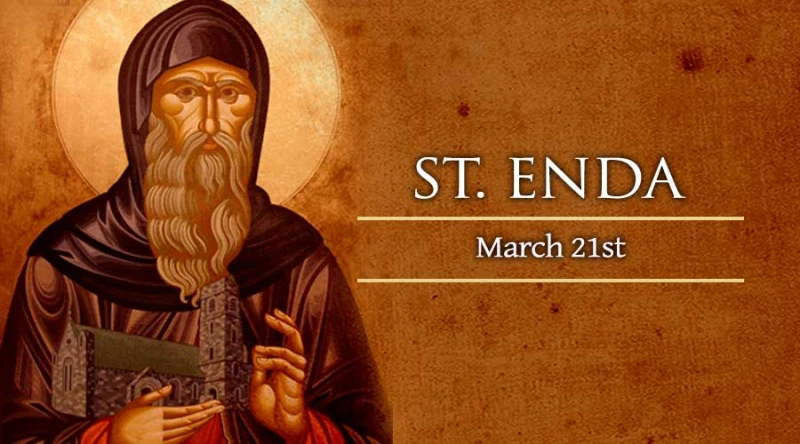
St. Enda

Feast date: Mar 21

On March 21, four days after the feast day of Ireland’s patron Saint Patrick, the Catholic Church honors Saint Enda of Aran, a warrior-turned-monk considered to be one of the founders of Irish monasticism.

Born during the fifth century, Enda inherited control of a large territory in present-day Northern Ireland from his father Conall. His sister Fanchea, however, had already embraced consecrated religious life with a community in Meath, and looked unfavorably on the battles and conquests of her brother.

Enda is said to have made a deal with his sister, promising to change his ways if he could marry one of the young women of her convent. But this was a ruse on Fanchea’s part, as the promised girl soon died. Fanchea forced him to view the girl’s corpse, to teach him that he, too, would face death and judgment.

In this way, Fanchea – whom the Church also remembers as a saint – succeeded in turning her brother not only from violence, but even from marriage. He left Ireland for several years, during which time he became a monk and was ordained as a priest.

Upon his return to Ireland, he petitioned his King Aengus of Munster – who was married to another of Enda’s sisters – to grant him land for a monastic settlement on the Aran Islands, a beautiful but austere location near Galway Bay off Ireland’s west coast.

During its early years, Enda’s island mission had around 150 monks. As the community grew, he divided up the territory between his disciples, who founded their own monasteries to accommodate the large number of vocations.

Enda did not found a religious order in the modern sense, but he did hold a position of authority and leadership over the monastic settlements of Aran – which became known as “Aran of the Saints,” renowned for the monks’ strict rule of life and passionate love for God.

While living on an Irish island, Enda’s monks imitated the asceticism and simplicity of the earliest Egytian desert hermits.

The monks of Aran lived alone in their stone cells, slept on the ground, ate together in silence, and survived by farming and fishing. St. Enda’s monastic rule, like those of St. Basil in the Greek East and St. Benedict in the Latin West, set aside many hours for prayer and the study of scripture.

During his own lifetime, Enda’s monastic settlement on the Aran islands became an important pilgrimage destination, as well as a center for the evangelizations of surrounding areas. At least two dozen canonized individuals had some association with “Aran of the Saints.”

St. Enda himself died in old age around the year 530. An early chronicler of his life declared that it would “never be known until the day of judgment, the number of saints whose bodies lie in the soil of Aran,” on account of the onetime-warrior’s response to God’s surprising call.

St. Enda Read More »

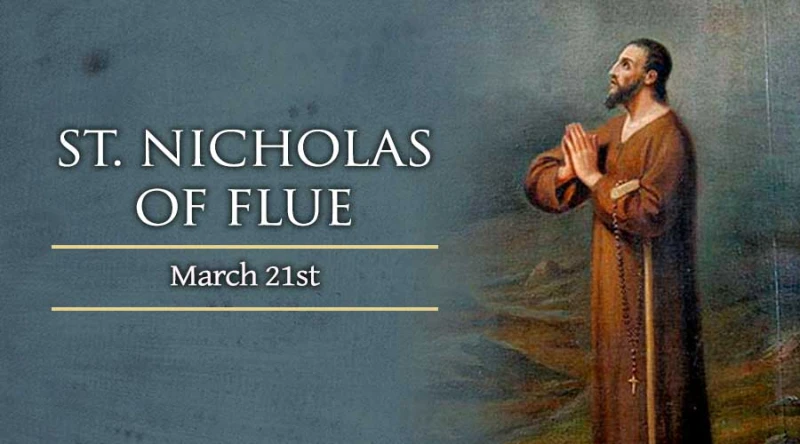
St. Nicholas of Flue


St. Nicholas of Flue

Feast date: Mar 21

Today, the universal church celebrates the feast of St. Nicholas of Flue. During his lifetime, the Swiss saint had 10 children, became a hermit and later prevented a civil war.

Nicholas was born in 1417 near the Lake of Lucerne in Switzerland. In addition to his duties as a husband and a father, Nicholas donated his talents and time selflessly to the community and always strove to give an excellent moral example to all.

The saint was also able to devote much of his private life to developing a strong relationship with the Lord.  He had a strict regime of fasting and he spent a great deal of time in contemplative prayer.

Around the year 1467, when he was 50 years old, Nicholas felt called to retire from the world and become a hermit. His wife and children gave their approval, and he left home to live in a hermitage a few miles away. While living as a hermit, Nicholas soon gained a wide reputation on account of his personal sanctity and many people sought him out to request his prayers and spiritual advice.

Nicholas lived the quiet life of a hermit for 13 years. However in 1481, a dispute arose between the delegates of the Swiss confederates at Stans and a civil war seemed imminent. The people called on Nicholas to settle the dispute, so he drafted several proposals which everyone eventually agreed on.

Nicholas’ work prevented civil war and solidified the country of Switzerland. But, as a true hermit, he then returned to his hermitage after settling the dispute.

He died six years later on March 21, 1487 surrounded by his wife and children.

St. Nicholas of Flue Read More »