Please mind our dust!

We are currently working on revamping our website!
Thank you for your patience!

CRD Solutions

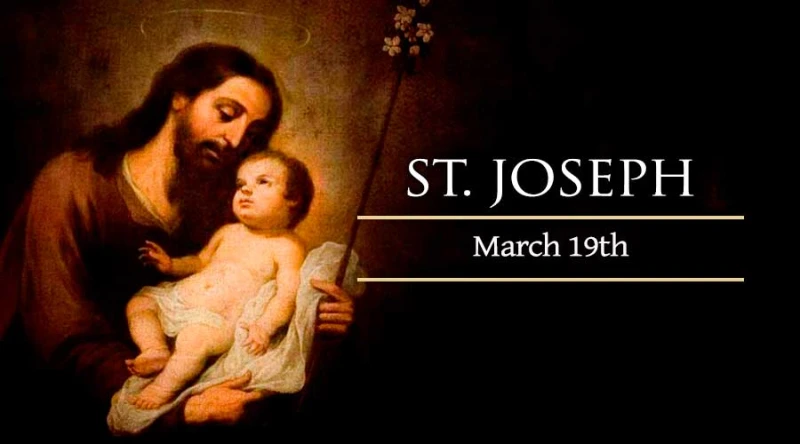
St. Joseph


St. Joseph

Feast date: Mar 19

St. Joseph is honored with feast days throughout the Liturgical Year. This feast encourages us to look at Joseph’s role as husband and head of the Holy Family.

Most of what we know about the life of St. Joseph comes to us from Scripture and legends that have sprung up regarding his life. Though Joseph is only mentioned by two of the evangelists, he is paid the compliment of being a “just” man. This is a way of saying that Joseph was such a good and holy man that he shares in God’s own holiness. In addition, Joseph gives us an example of how to be a just spouse and how to have holy relationships.

Joseph’s example as a husband can be best seen in how he respected Mary. He realized that God had a special plan for his wife and for his son, and Joseph did everything in his power to help this plan become reality. When Joseph was given chances to give up his vocation to the married life, by divorcing Mary or leaving her, he resisted the temptation and stayed by her side providing support and love.

The feast of St. Joseph Husband of Mary has been celebrated throughout the church since the tenth century and has been honored as the Patron of the Universal Church since 1870. St. Joseph is the patron of workers, carpenters, Austria, Belgium, Bohemia, Canada, Mexico, Peru, and southern Vietnam.

St. Joseph Read More »

Friday of the Second Week of Lent

Reading I Gn 37:3-4, 12-13a, 17b-28a

Israel loved Joseph best of all his sons,
for he was the child of his old age;
and he had made him a long tunic.
When his brothers saw that their father loved him best of all his sons,
they hated him so much that they would not even greet him.

One day, when his brothers had gone
to pasture their father’s flocks at Shechem,
Israel said to Joseph,
“Your brothers, you know, are tending our flocks at Shechem.
Get ready; I will send you to them.”

So Joseph went after his brothers and caught up with them in Dothan.
They noticed him from a distance,
and before he came up to them, they plotted to kill him.
They said to one another: “Here comes that master dreamer!
Come on, let us kill him and throw him into one of the cisterns here;
we could say that a wild beast devoured him.
We shall then see what comes of his dreams.”

When Reuben heard this,
he tried to save him from their hands, saying,
“We must not take his life.
Instead of shedding blood,” he continued,
“just throw him into that cistern there in the desert;
but do not kill him outright.”
His purpose was to rescue him from their hands
and return him to his father.
So when Joseph came up to them,
they stripped him of the long tunic he had on;
then they took him and threw him into the cistern,
which was empty and dry.

They then sat down to their meal.
Looking up, they saw a caravan of Ishmaelites coming from Gilead,
their camels laden with gum, balm and resin
to be taken down to Egypt.
Judah said to his brothers:
“What is to be gained by killing our brother and concealing his blood?
Rather, let us sell him to these Ishmaelites,
instead of doing away with him ourselves.
After all, he is our brother, our own flesh.”
His brothers agreed.
They sold Joseph to the Ishmaelites for twenty pieces of silver.

Responsorial Psalm 105:16-17, 18-19, 20-21

R.        (5a) Remember the marvels the Lord has done.
When the LORD called down a famine on the land
            and ruined the crop that sustained them,
He sent a man before them,
            Joseph, sold as a slave.
R.        Remember the marvels the Lord has done.
They had weighed him down with fetters,
            and he was bound with chains,
Till his prediction came to pas
            and the word of the LORD proved him true.
R.        Remember the marvels the Lord has done.
The king sent and released him,
            the ruler of the peoples set him free.
He made him lord of his house
            and ruler of all his possessions.
R.        Remember the marvels the Lord has done.

Verse Before the Gospel Jn 3:16

God so loved the world that he gave his only-begotten Son;
so that everyone who believes in him might have eternal life.

Gospel Mt 21:33-43, 45-46

Jesus said to the chief priests and the elders of the people:
“Hear another parable.
There was a landowner who planted a vineyard,
put a hedge around it,
dug a wine press in it, and built a tower.
Then he leased it to tenants and went on a journey.
When vintage time drew near,
he sent his servants to the tenants to obtain his produce.
But the tenants seized the servants and one they beat,
another they killed, and a third they stoned.
Again he sent other servants, more numerous than the first ones,
but they treated them in the same way.
Finally, he sent his son to them,
thinking, ‘They will respect my son.’
But when the tenants saw the son, they said to one another,
‘This is the heir.
Come, let us kill him and acquire his inheritance.’
They seized him, threw him out of the vineyard, and killed him.
What will the owner of the vineyard do to those tenants when he comes?”
They answered him,
“He will put those wretched men to a wretched death
and lease his vineyard to other tenants
who will give him the produce at the proper times.”
Jesus said to them, “Did you never read in the Scriptures:

            The stone that the builders rejected
                        has become the cornerstone;
            by the Lord has this been done,
                        and it is wonderful in our eyes?

Therefore, I say to you,
the Kingdom of God will be taken away from you
and given to a people that will produce its fruit.”
When the chief priests and the Pharisees heard his parables,
they knew that he was speaking about them.
And although they were attempting to arrest him,
they feared the crowds, for they regarded him as a prophet.

– – –

Lectionary for Mass for Use in the Dioceses of the United States, second typical edition, Copyright © 2001, 1998, 1997, 1986, 1970 Confraternity of Christian Doctrine; Psalm refrain © 1968, 1981, 1997, International Committee on English in the Liturgy, Inc. All rights reserved. Neither this work nor any part of it may be reproduced, distributed, performed or displayed in any medium, including electronic or digital, without permission in writing from the copyright owner.

Friday of the Second Week of Lent Read More »

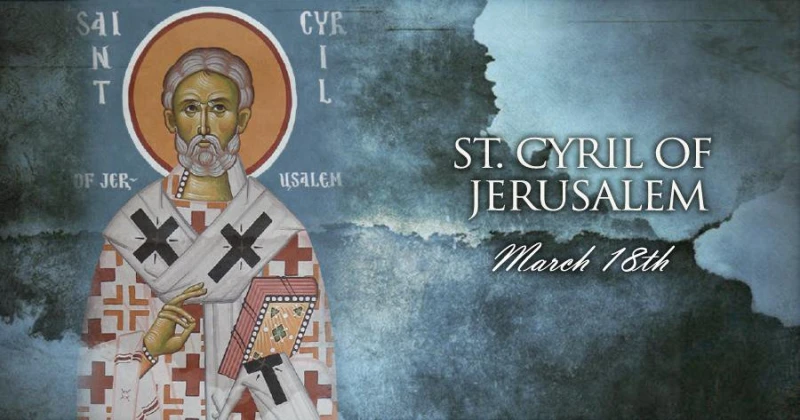
St. Cyril of Jerusalem


St. Cyril of Jerusalem

Feast date: Mar 18

On March 18, the Roman Catholic Church honors St. Cyril of Jerusalem, a fourth-century bishop and Doctor of the Church whose writings are still regarded as masterful expressions of Christian faith.

St. Cyril is also remembered for his exhaustive Biblical knowledge, and his endurance in the face of misunderstanding and opposition. Eastern Catholics and Eastern Orthodox Christians, who likewise celebrate him as a saint on March 18, also remember him on May 7 – the date of a miraculous apparition said to have occurred soon after his consecration as a bishop.

What we know of Cyril’s life is gathered from information concerning him from his younger contemporaries, Epiphanius, Jerome, and Rufinus, as well as from the fifth-century historians, Socrates, Sozomen and Theodoret.

Cyril was most likely born in Jerusalem around the year 315, shortly after the legalization of Christianity throughout the Roman Empire.

Although that legalization put a stop to many of the persecutions that threatened the Church for two centuries, it indirectly gave rise to a number of internal controversies – both in regard to theology, and the jurisdiction of bishops – in which Cyril would find himself involved.

Cyril received an excellent education in classical Greek literature as well as the Bible. He was ordained to the priesthood by Bishop Maximus of Jerusalem and succeeded him as bishop in 348.

During his early years as a bishop, most likely around 350, he delivered a series of lectures to new initiates of the Catholic Church. Twenty-four of the lectures have survived and are studied today. In a 2007 general audience, Pope Benedict XVI praised the saint for providing an “integral” form of Christian instruction, “involving body, soul, and spirit.” St. Cyril’s teaching, the Pope said, “remains emblematic for the catechetical formation of Christians today.

In 351, three years after Cyril became the Bishop of Jerusalem, a large cross-shaped light appeared for several hours in the sky over the city – an event that many interpreted as a sign of the Church’s triumph over heresy. It could also, however, be understood as a sign of the suffering the new bishop would undergo in leading his flock.

Unlike many other Eastern bishops and priests of the fourth century, Cyril did not allow his classical learning to lead him away from believing in the full humanity and divinity of Christ.

However, the man who consecrated Cyril as a bishop, Archbishop Acacius of Caesarea, was an ally of the Arians – who claimed that Jesus was a creature and not God. Because of his connection to the archbishop, Cyril himself was unjustly suspected of heresy by many of his brother bishops.

But he also found himself at odds with Archbishop Acacius, who claimed to have jurisdiction over the birthplace of the Church. Altogether, these disputes led to Cyril being exiled from Jerusalem three times in the course of 20 years.  Cyril first took refuge with Silvanus, Bishop of Taraus. He appeared at the Council of Seleucia in 359, in which the semi-Arian party was triumphant. Acacius was deposed and St. Cyril seems to have returned to his see. But the emperor was displeased at the turn of events, and, in 360, Cyril and other moderates were again driven out, and only returned at the accession of Julian in 361. In 367, a decree of Valens banished all the bishops who had been restored by Julian, and Cyril remained in exile until the death of the persecutor in 378. In 380, St. Gregory of Nyssa came to Jerusalem on the recommendation of a council held at Antioch in the preceding year. He found the Faith in accord with the truth and expressed admiration of his pastoral efforst, but the city was a prey to parties and corrupt in morals. 

In 381, St. Cyril participated in the Second Ecumenical Council, which condemned two different forms of Arianism and added statements about the Holy Spirit to the Nicene Creed of 325. St. Cyril of Jerusalem died in 387, and was named a Doctor of the Church by Pope Leo XIII in 1883.

St. Cyril of Jerusalem Read More »

Thursday of the Second Week of Lent

Reading I Jer 17:5-10

Thus says the LORD:
Cursed is the man who trusts in human beings,
            who seeks his strength in flesh,
            whose heart turns away from the LORD.
He is like a barren bush in the desert
            that enjoys no change of season,
But stands in a lava waste,
            a salt and empty earth.
Blessed is the man who trusts in the LORD,
            whose hope is the LORD.
He is like a tree planted beside the waters
            that stretches out its roots to the stream:
It fears not the heat when it comes,
            its leaves stay green;
In the year of drought it shows no distress,
            but still bears fruit.
More tortuous than all else is the human heart,
            beyond remedy; who can understand it?
I, the LORD, alone probe the mind
            and test the heart,
To reward everyone according to his ways,
            according to the merit of his deeds.

Responsorial Psalm 1:1-2, 3, 4 and 6

R.        (40:5a)  Blessed are they who hope in the Lord.
Blessed the man who follows not
            the counsel of the wicked
Nor walks in the way of sinners,
            nor sits in the company of the insolent,
But delights in the law of the LORD
           
and meditates on his law day and night.
R.        Blessed are they who hope in the Lord.
He is like a tree
            planted near running water,
That yields its fruit in due season,
            and whose leaves never fade.
            Whatever he does, prospers.
R.        Blessed are they who hope in the Lord.
Not so, the wicked, not so;
            they are like chaff which the wind drives away.
For the LORD watches over the way of the just,
            but the way of the wicked vanishes.
R.        Blessed are they who hope in the Lord.

Verse Before the Gospel See Lk 8:15

Blessed are they who have kept the word with a generous heart
and yield a harvest through perseverance.

Gospel Lk 16:19-31

Jesus said to the Pharisees:
“There was a rich man who dressed in purple garments and fine linen
and dined sumptuously each day.
And lying at his door was a poor man named Lazarus, covered with sores,
who would gladly have eaten his fill of the scraps
that fell from the rich man’s table.
Dogs even used to come and lick his sores.
When the poor man died,
he was carried away by angels to the bosom of Abraham.
The rich man also died and was buried,
and from the netherworld, where he was in torment,
he raised his eyes and saw Abraham far off
and Lazarus at his side.
And he cried out, ‘Father Abraham, have pity on me.
Send Lazarus to dip the tip of his finger in water and cool my tongue,
for I am suffering torment in these flames.’
Abraham replied, ‘My child,
remember that you received what was good during your lifetime
while Lazarus likewise received what was bad;
but now he is comforted here, whereas you are tormented.
Moreover, between us and you a great chasm is established
to prevent anyone from crossing
who might wish to go from our side to yours
or from your side to ours.’
He said, ‘Then I beg you, father, send him
to my father’s house,
for I have five brothers, so that he may warn them,
lest they too come to this place of torment.’
But Abraham replied, ‘They have Moses and the prophets.
Let them listen to them.’
He said, ‘Oh no, father Abraham,
but if someone from the dead goes to them, they will repent.’
Then Abraham said,
‘If they will not listen to Moses and the prophets,
neither will they be persuaded
if someone should rise from the dead.’”

– – –

Lectionary for Mass for Use in the Dioceses of the United States, second typical edition, Copyright © 2001, 1998, 1997, 1986, 1970 Confraternity of Christian Doctrine; Psalm refrain © 1968, 1981, 1997, International Committee on English in the Liturgy, Inc. All rights reserved. Neither this work nor any part of it may be reproduced, distributed, performed or displayed in any medium, including electronic or digital, without permission in writing from the copyright owner.

Thursday of the Second Week of Lent Read More »

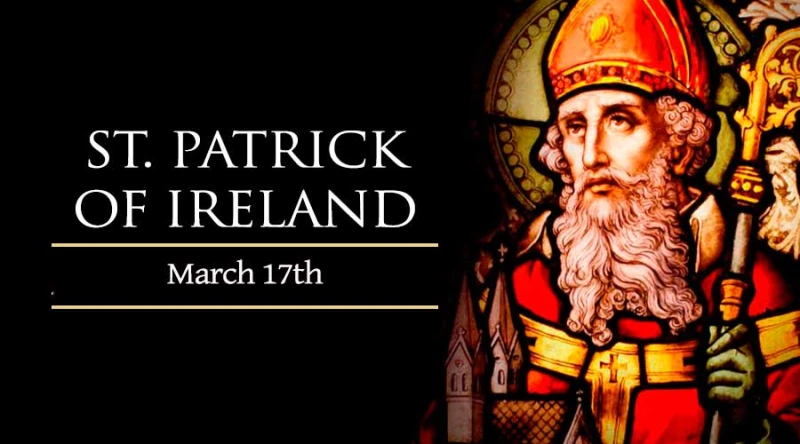
St. Patrick of Ireland


St. Patrick of Ireland

Feast date: Mar 17

On March 17, Catholics celebrate St. Patrick, the fifth century bishop and patron of Ireland, whose life of holiness set the example for many of the Church’s future saints.

St. Patrick is said to have been born around 389 AD in Britain. Captured by Irish raiders when he was about 16, St. Patrick was taken as a slave to Ireland where he lived for six years as a shepherd before escaping and returning to his home.

At home, he studied the Christian faith at monastic settlements in Italy and in what is now modern-day France. He was ordained a deacon by the Bishop of Auxerre, France around the year 418 AD and ordained a bishop in 432 AD.

It was around this time when that he was assigned to minister to the small, Christian communities in Ireland who lacked a central authority and were isolated from one another.

When St. Patrick returned to Ireland, he was able to use his knowledge of Irish culture that he gained during his years of captivity. Using the traditions and symbols of the Celtic people, he explained Christianity in a way that made sense to the Irish and was thus very successful in converting the natives.

The shamrock, which St. Patrick used to explain the Holy Trinity, is a symbol that has become synonymous with Irish Catholic culture.

Although St. Patrick’s Day is widely known and celebrated every March the world over, various folklore and legend that surround the saint can make it difficult to determine fact from fiction.

Legends falsely site him as the man who drove away snakes during his ministry despite the climate and location of Ireland, which have never allowed snakes to inhabit the area.

St. Patrick is most revered not for what he drove away from Ireland, but flor what he brought, and the foundation he built for the generations of Christians who followed him.

Although not the first missionary to the country, he is widely regarded as the most successful. The life of sacrifice, prayer and fasting has laid the foundation for the many saints that the small island was home to following his missionary work.

To this day, he continues to be revered as one of the most beloved Saints of Ireland.

In March of 2011, the Irish bishops’ conference marked their patron’s feast by remembering him as “pioneer in an inhospitable climate.”

As the Church in Ireland faces her own recent difficulties following clerical sex abuse scandals, comfort can be found in the plight of St. Patrick, the bishops said.

They quoted The Confession of St. Patrick, which reads: “May it never befall me to be separated by my God from his people whom he has won in this most remote land. I pray God that he gives me perseverance, and that he will deign that I should be a faithful witness for his sake right up to the time of my passing.”

St. Patrick of Ireland Read More »