
Please mind our dust!

We are currently working on revamping our website!
Thank you for your patience!

CRD Solutions

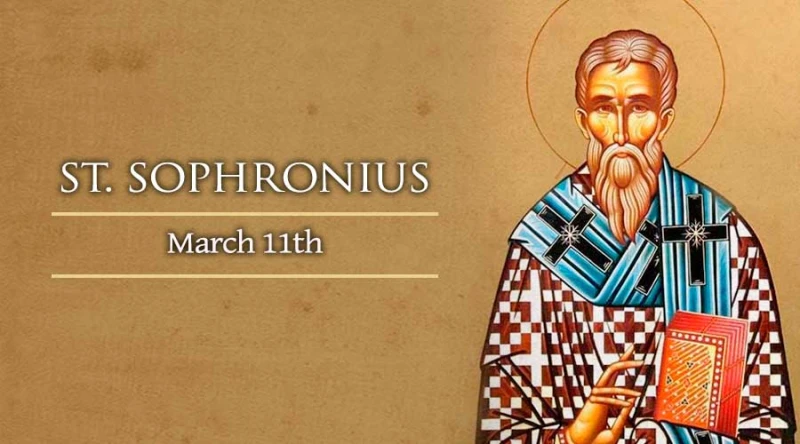
St. Sophronius


St. Sophronius

Feast date: Mar 11

A courageous leader of the Jerusalem Church during the Islamic conquests of the seventh century, Patriarch Saint Sophronius I has his liturgical memorial on March 11.

Though he is acknowledged and celebrated as a saint in the Roman Catholic Church, St. Sophronius is more commonly venerated among Eastern Catholics and within the Eastern Orthodox churches. All of these traditions commemorate him on the same date, the purported date of his death in 638.

Born in Damascus, Syria, around the year 560, Sophronius came from an esteemed family and received a deep philosophical education. His early devotion to God grew into an inclination toward monastic life, and while still young he entered a monastery in Palestine. He became a friend and student of John Moschus, his fellow monk who would become an important spiritual writer in the Eastern Christian tradition.

The Zoroastrian Persians – long-standing military rivals of the Byzantine Empire, hailing from present-day Iran – invaded Palestine in 605. As a result the two monks fled first to Antioch and then Egypt. But their flight became a spiritual quest, taking John and Sophronius to many monasteries throughout the Middle East. Moschus’ memoir of their travels, entitled “The Spiritual Meadow,” survives and is still read in the Church to this day.

The two monks’ foremost patron was Saint John the Almsgiver, patriarch of Alexandria, with whom they stayed for a time until the Persians conquered the city in 614. The Zoroastrian invasion of Egypt forced the kindly patriarch back to his homeland of Cyprus, while Sophronius and John Moschus took refuge in Rome along with a group of other monks. Moschus, regarded as a saint by some contemporary Eastern Christians, died in Rome during 619.

Jerusalem, the future site of Sophronius’ patriarchate, was the subject of violent disputes even before the rise of Islam. Captured by the Persians in 614, it was not retaken by the Byzantines until 628. The Christian reconquest of the city was triumphant, after the long wars with the Zoroastrian empire. But the triumph would be short-lived: By that time the Islamic founder Muhammad had begun his conquests, which would continue under his successors the caliphs.

Eastern Christendom also suffered internally during the 620s, with a recurrence of doctrinal controversy over the person of Christ. During the 630s, Sophronius prominently opposed the “monothelite” heresy – whose adherents supposed Jesus had only one will, the divine. This error denied Christ’s human will, making him less than “true God and true man.” Saint Maximus the Confessor, the greatest opponent of monothelitism, was taught and mentored by Sophronius.

Chosen to lead the Church in Jerusalem during 634, Sophronius continued to oppose the monothelite heresy. But he soon faced a more tangible threat from Caliph Umar and his army of followers. The Muslims beseiged Jerusalem for two years during Sophronius’ patriarchate, forcibly depriving the city’s residents of food. The patriarch could only save the lives of his people by negotiating a surrender with the caliph. Thus, Jerusalem fell to Islam for the first time in 637. Heartbroken, St. Sophronius died the following year.

Patriarch St. Sophronius’ stand against monothelitism was vindicated near the end of the seventh century, when the heresy of “one will” in Christ received formal condemnation at the Sixth Ecumenical Council in Constantinople. But the Jerusalem Patriarchate remained vacant for many decades after St. Sophronius’ death: a successor was not appointed until 705. Jerusalem, meanwhile, would not pass back into Christian hands until the First Crusade of 1099.
St. Sophronius Read More »

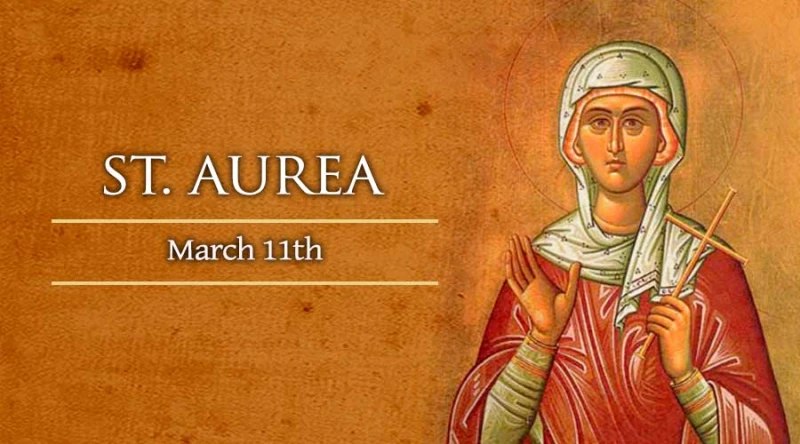
St. Aurea


St. Aurea

Feast date: Mar 11

St. Aurea was born around the year 1042 in the village of Villavelayo, Spain. As a youth, Aurea studied the Scriptures and the lives of the early martyrs of the Church. Her favorite saints to meditate upon and imitate were Agatha, Eulalia and Cecilia.

As a young woman, Aurea decided to leave home and join a convent. She was welcomed into the convent of San Millan de la Cogolla and completely applied herself to monastic life. She then followed the life of asceticism. By the age of 20, she was living in a cave where Aurea received a vision of her three favorite saints and was encouraged to follow her chosen lifestyle with greater zeal. God used St. Aurea to work many miracles and many people sought her advice and prayers.

Aurea spent only a few years of her life in the monastery. Around the year 1069 she contracted a painful disease and died at the age of 27.

St. Aurea Read More »

Thursday of the First Week in Lent

Reading I Est C:12, 14-16, 23-25

Queen Esther, seized with mortal anguish,
had recourse to the LORD.
She lay prostrate upon the ground, together with her handmaids,
from morning until evening, and said:
“God of Abraham, God of Isaac, and God of Jacob, blessed are you.
Help me, who am alone and have no help but you,
for I am taking my life in my hand.
As a child I used to hear from the books of my forefathers
that you, O LORD, always free those who are pleasing to you.
Now help me, who am alone and have no one but you,
O LORD, my God.

“And now, come to help me, an orphan.
Put in my mouth persuasive words in the presence of the lion
and turn his heart to hatred for our enemy,
so that he and those who are in league with him may perish.
Save us from the hand of our enemies;
turn our mourning into gladness
and our sorrows into wholeness.”

Responsorial Psalm 138:1-2ab, 2cde-3, 7c-8

R.        (3a)  Lord, on the day I called for help, you answered me.
I will give thanks to you, O LORD, with all my heart,
            for you have heard the words of my mouth;
            in the presence of the angels I will sing your praise;
I will worship at your holy temple
            and give thanks to your name.
R.        Lord, on the day I called for help, you answered me.
Because of your kindness and your truth;
            for you have made great above all things
            your name and your promise.
When I called, you answered me;
            you built up strength within me.
R.        Lord, on the day I called for help, you answered me.
Your right hand saves me.
The LORD will complete what he has done for me;
            your kindness, O LORD, endures forever;
            forsake not the work of your hands.
R.        Lord, on the day I called for help, you answered me.


Verse Before the Gospel Ps 51:12a, 14a

A clean heart create for me, O God;
give me back the joy of your salvation.

Gospel Mt 7:7-12

Jesus said to his disciples:
“Ask and it will be given to you;
seek and you will find;
knock and the door will be opened to you.
For everyone who asks, receives; and the one who seeks, finds;
and to the one who knocks, the door will be opened.
Which one of you would hand his son a stone
when he asked for a loaf of bread,
or a snake when he asked for a fish?
If you then, who are wicked,
know how to give good gifts to your children,
how much more will your heavenly Father give good things
to those who ask him.

“Do to others whatever you would have them do to you.
This is the law and the prophets.”

– – –

Lectionary for Mass for Use in the Dioceses of the United States, second typical edition, Copyright © 2001, 1998, 1997, 1986, 1970 Confraternity of Christian Doctrine; Psalm refrain © 1968, 1981, 1997, International Committee on English in the Liturgy, Inc. All rights reserved. Neither this work nor any part of it may be reproduced, distributed, performed or displayed in any medium, including electronic or digital, without permission in writing from the copyright owner.

Thursday of the First Week in Lent Read More »

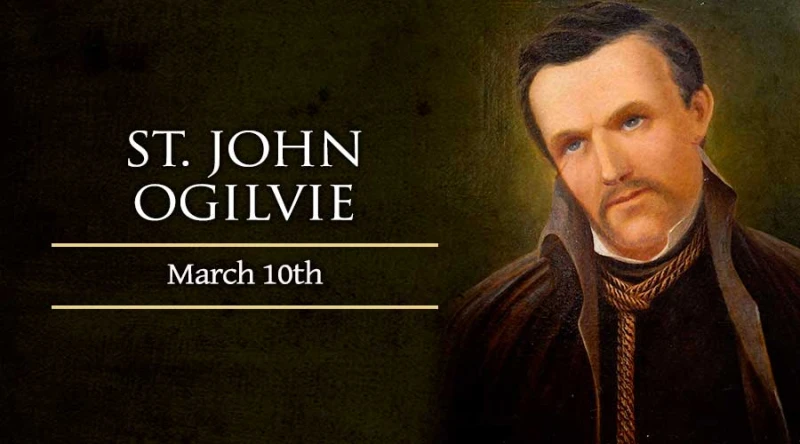
St. John Ogilvie


St. John Ogilvie

Feast date: Mar 10

March 10 is the liturgical memorial of Saint John Ogilvie, a 16th- and 17th-century Scotsman who converted from Protestantism to Catholicism, served as a Jesuit priest, and died as a martyr at the hands of state officials.

St. John was executed for treason, refusing to accept King James I’s claim of supremacy over the Church. Pope Paul VI canonized him in 1976. A Catholic priest, he is the only post-Reformation Scottish saint.

In February 2010, during a visit to Rome by the Scottish bishops’ conference, Benedict XVI asked the bishops to promote devotion to St. John Ogilvie among priests – since the Jesuit martyr had been “truly outstanding in his dedication to a difficult and dangerous pastoral ministry, to the point of laying down his life.” Later that year, during the Scottish segment of his U.K. visit, the Pope again encouraged priests to look to the saint’s “dedicated, selfless and brave” example.

John Ogilvie was born in 1579, a member of a noble family. Some of his relatives had kept the Catholic faith, while others adhered to John Calvin’s interpretation of Protestantism as Presbyterians. Though raised as a Calvinist, John had doubts about the compatibility of this system with Scripture. In particular, he could not reconcile Calvin’s theology of predestination with Biblical passages teaching that God loves all people and wills each of them to be saved.

This difficulty, coupled with the contrast between Catholic unity and the multiple Protestant sects and denominations, influenced John’s decision to enter the Catholic Church. He made the decision at age 17 while studying in Belgium, and in 1599 he became a novice in the Society of Jesus. After extensive study and training he was ordained a Jesuit priest in Paris during 1610.

John greatly desired to go back to his native country and encourage its return to the Catholic Church. He served for a time as a priest in France, while requesting to be sent back to Scotland. Others within his order made it clear to him that such a mission would be dangerous and unlikely to produce much fruit. In 1613, however, John obtained the assignment he desired.

He soon discovered the truth of the warnings he had received from other Jesuits, about the difficulty of Catholic evangelization in Scotland. Many members of the upper classes were not interested in returning to the Church, though he did carry out pastoral work among a largely poor population of Scots who had kept the faith. After a period in England he returned to France, seeking directions on how to proceed in light of his lack of success.

The French Jesuits ordered John back to Scotland, however, where he resumed his ministry to the underground Church as well as the smaller number of people interested in converting. His arrest came about when one potential “convert” turned out to be an informer, who had John arrested and interrogated.

The first criminal accusation St. John Ogilvie faced was that of celebrating Mass within the King’s realm. Unwilling to incriminate himself, he suffered two months of imprisonment. An iron bar was attached to his feet to prevent him from moving in his cell. Despite this ordeal, he strongly resisted pressure to give evidence against other Scottish Catholics.

Severe torture was then inflicted on John. His hair and fingernails were pulled out, and for a period of nine days he was prevented from sleeping by continual stabbing with sharp stakes. His jailers beat him, flung him to the floor of his cell, and shouted in his ears. Nothing, however, could make him renounce his faith or betray his Catholic countrymen to the authorities.

John’s tormentors were impressed by his fortitude, and by the surprising sense of humor that he showed in the face of the brutal punishments. But they could not spare his life, unless the Jesuit priest gave an acceptable response to a series of questions provided by King James I. John declared his loyalty to the king, but steadfastly rejected James’ claim to supremacy over the Church in religious matters. The priest was eventually convicted on a charge of high treason.

Attempts to ply John with bribery – in exchange for his return to Protestantism, and his betrayal of fellow Catholics – continued even as he was being led to his execution. His own defiant words are recorded: for the Catholic faith, he said, he would “willingly and joyfully pour forth even a hundred lives. Snatch away that one which I have from me, and make no delay about it, but my religion you will never snatch away from me!”

Asked whether he was afraid to die, the priest replied: “I fear death as much as you do your dinner.” St. John Ogilvie was executed by hanging on March 10, 1615.

As a last gesture before his hanging, St. John had tossed his Rosary beads into the crowd where they were caught by a Calvinist nobleman. The man, Baron John ab Eckersdorff, later became a Catholic, tracing his conversion to the incident and the martyr’s beads.

St. John Ogilvie Read More »

Wednesday of the First Week in Lent

Reading I Jon 3:1-10

The word of the LORD came to Jonah a second time:
“Set out for the great city of Nineveh,
and announce to it the message that I will tell you.”
So Jonah made ready and went to Nineveh,
according to the LORD’s bidding.
Now Nineveh was an enormously large city;
it took three days to go through it.
Jonah began his journey through the city,
and had gone but a single day’s walk announcing,
“Forty days more and Nineveh shall be destroyed,”
when the people of Nineveh believed God;
they proclaimed a fast
and all of them, great and small, put on sackcloth.

When the news reached the king of Nineveh,
he rose from his throne, laid aside his robe,
covered himself with sackcloth, and sat in the ashes.
Then he had this proclaimed throughout Nineveh,
by decree of the king and his nobles:
“Neither man nor beast, neither cattle nor sheep,
shall taste anything;
they shall not eat, nor shall they drink water.
Man and beast shall be covered with sackcloth and call loudly to God;
every man shall turn from his evil way
and from the violence he has in hand.
Who knows, God may relent and forgive, and withhold his blazing wrath,
so that we shall not perish.”
When God saw by their actions how they turned from their evil way,
he repented of the evil that he had threatened to do to them;
he did not carry it out.

Responsorial Psalm 51:3-4, 12-13, 18-19

R.        (19b) A heart contrite and humbled, O God, you will not spurn.
Have mercy on me, O God, in your goodness;
            in the greatness of your compassion wipe out my offense.
Thoroughly wash me from my guilt
            and of my sin cleanse me.
R.        A heart contrite and humbled, O God, you will not spurn.
A clean heart create for me, O God,
            and a steadfast spirit renew within me.
Cast me not out from your presence,
            and your Holy Spirit take not from me.
R.        A heart contrite and humbled, O God, you will not spurn.
For you are not pleased with sacrifices;
            should I offer a burnt offering, you would not accept it.
My sacrifice, O God, is a contrite spirit;
            a heart contrite and humbled, O God, you will not spurn.
R.        A heart contrite and humbled, O God, you will not spurn.

Verse Before the Gospel Jl 2:12-13

Even now, says the LORD,
return to me with your whole heart
for I am gracious and merciful.

Gospel Lk 11:29-32

While still more people gathered in the crowd, Jesus said to them,
“This generation is an evil generation;
it seeks a sign, but no sign will be given it,
except the sign of Jonah.
Just as Jonah became a sign to the Ninevites,
so will the Son of Man be to this generation.
At the judgment
the queen of the south will rise with the men of this generation
and she will condemn them,
because she came from the ends of the earth
to hear the wisdom of Solomon,
and there is something greater than Solomon here.
At the judgment the men of Nineveh will arise with this generation
and condemn it,
because at the preaching of Jonah they repented,
and there is something greater than Jonah here.”

– – –

Lectionary for Mass for Use in the Dioceses of the United States, second typical edition, Copyright © 2001, 1998, 1997, 1986, 1970 Confraternity of Christian Doctrine; Psalm refrain © 1968, 1981, 1997, International Committee on English in the Liturgy, Inc. All rights reserved. Neither this work nor any part of it may be reproduced, distributed, performed or displayed in any medium, including electronic or digital, without permission in writing from the copyright owner.

Wednesday of the First Week in Lent Read More »