Please mind our dust!

We are currently working on revamping our website!
Thank you for your patience!

CRD Solutions

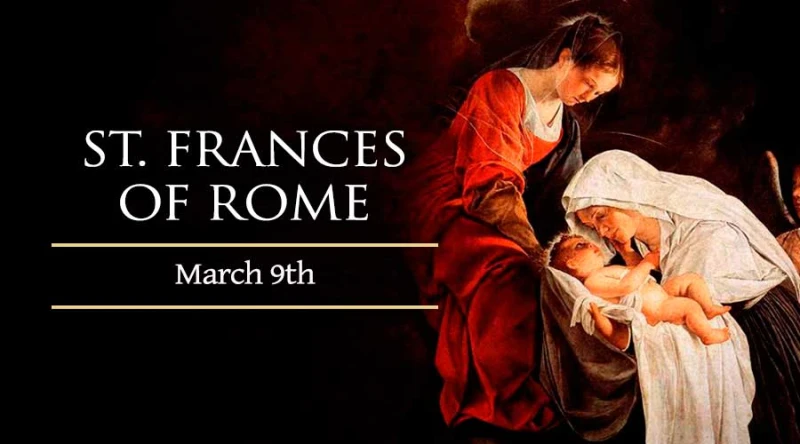
St. Frances of Rome


St. Frances of Rome

Feast date: Mar 09

St. Frances was born into a noble Roman family in the year 1384. From an early age, Frances felt drawn to the religious life, but at the age of thirteen her parents forced her into marriage. As Frances became acquainted with her in-laws she found that the wife of her brother-in-law felt the same calling to the religious life that she did.

From this point on, the two women began to work to help the poor. Frances did not allow her charitable work to interfere with her family life, and bore three children.

After the plague swept through Rome and left one of Frances’ children dead, she began to turn again to charitable work. Frances gave up all her wealth to the sick and poor and began to go door to door raising money to aid the sick and poor. After the plague claimed Frances’ daughter, she opened up a wing of her home as a hospital for the poor. As Frances became more deeply involved in charitable work, she began to realize the great need for it in the world and began to seek permission from the pope to form a charitable society of women to do this work. The women followed the ideals of the Benedictine order and carried on active charity and assistance of the poor. After setting up the foundation of this society, Frances continued to live with her husband until his death. After his death Frances lived the remainder of her life with the society that she formed. Frances died in 1440 and is the patron of widows and motorists.

St. Frances of Rome Read More »

Tuesday of the First Week of Lent

Reading I Is 55:10-11

Thus says the LORD:
Just as from the heaven
            the rain and snow come down
And do not return there
            till they have watered the earth,
            making it fertile and fruitful,
Giving seed to the one who sows
            and bread to the one who eats,
So shall my word be
            that goes forth from my mouth;
It shall not return to me void,
            but shall do my will,
            achieving the end for which I sent it.

Responsorial Psalm 34:4-5, 6-7, 16-17, 18-19

R.        (18b)  From all their distress God rescues the just.
Glorify the LORD with me,
            let us together extol his name.
I sought the LORD, and he answered me
            and delivered me from all my fears.
R.        From all their distress God rescues the just.
Look to him that you may be radiant with joy,
            and your faces may not blush with shame.
When the poor one called out, the LORD heard,
            and from all his distress he saved him.
R.        From all their distress God rescues the just.
The LORD has eyes for the just,
            and ears for their cry.
The LORD confronts the evildoers,
            to destroy remembrance of them from the earth.
R.        From all their distress God rescues the just.
When the just cry out, the LORD hears them,
            and from all their distress he rescues them.
The LORD is close to the brokenhearted;
            and those who are crushed in spirit he saves.
R.        From all their distress God rescues the just.

Verse before the Gospel Mt 4:4b

One does not live on bread alone,
but on every word that comes forth from the mouth of God.

Gospel Mt 6:7-15

Jesus said to his disciples:
“In praying, do not babble like the pagans,
who think that they will be heard because of their many words.
Do not be like them.
Your Father knows what you need before you ask him.

“This is how you are to pray:

            Our Father who art in heaven,
                        hallowed be thy name,
                        thy Kingdom come,
            thy will be done,
                        on earth as it is in heaven.
            Give us this day our daily bread;
            and forgive us our trespasses,
                        as we forgive those who trespass against us;
            and lead us not into temptation,
                        but deliver us from evil.

“If you forgive men their transgressions,
your heavenly Father will forgive you.
But if you do not forgive men,
neither will your Father forgive your transgressions.”

– – –

Lectionary for Mass for Use in the Dioceses of the United States, second typical edition, Copyright © 2001, 1998, 1997, 1986, 1970 Confraternity of Christian Doctrine; Psalm refrain © 1968, 1981, 1997, International Committee on English in the Liturgy, Inc. All rights reserved. Neither this work nor any part of it may be reproduced, distributed, performed or displayed in any medium, including electronic or digital, without permission in writing from the copyright owner.

Tuesday of the First Week of Lent Read More »

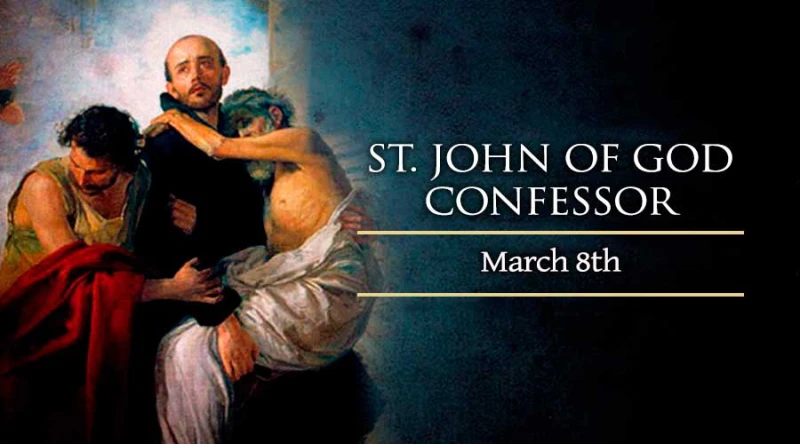
St. John of God, Confessor


St. John of God, Confessor

Feast date: Mar 08

The Catholic Church celebrates the extraordinary life of St. John of God on March 8. The saint lived through decades of sin and suffering before a profound conversion that led him to embrace poverty, humility and charity.

John was born in Portugal during the year 1495 to middle-class parents. Tragically, at the age of 8, he was kidnapped by a stranger and was later abandoned to homelessness in a remote part of Spain.

He worked as a shepherd until age 22, when the opportunity came along for him to join the army of the Holy Roman Emperor Charles V. This apparent stroke of fortune, however, would eventually lead John into greater misery.

For the next 18 years, John lived and fought among the emperor’s foot soldiers, first against the French and later the Turks. His morals began to decline, as he completely abandoned the piety of his earliest youth for a greedy and brutal way of life.

John’s conscience was occasionally troubled, particularly by the memories of his early years before he was taken from his parents. And despite falling into a lifestyle of violence and plundering, he had a certain weakness for those who were poor or in extreme distress, and would give alms to them.

He was narrowly saved on two occasions from what seemed like certain death – once after instinctively uttering a prayer to the Virgin Mary after falling wounded in enemy territory; and again, when he was falsely suspected of theft and nearly executed but for another soldier’s intervention.

Events such as these weighed heavily upon him, and when his regiment was disbanded he decided to amend his life – beginning with a pilgrimage to Spain’s Santiago de Compostela Cathedral along the “Way of St. James.” There, he confessed his sins and committed himself to living a life of repentance.

Soon after this, he returned to Portugal and discovered what had become of his parents. His mother had died, brokenhearted, after the loss of her son, after which his father had become a Franciscan monk.

At age 42, John returned to Spain and picked up nearly where he had left off 20 years before, working again as a shepherd. This time, however, he was committed to living out the faith in God that he had regained.

He traveled briefly to North Africa, seeking to help Christians there who had been enslaved by Muslims. Eventually, however, he returned to Spain and settled for a time in the occupation of selling religious books and other goods, always encouraging his customers to live their faith sincerely. St. John of God’s later reputation as the patron saint of booksellers derives from this period of his life.

Later, however, he felt compelled to give himself entirely to the service of the poor, sick, and vulnerable. He opened his house to them – allowing it to become a combined hospital, homeless shelter, and halfway-house, run entirely by John himself. When he was not bandaging wounded occupants or breaking up fights between them, he would go out begging on their behalf.

The Bishop of Granada approved his work, and gave him the name “John of God.” A group of volunteers came to accompany him in his work, many of whom had first come to him while in dire need themselves.

Others, who resented his work, assaulted John’s reputation by focusing on his past sins – but John, unfazed in his humility, would acknowledge the truth of what was said, as a testament to God’s grace in his life. He once offered to pay a woman to tell the entire city what she had been saying about him in private.

John served the sick and poor for 15 years before meeting his death through an act of charity. He jumped into a freezing river and managed to save a drowning man, but came home shivering and weakened from the ordeal. He lay down in one of his own hospital beds, where his condition further declined.

The Bishop of Granada came to administer the last rites. As the bishop prepared him for death, John expressed a number of anxieties.

“There are three things that make me uneasy,” he said. “The first is that I have received so many graces from God, and have not recognized them, and have repaid them with so little of my own.”

“The second is that after I am dead, I fear lest the poor women I have rescued, and the poor sinners I have reclaimed, may be treated badly.”

“The third is that those who have trusted me with money, and whom I have not fully repaid, may suffer loss on my account.”

The bishop, however, assured him that he had nothing to fear. John then asked to be alone, and summoned his last strength to rise from bed and kneel before a crucifix.

He died in prayer, with his face pressed against the figure of Christ, on the night of March 7, 1550. St. John of God was canonized in 1690, and has become the patron of hospitals and the dying.

St. John of God, Confessor Read More »

Monday of the First Week of Lent

Reading I Lv 19:1-2, 11-18

The LORD said to Moses,
“Speak to the whole assembly of the children of Israel and tell them:
Be holy, for I, the LORD, your God, am holy.

“You shall not steal.
You shall not lie or speak falsely to one another.
You shall not swear falsely by my name,
thus profaning the name of your God.
I am the LORD.

“You shall not defraud or rob your neighbor.
You shall not withhold overnight the wages of your day laborer.
You shall not curse the deaf,
or put a stumbling block in front of the blind,
but you shall fear your God.
I am the LORD.

“You shall not act dishonestly in rendering judgment.
Show neither partiality to the weak nor deference to the mighty,
but judge your fellow men justly.
You shall not go about spreading slander among your kin;
nor shall you stand by idly when your neighbor’s life is at stake.
I am the LORD.

“You shall not bear hatred for your brother in your heart.
Though you may have to reprove him,
do not incur sin because of him.
Take no revenge and cherish no grudge against your fellow countrymen.
You shall love your neighbor as yourself.
I am the LORD.”

Responsorial Psalm 19:8, 9, 10, 15

R.        (John 6:63b)  Your words, Lord, are Spirit and life.
The law of the LORD is perfect,
            refreshing the soul.
The decree of the LORD is trustworthy,
            giving wisdom to the simple.
R.        Your words, Lord, are Spirit and life.
The precepts of the LORD are right,
            rejoicing the heart.
The command of the LORD is clear,
            enlightening the eye.
R.        Your words, Lord, are Spirit and life.
The fear of the LORD is pure,
            enduring forever;
The ordinances of the LORD are true,
            all of them just.
R.        Your words, Lord, are Spirit and life.
Let the words of my mouth and the thought of my heart
            find favor before you,
            O LORD, my rock and my redeemer.
R.        Your words, Lord, are Spirit and life.

Verse Before the Gospel 2 Cor 6:2b

Behold, now is a very acceptable time;
behold, now is the day of salvation.

Gospel Mt 25:31-46

Jesus said to his disciples:
“When the Son of Man comes in his glory,
and all the angels with him,
he will sit upon his glorious throne,
and all the nations will be assembled before him.
And he will separate them one from another,
as a shepherd separates the sheep from the goats.
He will place the sheep on his right and the goats on his left.
Then the king will say to those on his right,
‘Come, you who are blessed by my Father.
Inherit the kingdom prepared for you from the foundation of the world.
For I was hungry and you gave me food,
I was thirsty and you gave me drink,
a stranger and you welcomed me,
naked and you clothed me,
ill and you cared for me,
in prison and you visited me.’
Then the righteous will answer him and say,
‘Lord, when did we see you hungry and feed you,
or thirsty and give you drink?
When did we see you a stranger and welcome you,
or naked and clothe you?
When did we see you ill or in prison, and visit you?’
And the king will say to them in reply,
‘Amen, I say to you, whatever you did
for one of these least brothers of mine, you did for me.’
Then he will say to those on his left,
‘Depart from me, you accursed,
into the eternal fire prepared for the Devil and his angels.
For I was hungry and you gave me no food,
I was thirsty and you gave me no drink,
a stranger and you gave me no welcome,
naked and you gave me no clothing,
ill and in prison, and you did not care for me.’
Then they will answer and say,
‘Lord, when did we see you hungry or thirsty
or a stranger or naked or ill or in prison,
and not minister to your needs?’
He will answer them, ‘Amen, I say to you,
what you did not do for one of these least ones,
you did not do for me.’
And these will go off to eternal punishment,
but the righteous to eternal life.”


– – –

Lectionary for Mass for Use in the Dioceses of the United States, second typical edition, Copyright © 2001, 1998, 1997, 1986, 1970 Confraternity of Christian Doctrine; Psalm refrain © 1968, 1981, 1997, International Committee on English in the Liturgy, Inc. All rights reserved. Neither this work nor any part of it may be reproduced, distributed, performed or displayed in any medium, including electronic or digital, without permission in writing from the copyright owner.

Monday of the First Week of Lent Read More »

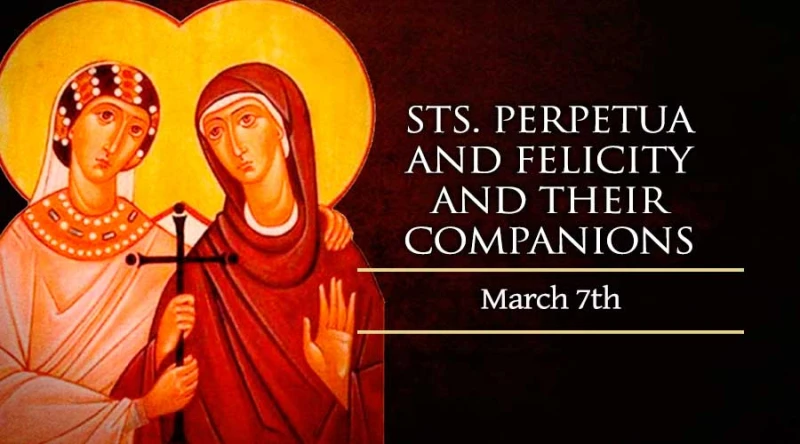
Sts. Perpetua and Felicity and their Companions


Sts. Perpetua and Felicity and their Companions

Feast date: Mar 07

Saints Perpetua and Felicity were martyrs who died for the faith around the year 203.

St. Perpetua was a young, well-educated, noblewoman and mother living in the city of Carthage in North Africa. Her mother was a Christian and her father was a pagan. In terms of her faith, Perpetua followed the example of her mother. Despite the pleas of her father to deny her faith, Perpetua did the very opposite, and fearlessly proclaimed it. At the age of 22, she was imprisoned for her faith. While in prison she continued to care for her infant child and put up with the tortures designed to make her renounce her faith. Perpetua remained steadfast until the end. St. Perpetua was sacrificed at the games as a public spectacle for not renouncing her faith.

St. Felicity was a pregnant slave girl who was imprisoned with St. Perpetua. Little is known about the life of St. Felicity because, unlike Perpetua, she did not keep a diary of her life. After imprisonment and torture, Felicity was also condemned to die at the games. Only a few days before her execution, Felicity gave birth to a daughter, who was secretly taken away to be cared for by some of the Faithful.

The feast of these Saints is March 7.

Sts. Perpetua and Felicity and their Companions Read More »