Please mind our dust!

We are currently working on revamping our website!
Thank you for your patience!

CRD Solutions

St. Casimir of Poland


St. Casimir of Poland

Feast date: Mar 04

On March 4, the Catholic Church honors Saint Casimir Jagiellon, a prince whose life of service to God has made him a patron saint of Poland, Lithuania, and young people.

In 1984, Pope John Paul II addressed Lithuanian pilgrims commemorating the 500th anniversary of the prince’s death. He said the Church “proclaimed Casimir a saint and placed him before us not only to be venerated but also that we might imitate his heroic virtues and follow his example of holiness.”

“His witness of great faith and fervent piety continues to have special meaning for us today,” the Pope said, noting especially the “challenging call” he offers to young people.

“His life of purity and prayer beckons you to practice your faith with courage and zeal, to reject the deceptive attractions of modern permissive society, and to live your convictions with fearless confidence and joy.”

Casimir Jagiellon was born in 1458, the third of thirteen children born to Poland’s King Casimir IV and his wife Elizabeth of Austria. He and several of his brothers studied with the priest and historian John Dlugosz, whose deep piety and political expertise influenced Casimir in his upbringing.

The young prince had a distaste for the luxury of courtly life, and instead chose the way of asceticism and devotion. He wore plain clothes with a hair shirt beneath them, slept frequently on the ground, and would spend much of the night in prayer and meditation on the suffering and death of Christ.

Casimir showed his love for God through these exercises of devotion, and also through his material charity to the poor. He was known as a deeply compassionate young man who felt others’ pains acutely.

The young prince was only 13 years old when his father was asked by the Hungarians to offer his son as their new king. Casimir was eager to aid the Hungarians in their defense against the Turks, and went to be crowned. This plan was unsuccessful, however, and he was forced to return to Poland.

After his return Casimir resumed his studies with Dlugosz, while developing a canny grasp of politics by observing his father’s rule. In 1479 the king left Poland to attend to state business in Lithuania, leaving Prince Casimir in charge of the realm between 1481 and 1483.

Advisers to the prince joined his father in trying to convince Casimir to marry. But he preferred to remain single, focusing his life on the service of God and the good of his people.

After experiencing symptoms of tuberculosis, Casimir foresaw his death and prepared for it by deepening his devotion to God. He died en route to Lithuania on March 4, 1484, and was buried with a copy of a Marian hymn he frequently recited. Pope Adrian VI canonized him in 1522.

Five centuries after his death, Pope John Paul II recalled how St. Casimir “embraced a life of celibacy, submitted himself humbly to God’s will in all things, devoted himself with tender love to the Blessed Virgin Mary and developed a fervent practice of adoring Christ present in the Blessed Sacrament.”

“To all,” the Pope said, “he was a shining example of poverty and of sacrificial love for the poor and needy.”

St. Casimir of Poland Read More »
Thursday after Ash Wednesday

Reading I Dt 30:15-20

Moses said to the people:
“Today I have set before you
life and prosperity, death and doom.
If you obey the commandments of the LORD, your God,
which I enjoin on you today,
loving him, and walking in his ways,
and keeping his commandments, statutes and decrees,
you will live and grow numerous,
and the LORD, your God,
will bless you in the land you are entering to occupy.
If, however, you turn away your hearts and will not listen,
but are led astray and adore and serve other gods,
I tell you now that you will certainly perish;
you will not have a long life
on the land that you are crossing the Jordan to enter and occupy.
I call heaven and earth today to witness against you:
I have set before you life and death,
the blessing and the curse.
Choose life, then,
that you and your descendants may live, by loving the LORD, your God,
heeding his voice, and holding fast to him.
For that will mean life for you,
a long life for you to live on the land that the LORD swore
he would give to your fathers Abraham, Isaac and Jacob.”

Responsorial Psalm 1:1-2, 3, 4 and 6

R.        (40:5a)  Blessed are they who hope in the Lord.
Blessed the man who follows not
            the counsel of the wicked
Nor walks in the way of sinners,
            nor sits in the company of the insolent,
But delights in the law of the LORD
            and meditates on his law day and night.
R.        Blessed are they who hope in the Lord.
He is like a tree
            planted near running water,
That yields its fruit in due season,
            and whose leaves never fade.
            Whatever he does, prospers.
R.        Blessed are they who hope in the Lord.
Not so the wicked, not so;
            they are like chaff which the wind drives away.
For the LORD watches over the way of the just,
            but the way of the wicked vanishes.
R.        Blessed are they who hope in the Lord.

Verse Before the Gospel Mt 4:17

Repent, says the Lord;
the Kingdom of heaven is at hand.

Gospel Lk 9:22-25

Jesus said to his disciples:
“The Son of Man must suffer greatly and be rejected
by the elders, the chief priests, and the scribes,
and be killed and on the third day be raised.”

Then he said to all,
 “If anyone wishes to come after me, he must deny himself
and take up his cross daily and follow me.
For whoever wishes to save his life will lose it,
but whoever loses his life for my sake will save it.
What profit is there for one to gain the whole world
yet lose or forfeit himself?”

– – –

Lectionary for Mass for Use in the Dioceses of the United States, second typical edition, Copyright © 2001, 1998, 1997, 1986, 1970 Confraternity of Christian Doctrine; Psalm refrain © 1968, 1981, 1997, International Committee on English in the Liturgy, Inc. All rights reserved. Neither this work nor any part of it may be reproduced, distributed, performed or displayed in any medium, including electronic or digital, without permission in writing from the copyright owner.

Thursday after Ash Wednesday Read More »

St. Katharine Drexel


St. Katharine Drexel

Feast date: Mar 03

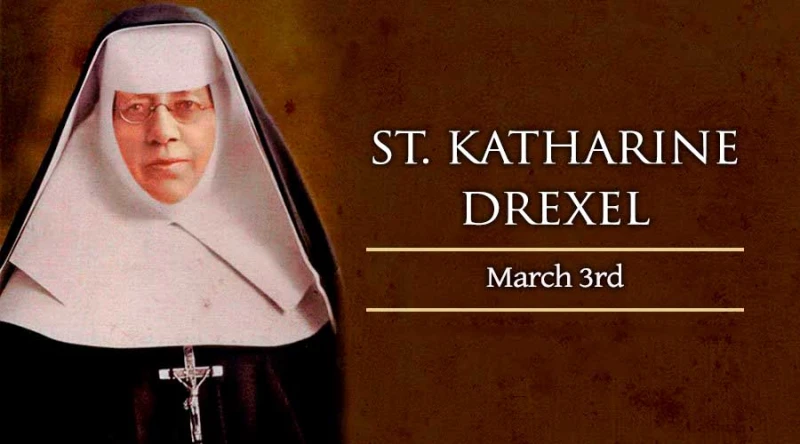
On March 3, the universal Church celebrates the feast of St. Katharine Drexel, a Philadelphia heiress who abandoned her family’s fortune to found an order of sisters dedicated to serving the impoverished African American and American Indian populations of the United States.

Katharine was born November 26, 1858 into a wealthy and well-connected banking family. The family’s wealth, however, did not prevent them from living out a serious commitment to their faith. 

Her mother opened up the family house three times a week to feed and care for the poor, and her father had a deep personal prayer life. Both parents encouraged their daughters to think of the family’s wealth not as their own, but as a gift from God which was to be used to help others.

During the summer months, Katharine and her sisters would teach catechism classes to the children of the workers on her family’s summer estate. The practice would prepare her for a life of service, with a strong focus on education and attention to the poor and vulnerable.

While traveling with her family through the Western U.S., Katharine witnessed the poor living conditions of the Native Americans. Eventually, while still a laywoman, she would give much of her own money to fund the missions and schools in these seriously deprived areas.

Eventually, however, the young heiress would give more than just funding to these much-needed missions and schools. She would decide to devote her whole life to the social and spiritual development of black and American Indian communities.

The inspiration for this work came to her during a visit to Rome, where she was granted an audience with Pope Leo XIII. During that time, Katharine had been considering a vocation to cloistered contemplative life as a nun. But when she asked Pope Leo XIII to send missionaries to Wyoming, he told Katharine she should undertake the work herself.

In February of 1891, she made her first vows in religious life – formally renouncing her fortune and her personal freedom for the sake of growing closer to God in solidarity with the victims of injustice. 

Although African-Americans had been freed from slavery, they continued to suffer serious abuse and were often prevented from obtaining even a basic education. Much the same situation held in the case of the native American Indians, who had been forcibly moved into reservations over the course of the 19th century.

Katharine founded the Sisters of the Blessed Sacrament for the purpose of living with these communities while helping them acquire education and grow in faith.

Between 1891 and 1935 she led her order in the founding and maintenance of almost 60 schools and missions, located primarily in the American West and Southwest. Among the prominent achievements of Drexel and her order is New Orleans’ Xavier University, the only historically black Catholic college in the U.S.

Katharine was forced into retirement for the last 20 years of her life after she suffered a severe heart attack. Although she was no longer able to lead her order, she left the sisters with her charism of love and concern for the missions.

She died on March 3, 1955 and was canonized by Pope John Paul II on October 1, 2000.

St. Katharine Drexel Read More »

Blessed Charles the Good

Feast date: Mar 02

Charles was a son of Canute IV of Denmark and Adela of Flanders. When he was only five years old, his father was assassinated in St. Alban´s Church, Odence. He was taken by his mother to the court of Robert, his maternal grandfather and Count of Flanders as a suitable place for him to grow up.

Blessed Charles became quite the warrior, and accompanied his grandfather in a crusade to the Holy Land and also fought against the English. After Roberts death in 1111, the new Count Baldwin, Roberts son, relied heavily on Charles for advice.

The people came to have a high regard for Charles´ wise and beneficent ways as well as his personal holiness. Baldwin arranged for Charles’ marriage to the daughter of the Count of Clermont and when Baldwin was wounded in battle, he assigned Charles as successor before he died in 1119. Charles ruled his people with wisdom, diligence, and compassion.

He made sure that times of truce were respected, and fought against unethical marketing practices. One such example is his action against greedy and influential families who had plotted to hoard grain so that it would be sold at excessively high prices. His just nature encouraged the wrath of his opposition.

One day in 1127, as Charles was praying in the Church St. Donatian, his enemies set upon him and killed him. The feast day of Blessed Charles the Good is March 2nd.

Blessed Charles the Good Read More »

St. Agnes of Prague


St. Agnes of Prague

Feast date: Mar 02

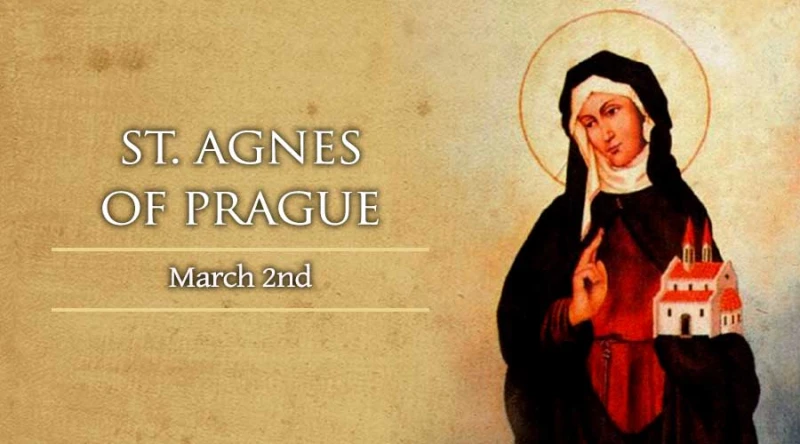
St. Agnes was born in Prague in the year 1200, and probably died in the year 1281. She was the daughter of Ottocar, King of Bohemia and Constance of Hungary, who was a relative of St. Elizabeth. At an early age she was sent to the monastery of Treinitz, where she was educated in the hands of the Cistercian religious, who would eventually become her rank.

She was betrothed to Henry, son of the Emperor Frederick II, Holy Roman Emperor, but when the time arrived for the solemnization of the marriage, they backed out of the agreement. Ottokar then planned for Agnes to marry Henry III of England, but this was vetoed by the Emperor, who wanted to marry Agnes himself.

She then dedicated herself to the resolution of consecrating herself to the service of God in the sanctuary of the cloister. Emperor Frederick is said to have remarked: “If she had left me for a mortal man, I would have taken vengeance with the sword, but I cannot take offence because in preference to me she has chosen the King of Heaven.”

The servant of God entered the Order of St. Clare in the monastery of St. Saviour at Prague, which she herself had erected. She was elected abbess of the monastery, and through this office became a model of Christian virtue and religious observance for all. God favored her with the gift of miracles, and she predicted the victory of her brother Wenceslaus over the Duke of Austria.

The exact year of Agnes’ death is not certain, but 1281 is the most probable date. She was beatified in 1874 by Pope Pius IX and canonized by Pope John Paul II on November 12, 1989.

St. Agnes of Prague Read More »