Please mind our dust!

We are currently working on revamping our website!
Thank you for your patience!

CRD Solutions

St. Angela of the Cross
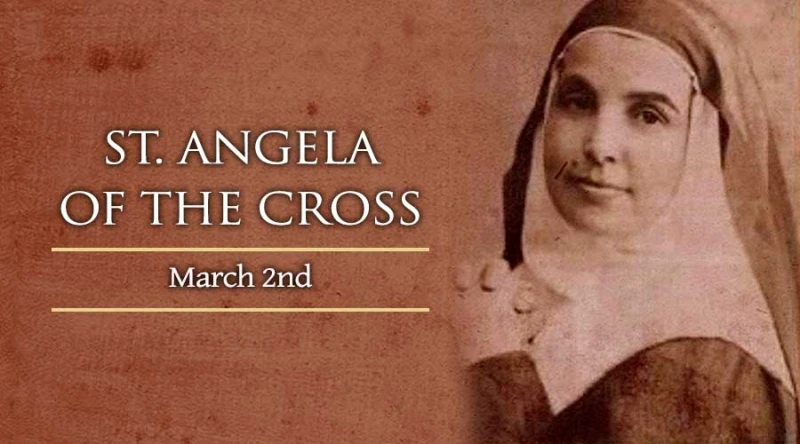

St. Angela of the Cross

Feast date: Mar 02

St. Angela of the Cross is the Foundress of the Institute of the Sisters of the Company of the Cross.

Born on January 30, 1846 in Seville, Spain, and given the baptismal name “Maria of the Angels” Guerrero Gonzalez, the future Saint was affectionately known as “Angelita”. Her father worked as a cook in the convent of the Trinitarian Fathers, where her mother also worked doing the laundry. They had 14 children, with only six reaching adulthood.

Angelita was greatly influenced by the teaching and example of her pious parents, and was taught from an early age how to pray the Rosary. She could often be found in the parish church praying before the image of “Our Lady of Good Health”, while her mother prepared a nearby altar. In their own home, a simple altar was erected in honour of the Virgin Mary during the month of May, where the family would recite the Rosary and give special honour to Our Lady.

Angelita made her First Communion when she was eight, and her Confirmation when she was nine. She had little formal education, and began work as a young girl in a shoeshop. Her employer and teacher of shoe repair, Antonia Maldonado, was a holy woman; every day the employees prayed the Rosary together and read the lives of the Saints. Canon José Torres Padilla of Seville was Antonia’s spiritual director, and had a reputation of “forming saints”. Angelita was 16 years old when she met Fr. Torres and was put under his direction.

Angelita’s desire to enter religious life was growing, and when she was 19, she asked to enter the Discalced Carmelites in Santa Cruz but was refused admission because of her poor health. Instead, following the advice of Fr Torres, she began caring for destitute cholera patients, because a cholera epidemic was quickly spreading among the poor.

In 1868 Angelita tried once again to enter the convent, this time the Daughters of Charity of Seville. Although her health was still frail, she was admitted. The sisters tried to improve her health and sent her to Cuenca and Valencia, but to no avail. She left the Daughters of Charity during the novitiate and returned home to continue working in the shoeshop.

Fr Torres believed that God had a plan for Angelita, but this plan was still a mystery. On 1 November 1871, at the foot of the Cross, she made a private vow to live the evangelical counsels, and in 1873 she received the call from God that would mark the beginning of her “new mission”. During prayer, Angelita saw an empty cross standing directly in front of the one upon which Jesus was hanging. She understood immediately that God was asking her to hang from the empty cross, to be “poor with the poor in order to bring them to Christ”.

Angelita continued to work in the shoeshop, but under obedience to Fr Torres she dedicated her free time to writing a detailed spiritual diary that revealed the style and ideal of life she was being called to live. On 2 August 1875 three other women joined Angelita, beginning community life together in a room they rented in Seville. From that day on, they began their visits and gave assistance to the poor, day and night.

These Sisters of the Company of the Cross, under the guidance of Angelita, named “Mother Angela of the Cross”, lived an authentically recluse contemplative life when they were not among the poor. Once they returned to their home, they dedicated themselves to prayer and silence, but were always ready when needed to go out and serve the poor and dying. Mother Angela saw the sisters as “angels”, called to help and love the poor and sick in their homes who otherwise would have been abandoned.

In 1877 a second community was founded in Utrera, in the province of Seville, and a year later one in Ayamonte. Fr Torres died that same year, and Fr José María Alvarez was appointed as the second director of the Institute.

While Mother Angela was alive, another 23 convents were established, with the sisters edifying everyone they served by their example of charity, poverty and humility. In fact, Mother Angela herself was known by all as “Mother of the Poor”.

Mother Angela of the Cross died on 2 March 1932 in Seville. She was beatified by Pope John Paul II on 5 November 1982.

With her characteristic humility, she once wrote these words:  “The nothing keeps silent, the nothing does not want to be, the nothing suffers all…. The nothing does not impose itself, the nothing does not command with authority, and finally, the nothing in the creature is practical humility”.

St. Angela of the Cross Read More »

Tuesday of the Eighth Week in Ordinary Time

Reading I 1 Pt 1:10-16

Beloved:
Concerning the salvation of your souls
the prophets who prophesied about the grace that was to be yours
searched and investigated it
investigating the time and circumstances
that the Spirit of Christ within them indicated
when it testified in advance
to the sufferings destined for Christ
and the glories to follow them.
It was revealed to them that they were serving not themselves but you
with regard to the things that have now been announced to you
by those who preached the Good News to you
through the Holy Spirit sent from heaven,
things into which angels longed to look.

Therefore, gird up the loins of your mind, live soberly,
and set your hopes completely on the grace to be brought to you
at the revelation of Jesus Christ.
Like obedient children,
do not act in compliance with the desires of your former ignorance
but, as he who called you is holy,
be holy yourselves in every aspect of your conduct,
for it is written, Be holy because I am holy.

Responsorial Psalm 98:1, 2-3ab, 3cd-4

R.        (2a)  The Lord has made known his salvation.
Sing to the LORD a new song,
            for he has done wondrous deeds;
His right hand has won victory for him,
            his holy arm.
R.        The Lord has made known his salvation.
The LORD has made his salvation known:
            in the sight of the nations he has revealed his justice.
He has remembered his kindness and his faithfulness
            toward the house of Israel.
R.        The Lord has made known his salvation.
All the ends of the earth have seen
            the salvation by our God.
Sing joyfully to the LORD, all you lands;
            break into song; sing praise.
R.        The Lord has made known his salvation.

Alleluia See Mt 11:25

R. Alleluia, alleluia.
Blessed are you, Father, Lord of heaven and earth;
you have revealed to little ones the mysteries of the Kingdom.

R. Alleluia, alleluia.

Gospel Mk 10:28-31

Peter began to say to Jesus,
“We have given up everything and followed you.”
Jesus said, “Amen, I say to you,
there is no one who has given up house or brothers or sisters
or mother or father or children or lands
for my sake and for the sake of the Gospel
who will not receive a hundred times more now in this present age:
houses and brothers and sisters
and mothers and children and lands,
with persecutions, and eternal life in the age to come.
But many that are first will be last, and the last will be first.”

– – –

Lectionary for Mass for Use in the Dioceses of the United States, second typical edition, Copyright © 2001, 1998, 1997, 1986, 1970 Confraternity of Christian Doctrine; Psalm refrain © 1968, 1981, 1997, International Committee on English in the Liturgy, Inc. All rights reserved. Neither this work nor any part of it may be reproduced, distributed, performed or displayed in any medium, including electronic or digital, without permission in writing from the copyright owner.

Tuesday of the Eighth Week in Ordinary Time Read More »

St. David of Wales


St. David of Wales

Feast date: Mar 01

Among Welsh Catholics, as well as those in England, March 1 is the liturgical celebration of Saint David of Wales.

St. David is the patron of the Welsh people, remembered as a missionary bishop and the founder of many monasteries during the sixth century.

David was a popular namesake for churches in Wales prior to the Anglican schism, and his feast day is still an important religious and civic observance.

Although Pope Benedict XVI did not visit Wales during his 2010 trip to the U.K., he blessed a mosaic icon of its patron, and delivered remarks praising St. David as “one of the great saints of the sixth century, that golden age of saints and missionaries in these isles, and…thus a founder of the Christian culture which lies at the root of modern Europe.”

In his comments, Pope Benedict recalled the saint’s dying words to his monastic brethren: “Be joyful, keep the faith, and do the little things.” He urged that St. David’s message, “in all its simplicity and richness, continue to resound in Wales today, drawing the hearts of its people to renewed love for Christ and his Church.”

From a purely historical standpoint, little is known of David’s life, with the earliest biography dating from centuries after his time. As with some other saints of sixth-century Wales, even the chronology of his life is not easy to ascertain.

David’s conception is said to have occurred as a result of rape – a detail that seems unlikely to have been invented by later biographers, though it cannot (like almost all of the traditions surrounding his life) be established with certainty. His mother Saint Nonna, or Nonnita, has her traditional feast day on March 3.

David appears to have been the cousin of his contemporary Saint Teilo, another Welsh bishop and monk. He is described as a pupil of the monastic educator Saint Paulinus, who was one of St. Teilo’s teachers as well. There are doubts, however, about the story which holds that David and Teilo traveled to Jerusalem and were ordained together as bishops.

It is clear that David served as the Bishop of Menevia, an important port city linking Wales and Ireland in his time. His leading role in two local councils of the Church is also a matter of record.

Twelve monasteries have their founding ascribed to David, who developed a reputation for strict asceticism. His monks modeled their lives on the earliest desert hermits – combining hard manual labor, silence, long hours of prayer, and a diet that completely excluded meat and alcohol.

The monks did not use animals to take care of their fields, and lived off of only bread, vegetables, and water.

One tradition places his death in the year 601, but other writers believe he died in the 540s. David may well have survived to an advanced age, but evidence is lacking for the claim (made by his 11th-century biographer) that he lived to the age of 147. Pope Callistus II canonized St. David of Wales in 1120.

St. David of Wales Read More »

Monday of the Eighth Week in Ordinary Time

Reading I 1 Pt 1:3-9

Blessed be the God and Father of our Lord Jesus Christ,
who in his great mercy gave us a new birth to a living hope
through the resurrection of Jesus Christ from the dead,
to an inheritance that is imperishable, undefiled, and unfading,
kept in heaven for you
who by the power of God are safeguarded through faith,
to a salvation that is ready to be revealed in the final time.
In this you rejoice, although now for a little while
you may have to suffer through various trials,
so that the genuineness of your faith,
more precious than gold that is perishable even though tested by fire,
may prove to be for praise, glory, and honor
at the revelation of Jesus Christ.
Although you have not seen him you love him;
even though you do not see him now yet you believe in him,
you rejoice with an indescribable and glorious joy,
as you attain the goal of faith, the salvation of your souls.

Responsorial Psalm 111:1-2, 5-6, 9 and 10c

R.        (5)  The Lord will remember his covenant for ever.
or:
R.        Alleluia.
I will give thanks to the LORD with all my heart
            in the company and assembly of the just.
Great are the works of the LORD,
            exquisite in all their delights.
R.        The Lord will remember his covenant for ever.
or:
R.        Alleluia.
He has given food to those who fear him;
            he will forever be mindful of his covenant.
He has made known to his people the power of his works,
            giving them the inheritance of the nations.
R.        The Lord will remember his covenant for ever.
or:
R.        Alleluia.
He has sent deliverance to his people;
            he has ratified his covenant forever;
            holy and awesome is his name.
            His praise endures forever.
R.        The Lord will remember his covenant for ever.
or:
R.        Alleluia.

Alleluia 2 Cor 8:9

R. Alleluia, alleluia.
Jesus Christ became poor although he was rich,
so that by his poverty you might become rich.

R. Alleluia, alleluia.

Gospel Mk 10:17-27

As Jesus was setting out on a journey, a man ran up,
knelt down before him, and asked him,
“Good teacher, what must I do to inherit eternal life?”
Jesus answered him, “Why do you call me good?
No one is good but God alone.
You know the commandments: You shall not kill;
you shall not commit adultery;
you shall not steal;
you shall not bear false witness;
you shall not defraud;
honor your father and your mother
.”
He replied and said to him,
“Teacher, all of these I have observed from my youth.”
Jesus, looking at him, loved him and said to him,
“You are lacking in one thing.
Go, sell what you have, and give to the poor
and you will have treasure in heaven; then come, follow me.”
At that statement, his face fell,
and he went away sad, for he had many possessions.

Jesus looked around and said to his disciples,
“How hard it is for those who have wealth
to enter the Kingdom of God!”
The disciples were amazed at his words.
So Jesus again said to them in reply,
“Children, how hard it is to enter the Kingdom of God!
It is easier for a camel to pass through the eye of a needle
than for one who is rich to enter the Kingdom of God.”
They were exceedingly astonished and said among themselves,
 “Then who can be saved?”
Jesus looked at them and said,
“For men it is impossible, but not for God.
All things are possible for God.”

– – –

Lectionary for Mass for Use in the Dioceses of the United States, second typical edition, Copyright © 2001, 1998, 1997, 1986, 1970 Confraternity of Christian Doctrine; Psalm refrain © 1968, 1981, 1997, International Committee on English in the Liturgy, Inc. All rights reserved. Neither this work nor any part of it may be reproduced, distributed, performed or displayed in any medium, including electronic or digital, without permission in writing from the copyright owner.

Monday of the Eighth Week in Ordinary Time Read More »

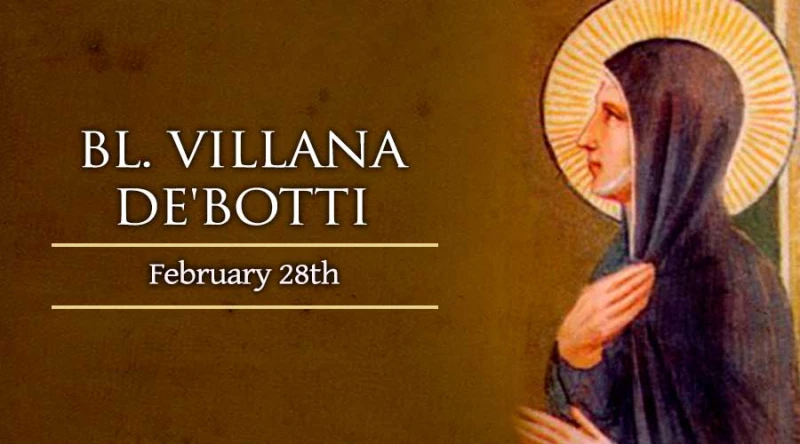
Blessed Villana de’Botti


Blessed Villana de’Botti

Feast date: Feb 28

Villana de’Botti was a wife and a Third Order Dominican. She was born in Florence in 1332. She was a very pious child, and at age 13 she ran away from home to join a convent. She was refused and returned home. Soon after, her family married her to Rosso di Piero.

The rejection at the convent and the marriage seemed to change Villana. She became lazy and worldly, concerned only with pleasure. One day, as she was getting dressed, her reflection in her mirrors suddenly changed to a demon. Villana understood this to be a reflection of her sinful soul. She tore off her clothes, put on something poor and simple, and ran to the Dominican Fathers for help.

She became a Dominican tertiary, concentrated on her vocation of married life, and spent her free time praying and reading Scripture and the lives of the saints. She was given to religious ecstasies at Mass, visions of Our Lady and the saints, and had the gift of prophecy. She became the object of much ridicule and slander, but even her fiercest opponents eventually came to see her as a living saint.

She died in 1361 of natural causes at the age of 30. Her body was taken to the church of Santa Maria Novella in Florence, which was under the care of the Dominican Fathers. The priests were unable to bury her for a month due to the constant crowd of mourners. She was beatified by Pope Leo XII in 1824.

Blessed Villana de’Botti Read More »