Please mind our dust!

We are currently working on revamping our website!
Thank you for your patience!

CRD Solutions

St. Polycarp of Smyrna
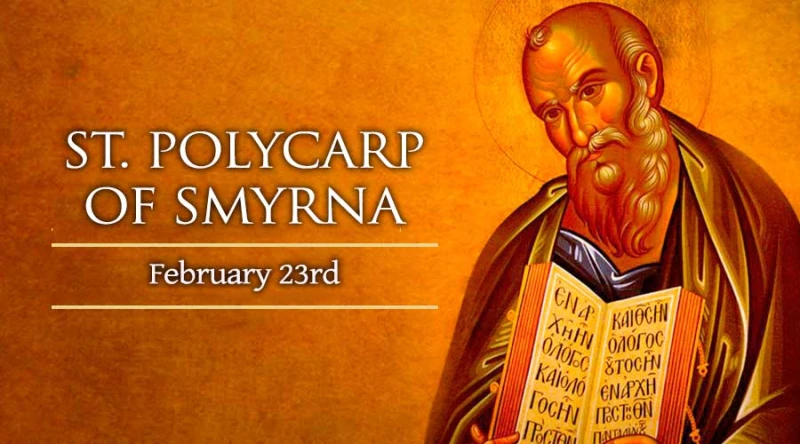

St. Polycarp of Smyrna

Feast date: Feb 23

On Feb. 23, the Catholic Church remembers the life and martyrdom of St. Polycarp, a disciple of the apostle and evangelist St. John. Polycarp is celebrated on the same date by Eastern Orthodox Christians, who also honor him as a Saint.

Polycarp is known to later generations primarily through the account of his martyrdom, rather than by a formal biography. However, it can be determined from that account that he was born around the year 69 AD. From the testimony he gave to his persecutors – stating he had served Christ for 86 years – it is clear that he was either raised as a Christian, or became one in his youth.

Growing up among the Greek-speaking Christians of the Roman Empire, Polycarp received the teachings and recollections of individuals who had seen and known Jesus during his earthly life. This important connection – between Jesus’ first disciples and apostles and their respective students – served to protect the Catholic Church against the influence of heresy during its earliest days, particularly against early attempts to deny Jesus’ bodily incarnation and full humanity.

Polycarp’s most significant teacher, with whom he studied personally, was St. John – whose contributions to the Bible included not only the clearest indication of Jesus’ eternal divinity, but also the strongest assertions of the human nature he assumed on behalf of mankind. By contrast, certain tendencies had already emerged among the first Christians – to deny the reality of Jesus’ literal suffering, death, and resurrection, regarding them as mere “symbols” of highly abstract ideas. With John’s help, Polycarp may have been the one who compiled, edited, and published the New Testament

Another Catholic teacher of the second century, St. Irenaeus, wrote that Polycarp “was not only instructed by apostles, and conversed with many who had seen Christ; but he was also, by apostles, appointed bishop of the Church in Smyrna.” In a surviving letter that he wrote to the Philippians, he reminded that Church – which had also received the teaching of St. Paul – not to surrender their faith to the “gnostic” teachers claiming to teach a more intellectually refined gospel.

“For every one who shall not confess that Jesus Christ is come in the flesh, is antichrist,” he wrote –  citing St. John himself – “and whosoever shall not confess the testimony of the Cross, is of the devil; and whosoever shall pervert the oracles of the Lord to his own lusts and say that there is neither resurrection nor judgment, that man is the firstborn of Satan.”

“Let us therefore, without ceasing, hold fast by our hope and by the pledge of our righteousness,” Polycarp taught – as he went on to explain that both hope and righteousness depended upon “Jesus Christ, who took up our sins in His own body upon the cross.” With eloquence and clarity, he reminded the Philippian Church that Christ, “for our sakes, endured all things – so that we might live in him.”

However, Polycarp’s most eloquent testimony to his faith in Jesus came not through his words, but through his martyrdom, described in another early Christian work. The Church of Smyrna, in present-day Turkey, compiled their recollections of their bishop’s death at the hands of public authorities in a letter to another local church.

“We have written to you, brethren, as to what relates to the martyrs, and especially to the blessed Polycarp” – who, in the words of the Catholics of Smyrna, “put an end to the persecution – having, as it were, set a seal upon it by his martyrdom.”

Around the year 155, Polycarp became aware that government authorities were on the lookout for him, seeking to stamp out the Catholic Church’s claim of obeying a higher authority than the Emperor. He retreated to a country house and occupied himself with constant prayer, before receiving a vision of his death that prompted him to inform his friends: “I must be burned alive.” He changed locations, but was betrayed by a young man who knew his whereabouts and confessed under torture.

He was captured on a Saturday evening by two public officials, who urged him to submit to the state demands. “What harm is there,” one asked, “in saying, ‘Caesar is Lord,’ and in sacrificing to him, with the other ceremonies observed on such occasions, so as to make sure of safety?”

“I shall not do as you advise me,” he answered. Outraged by his response, the officials had him violently thrown from their chariot and taken to an arena for execution. Entering the stadium, the bishop – along with some of his companions, who survived to tell of it – heard a heavenly voice, saying: “Be strong, and show yourself a man, O Polycarp!”

Before the crowd, the Roman proconsul demanded again that he worship the emperor.

“Hear me declare with boldness, I am a Christian,” the bishop said. “And if you wish to learn what the doctrines of Christianity are, appoint me a day, and you shall hear them.”

“You threaten me with fire,” he continued “which burns for an hour, and after a little is extinguished. But you are ignorant of the fire of the coming judgment and of eternal punishment, reserved for the ungodly.”

“But,” he challenged the proconsul, “what are you waiting for? Bring forth what you will.”

Although the crowds clamored for Polycarp to be devoured by beasts, it was decided he should be burned alive, just as he had prophesied. He prayed aloud to God: “May I be accepted this day before you as an acceptable sacrifice — just as you, the ever-truthful God, have foreordained, revealed beforehand to me, and now have fulfilled.”

What happened next struck Polycarp’s companions with amazement; they recorded the sight in the letter that they circulated after Polycarp’s death.

“As the flame blazed forth in great fury,” they wrote, “we to whom it was given to witness it, beheld a great miracle.” The fire did not seem to touch the bishop’s body. Rather, as they described, “shaping itself into the form of an arch, it encompassed – as by a circle – the body of the martyr. And he appeared within not like flesh which is burnt, but as bread that is baked, or as gold and silver glowing in a furnace.”

“Moreover, we perceived such a sweet odour coming from the flames – as if frankincense or some such precious spices had been burning there.”

The executioners perceived that Polycarp’s death was not going as planned. Losing patience, they ordered him to be stabbed to death.

From the resulting wound, “there came forth a dove, and a great quantity of blood, so that the fire was extinguished.”

The crowd, as the Christian witnesses recalled, were understandably amazed.

“All the people marveled,” they wrote, “that there should be such a difference between the unbelievers and the elect.” Polycarp, they proclaimed, had been among that elect – “having in our own times been an apostolic and prophetic teacher, and bishop of the Catholic Church which is in Smyrna.”

St. Polycarp has been venerated as a Saint since his death in 155.

St. Polycarp of Smyrna Read More »
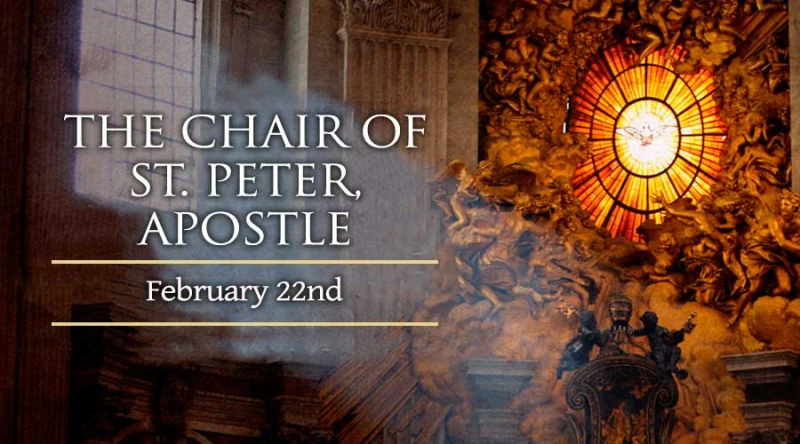
Feast of the Chair of Saint Peter, Apostle

Reading I 1 Pt 5:1-4

Beloved:
I exhort the presbyters among you,
as a fellow presbyter and witness to the sufferings of Christ
and one who has a share in the glory to be revealed.
Tend the flock of God in your midst,
overseeing not by constraint but willingly,
as God would have it, not for shameful profit but eagerly.
Do not lord it over those assigned to you,
but be examples to the flock.
And when the chief Shepherd is revealed,
you will receive the unfading crown of glory.

Responsorial Psalm 23:1-3a, 4, 5, 6

R.        (1)  The Lord is my shepherd; there is nothing I shall want.
The LORD is my shepherd; I shall not want.
            In verdant pastures he gives me repose;
Beside restful waters he leads me;
            he refreshes my soul.
R.        The Lord is my shepherd; there is nothing I shall want.
Even though I walk in the dark valley
            I fear no evil; for you are at my side
With your rod and your staff
            that give me courage.
R.        The Lord is my shepherd; there is nothing I shall want.
You spread the table before me
            in the sight of my foes;
You anoint my head with oil;
            my cup overflows.
R.        The Lord is my shepherd; there is nothing I shall want.
Only goodness and kindness follow me
            all the days of my life;
And I shall dwell in the house of the LORD
            for years to come.
R.        The Lord is my shepherd; there is nothing I shall want.

Alleluia Mt 16:18

R. Alleluia, alleluia.
You are Peter, and upon this rock I will build my Church;
the gates of the netherworld shall not prevail against it.
R. Alleluia, alleluia.

Gospel Mt 16:13-19

When Jesus went into the region of Caesarea Philippi
he asked his disciples,
“Who do people say that the Son of Man is?”
They replied, “Some say John the Baptist, others Elijah,
still others Jeremiah or one of the prophets.”
He said to them, “But who do you say that I am?”
Simon Peter said in reply,
“You are the Christ, the Son of the living God.”
Jesus said to him in reply, “Blessed are you, Simon son of Jonah.
For flesh and blood has not revealed this to you, but my heavenly Father.
And so I say to you, you are Peter,
and upon this rock I will build my Church,
and the gates of the netherworld shall not prevail against it.
I will give you the keys to the Kingdom of heaven.
Whatever you bind on earth shall be bound in heaven;
and whatever you loose on earth shall be loosed in heaven.”

– – –

Lectionary for Mass for Use in the Dioceses of the United States, second typical edition, Copyright © 2001, 1998, 1997, 1986, 1970 Confraternity of Christian Doctrine; Psalm refrain © 1968, 1981, 1997, International Committee on English in the Liturgy, Inc. All rights reserved. Neither this work nor any part of it may be reproduced, distributed, performed or displayed in any medium, including electronic or digital, without permission in writing from the copyright owner.

Feast of the Chair of Saint Peter, Apostle Read More »

Chair of Saint Peter


Chair of Saint Peter

Feast date: Feb 22

The Feast of the Chair of St. Peter celebrates the papacy and St. Peter as the first bishop of Rome. St. Peter’s original name was Simon. He was married with children and was living and working in Capernaum as a fisherman when Jesus called him to be one of the Twelve Apostles.

Jesus bestowed to Peter a special place among the Apostles. He was one of the three who were with Christ on special occasions, such as the Transfiguration of Christ and the Agony in the Garden of Gethsemane. He was the only Apostle to whom Christ appeared on the first day after the Resurrection. Peter, in turn, often spoke on behalf of the Apostles.

When Jesus asked the Apostles: “Whom do men say that the Son of Man is?”

Simon replied: “Thou art Christ, the Son of the Living God.”

And Jesus said: “Blessed are you, Simon Bar-Jona: because flesh and blood have not revealed it to you, but my Father who is in heaven. And I say to you: That you are Peter [Cephas, a rock], and upon this rock [Cephas] I will build my Church [ekklesian], and the gates of hell shall not prevail against it. And I will give to you the keys of the kingdom of heaven. And whatsoever you shall bind upon earth, it shall be bound also in heaven: and whatsoever you shall loose on earth, it shall be loosed also in heaven”. (Mt 16:13-20)

In saying this Jesus made St. Peter the head of the entire community of believers and placed the spiritual guidance of the faithful in St. Peter’s hands.

However, St. Peter was not without faults. He was rash and reproached often by Christ. He had fallen asleep in the Garden of Gethsemane instead of praying, as Jesus had asked him to do. He also denied knowing Jesus three times after Christ’s arrest.

Peter delivered the first public sermon after the Pentecost and won a large number of converts. He also performed many miracles and defended the freedom of the Apostles to preach the Gospels. He preached in Jerusalem, Judaea, and as far north as Syria.

He was arrested in Jerusalem under Herod Agrippa I, but miraculously escaped execution. He left Jerusalem and eventually went to Rome, where he preached during the last portion of his life. He was crucified there, head downwards, as he had desired to suffer, saying that he did not deserve to die as Christ had died.

The date of St. Peter’s death is not clear. Historians estimate he was executed between the years 64 and 68. His remains now rest beneath the altar of St. Peter’s Basilica in Rome.

Chair of Saint Peter Read More »

Monday of the Seventh Week in Ordinary Time

Reading I Jas 3:13-18

Beloved:
Who among you is wise and understanding?
Let him show his works by a good life  
in the humility that comes from wisdom.
But if you have bitter jealousy and selfish ambition in your hearts,
do not boast and be false to the truth.
Wisdom of this kind does not come down from above
but is earthly, unspiritual, demonic.
For where jealousy and selfish ambition exist,
there is disorder and every foul practice.
But the wisdom from above is first of all pure,
then peaceable, gentle, compliant,
full of mercy and good fruits,
without inconstancy or insincerity.
And the fruit of righteousness is sown in peace
for those who cultivate peace.

Responsorial Psalm 19:8, 9, 10, 15

R.        (9a)  The precepts of the Lord give joy to the heart.
The law of the LORD is perfect,
            refreshing the soul;
The decree of the LORD is trustworthy,
            giving wisdom to the simple.
R.        The precepts of the Lord give joy to the heart.
The precepts of the LORD are right,
            rejoicing the heart;
The command of the LORD is clear,
            enlightening the eye.
R.        The precepts of the Lord give joy to the heart.
The fear of the LORD is pure,
            enduring forever;
The ordinances of the LORD are true,
            all of them just.
R.        The precepts of the Lord give joy to the heart.
Let the words of my mouth and the thought of my heart
            find favor before you,
            O LORD, my rock and my redeemer.
R.        The precepts of the Lord give joy to the heart.

Alleluia See 2 Tm 1:10

R. Alleluia, alleluia.
Our Savior Jesus Christ has destroyed death
and brought life to light through the Gospel.

R. Alleluia, alleluia.

Gospel Mk 9:14-29

As Jesus came down from the mountain with Peter, James, John
and approached the other disciples,
they saw a large crowd around them and scribes arguing with them.
Immediately on seeing him,
the whole crowd was utterly amazed.
They ran up to him and greeted him.
He asked them, “What are you arguing about with them?”
Someone from the crowd answered him,
“Teacher, I have brought to you my son possessed by a mute spirit.
Wherever it seizes him, it throws him down;
he foams at the mouth, grinds his teeth, and becomes rigid.
I asked your disciples to drive it out, but they were unable to do so.”
He said to them in reply,
“O faithless generation, how long will I be with you?
How long will I endure you?  Bring him to me.”
They brought the boy to him.
And when he saw him,
the spirit immediately threw the boy into convulsions.
As he fell to the ground, he began to roll around  
and foam at the mouth.
Then he questioned his father,
“How long has this been happening to him?”
He replied, “Since childhood.
It has often thrown him into fire and into water to kill him.
But if you can do anything, have compassion on us and help us.”
Jesus said to him,
“‘If you can!’ Everything is possible to one who has faith.”
Then the boy’s father cried out, “I do believe, help my unbelief!”
Jesus, on seeing a crowd rapidly gathering,
rebuked the unclean spirit and said to it,
“Mute and deaf spirit, I command you:
come out of him and never enter him again!”
Shouting and throwing the boy into convulsions, it came out.
He became like a corpse, which caused many to say, “He is dead!”
But Jesus took him by the hand, raised him, and he stood up.
When he entered the house, his disciples asked him in private,
“Why could we not drive the spirit out?”
He said to them, “This kind can only come out through prayer.”

– – –

Lectionary for Mass for Use in the Dioceses of the United States, second typical edition, Copyright © 2001, 1998, 1997, 1986, 1970 Confraternity of Christian Doctrine; Psalm refrain © 1968, 1981, 1997, International Committee on English in the Liturgy, Inc. All rights reserved. Neither this work nor any part of it may be reproduced, distributed, performed or displayed in any medium, including electronic or digital, without permission in writing from the copyright owner.

Monday of the Seventh Week in Ordinary Time Read More »

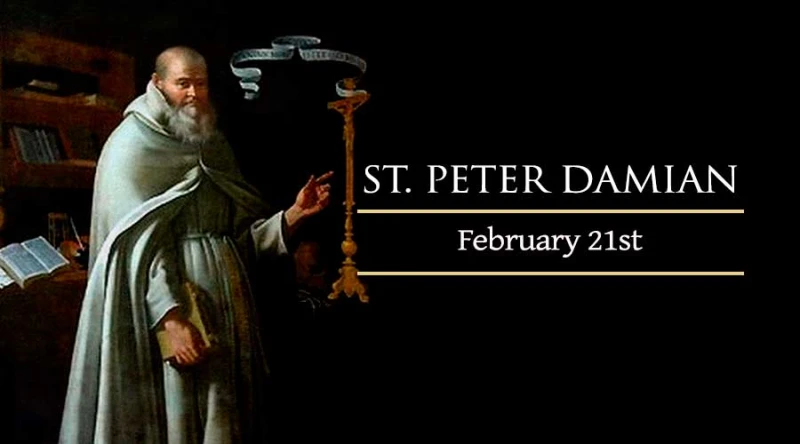
St. Peter Damian


St. Peter Damian

Feast date: Feb 21

On Feb. 21, Catholics honor Saint Peter Damian, a Benedictine monk who strove to purify the Church during the early years of its second millennium.

In his Sept. 9, 2009 general audience on the saint, Pope Benedict XVI described him as “one of the most significant figures of the 11th century … a lover of solitude and at the same time a fearless man of the Church, committed personally to the task of reform.”

Born during 1007 in the Italian city of Ravenna, Peter belonged to a large family but lost both his father and mother early in life. An older brother took the boy into his household, yet treated him poorly. But another of Peter’s brothers, a priest, took steps to provide for his education; and the priest’s own name, Damian, became his younger brother’s surname.

Peter excelled in school while also taking up forms of asceticism, such as fasting, wearing a hair shirt, and spending long hours in prayer with an emphasis on reciting the Psalms. He offered hospitality to the poor as a means of serving Christ, and eventually resolved to embrace voluntary poverty himself through the Order of Saint Benedict.

The monks he chose to join, in the hermitage of Fonte Avellana, lived out their devotion to the Cross of Christ through a rigorous rule of life. They lived mainly on bread and water, prayed all 150 Psalms daily, and practiced many physical mortifications. Peter embraced this way of life somewhat excessively at first, which led to a bout with insomnia.

Deeply versed in the Bible and the writings of earlier theologians, Peter developed his own theological acumen and became a skilled preacher. The leaders of other monasteries sought his help to build up their monks in holiness, and in 1043 he took up a position of leadership as the prior of Fonte Avellana. Five other hermitages were established under his direction.

Serious corruption plagued the Church during Peter’s lifetime, including the sale of religious offices and immorality among many of the clergy. Through his writings and involvements in controversies of the day, the prior of Fonte Avellana called on members of the hierarchy and religious orders to live out their commitments and strive for holiness.

In 1057, Pope Stephen IX became determined to make Peter Damian a bishop, a goal he accomplished only by demanding the monk’s obedience under threat of excommunication. Consecrated as the Bishop of Ostia in November of that year, he also joined the College of Cardinals and wrote a letter encouraging its members to set an example for the whole Church.

With Pope Stephen’s death in 1058, and the election of his successor Nicholas II, Peter’s involvement in Church controversies grew. He supported Pope Nicholas against a rival claimant to the papacy, and went to Milan as the Pope’s representative when a crisis broke out over canonical and moral issues. There, he was forced to confront rioters who rejected papal authority.

Peter, meanwhile, wished to withdraw from these controversies and return to the contemplative life. But Nicholas’ death in 1061 caused another papal succession crisis, which the cardinal-bishop helped to resolve in favor of Alexander II. That Pope kept the Cardinal Bishop of Ostia occupied with a series of journeys and negotiations for the next six years.

In 1067, Peter Damian was allowed to resign his episcopate and return to the monastery at Fonte Avellana. Two years later, however, Pope Alexander needed his help to prevent the German King Henry IV from divorcing his wife. Peter lived another two years in the monastery before making a pilgrimage to Monte Cassino, the birthplace of the Benedictine order.

In 1072, Peter returned to his own birthplace of Ravenna, to reconcile the local church with the Pope. The monk’s last illness came upon him during his return from this final task, and he died after a week at a Benedictine monastery in Faenza during February of that year.

Never formally canonized, St. Peter Damian was celebrated as a saint after his death in many of the places associated with his life. In 1823, Pope Leo XII named him a Doctor of the Church and extended the observance of his feast day throughout the Western Church.

St. Peter Damian Read More »