
Please mind our dust!

We are currently working on revamping our website!
Thank you for your patience!

CRD Solutions

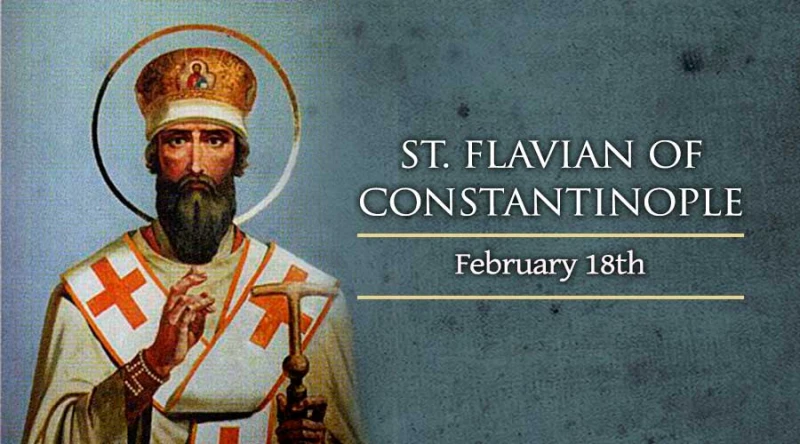
St. Flavian


St. Flavian

Feast date: Feb 18

On Feb. 18, the Roman Catholic Church remembers Patriarch Saint Flavian of Constantinople, who is honored on the same date by Eastern Catholics of the Byzantine tradition and by Eastern Orthodox Christians.

Known to Eastern Christians as “St. Flavian the Confessor,” the patriarch endured condemnation and severe beatings during a fifth-century dispute about the humanity and divinity of Jesus Christ. Though he died from his injuries, his stand against heresy was later vindicated at the Church’s fourth ecumenical council in 451.

St. Flavian is closely associated with Pope St. Leo the Great, who also upheld the truth about Christ’s divine and human natures during the controversy. The Pope’s best-known contribution to the fourth council – a letter known as the “Tome of Leo” – was originally addressed to St. Flavian, though it did not reach the patriarch during his lifetime.

Flavian’s date of birth is unknown, as are most of his biographical details. He was highly-regarded as a priest during the reign of the Eastern Roman Emperor Theodosius II (which lasted from 408 to 450), and he became Archbishop of Constantinople following the death of Patriarch Saint Proclus in approximately 447.

Early in his patriarchate, Flavian angered a state official named Chrysaphius by refusing to offer a bribe to the emperor. The ruler’s wife Eudocia joined the resulting conspiracy which Chrysaphius hatched against Flavian, a plot that would come to fruition in an illegitimate Church council and the patriarch’s death.

As head of the Church in Constantinople, Flavian had inherited a theological controversy about the relationship between deity and humanity in the person of Jesus Christ. In an occurrence that was not uncommon for the time, the doctrinal issue became entangled with personal and political rivalries. Flavian’s stand for orthodoxy gave his high-ranking court opponents a chance to act against him by encouraging the proponents of doctrinal error and manipulating the emperor in their favor.

The theological issue had arisen after the Council of Ephesus, which in 431 had confirmed the personal unity of Christ and condemned the error (known as Nestorianism) that said he was a composite being made up of a divine person and a human person. But questions persisted: Were Jesus’ eternal divinity, and his assumed humanity, two distinct and complete natures fully united in one person? Or did the person of Christ have only one hybrid nature, made up in some manner of both humanity and divinity?

The Church would eventually confirm that the Lord’s incarnation involved both a divine and a human nature at all times. When God took on a human nature at the incarnation, in the words of Pope St. Leo the Great, “the proper character of both natures was maintained and came together in a single person,” and “each nature kept its proper character without loss.”

During Flavian’s patriarchate, however, the doctrine of Christ’s two natures had not been fully and explicitly defined. Thus, controversy came up regarding the doctrine of a monk named Eutyches, who insisted that Christ had only “one nature.” Flavian understood the “monophysite” doctrine as contrary to faith in Christ’s full humanity, and he condemned it at a local council in November of 448. He excommunicated Eutyches, and sent his decision to Pope Leo, who gave his approval in May 449.

Chrysaphius, who knew Eutyches personally, proceeded to use the monk as his instrument against the patriarch who had angered him. He convinced the emperor that a Church council should be convened to consider Eutyches’ doctrine again. The resulting council, held in August 449 and led by Dioscorus of Alexandria, was completely illegitimate, and later formally condemned. But it pronounced against Flavian and declared him deposed from the patriarchate.

During this same illicit gathering, known to history as the “Robber Council,” a mob of monks beat St. Flavian so aggressively that he died from his injuries three days later. Chrysaphius seemed, for the moment, to have triumphed over the patriarch.

But the state official’s ambitions soon collapsed. Chrysaphius fell out of favor with Theodosius II shortly before the emperor’s death in July 450, and he was executed early in the reign of his successor Marcian.

St. Flavian, meanwhile, was canonized by the Fourth Ecumenical Council in 451. Its participants gave strong acclamation to the “Tome of Leo” – in which the Pope confirmed St. Flavian’s condemnation of Eutyches and affirmed the truth about Christ’s two natures, both divine and human.
St. Flavian Read More »

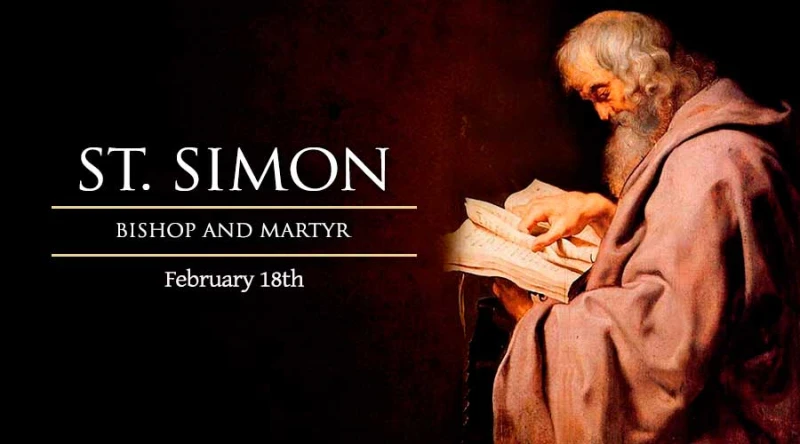
St. Simon


St. Simon

Feast date: Feb 18

A relative of Jesus’, possibly a first cousin. He is in the Gospel of Matthew, and is one of the brethren of Christ mentioned in Acts who was present at the birth of the Church on the first Pentecost.

Reported to have been at the martyrdom of Saint James the Lesser, he was chosen to succeed James as bishop of Jerusalem. In 66, before the city fell to the Romans, the Christians received a divine warning, and evacuated to nearby Pella, with Simon as their leader.

In the aftermath of the destruction of Jerusalem, Simon led the Christians back to the city where they flourished, performed miracles, and converted many.

Simon was eventually arrested, tortured and martyred for the twin crimes of being Jewish and Christian.

His death was that of crucifixion.

St. Simon Read More »

Seven Founders of the Order of Servites


Seven Founders of the Order of Servites

Feast date: Feb 17

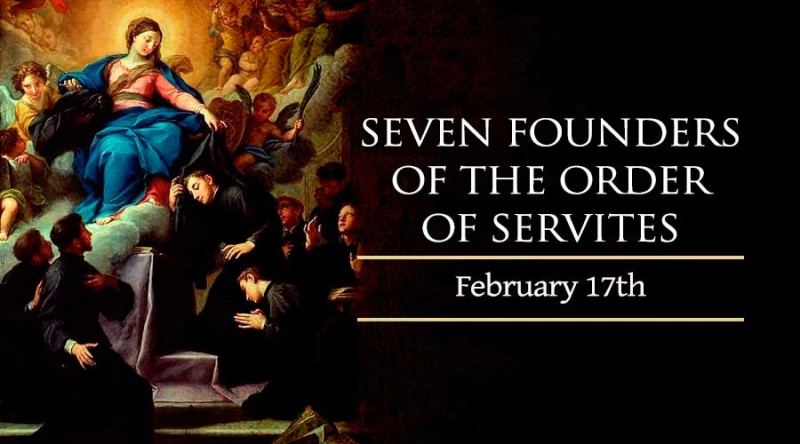
These seven men were born in Florence, Italy and led lives as hermits on Monte Senario. They had a special devotion to the Blessed Virgin Mary.

On Friday, April 13, 1240, the hermits received a vision of Our Lady. She held in her hand a black habit, and a nearby angel bore a scroll reading “Servants of Mary.”

Mary told them:

“You will found a new order, and you will be my witnesses throughout the world. This is your name: Servants of Mary. This is your rule: that of Saint Augustine. And here is your distinctive sign: the black scapular, in memory of my sufferings.

They accepted the wisdom of Our Lady, wrote a Rule based on Saint Augustine and the Dominican Constitutions, adopted the black habit of an Augustinian monk, and lived as mendicant friars. The men founded the Order of Servites which in 1304 received the approval of the Holy See.

They are venerated on Feb. 17 because it is said to be the day on which Saint Alexis Falconieri, one of the seven, died in 1310.

All seven were beatified December 1, 1717 by Pope Clement XI  and canonized in 1887 by Pope Leo XIII.

Seven Founders of the Order of Servites Read More »

Thursday of the Sixth Week in Ordinary Time

Reading I Jas 2:1-9

My brothers and sisters, show no partiality
as you adhere to the faith in our glorious Lord Jesus Christ.
For if a man with gold rings and fine clothes  
comes into your assembly,
and a poor person with shabby clothes also comes in,  
and you pay attention to the one wearing the fine clothes
and say, “Sit here, please,”
while you say to the poor one, “Stand there,” or “Sit at my feet,” 
have you not made distinctions among yourselves
and become judges with evil designs?

Listen, my beloved brothers and sisters.
Did not God choose those who are poor in the world
to be rich in faith and heirs of the Kingdom
that he promised to those who love him?
But you dishonored the poor.
Are not the rich oppressing you?
And do they themselves not haul you off to court?
Is it not they who blaspheme the noble name that was invoked over you?
However, if you fulfill the royal law according to the Scripture,
You shall love your neighbor as yourself, you are doing well.
But if you show partiality, you commit sin,
and are convicted by the law as transgressors. 

Responsorial Psalm 34:2-3, 4-5, 6-7

R.        (7a) The Lord hears the cry of the poor.
I will bless the LORD at all times;
            his praise shall be ever in my mouth.
Let my soul glory in the LORD;
            the lowly will hear me and be glad. 
R.        The Lord hears the cry of the poor.
Glorify the LORD with me,
            let us together extol his name.
I sought the LORD, and he answered me
            and delivered me from all my fears. 
R.        The Lord hears the cry of the poor.
Look to him that you may be radiant with joy,
            and your faces may not blush with shame.
When the poor one called out, the LORD heard,
            and from all his distress he saved him.
R.        The Lord hears the cry of the poor.

Alleluia See John 6:63c, 68c

R.        Alleluia, alleluia.
Your words, Lord, are Spirit and life;
you have the words of everlasting life.
R.        Alleluia, alleluia.

Gospel Mk 8:27-33

Jesus and his disciples set out
for the villages of Caesarea Philippi.
Along the way he asked his disciples,
“Who do people say that I am?”
They said in reply,
“John the Baptist, others Elijah,
still others one of the prophets.”
And he asked them,
“But who do you say that I am?”
Peter said to him in reply,
“You are the Christ.”
Then he warned them not to tell anyone about him.

He began to teach them
that the Son of Man must suffer greatly
and be rejected by the elders, the chief priests, and the scribes,
and be killed, and rise after three days.
He spoke this openly.
Then Peter took him aside and began to rebuke him.
At this he turned around and, looking at his disciples,
rebuked Peter and said, “Get behind me, Satan.
You are thinking not as God does, but as human beings do.” 

– – –

Lectionary for Mass for Use in the Dioceses of the United States, second typical edition, Copyright © 2001, 1998, 1997, 1986, 1970 Confraternity of Christian Doctrine; Psalm refrain © 1968, 1981, 1997, International Committee on English in the Liturgy, Inc. All rights reserved. Neither this work nor any part of it may be reproduced, distributed, performed or displayed in any medium, including electronic or digital, without permission in writing from the copyright owner.

Thursday of the Sixth Week in Ordinary Time Read More »

Wednesday of the Sixth Week in Ordinary Time

Reading I Jas 1:19-27

Know this, my dear brothers and sisters:
everyone should be quick to hear, slow to speak, slow to anger
for anger does not accomplish
the righteousness of God.
Therefore, put away all filth and evil excess
and humbly welcome the word that has been planted in you
and is able to save your souls.

Be doers of the word and not hearers only, deluding yourselves.
For if anyone is a hearer of the word and not a doer, 
he is like a man who looks at his own face in a mirror.
He sees himself, then goes off and promptly forgets
what he looked like.
But the one who peers into the perfect law of freedom and perseveres,
and is not a hearer who forgets but a doer who acts;
such a one shall be blessed in what he does.

If anyone thinks he is religious and does not bridle his tongue
but deceives his heart, his religion is vain.
Religion that is pure and undefiled before God and the Father is this:
to care for orphans and widows in their affliction
and to keep oneself unstained by the world.

Responsorial Psalm 15:2-3a, 3bc-4ab, 5

R.        (1b)  Who shall live on your holy mountain, O Lord?
He who walks blamelessly and does justice;
            who thinks the truth in his heart
            and slanders not with his tongue. 
R.        Who shall live on your holy mountain, O Lord?
Who harms not his fellow man,
            nor takes up a reproach against his neighbor;
By whom the reprobate is despised,
            while he honors those who fear the Lord. 
R.        Who shall live on your holy mountain, O Lord?
Who lends not his money at usury
            and accepts no bribe against the innocent.
He who does these things
            shall never be disturbed. 
R.        Who shall live on your holy mountain, O Lord?

Alleluia See Ephesians 1:17-18

R.        Alleluia, alleluia.
May the Father of our Lord Jesus Christ
enlighten the eyes of our hearts,
that we may know what is the hope
that belongs to his call.
R.        Alleluia, alleluia.


Gospel Mk 8:22-26

When Jesus and his disciples arrived at Bethsaida,
people brought to him a blind man and begged Jesus to touch him.
He took the blind man by the hand and led him outside the village.
Putting spittle on his eyes he laid his hands on the man and asked,
“Do you see anything?”
Looking up the man replied, “I see people looking like trees and walking.”
Then he laid hands on the man’s eyes a second time and he saw clearly;
his sight was restored and he could see everything distinctly.
Then he sent him home and said, “Do not even go into the village.”

– – –

Lectionary for Mass for Use in the Dioceses of the United States, second typical edition, Copyright © 2001, 1998, 1997, 1986, 1970 Confraternity of Christian Doctrine; Psalm refrain © 1968, 1981, 1997, International Committee on English in the Liturgy, Inc. All rights reserved. Neither this work nor any part of it may be reproduced, distributed, performed or displayed in any medium, including electronic or digital, without permission in writing from the copyright owner.

Wednesday of the Sixth Week in Ordinary Time Read More »