Please mind our dust!

We are currently working on revamping our website!
Thank you for your patience!

CRD Solutions

St. Onesimus


St. Onesimus

Feast date: Feb 16

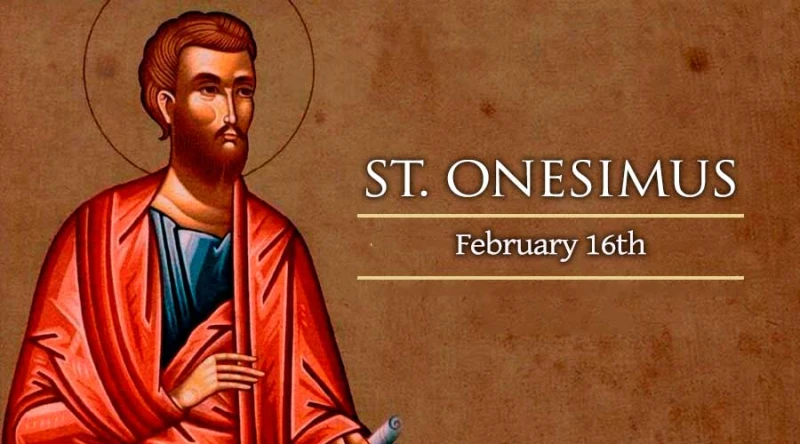
St. Onesimus was a slave to Philemon, an influential man who had been converted by St. Paul. Onesimus offended Philemon and fled in order to escape any sort of retribution. He then met St. Paul while Paul was in a Roman prison. Shortly after, Onesimus was baptized.

Paul then sent a letter to Philemon asking for Onesimus’ freedom, so Onesimus could become one of his own assistants. This letter is the Epistle to Philemon and entreats Philemon to accept Onesimus “no longer as a slave, but more than a slave, a brother, beloved especially to me.”

Philemon pardoned Onesimus and he returned to faithfully serve St. Paul. We know that St. Paul made him, with Tychicus, the bearer of his Epistle to the Colossians. (Col. 4:7-9)

Later, as St. Jerome and other fathers testify, he became an ardent preacher of the Gospel and succeeded St. Timothy as bishop of Ephesus.

He was cruelly tortured in Rome, for 18 days, by a governor who was infuriated by his preaching on the merit of celibacy. Onesimus’ legs and thighs were broken with bludgeons before he was stoned to death.

His martyrdom occurred under Domitian in the year 90.


St. Onesimus Read More »

Tuesday of the Sixth Week in Ordinary Time

Reading I Jas 1:12-18

Blessed is he who perseveres in temptation,
for when he has been proven he will receive the crown of life 
that he promised to those who love him.
No one experiencing temptation should say,
“I am being tempted by God”;
for God is not subject to temptation to evil,
and he himself tempts no one.
Rather, each person is tempted when lured and enticed by his desire.
Then desire conceives and brings forth sin,
and when sin reaches maturity it gives birth to death.

Do not be deceived, my beloved brothers and sisters:
all good giving and every perfect gift is from above,
coming down from the Father of lights,
with whom there is no alteration or shadow caused by change.
He willed to give us birth by the word of truth
that we may be a kind of firstfruits of his creatures.

Responsorial Psalm 94:12-13a, 14-15, 18-19

R.        (12a) Blessed the man you instruct, O Lord.
Blessed the man whom you instruct, O LORD,
            whom by your law you teach,
Giving him rest from evil days. 
R.        Blessed the man you instruct, O Lord.
For the LORD will not cast off his people,
            nor abandon his inheritance;
But judgment shall again be with justice,
            and all the upright of heart shall follow it. 
R.        Blessed the man you instruct, O Lord.
When I say, “My foot is slipping,
            your mercy, O LORD, sustains me;
When cares abound within me,
            your comfort gladdens my soul. 
R.        Blessed the man you instruct, O Lord.
 

Alleluia Jn 14:23

R. Alleluia, alleluia.
Whoever loves me will keep my word, says the Lord;
and my Father will love him
and we will come to him.
R. Alleluia, alleluia.

Gospel Mk 8:14-21

The disciples had forgotten to bring bread,
and they had only one loaf with them in the boat.
Jesus enjoined them, “Watch out,
guard against the leaven of the Pharisees
and the leaven of Herod.” 
They concluded among themselves that
it was because they had no bread.
When he became aware of this he said to them,
“Why do you conclude that it is because you have no bread?
Do you not yet understand or comprehend?
Are your hearts hardened?
Do you have eyes and not see, ears and not hear?
And do you not remember,
when I broke the five loaves for the five thousand,
how many wicker baskets full of fragments you picked up?”
They answered him, “Twelve.”
“When I broke the seven loaves for the four thousand,
how many full baskets of fragments did you pick up?”
They answered him, “Seven.”
He said to them, “Do you still not understand?”
 

– – –

Lectionary for Mass for Use in the Dioceses of the United States, second typical edition, Copyright © 2001, 1998, 1997, 1986, 1970 Confraternity of Christian Doctrine; Psalm refrain © 1968, 1981, 1997, International Committee on English in the Liturgy, Inc. All rights reserved. Neither this work nor any part of it may be reproduced, distributed, performed or displayed in any medium, including electronic or digital, without permission in writing from the copyright owner.

Tuesday of the Sixth Week in Ordinary Time Read More »

St. Claude de la Colombière


St. Claude de la Colombière

Feast date: Feb 15

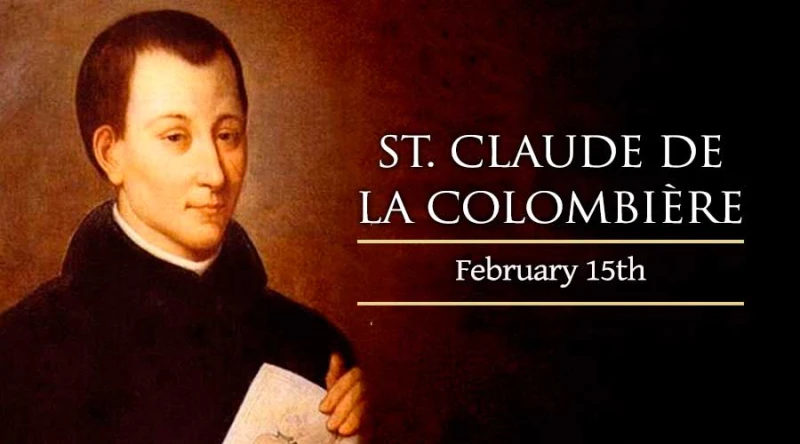
On Feb. 15 the Catholic Church honors Saint Claude de la Colombiere, the 17th century French Jesuit who authenticated and wrote about Saint Margaret Mary Alacoque’s visions of the Sacred Heart of Jesus.

When he canonized St. Claude in 1992, Blessed John Paul II upheld him as a model Jesuit, recalling how the saint “gave himself completely to the Sacred Heart, ‘ever burning with love.’ Even in trials he practiced forgetfulness of self in order to attain purity of love and to raise the world to God.”

Born in the south of France during 1641, Claude de la Colombiere belonged to a family of seven children, four of whom entered the priesthood or religious life. He attended a Jesuit school in his youth, and entered the order himself at age 17.

As a young Jesuit recruit, Claude admitted to having a “horrible aversion” to the rigorous training required by the order in his day. But the novitiate of the Society of Jesus focused and sharpened his natural talents, and he would later take a private vow to obey the order’s rules as perfectly as possible.

After completing his order’s traditional periods of study and teaching, Claude became a priest in 1669. Known as a gifted preacher, he also taught at the college level and served as a tutor to the children of King Louis XIV’s minister of finance.

In 1674, the priest became the superior of a Jesuit house in the town of Paray-le-Monial. It was during this time, in his role as confessor to a convent of Visitationist nuns, that Claude de la Colombiere became involved in events that would change his own life and the history of the Western Church.

One of the nuns, later canonized as St. Margaret Mary Alacoque, claimed to have experienced private revelations from Christ urging devotion to his heart as the symbol and seat of God’s love for mankind. Within the convent, however, these reports met with dismissal and contempt.

During his time in Paray-le-Monial, Father la Colombiere became the nun’s spiritual director, giving careful consideration to her testimony about the purported revelations. He concluded that Sister Margaret Mary had indeed encountered Jesus in an extraordinary way.

Claude la Colombiere’s writings and his testimony to the reality of St. Margaret Mary’s experiences helped to establish the Sacred Heart as a feature of Western Catholic devotion. This, in turn, helped to combat the heresy of Jansenism, which claimed that God did not desire the salvation of some people.

In the fall of 1676, Father la Colombiere, was called away from Paray-le-Monial to England. During a time of tension in the religiously torn country, he ministered as chaplain and preacher to Mary of Modena, a Catholic who had become the Duchess of York.

In 1678, a false rumor spread about an alleged Catholic “plot” against the English monarchy. The lie led to the execution of 35 innocent people, including eight Jesuits. La Colombiere was not put to death, but was accused, arrested, and locked in a dungeon for several weeks.

The French Jesuit held up heroically during the ordeal, but conditions in the prison ruined his health before his expulsion from England. He went back to France in 1679 and resumed his work as a teacher and priest, encouraging love for Christ’s Sacred Heart among the faithful.

In 1681, Claude de la Colombiere returned to Paray-le-Monial, the site of St. Margaret Mary Alacoque’s revelations. It was there, during 1682, that the 41-year-old priest died from internal bleeding on the year’s first Sunday of Lent, Feb. 15.

St. Claude de la Colombiere was beatified in 1929 – nine years after the canonization of St. Margaret Mary Alacoque – and canonized 63 years later.

St. Claude de la Colombière Read More »

Memorial of Saints Cyril, Monk, and Methodius, Bishop

Reading I Jas 1:1-11

James, a servant of God and of the Lord Jesus Christ,
to the twelve tribes in the dispersion, greetings.

Consider it all joy, my brothers and sisters,
when you encounter various trials,
for you know that the testing of your faith produces perseverance.
And let perseverance be perfect,
so that you may be perfect and complete, lacking in nothing.
But if any of you lacks wisdom,
he should ask God who gives to all generously and ungrudgingly,
and he will be given it.
But he should ask in faith, not doubting,
for the one who doubts is like a wave of the sea
that is driven and tossed about by the wind.
For that person must not suppose that he will receive anything from the Lord,
since he is a man of two minds, unstable in all his ways.

The brother in lowly circumstances  
should take pride in high standing,
and the rich one in his lowliness,  
for he will pass away “like the flower of the field.”
For the sun comes up with its scorching heat and dries up the grass,
its flower droops, and the beauty of its appearance vanishes.
So will the rich person fade away in the midst of his pursuits.

Responsorial Psalm 119:67, 68, 71, 72, 75, 76

R.        (77a)  Be kind to me, Lord, and I shall live.
Before I was afflicted I went astray,
            but now I hold to your promise. 
R.        Be kind to me, Lord, and I shall live.
You are good and bountiful;
            teach me your statutes. 
R.        Be kind to me, Lord, and I shall live.
It is good for me that I have been afflicted,
            that I may learn your statutes. 
R.        Be kind to me, Lord, and I shall live.
The law of your mouth is to me more precious
            than thousands of gold and silver pieces. 
R.        Be kind to me, Lord, and I shall live.
I know, O LORD, that your ordinances are just,
            and in your faithfulness you have afflicted me. 
R.        Be kind to me, Lord, and I shall live.
Let your kindness comfort me
            according to your promise to your servants. 
R.        Be kind to me, Lord, and I shall live.

Alleluia Jn 14:6

R. Alleluia, alleluia.
I am the way and the truth and the life, says the Lord;
no one comes to the Father except through me.
R. Alleluia, alleluia.

Gospel Mk 8:11-13

The Pharisees came forward and began to argue with Jesus,
seeking from him a sign from heaven to test him.
He sighed from the depth of his spirit and said,
“Why does this generation seek a sign?
Amen, I say to you, no sign will be given to this generation.”
Then he left them, got into the boat again,
and went off to the other shore.

– – –

Lectionary for Mass for Use in the Dioceses of the United States, second typical edition, Copyright © 2001, 1998, 1997, 1986, 1970 Confraternity of Christian Doctrine; Psalm refrain © 1968, 1981, 1997, International Committee on English in the Liturgy, Inc. All rights reserved. Neither this work nor any part of it may be reproduced, distributed, performed or displayed in any medium, including electronic or digital, without permission in writing from the copyright owner.

Memorial of Saints Cyril, Monk, and Methodius, Bishop Read More »

St. Valentine


St. Valentine

Feast date: Feb 14

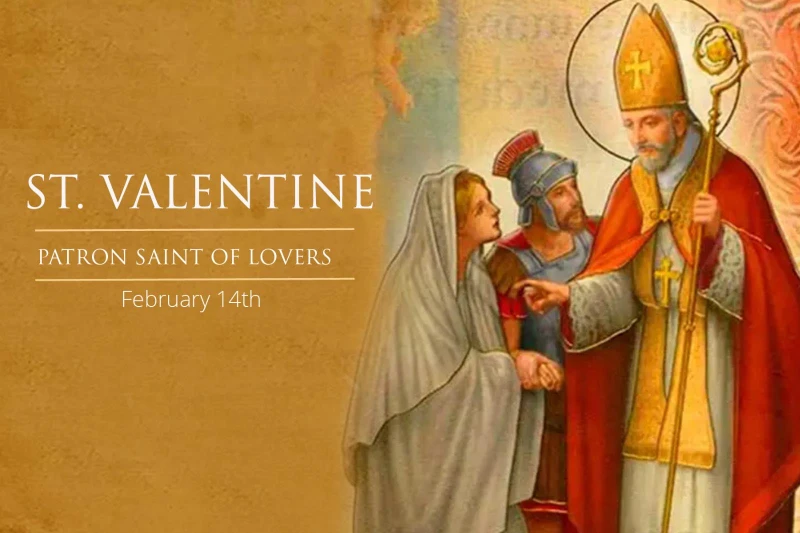
The love of God reigns in the hearts of all saints, but there is one who has the joy of being the patron saint of lovers: St. Valentine.

According to a tradition, St. Valentine risked his life to marry couples in a Christian way during the time of persecution. He finally gave his life in martyrdom, which is the ultimate manifestation of love. The love of this holy priest for Jesus Christ and for defending the Sacrament of Matrimony inspires us to raise human love to the heights of the divine love for which we were created. Christians should take advantage of this feast to recover the Christian meaning of love and marriage in the light of Christ.

St. Valentine Read More »