Please mind our dust!

We are currently working on revamping our website!
Thank you for your patience!

CRD Solutions

Sts. Cyril and Methodius
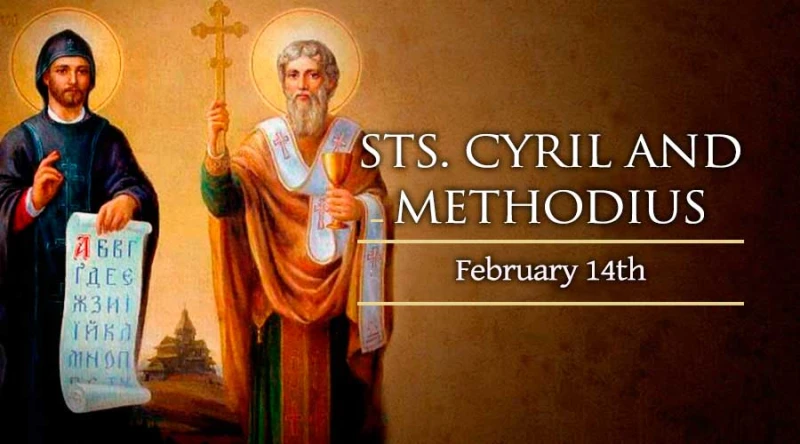

Sts. Cyril and Methodius

Feast date: Feb 14

On Feb. 14, the universal Church honors two brothers, Sts. Cyril and Methodius, who are called the “Apostles of the Slavs” for their tireless work in spreading the Gospel throughout Eastern Europe in the ninth century.

Such was their influence in Church history, through their evangelization efforts, that the late Pope John Paul II named the two brothers the patron saints of Europe along with fifth century monastic leader St. Benedict.

Born into a prestigious senatorial family in Thessalonica, in 815 and 826 respectively, Sts. Cyril and Methodius renounced their wealth and status. They chose instead to become priests.

Both were living in a monastery on the Bosporus – now known as the Istanbul strait which separates Europe and Asia – when the authorities from the Khazar Empire sent to Constantinople for a Christian missionary. Cyril was chosen and was accompanied by his brother. Both learned the Khazar language and converted many of the people.

Soon after the Khazar mission, there was a request from officials in Moravia – a region in the present-day Czech Republic –  for missionaries who could preach and celebrate liturgical services in the local dialect. Although German missionaries had already labored among the people for some time, they had little success.

In order to fulfill this mission, Cyril and Methodius took the step of adapting the Greek alphabet into a script for the Slavonic language. The result was the “Cyrillic” alphabet, which was first used to translate the Bible and liturgical books. It also became the primary means of written communication for large portions of the world, including modern day Russia.

The two labored in Moravia for four years until 868, achieving greater success than the German missionaries. Their Byzantine origins and use of the vernacular language caused some German church officials to regard them with suspicion. However, after being summoned to Rome they met with Pope Adrian II who warmly approved of their methods.

Cyril and Methodius were commended by the pope for their missionary activity and ordained bishops. Yet Cyril would not return to Moravia, and died in Rome in 869.

In order to further Methodius’ work in Moravia, Pope Adrian II appointed him archbishop of a new archdiocese in the territory, independent from the German church. Unfortunately this had the effect of angering his German critics, who had him deposed and imprisoned for a period of three years.

Pope Adrian’s successor, John VIII, managed to have Methodius freed and had him reinstated as archbishop, after which he expanded his work to incorporate the region of modern day Poland. The new Pope continued to support Methodius’ use of the Slavic languages in worship and his translations of the Bible, despite continuing controversy with some elements of the German church.

Eventually, with the assistance of several Greek priests, he translated the whole Bible into the language that is known today as Church Slavonic. He chose his successor from among the native Moravian Slavs whom he had evangelized, and died on April 6 in 885.

Sts. Cyril and Methodius’ missionary work among the Slavs laid the essential foundation for the later Christianization of Ukraine and Russia in 988, when the Russian Prince Vladimir accepted Baptism.

Sts. Cyril and Methodius Read More »
Sixth Sunday in Ordinary Time

Reading I Jer 17:5-8

Thus says the LORD:
            Cursed is the one who trusts in human beings,
                        who seeks his strength in flesh,
                        whose heart turns away from the LORD.
            He is like a barren bush in the desert
                        that enjoys no change of season,
            but stands in a lava waste,
                        a salt and empty earth.
            Blessed is the one who trusts in the LORD,
                        whose hope is the LORD.
            He is like a tree planted beside the waters
                        that stretches out its roots to the stream:
            it fears not the heat when it comes;
                        its leaves stay green;
            in the year of drought it shows no distress,
                        but still bears fruit.

Responsorial Psalm Ps 1:1-2, 3, 4 and 6

R (40:5a) Blessed are they who hope in the Lord.
Blessed the man who follows not
            the counsel of the wicked,
nor walks in the way of sinners,
            nor sits in the company of the insolent,
but delights in the law of the LORD
            and meditates on his law day and night.
Blessed are they who hope in the Lord.
He is like a tree
            planted near running water,
that yields its fruit in due season,
            and whose leaves never fade.
Whatever he does, prospers.
Blessed are they who hope in the Lord.
Not so the wicked, not so;
            they are like chaff which the wind drives away.
For the LORD watches over the way of the just,
            but the way of the wicked vanishes.
Blessed are they who hope in the Lord.

Reading II 1 Cor 15:12, 16-20

Brothers and sisters:
If Christ is preached as raised from the dead,
how can some among you say there is no resurrection of the dead?
If the dead are not raised, neither has Christ been raised,
and if Christ has not been raised, your faith is vain;
you are still in your sins.
Then those who have fallen asleep in Christ have perished.
If for this life only we have hoped in Christ,
we are the most pitiable people of all.

But now Christ has been raised from the dead,
the firstfruits of those who have fallen asleep.

Alleluia Lk 6:23ab

R. Alleluia, alleluia.
Rejoice and be glad;
your reward will be great in heaven.
R. Alleluia, alleluia.

Gospel Lk 6:17, 20-26

Jesus came down with the Twelve
and stood on a stretch of level ground
with a great crowd of his disciples
and a large number of the people
from all Judea and Jerusalem
and the coastal region of Tyre and Sidon.
And raising his eyes toward his disciples he said:
            “Blessed are you who are poor,
                        for the kingdom of God is yours.
            Blessed are you who are now hungry,
                        for you will be satisfied.
            Blessed are you who are now weeping,
                        for you will laugh.
            Blessed are you when people hate you,
                        and when they exclude and insult you,
                        and denounce your name as evil
                        on account of the Son of Man.
Rejoice and leap for joy on that day!
Behold, your reward will be great in heaven.
For their ancestors treated the prophets in the same way.
            But woe to you who are rich,
                        for you have received your consolation.
            Woe to you who are filled now,
                        for you will be hungry.
            Woe to you who laugh now,
                        for you will grieve and weep.
            Woe to you when all speak well of you,
                        for their ancestors treated the false prophets in this way.”
 

– – –

Lectionary for Mass for Use in the Dioceses of the United States, second typical edition, Copyright © 2001, 1998, 1997, 1986, 1970 Confraternity of Christian Doctrine; Psalm refrain © 1968, 1981, 1997, International Committee on English in the Liturgy, Inc. All rights reserved. Neither this work nor any part of it may be reproduced, distributed, performed or displayed in any medium, including electronic or digital, without permission in writing from the copyright owner.

Sixth Sunday in Ordinary Time Read More »

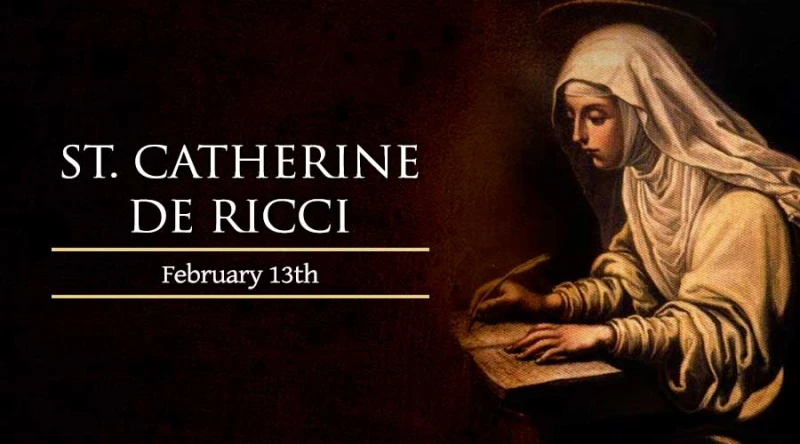
St. Catherine de Ricci


St. Catherine de Ricci

Feast date: Feb 13

The Ricci are an ancient family in Tuscany. Catherine was born at Florence in 1522, and called at her baptism Alexandrina, but she took the name of Catherine at her religious profession. Having lost her mother in her infancy, her father placed her in the Convent of Monticelli, near the gates of Florence, where her aunt, Louisa de Ricci, was a nun when she was between the age of six and seven. To her, this place was a paradise, but after some years her father took her home. Attracted to the religious life, and with the consent of her father,  she received the religious veil in the convent of Dominicanesses at Prat, in Tuscany in the year 1535 at fourteen years of age.

For two years she suffered inexpressible pains under a complication of violent distempers, which remedies only seemed to increase. These sufferings she sanctified by the interior disposition with which she bore them, and which she nourished by assiduous meditation on the passion of Christ. The victory over herself, and purgation of her affections was completed by a perfect spirit of prayer; for by the union of her soul with God, and the establishment of the absolute reign of his love in her heart, she was dead to and disengaged from all earthly things.

The saint was chosen, when very young, first as mistress of the novices, then sub-prioress, and, in the twenty-fifth year of her age, was appointed as perpetual prioress. The reputation of her extraordinary sanctity and prudence drew her many visits from a great number of bishops, princes, and cardinals-among them, the Cardinals Cervini, Alexander of Medicis, and Aldobrandini, who all three were afterwards raised to St. Peter’s chair, under the names of Marcellus II, Clement VIII, and Leo XI.

Most wonderful were the raptures of St. Catherine in meditating on the passion of Christ, which was her daily exercise, but to which she totally devoted herself every week from Thursday noon to three o’clock in the afternoon on Friday.

One of the miracles that was documented for her canonization was her appearance many hundreds of miles away from where she was physically located. This involved appearing in a vision St Philip Neri, a resident of Rome, with whom she had maintained a long-term correspondence. Neri, who was otherwise very reluctant to discuss miraculous events, confirmed the event.

After a long illness she passed from this mortal life to everlasting bliss and possession of the object of all her desires on the feast of the Purification of our Lady, on the 2nd of February, in 1589, the sixty-seventh year of her age. The ceremony of her beatification was performed by Clement XII in 1732, and that of her canonization by Benedict XIV in 1746.

St. Catherine de Ricci Read More »

Saturday of the Fifth Week in Ordinary Time

Reading I 1 Kgs 12:26-32; 13:33-34

Jeroboam thought to himself:
“The kingdom will return to David’s house.
If now this people go up to offer sacrifices
in the temple of the LORD in Jerusalem,
the hearts of this people will return to their master,
Rehoboam, king of Judah,
and they will kill me.”
After taking counsel, the king made two calves of gold
and said to the people:
“You have been going up to Jerusalem long enough.
Here is your God, O Israel, who brought you up from the land of Egypt.”
And he put one in Bethel, the other in Dan.
This led to sin, because the people frequented those calves
in Bethel and in Dan.
He also built temples on the high places
and made priests from among the people who were not Levites.
Jeroboam established a feast in the eighth month
on the fifteenth day of the month
to duplicate in Bethel the pilgrimage feast of Judah,
with sacrifices to the calves he had made;
and he stationed in Bethel priests of the high places he had built.

Jeroboam did not give up his evil ways after this,
but again made priests for the high places
from among the common people.
Whoever desired it was consecrated
and became a priest of the high places.
This was a sin on the part of the house of Jeroboam
for which it was to be cut off and destroyed from the earth.

Responsorial Psalm 106:6-7ab, 19-20, 21-22

R.        (4a) Remember us, O Lord, as you favor your people.
We have sinned, we and our fathers;
            we have committed crimes; we have done wrong.
Our fathers in Egypt
            considered not your wonders. 
R.        Remember us, O Lord, as you favor your people.
They made a calf in Horeb
            and adored a molten image;
They exchanged their glory
            for the image of a grass-eating bullock. 
R.        Remember us, O Lord, as you favor your people.
They forgot the God who had saved them,
            who had done great deeds in Egypt,
Wondrous deeds in the land of Ham,
            terrible things at the Red Sea.
R.        Remember us, O Lord, as you favor your people.

Alleluia Mt 4:4b

R. Alleluia, alleluia.
One does not live on bread alone,
but on every word that comes forth from the mouth of God.
R. Alleluia, alleluia.

Gospel Mk 8:1-10

In those days when there again was a great crowd without anything to eat,
Jesus summoned the disciples and said,
“My heart is moved with pity for the crowd,
because they have been with me now for three days
and have nothing to eat.
If I send them away hungry to their homes,
they will collapse on the way,
and some of them have come a great distance.”
His disciples answered him, “Where can anyone get enough bread
to satisfy them here in this deserted place?”
Still he asked them, “How many loaves do you have?”
They replied, “Seven.”
He ordered the crowd to sit down on the ground.
Then, taking the seven loaves he gave thanks, broke them,
and gave them to his disciples to distribute,
and they distributed them to the crowd.
They also had a few fish.
He said the blessing over them
and ordered them distributed also.
They ate and were satisfied.
They picked up the fragments left over–seven baskets.
There were about four thousand people.

He dismissed the crowd and got into the boat with his disciples
and came to the region of Dalmanutha.

– – –

Lectionary for Mass for Use in the Dioceses of the United States, second typical edition, Copyright © 2001, 1998, 1997, 1986, 1970 Confraternity of Christian Doctrine; Psalm refrain © 1968, 1981, 1997, International Committee on English in the Liturgy, Inc. All rights reserved. Neither this work nor any part of it may be reproduced, distributed, performed or displayed in any medium, including electronic or digital, without permission in writing from the copyright owner.

Saturday of the Fifth Week in Ordinary Time Read More »

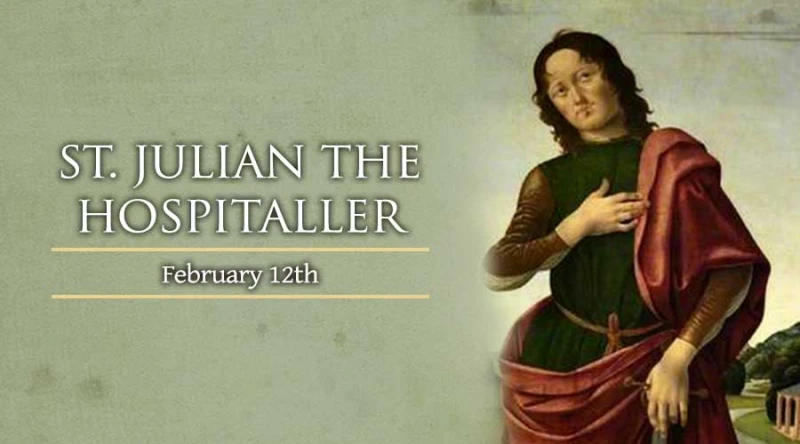
St. Julian the Hospitaller


St. Julian the Hospitaller

Feast date: Feb 12

St. Julian the Hospitaller, or “the Poor Man,” came from a wealthy, noble family in the early 4th century and is a popular saint in Western Europe.

According to a legend, while Julian was a baby, he was cursed to one-day kill his own parents. His father wanted him killed, but his mother kept him alive. When he was old enough to learn of the curse, he left his family to preserve their safety.

While he was hunting, his mother and father made an unexpected visit to his castle. His wife gave them one of the best rooms. He received a vision from the devil that his wife was in his bed with another man, and he returned home to kill whoever was in his bed. When Julian returned from his hunt and saw the two figures in bed, he assumed it was his wife with a lover. In a jealous rage, Julian killed his mother and father.

Julian was so horrified upon learning the truth that he swore to devote the remainder of his life to good works. He and his wife then undertook a pilgrimage to a distant country where he established a hospital.

The hospital was near a river that was frequently crossed by people prompted to travel by the Holy Crusades. People frequently drowned crossing this river so Julian took responsibility of ferrying travelers across and tending to the sick.

One night, the devil vandalized his house, and blaming it on those he helped, Julian said that he would never house anyone else ever again. God showed up at his door, asking for help, and he denied Him. After recognizing him, he retracted his statement and decided to help all those who needed it once again.

/p>

One night, thieves came into their hospital and killed Julian and his wife in the same way Julian had killed his mother and father.

“There were great miracles without end in that place and land,” recounts the legend. “So many that, as it pleased God, their bodies were brought to Brioude (France).”

St. Julian is considered the patron of ferrymen, innkeepers and circus performers.

St. Julian the Hospitaller Read More »