Please mind our dust!

We are currently working on revamping our website!
Thank you for your patience!

CRD Solutions

Friday of the Fifth Week in Ordinary Time

Reading I 1 Kgs 11:29-32; 12:19

Jeroboam left Jerusalem,
and the prophet Ahijah the Shilonite met him on the road.
The two were alone in the area,
and the prophet was wearing a new cloak.
Ahijah took off his new cloak,
tore it into twelve pieces, and said to Jeroboam:

“Take ten pieces for yourself;
            the LORD, the God of Israel, says:
            ‘I will tear away the kingdom from Solomon’s grasp
            and will give you ten of the tribes.
One tribe shall remain to him for the sake of David my servant,
            and of Jerusalem,
            the city I have chosen out of all the tribes of Israel.’”

Israel went into rebellion against David’s house to this day.

Responsorial Psalm 81:10-11ab, 12-13, 14-15

R.        (11a and 9a)  I am the Lord, your God: hear my voice.
“There shall be no strange god among you
            nor shall you worship any alien god.
I, the LORD, am your God
            who led you forth from the land of Egypt.”
R.        I am the Lord, your God: hear my voice.
“My people heard not my voice,
            and Israel obeyed me not;
So I gave them up to the hardness of their hearts;
            they walked according to their own counsels.”
R.        I am the Lord, your God: hear my voice.
“If only my people would hear me,
            and Israel walk in my ways,
Quickly would I humble their enemies;
            against their foes I would turn my hand.”
R.        I am the Lord, your God: hear my voice.

Alleluia See Acts 16:14b

R. Alleluia, alleluia.
Open our hearts, O Lord,
to listen to the words of your Son.
R. Alleluia, alleluia.

Gospel Mk 7:31-37

Jesus left the district of Tyre
and went by way of Sidon to the Sea of Galilee,
into the district of the Decapolis. 
And people brought to him a deaf man who had a speech impediment
and begged him to lay his hand on him.
He took him off by himself away from the crowd. 
He put his finger into the man’s ears
and, spitting, touched his tongue;
then he looked up to heaven and groaned, and said to him,
Ephphatha!” (that is, “Be opened!”)
And immediately the man’s ears were opened,
his speech impediment was removed,
and he spoke plainly. 
He ordered them not to tell anyone. 
But the more he ordered them not to,
the more they proclaimed it. 
They were exceedingly astonished and they said,
“He has done all things well. 
He makes the deaf hear and the mute speak.”

– – –

Lectionary for Mass for Use in the Dioceses of the United States, second typical edition, Copyright © 2001, 1998, 1997, 1986, 1970 Confraternity of Christian Doctrine; Psalm refrain © 1968, 1981, 1997, International Committee on English in the Liturgy, Inc. All rights reserved. Neither this work nor any part of it may be reproduced, distributed, performed or displayed in any medium, including electronic or digital, without permission in writing from the copyright owner.

Friday of the Fifth Week in Ordinary Time Read More »
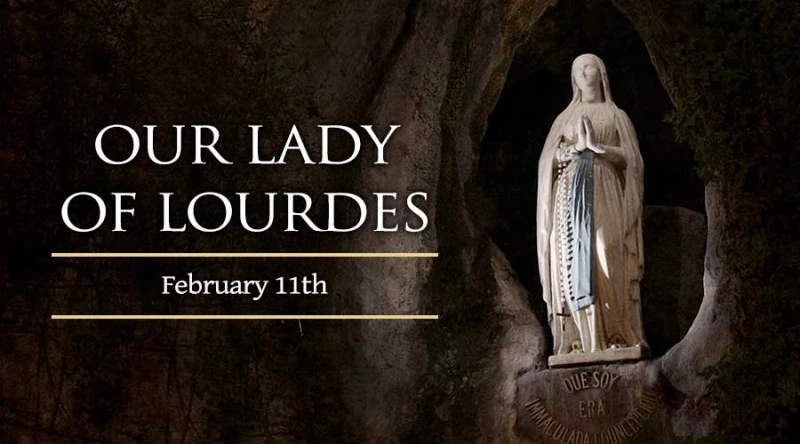
Our Lady of Lourdes


Our Lady of Lourdes

Feast date: Feb 11

On Feb. 11, the Catholic Church celebrates the liturgical memorial of Our Lady of Lourdes, recalling a series of 18 appearances that the Blessed Virgin Mary made to a 14-year-old French peasant girl, Saint Bernadette Soubirous.

The Marian apparitions began Feb. 11, 1858, ended July 16 that year and received the local bishop’s approval after a four-year inquiry.

Coming soon after the 1854 dogmatic definition of her Immaculate Conception, the Virgin Mary’s appearances at Lourdes turned the town into a popular travel destination. Thousands of people say their medical conditions have been cured through pilgrimage, prayer and the water flowing from a spring to which Bernadette was directed by the Blessed Virgin. Experts have verified 69 cases of miraculous healing at Lourdes since 1862.

St. Bernadette also has her own liturgical memorial, which occurs Feb. 18 in France and Canada and April 16 elsewhere. Born in January 1844, the future visionary was the first child of her parents Francois and Louise, who both worked in a mill run by Francois. Their family life was loving but difficult. Many of Bernadette’s siblings died in childhood, and she developed asthma. Economic hardship and an injury suffered by her father cost them the mill in 1854.

Years of poverty followed, during which Bernadette often had to live apart from her parents and work rather than attending school. In January 1858 she returned to her family, whose members were living in a cramped single room. Strongly committed to her faith, Bernadette made an effort to learn the Church’s teachings despite her lack of formal education.

On Feb. 11, 1858, Bernadette went to gather firewood with her sister and a friend. As she approached a grotto near a river, she saw a light coming from a spot near a rosebush. The light surrounded a woman who wore a white dress and held a rosary. Seeing the lady in white make the sign of the Cross, Bernadette knelt, took out her own rosary, and began to pray. When she finished praying, the woman motioned for her to approach. But she remained still, and the vision disappeared.

Her companions had seen nothing. Bernadette described the lady in white to them, demanding they tell no one. But the secret came out later that day. The next Sunday, Bernadette returned to the grotto, where she saw the woman again. The identity of the apparition, however, would remain unknown for several weeks.

Some adults accompanied Bernadette on her third trip, on Feb. 18, though they did not see the vision she received. The woman in white asked the girl to return for two weeks. “She told me also,” Bernadette later wrote, “that she did not promise to make me happy in this world, but in the next.” A group of family members and others went with her to the cave the next day, but only the young peasant girl saw the woman and heard her words.

Over the next few days, the number of people in attendance at the cave swelled to more than 100. A parish priest, Father Peyramale, became concerned – as did the police. On Feb. 24, 250 people saw Bernadette break into tears, but only she heard the woman’s message: “Penance! Penance! Penance! Pray to God for sinners. Go, kiss the ground for the conversion of sinners.”

A larger crowd was there on Feb. 25 – but they were shocked to see Bernadette drinking from a muddy stream and eating weeds. The apparition had told her to drink the water, and the weed-eating was a penitential act. Onlookers, meanwhile, saw only the girl’s unusual behavior, and popular fascination turned to ridicule and suspicion.

On Feb. 27, Bernadette made a joyful discovery: the spring from which she drank was not muddy now, but clear. As the crowds continued to gather, this change was noticed, and a woman with a paralyzed arm came to the water hoping to be healed. Four years later, her case would be recognized as the first miraculous healing at Lourdes. Public interest continued, and Bernadette heard a recurring message from the vision: “Go, tell the priests to bring people here in procession and have a chapel built here.”

While others were quick to conclude that Bernadette was seeing the Virgin Mary, the visionary herself did not claim to know the woman’s identity. As she conveyed the repeated message to Fr. Peyramale, the priest grew frustrated and told Bernadette to ask the woman her name. But when she did so, the woman smiled and remained silent. Her identity remained a mystery after the initial two-week period.

Three weeks later, on the Feast of the Annunciation, Bernadette visited the cave again. When she saw the lady, she kept asking to know her identity. Finally, the woman folded her hands, looked up and said: “I am the Immaculate Conception.” The seer, devout but uneducated, did not know what these words meant. She related them to Fr. Peyramale, who was stunned and informed his bishop.

Bernadette saw the Blessed Virgin Mary two more times in 1858: on the Wednesday after Easter, and on the feast of Our Lady of Mount Carmel. In 1862, the local bishop declared the apparitions worthy of belief.

St. Bernadette left Lourdes in 1866 to join a religious order in central France, where she died after several years of illness in 1879. By the time of her death, a basilica had been built and consecrated at the apparition site, under the leadership of Fr. Peyramale.

Our Lady of Lourdes Read More »

Memorial of Saint Scholastica, Virgin

Reading I 1 Kgs 11:4-13

When Solomon was old his wives had turned his heart to strange gods,
and his heart was not entirely with the LORD, his God,
as the heart of his father David had been.
By adoring Astarte, the goddess of the Sidonians,
and Milcom, the idol of the Ammonites,
Solomon did evil in the sight of the LORD;
he did not follow him unreservedly as his father David had done.
Solomon then built a high place to Chemosh, the idol of Moab,
and to Molech, the idol of the Ammonites,
on the hill opposite Jerusalem.
He did the same for all his foreign wives
who burned incense and sacrificed to their gods.
The LORD, therefore, became angry with Solomon,
because his heart was turned away from the LORD, the God of Israel,
who had appeared to him twice
(for though the LORD had forbidden him 
this very act of following strange gods,
Solomon had not obeyed him).

So the LORD said to Solomon: “Since this is what you want,
and you have not kept my covenant and my statutes
which I enjoined on you,
I will deprive you of the kingdom and give it to your servant.
I will not do this during your lifetime, however,
for the sake of your father David;
it is your son whom I will deprive.
Nor will I take away the whole kingdom.
I will leave your son one tribe for the sake of my servant David
and of Jerusalem, which I have chosen.”

Responsorial Psalm 106:3-4, 35-36, 37 and 40

R.        (4a) Remember us, O Lord, as you favor your people.
Blessed are they who observe what is right,
            who do always what is just.
Remember us, O LORD, as you favor your people;
            visit us with your saving help. 
R.        Remember us, O Lord, as you favor your people.
But they mingled with the nations
            and learned their works.
They served their idols,
            which became a snare for them. 
R.        Remember us, O Lord, as you favor your people.
They sacrificed their sons
            and their daughters to demons.
And the LORD grew angry with his people,
            and abhorred his inheritance. 
R.        Remember us, O Lord, as you favor your people.

Alleluia Jas 1:21bc

R. Alleluia, alleluia.
Humbly welcome the word that has been planted in you
and is able to save your souls.
R. Alleluia, alleluia.

Gospel Mk 7:24-30

Jesus went to the district of Tyre.
He entered a house and wanted no one to know about it,
but he could not escape notice.
Soon a woman whose daughter had an unclean spirit heard about him.
She came and fell at his feet.
The woman was a Greek, a Syrophoenician by birth,
and she begged him to drive the demon out of her daughter.
He said to her, “Let the children be fed first.
For it is not right to take the food of the children
and throw it to the dogs.”
She replied and said to him,
“Lord, even the dogs under the table eat the children’s scraps.”
Then he said to her, “For saying this, you may go.
The demon has gone out of your daughter.”
When the woman went home, she found the child lying in bed
and the demon gone.

– – –

Lectionary for Mass for Use in the Dioceses of the United States, second typical edition, Copyright © 2001, 1998, 1997, 1986, 1970 Confraternity of Christian Doctrine; Psalm refrain © 1968, 1981, 1997, International Committee on English in the Liturgy, Inc. All rights reserved. Neither this work nor any part of it may be reproduced, distributed, performed or displayed in any medium, including electronic or digital, without permission in writing from the copyright owner.

Memorial of Saint Scholastica, Virgin Read More »

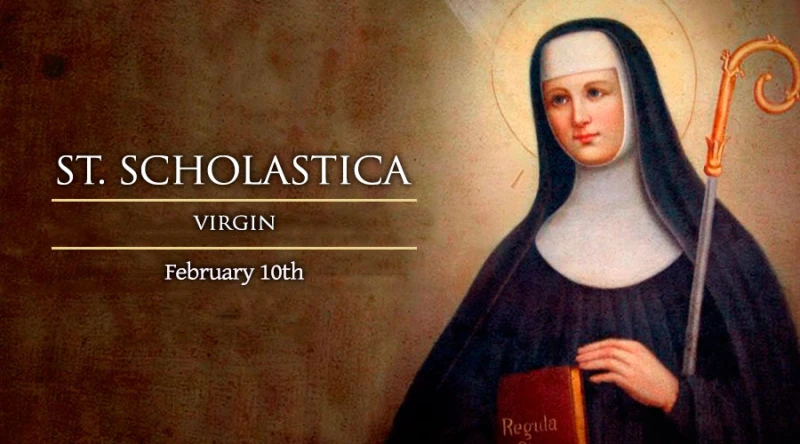
St. Scholastica


St. Scholastica

Feast date: Feb 10

On Feb. 10, the Catholic Church remembers St. Scholastica, a nun who was the twin sister of St. Benedict, the “father of monasticism” in Western Europe.

The siblings were born around 480 to a Roman noble family in Nursia, Italy. Scholastica seems to have devoted herself to God from her earliest youth, as the account of Benedict’s life by Pope Gregory the Great mentions that his sister was “dedicated from her infancy to Our Lord.”

The twins’ mother died at their birth. When Benedict was old enough he left home to study in Rome leaving Scholastica with her father to tend the Nursian estate. In time, Benedict left his studies to live first as a hermit, and then as the head of a community of monks in Italy.

When Scholastica learned of her brother’s total dedication to the Lord, she was determined to follow his example. It is not certain that she became a nun immediately, but it is generally supposed that she lived for some time in a community of pious virgins.  Some biographers believe she eventually founded a monastery of nuns there.

The brother and sister communities were about five miles apart. St. Benedict seems to have directed his sister and her nuns, most likely in the practice of the same rule by which his own monks lived.

Unlike her brother, St. Scholastica was never the subject of a formal biography. As such, little is known of her life apart from her commitment to religious life which paralleled that of her brother. Pope Gregory wrote that Scholastica used to come once a year to visit Benedict, at a house situated halfway between the two communities.

St. Benedict’s biographer recounted a story which is frequently told about the last such visit between the siblings. They passed the time as usual in prayer and pious conversation — after which Scholastica begged her brother to remain for the night, but he refused.

She then joined her hands together, laid them on the table and bowed her head upon them in supplication to God. When she lifted her head from the table, immediately there arose such a storm that neither Benedict nor his fellow monks could leave.

“Seeing that he could not return to his abbey because of such thunder and lightning and great abundance of rain,” Pope Gregory wrote, “the man of God became sad and began to complain to his sister, saying, ‘God forgive you, what have you done?'”

“‘I wanted you to stay, and you wouldn’t listen,’ she answered. ‘I have asked our good Lord, and He graciously granted my request, so if you can still depart, in God’s name return to your monastery, and leave me here alone.'” St. Benedict had no choice but to stay and speak to his sister all night long about spiritual matters — including the kingdom of heaven for which she would soon depart.

Three days later in the year 543, in a vision Benedict saw the soul of his sister, departed from her body and in the likeness of a dove, ascend into heaven. He rejoiced with hymns and praise, giving thanks to God. His monks brought her body to his monastery and buried it in the grave that he had provided for himself. St. Benedict followed her soon after, and was buried in the same grave with his sister.

St. Scholastica Read More »

Wednesday of the Fifth Week in Ordinary Time

Reading I 1 Kgs 10:1-10

The queen of Sheba, having heard of Solomon’s fame,
came to test him with subtle questions.
She arrived in Jerusalem with a very numerous retinue,
and with camels bearing spices,
a large amount of gold, and precious stones.
She came to Solomon and questioned him on every subject
in which she was interested.
King Solomon explained everything she asked about,
and there remained nothing hidden from him
that he could not explain to her.

When the queen of Sheba witnessed Solomon’s great wisdom,
the palace he had built, the food at his table,
the seating of his ministers, the attendance and garb of his waiters,
his banquet service,
and the burnt offerings he offered in the temple of the LORD,
she was breathless.
“The report I heard in my country
about your deeds and your wisdom is true,” she told the king.
“Though I did not believe the report until I came and saw with my own eyes,
I have discovered that they were not telling me the half.
Your wisdom and prosperity surpass the report I heard.
Blessed are your men, blessed these servants of yours,
who stand before you always and listen to your wisdom.
Blessed be the LORD, your God,
whom it has pleased to place you on the throne of Israel.
In his enduring love for Israel,
the LORD has made you king to carry out judgment and justice.”
Then she gave the king one hundred and twenty gold talents,
a very large quantity of spices, and precious stones.
Never again did anyone bring such an abundance of spices
as the queen of Sheba gave to King Solomon.

Responsorial Psalm 37:5-6, 30-31, 39-40

R.        (30a)  The mouth of the just murmurs wisdom.
Commit to the LORD your way;
            trust in him, and he will act.
He will make justice dawn for you like the light;
            bright as the noonday shall be your vindication.
R.        The mouth of the just murmurs wisdom.
The mouth of the just man tells of wisdom
            and his tongue utters what is right.
The law of his God is in his heart,
            and his steps do not falter.
R.        The mouth of the just murmurs wisdom.
The salvation of the just is from the LORD;
            he is their refuge in time of distress.
And the LORD helps them and delivers them;
            he delivers them from the wicked and saves them,
            because they take refuge in him.
R.        The mouth of the just murmurs wisdom.

Alleluia See Jn 17:17b, 17a

R. Alleluia, alleluia.
Your word, O Lord, is truth:
consecrate us in the truth.
R. Alleluia, alleluia.

Gospel Mk 7:14-23

Jesus summoned the crowd again and said to them,
“Hear me, all of you, and understand.
Nothing that enters one from outside can defile that person;
but the things that come out from within are what defile.” 

When he got home away from the crowd
his disciples questioned him about the parable.
He said to them,
“Are even you likewise without understanding?
Do you not realize that everything
that goes into a person from outside cannot defile,
since it enters not the heart but the stomach
and passes out into the latrine?”
(Thus he declared all foods clean.)
“But what comes out of the man, that is what defiles him.
From within the man, from his heart,
come evil thoughts, unchastity, theft, murder,
adultery, greed, malice, deceit,
licentiousness, envy, blasphemy, arrogance, folly.
All these evils come from within and they defile.”

– – –

Lectionary for Mass for Use in the Dioceses of the United States, second typical edition, Copyright © 2001, 1998, 1997, 1986, 1970 Confraternity of Christian Doctrine; Psalm refrain © 1968, 1981, 1997, International Committee on English in the Liturgy, Inc. All rights reserved. Neither this work nor any part of it may be reproduced, distributed, performed or displayed in any medium, including electronic or digital, without permission in writing from the copyright owner.

Wednesday of the Fifth Week in Ordinary Time Read More »