Please mind our dust!

We are currently working on revamping our website!
Thank you for your patience!

CRD Solutions

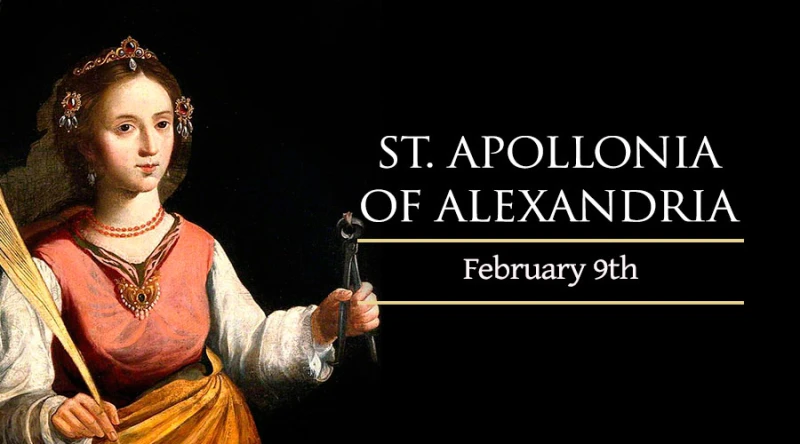
St. Apollonia of Alexandria


St. Apollonia of Alexandria

Feast date: Feb 09

St. Apollonia was a holy virgin who suffered martyrdom in Alexandria during a local uprising against the Christians in the early 3rd century.

During festivities commemorating the founding of the Roman Empire, a mob began attacking Christians.

The great Dionysius, then Bishop of Alexandria (247-265), related the sufferings of Apollonia:

Men seized her and, by repeated blows, broke all of her teeth. Then they erected a pile of sticks outside the city and threatened to burn her alive if she refused to repeat impious words after them (either a blasphemy against Christ, or an invocation of the heathen gods). When she was given a little freedom, at her own request, she sprang quickly into the fire and was burned to death.

Apollonia belongs to a class of early Christian martyrs who when confronted with the choice between renouncing their faith or suffering death, voluntarily embraced the latter.

She is popularly invoked for toothaches because of the torments she had to endure. She is represented in art with pincers holding a tooth.

St. Apollonia of Alexandria Read More »

Tuesday of the Fifth Week in Ordinary Time

Reading I 1 Kgs 8:22-23, 27-30

Solomon stood before the altar of the LORD
in the presence of the whole community of Israel,
and stretching forth his hands toward heaven,
he said, “LORD, God of Israel,
there is no God like you in heaven above or on earth below;
you keep your covenant of mercy with your servants
who are faithful to you with their whole heart.

“Can it indeed be that God dwells on earth?
If the heavens and the highest heavens cannot contain you,
how much less this temple which I have built! 
Look kindly on the prayer and petition of your servant, O LORD, my God,
and listen to the cry of supplication which I, your servant,
utter before you this day.
May your eyes watch night and day over this temple,
the place where you have decreed you shall be honored;
may you heed the prayer which I, your servant, offer in this place.
Listen to the petitions of your servant and of your people Israel
which they offer in this place.
Listen from your heavenly dwelling and grant pardon.”

Responsorial Psalm 84:3, 4, 5 and 10, 11

R.        (2)  How lovely is your dwelling place, Lord, mighty God!
My soul yearns and pines 
            for the courts of the LORD.
My heart and my flesh
            cry out for the living God. 
R.        How lovely is your dwelling place, Lord, mighty God!
Even the sparrow finds a home,
             and the swallow a nest
             in which she puts her young—
Your altars, O LORD of hosts,
            my king and my God!
R.        How lovely is your dwelling place, Lord, mighty God!
Blessed they who dwell in your house!
            continually they praise you.
O God, behold our shield,
            and look upon the face of your anointed.
R.        How lovely is your dwelling place, Lord, mighty God!
I had rather one day in your courts
            than a thousand elsewhere;
I had rather lie at the threshold of the house of my God
            than dwell in the tents of the wicked.
R.        How lovely is your dwelling place, Lord, mighty God!

Alleluia Ps 119:36, 29b

R. Alleluia, alleluia.
Incline my heart, O God, to your decrees;
and favor me with your law.
R. Alleluia, alleluia.

Gospel Mk 7:1-13

When the Pharisees with some scribes who had come from Jerusalem
gathered around Jesus,
they observed that some of his disciples ate their meals
with unclean, that is, unwashed, hands.
(For the Pharisees and, in fact, all Jews,
do not eat without carefully washing their hands,
keeping the tradition of the elders.
And on coming from the marketplace
they do not eat without purifying themselves.
And there are many other things that they have traditionally observed,
the purification of cups and jugs and kettles and beds.)
So the Pharisees and scribes questioned him,
“Why do your disciples not follow the tradition of the elders
but instead eat a meal with unclean hands?”  
He responded,
“Well did Isaiah prophesy about you hypocrites,
as it is written:

            This people honors me with their lips,
                        but their hearts are far from me;
            In vain do they worship me,
                        teaching as doctrines human precepts.

You disregard God’s commandment but cling to human tradition.”
He went on to say,
“How well you have set aside the commandment of God
in order to uphold your tradition!
For Moses said,
Honor your father and your mother,
and Whoever curses father or mother shall die.
Yet you say,
‘If someone says to father or mother,
“Any support you might have had from me is qorban”’
(meaning, dedicated to God),
you allow him to do nothing more for his father or mother.
You nullify the word of God
in favor of your tradition that you have handed on.
And you do many such things.” 

– – –

Lectionary for Mass for Use in the Dioceses of the United States, second typical edition, Copyright © 2001, 1998, 1997, 1986, 1970 Confraternity of Christian Doctrine; Psalm refrain © 1968, 1981, 1997, International Committee on English in the Liturgy, Inc. All rights reserved. Neither this work nor any part of it may be reproduced, distributed, performed or displayed in any medium, including electronic or digital, without permission in writing from the copyright owner.

Tuesday of the Fifth Week in Ordinary Time Read More »

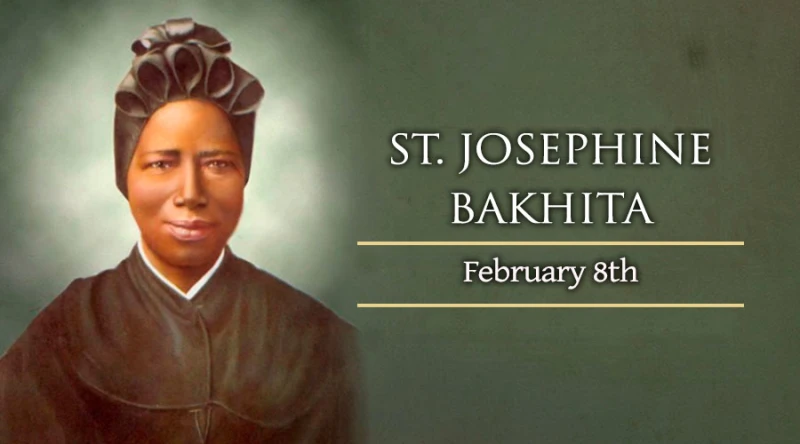
St. Josephine Bakhita


St. Josephine Bakhita

Feast date: Feb 08

On February 8, the Church commemorates the life of St. Josephine Bakhita, a Canossian Sister who was kidnapped and sold into slavery in Sudan.

Josephine Bakhita was born in 1869, in a small village in the Darfur region of Sudan. She was kidnapped while working in the fields with her family and subsequently sold into slavery. Her captors asked for her name but she was too terrified to remember so they named her “Bakhita,” which means “fortunate” in Arabic.

Retrospectively, Bakhita was very fortunate, but the first years of her life do not necessarily attest to it. She was tortured by her various owners who branded her, beat and cut her.

In her biography she notes one particularly terrifying moment when one of her masters cut her 114 times and poured salt in her wounds to ensure that the scars remained.

“I felt I was going to die any moment, especially when they rubbed me in with the salt,” Bakhita wrote.

She bore her suffering valiantly though she did not know Christ or the redemptive nature of suffering. She also had a certain awe for the world and its creator.

“Seeing the sun, the moon and the stars, I said to myself: ‘Who could be the Master of these beautiful things?’ And I felt a great desire to see Him, to know Him and to pay Him homage.”

After being sold a total of five times, Bakhita was purchased by Callisto Legnani, the Italian consul in Khartoum, the capital of Sudan.

Two years later, he took Bakhita to Italy to work as a nanny for his colleague, Augusto Michieli.

He, in turn, sent Bakhita to accompany his daughter to a school in Venice run by the Canossian Sisters.

Bakhita felt called to learn more about the Church, and was baptized with the name “Josephine Margaret.” In the meantime, Michieli wanted to take Josephine and his daughter back to Sudan, but Josephine refused to return.

The disagreement escalated and was taken to the Italian courts where it was ruled that Josephine could stay in Italy because she was a free woman.

Slavery was not recognized in Italy and it had also been illegal in Sudan since before Josephine had been born.

Josephine remained in Italy and decided to enter Canossians in 1893. She made her profession in 1896 and was sent to Northern Italy, where she dedicated her life to assisting her community and teaching others to love God.

She was known for her smile, gentleness and holiness.

She even went on record saying, “If I were to meet the slave-traders who kidnapped me and even those who tortured me, I would kneel and kiss their hands, for if that did not happen, I would not be a Christian and Religious today.”

St. Josephine was beatified in 1992 and canonized shortly after on October 2000 by Pope John Paul II. She is the first person to be canonized from Sudan and is the patron saint of the country.

St. Josephine Bakhita Read More »

Monday of the Fifth Week in Ordinary Time

Reading I 1 Kgs 8:1-7, 9-13

The elders of Israel and all the leaders of the tribes,
the princes in the ancestral houses of the children of Israel,
came to King Solomon in Jerusalem,
to bring up the ark of the LORD’s covenant
from the City of David, which is Zion.
All the people of Israel assembled before King Solomon
during the festival in the month of Ethanim (the seventh month).
When all the elders of Israel had arrived,
the priests took up the ark;
they carried the ark of the LORD
and the meeting tent with all the sacred vessels
that were in the tent.
(The priests and Levites carried them.)

King Solomon and the entire community of Israel
present for the occasion
sacrificed before the ark sheep and oxen
too many to number or count.
The priests brought the ark of the covenant of the LORD
to its place beneath the wings of the cherubim in the sanctuary,
the holy of holies of the temple.
The cherubim had their wings spread out over the place of the ark,
sheltering the ark and its poles from above.
There was nothing in the ark but the two stone tablets
which Moses had put there at Horeb,
when the LORD made a covenant with the children of Israel
at their departure from the land of Egypt.

When the priests left the holy place,
the cloud filled the temple of the LORD
so that the priests could no longer minister because of the cloud,
since the LORD’s glory had filled the temple of the LORD.
Then Solomon said, “The LORD intends to dwell in the dark cloud;
I have truly built you a princely house,
a dwelling where you may abide forever.”

Responsorial Psalm 132:6-7, 8-10

R.        (8a)  Lord, go up to the place of your rest!
Behold, we heard of it in Ephrathah;
            we found it in the fields of Jaar.
Let us enter into his dwelling,
            let us worship at his footstool.
R.        Lord, go up to the place of your rest!
Advance, O LORD, to your resting place,
            you and the ark of your majesty.
May your priests be clothed with justice;
            let your faithful ones shout merrily for joy.
For the sake of David your servant,
            reject not the plea of your anointed.
R.        Lord, go up to the place of your rest!

Alleluia See Mt 4:23

R. Alleluia, alleluia.
Jesus preached the Gospel of the Kingdom
and cured every disease among the people.
R. Alleluia, alleluia.

Gospel Mk 6:53-56

After making the crossing to the other side of the sea,
Jesus and his disciples came to land at Gennesaret
and tied up there.
As they were leaving the boat, people immediately recognized him.
They scurried about the surrounding country 
and began to bring in the sick on mats
to wherever they heard he was.
Whatever villages or towns or countryside he entered,
they laid the sick in the marketplaces
and begged him that they might touch only the tassel on his cloak;
and as many as touched it were healed.

– – –

Lectionary for Mass for Use in the Dioceses of the United States, second typical edition, Copyright © 2001, 1998, 1997, 1986, 1970 Confraternity of Christian Doctrine; Psalm refrain © 1968, 1981, 1997, International Committee on English in the Liturgy, Inc. All rights reserved. Neither this work nor any part of it may be reproduced, distributed, performed or displayed in any medium, including electronic or digital, without permission in writing from the copyright owner.

Monday of the Fifth Week in Ordinary Time Read More »

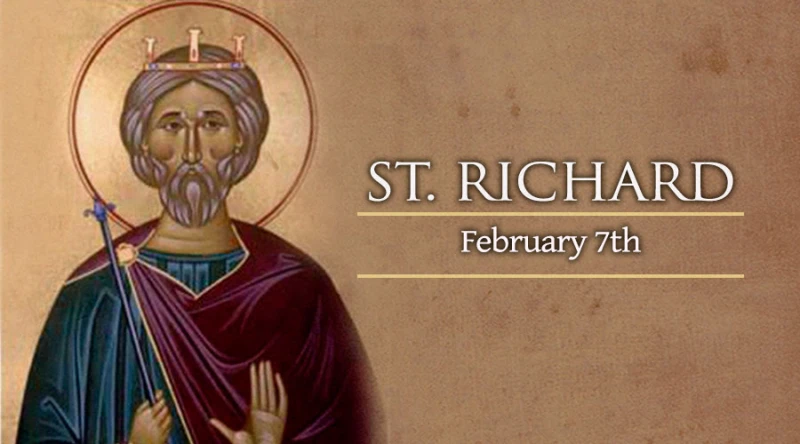
St. Richard


St. Richard

Feast date: Feb 07

St. Richard was orphaned at a young age. His brother inherited his parents’ estate after he was of age, but the death tax was so great that they were sent into poverty, and Richard had to work on his brother’s farm. He was set to be next in line to inherit the estate, but Richard preferred a life of study and the church. When it was set for him to be married to a noblewoman, he rejected the proposed match, suggesting that his brother might marry her instead.

He was eventually elected as bishop, and lived an ascetic lifestyle.

Richard was the father of Saints Willibald, Winnebald, and Walburga. He was on a pilgrimage to Rome from his native Wessex, England, with his two sons when he was stricken and died at Lucca, Italy. Miracles were reported at his tomb and he became greatly venerated by the citizens of Lucca, who embellished accounts of his life by calling him “King of the English”.

St. Richard Read More »