
Please mind our dust!

We are currently working on revamping our website!
Thank you for your patience!

CRD Solutions

Fifth Sunday in Ordinary Time

Reading I Is 6:1-2a, 3-8

In the year King Uzziah died,
I saw the Lord seated on a high and lofty throne,
with the train of his garment filling the temple.
Seraphim were stationed above.

They cried one to the other,
“Holy, holy, holy is the LORD of hosts!
All the earth is filled with his glory!”
At the sound of that cry, the frame of the door shook
and the house was filled with smoke.

Then I said, “Woe is me, I am doomed!
For I am a man of unclean lips,
living among a people of unclean lips;
yet my eyes have seen the King, the LORD of hosts!”
Then one of the seraphim flew to me,
holding an ember that he had taken with tongs from the altar.

He touched my mouth with it, and said,
“See, now that this has touched your lips,
your wickedness is removed, your sin purged.”

Then I heard the voice of the Lord saying,
“Whom shall I send?  Who will go for us?”
“Here I am,” I said; “send me!”

Responsorial Psalm Ps 138:1-2, 2-3, 4-5, 7-8

R. (1c) In the sight of the angels I will sing your praises, Lord.
I will give thanks to you, O LORD, with all my heart,
            for you have heard the words of my mouth;
in the presence of the angels I will sing your praise;
            I will worship at your holy temple
and give thanks to your name.
R. In the sight of the angels I will sing your praises, Lord.
Because of your kindness and your truth;
            for you have made great above all things
            your name and your promise.
When I called, you answered me;
            you built up strength within me.
R. In the sight of the angels I will sing your praises, Lord.
All the kings of the earth shall give thanks to you, O LORD,
            when they hear the words of your mouth;
and they shall sing of the ways of the LORD:
            “Great is the glory of the LORD.”
R. In the sight of the angels I will sing your praises, Lord.
Your right hand saves me.
            The LORD will complete what he has done for me;
your kindness, O LORD, endures forever;
            forsake not the work of your hands.
R. In the sight of the angels I will sing your praises, Lord.

Reading II 1 Cor 15:1-11

I am reminding you, brothers and sisters,
of the gospel I preached to you,
which you indeed received and in which you also stand.
Through it you are also being saved,
if you hold fast to the word I preached to you,
unless you believed in vain.
For I handed on to you as of first importance what I also received:
that Christ died for our sins
in accordance with the Scriptures;
that he was buried;
that he was raised on the third day
in accordance with the Scriptures;
that he appeared to Cephas, then to the Twelve.
After that, Christ appeared to more
than five hundred brothers at once,
most of whom are still living,
though some have fallen asleep.
After that he appeared to James,
then to all the apostles.
Last of all, as to one born abnormally,
he appeared to me.
For I am the least of the apostles,
not fit to be called an apostle,
because I persecuted the church of God.
But by the grace of God I am what I am,
and his grace to me has not been ineffective.
Indeed, I have toiled harder than all of them;
not I, however, but the grace of God that is with me.
Therefore, whether it be I or they,
so we preach and so you believed.

OR:

1 Cor 15:3-8, 11

Brothers and sisters,
I handed on to you as of first importance what I also received:
that Christ died for our sins
in accordance with the Scriptures;
that he was buried;
that he was raised on the third day
in accordance with the Scriptures; 
that he appeared to Cephas, then to the Twelve.
After that, he appeared to more
than five hundred brothers at once,
most of whom are still living,
though some have fallen asleep.
After that he appeared to James,
then to all the apostles.
Last of all, as to one abnormally born,
he appeared to me.
Therefore, whether it be I or they,
so we preach and so you believed. 

Alleluia Mt 4:19

R. Alleluia, alleluia.
Come after me
and I will make you fishers of men.
R. Alleluia, alleluia.

Gospel Lk 5:1-11

While the crowd was pressing in on Jesus and listening to the word of God,
he was standing by the Lake of Gennesaret.
He saw two boats there alongside the lake;
the fishermen had disembarked and were washing their nets.
Getting into one of the boats, the one belonging to Simon,
he asked him to put out a short distance from the shore.
Then he sat down and taught the crowds from the boat.
After he had finished speaking, he said to Simon,
“Put out into deep water and lower your nets for a catch.”
Simon said in reply,
“Master, we have worked hard all night and have caught nothing,
but at your command I will lower the nets.”
When they had done this, they caught a great number of fish
and their nets were tearing.
They signaled to their partners in the other boat
to come to help them. 
They came and filled both boats
so that the boats were in danger of sinking.
When Simon Peter saw this, he fell at the knees of Jesus and said,
“Depart from me, Lord, for I am a sinful man.”
For astonishment at the catch of fish they had made seized him
and all those with him,
and likewise James and John, the sons of Zebedee,
who were partners of Simon.
Jesus said to Simon, “Do not be afraid;
from now on you will be catching men.”
When they brought their boats to the shore,
they left everything and followed him.

– – –

Lectionary for Mass for Use in the Dioceses of the United States, second typical edition, Copyright © 2001, 1998, 1997, 1986, 1970 Confraternity of Christian Doctrine; Psalm refrain © 1968, 1981, 1997, International Committee on English in the Liturgy, Inc. All rights reserved. Neither this work nor any part of it may be reproduced, distributed, performed or displayed in any medium, including electronic or digital, without permission in writing from the copyright owner.

Fifth Sunday in Ordinary Time Read More »
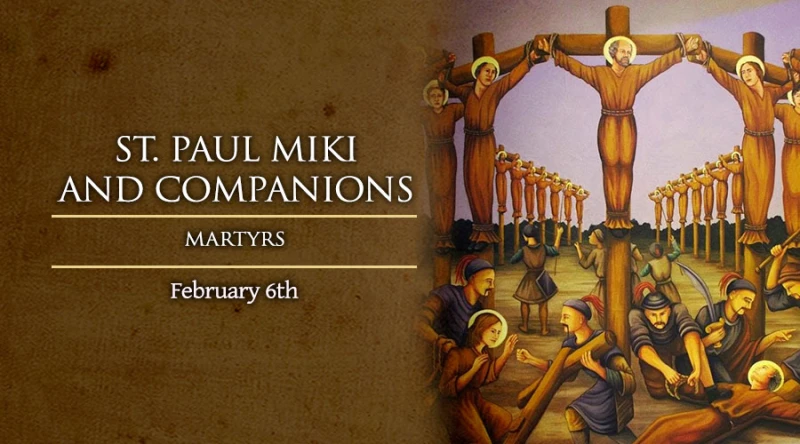
St. Paul Miki and Companions


St. Paul Miki and Companions

Feast date: Feb 06

On Feb. 6, the Catholic Church honors the 26 Martyrs of Nagasaki, a group of native Japanese Catholics and foreign missionaries who suffered death for their faith in the year 1597.

During the 16th century, the Catholic faith reached Japan by the efforts of the Jesuit missionary Saint Francis Xavier (1506-1552). Jesuit outreach to the Japanese continued after his death, and around 200,000 Japanese had entered the Church by 1587.

Religious tensions led to a period of persecution during that year, during which many churches were destroyed and missionaries forced to work in secret. But few episodes of martyrdom took place during this time, and within a decade 100,000 more Japanese became Catholic despite the restrictions.

During 1593, Franciscan missionaries came to Japan from the Philippines by order of Spain’s King Philip II. These new arrivals gave themselves zealously to the work of charity and evangelism, but their presence disturbed a delicate situation between the Church and Japanese authorities.

Suspicion against Catholic missionaries grew when a Spanish ship was seized off the Japanese coast and found to be carrying artillery. Toyotomi Hideyoshi, a powerful imperial minister, responded by sentencing 26 Catholics to death.

The group was comprised of three native Jesuits, six foreign Franciscans, and several lay Catholics including some children. Sentenced to die by crucifixion and lancing, they were first marched 600 miles to the city of Nagasaki.

During the journey they underwent public torture meant to terrorize other Japanese believers in Christ. But all of the 26 held out courageously, even singing the hymn of praise “Te Deum” when they arrived at the hill where they would be crucified.

Three of the best-known martyrs of Nagaki are Saints Paul Miki, John of Goto, and James Kisai. Though none were priests, all were associated with the Jesuits: Miki was training for the priesthood, while Kisai was a lay brother and John of Goto was a catechist preparing to enter the order.

Paul Miki offered an especially strong witness to his faith during the group’s month-long march to Nagasaki, as he joined one of the captive Franciscan priests in preaching to the crowds who came to mock the prisoners.

The son of a wealthy military leader, Miki was born in 1562 and entered the Church along with the rest of his family. He joined the Jesuits as a young man and helped many Buddhists to embrace Christianity. His last act of evangelism took place as he hung on his cross, preaching to the crowds.

“The only reason for my being killed is that I have taught the doctrine of Christ,” he announced. “I thank God it is for this reason that I die. I believe that I am telling the truth before I die.”

“After Christ’s example, I forgive my persecutors. I do not hate them. I ask God to have pity on all, and I hope my blood will fall on my fellow men as a fruitful rain.”

St. Paul Miki and his 25 companions were stabbed to death with lances on Feb. 5, 1597, at the site that became known as “Martyrs’ Hill.” Pope Pius IX canonized the Martyrs of Nagasaki in 1862.

St. Paul Miki and Companions Read More »

Memorial of Saint Agatha, Virgin and Martyr

Reading I 1 Kgs 3:4-13

Solomon went to Gibeon to sacrifice there,
because that was the most renowned high place.
Upon its altar Solomon offered a thousand burnt offerings.
In Gibeon the LORD appeared to Solomon in a dream at night.
God said, “Ask something of me and I will give it to you.”
Solomon answered:
“You have shown great favor to your servant, my father David,
because he behaved faithfully toward you,
with justice and an upright heart;
and you have continued this great favor toward him, even today,
seating a son of his on his throne.
O LORD, my God, you have made me, your servant,
king to succeed my father David;
but I am a mere youth, not knowing at all how to act.
I serve you in the midst of the people whom you have chosen,
a people so vast that it cannot be numbered or counted.
Give your servant, therefore, an understanding heart
to judge your people and to distinguish right from wrong.
For who is able to govern this vast people of yours?”

The LORD was pleased that Solomon made this request.
So God said to him: “Because you have asked for this–
not for a long life for yourself,
nor for riches, nor for the life of your enemies,
but for understanding so that you may know what is right–
I do as you requested. 
I give you a heart so wise and understanding
that there has never been anyone like you up to now,
and after you there will come no one to equal you.
In addition, I give you what you have not asked for,
such riches and glory that among kings there is not your like.”

Responsorial Psalm 119:9, 10, 11, 12, 13, 14

R.        (12b)  Lord, teach me your statutes.
How shall a young man be faultless in his way?
            By keeping to your words.
R.        Lord, teach me your statutes.
With all my heart I seek you;
            let me not stray from your commands.
R.        Lord, teach me your statutes.
Within my heart I treasure your promise,
            that I may not sin against you.
R.        Lord, teach me your statutes.
Blessed are you, O LORD;
            teach me your statutes.
R.        Lord, teach me your statutes.
With my lips I declare
            all the ordinances of your mouth. 
R.        Lord, teach me your statutes.
In the way of your decrees I rejoice,
            as much as in all riches.
R.        Lord, teach me your statutes.

Alleluia Jn 10:27

R. Alleluia, alleluia.
My sheep hear my voice, says the Lord;
I know them, and they follow me.
R. Alleluia, alleluia.

Gospel Mk 6:30-34

The Apostles gathered together with Jesus
and reported all they had done and taught.
He said to them,
“Come away by yourselves to a deserted place and rest a while.” 
People were coming and going in great numbers,
and they had no opportunity even to eat.
So they went off in the boat by themselves to a deserted place.
People saw them leaving and many came to know about it.
They hastened there on foot from all the towns
and arrived at the place before them.

When Jesus disembarked and saw the vast crowd,
his heart was moved with pity for them,
for they were like sheep without a shepherd;
and he began to teach them many things.

– – –

Lectionary for Mass for Use in the Dioceses of the United States, second typical edition, Copyright © 2001, 1998, 1997, 1986, 1970 Confraternity of Christian Doctrine; Psalm refrain © 1968, 1981, 1997, International Committee on English in the Liturgy, Inc. All rights reserved. Neither this work nor any part of it may be reproduced, distributed, performed or displayed in any medium, including electronic or digital, without permission in writing from the copyright owner.

Memorial of Saint Agatha, Virgin and Martyr Read More »

St. Agatha


St. Agatha

Feast date: Feb 05

Although we have evidece that Agatha was venerated at least as far back as the sixth century, the only facts we have about her are that she was born in Sicily and died there a martyr.

In the legend of her life, we are told that she belonged to a rich, important family. When she was young, she dedicated her life to God and resisted any men who wanted to marry her. One of these men, Quintian, was of a high enough rank that he felt he could force her to acquiesce. Knowing she was a Christian in a time of persecution, he had  her arrested and brought before the judge – – himself. He expected her to give in to when faced with torture and possible death, but she simply affirmed her belief in God by praying: “Jesus Christ, Lord of all, you see  my heart, you know my desires. Possess all that I am. I am your sheep: make me worthy to overcome the devil.”

When she continued to profess her faith in Jesus, Quintian had her tortured. He refused her any medical care but God gave her all the care she needed in the form of a vision of St. Peter. When she was tortured again, she died after saying a final prayer: “Lord, my Creator, you have always protected me from the cradle; you have taken me from the love of the world and given me patience to suffer. Receive my soul.”

Because she was asked for help during the eruption of Mount Etna she is considered a protector against the outbreak of fire. She is also considered the patroness of bellmakers for an unknown reason — though some speculate it may have something to do with the fact that bells were used as fire alarms.

St. Agatha Read More »

Friday of the Fourth Week in Ordinary Time

Reading I Sir 47:2-11

Like the choice fat of the sacred offerings,
            so was David in Israel.
He made sport of lions as though they were kids,
            and of bears, like lambs of the flock.
As a youth he slew the giant
            and wiped out the people’s disgrace,
When his hand let fly the slingstone
            that crushed the pride of Goliath.
Since he called upon the Most High God, 
            who gave strength to his right arm
To defeat the skilled warrior
            and raise up the might of his people,
Therefore the women sang his praises,
            and ascribed to him tens of thousands
            and praised him when they blessed the Lord.
When he assumed the royal crown, he battled
            and subdued the enemy on every side.
He destroyed the hostile Philistines
            and shattered their power till our own day.
With his every deed he offered thanks 
            to God Most High, in words of praise.
With his whole being he loved his Maker
            and daily had his praises sung;
            He set singers before the altar and by their voices
                        he made sweet melodies,
He added beauty to the feasts
            and solemnized the seasons of each year
So that when the Holy Name was praised,
            before daybreak the sanctuary would resound.
The Lord forgave him his sins
            and exalted his strength forever;
He conferred on him the rights of royalty
            and established his throne in Israel.

Responsorial Psalm 18:31, 47 and 50, 51

R.        (see 47b)  Blessed be God my salvation!
God’s way is unerring,
            the promise of the LORD is fire-tried;
            he is a shield to all who take refuge in him.
R.        Blessed be God my salvation!
The LORD live! And blessed be my Rock!
            Extolled be God my savior.
Therefore will I proclaim you, O LORD, among the nations,
            and I will sing praise to your name.
R.        Blessed be God my salvation!
You who gave great victories to your king
            and showed kindness to your anointed,
            to David and his posterity forever.
R.        Blessed be God my salvation!

Alleluia See Lk 8:15

R. Alleluia, alleluia.
Blessed are they who have kept the word with a generous heart,
and yield a harvest through perseverance.
R. Alleluia, alleluia.

Gospel Mk 6:14-29

King Herod heard about Jesus, for his fame had become widespread,
and people were saying,
“John the Baptist has been raised from the dead;
that is why mighty powers are at work in him.”
Others were saying, “He is Elijah”;
still others, “He is a prophet like any of the prophets.”
But when Herod learned of it, he said,
“It is John whom I beheaded. He has been raised up.”

Herod was the one who had John arrested and bound in prison
on account of Herodias, 
the wife of his brother Philip, whom he had married.
John had said to Herod,
“It is not lawful for you to have your brother’s wife.”
Herodias harbored a grudge against him
and wanted to kill him but was unable to do so.
Herod feared John, knowing him to be a righteous and holy man,
and kept him in custody.
When he heard him speak he was very much perplexed,
yet he liked to listen to him.
Herodias had an opportunity one day when Herod, on his birthday,
gave a banquet for his courtiers, his military officers,
and the leading men of Galilee.
His own daughter came in and performed a dance
that delighted Herod and his guests.
The king said to the girl,
“Ask of me whatever you wish and I will grant it to you.” 
He even swore many things to her,
“I will grant you whatever you ask of me,
even to half of my kingdom.”
She went out and said to her mother,
“What shall I ask for?”
Her mother replied, “The head of John the Baptist.”
The girl hurried back to the king’s presence and made her request,
“I want you to give me at once on a platter
the head of John the Baptist.”
The king was deeply distressed,
but because of his oaths and the guests
he did not wish to break his word to her.
So he promptly dispatched an executioner
with orders to bring back his head.
He went off and beheaded him in the prison.
He brought in the head on a platter
and gave it to the girl.
The girl in turn gave it to her mother.
When his disciples heard about it,
they came and took his body and laid it in a tomb.

– – –

Lectionary for Mass for Use in the Dioceses of the United States, second typical edition, Copyright © 2001, 1998, 1997, 1986, 1970 Confraternity of Christian Doctrine; Psalm refrain © 1968, 1981, 1997, International Committee on English in the Liturgy, Inc. All rights reserved. Neither this work nor any part of it may be reproduced, distributed, performed or displayed in any medium, including electronic or digital, without permission in writing from the copyright owner.

Friday of the Fourth Week in Ordinary Time Read More »