
Please mind our dust!

We are currently working on revamping our website!
Thank you for your patience!

CRD Solutions

St. Joseph of Leonissa


St. Joseph of Leonissa

Feast date: Feb 04

Joseph of Leonissa, OFM Cap.;  was the third of eight children born at Leonessa (Italy) on January 8, 1556.

At baptism he was given the name Eufranio.

Impressed by the example of Matthew Silvestri, who had left the medical profession to embrace the Capuchin life and whose holiness was evident, Eufranio was inspired to become a Capuchin.  After overcoming family opposition, he was admitted to the novitiate and received the habit and the name Joseph and made profession on January 8, 1573.

On May 21, 1581, the Capuchin general vicar issued patents for preaching, the ministry in which Joseph would be engaged for the remainder of his life.

Relying solely on grace and with a mission crucifix always tucked in his cincture, Joseph negotiated the most obscure, mountainous regions of Umbria, Lazio and the Abruzzi in an intense and extensive mission of evangelization among those who were poor.

Joseph enjoyed such great success in preaching because of his intimate union with God which was cultivated by incessant prayer. He would pray and meditate on the road, while holding his crucifix. Assigned to Constantinople he was appointed as chaplain to some 4,000 Christian slaves who worked in the penal colony of Qaasim-pacha. He immediately went to work bringing the gospel and charitable relief to those who were languishing in inhumane conditions. Many times he offered himself as a substitute in order to obtain the release of a slave who was near death. His offer was never accepted.

When the plague broke out in the penal colonies, the Capuchins immediately took up the ministry of assisting those who were sick and dying. Two Capuchins, Peter and Dennis, died doing so. Although Joseph became ill, he and Brother Gregory alone survived to remain at the mission. After converting a Greek bishop who had renounced the faith, Joseph devised a plan which entailed approaching the sultan, Murad 111, to seek the recognition of the right of freedom of conscience for anyone who was converted or returned to the Christian faith.

When Joseph attempted to enter the sultan’s chambers, he was arrested and bound in chains. He was condemned to an immediate death by being hung on hooks. He was hung from the gallows with one hook through the tendons of his right hand and another through his right foot.  Near death, on the evening of the third day, the guards cut him down.

Joseph quickly left Turkey and arrived at Rome where he and the converted Greek bishop presented themselves to Pope Sixtus V. Following Joseph’s return to Italy, in the autumn of 1589, he took up residence at the Carcerelle in Assisi.

In the aftermath of the Council of Trent, Joseph spent much time and energy catechizing. He began a ministry of evangelization among shepherds who lacked even rudimentary knowledge of the faith, prayer and the commandments. He would walk through the streets ringing a bell, reminding parents to send their children to catechism class.

When he became deathly ill, Joseph asked to be taken to Leonessa in order to pay his last respects to his relatives and friends. On Saturday evening, February 4, 1612, after beginning the divine office,which proved too difficult to continue, Joseph repeated his favorite prayer: “Sancta Maria, succurre miseris.”  Joseph was beatified by Clement XII in 1737 and canonized by Benedict XIV in 1746.

St. Joseph of Leonissa Read More »
Thursday of the Fourth Week in Ordinary Time

Reading I 1 Kgs 2:1-4, 10-12

When the time of David’s death drew near,
he gave these instructions to his son Solomon:
“I am going the way of all flesh.
Take courage and be a man.
Keep the mandate of the Lord, your God, following his ways
and observing his statutes, commands, ordinances, and decrees
as they are written in the law of Moses,
that you may succeed in whatever you do,
wherever you turn, and the Lord may fulfill
the promise he made on my behalf when he said,
‘If your sons so conduct themselves
that they remain faithful to me with their whole heart
and with their whole soul,
you shall always have someone of your line
on the throne of Israel.’”

David rested with his ancestors and was buried in the City of David.
The length of David’s reign over Israel was forty years:
he reigned seven years in Hebron
and thirty-three years in Jerusalem.

Solomon was seated on the throne of his father David,
with his sovereignty firmly established. 

Responsorial Psalm 1 Chronicles 29:10, 11ab, 11d-12a, 12bcd

R.        (12b)  Lord, you are exalted over all.
“Blessed may you be, O LORD,
            God of Israel our father,
            from eternity to eternity.”
R.        Lord, you are exalted over all.
“Yours, O LORD, are grandeur and power,
            majesty, splendor, and glory.”
R.        Lord, you are exalted over all.
“LORD, you are exalted over all.
            Yours, O Lord, is the sovereignty;
            you are exalted as head over all.
Riches and honor are from you.”
R.        Lord, you are exalted over all.
“In your hand are power and might;
            it is yours to give grandeur and strength to all.”
R.        Lord, you are exalted over all.

Alleluia Mk 1:15

R. Alleluia, alleluia.
The Kingdom of God is at hand;
repent and believe in the Gospel.
R. Alleluia, alleluia.

Gospel Mk 6:7-13

Jesus summoned the Twelve and began to send them out two by two
and gave them authority over unclean spirits.
He instructed them to take nothing for the journey but a walking stick
–no food, no sack, no money in their belts.
They were, however, to wear sandals but not a second tunic.
He said to them,
“Wherever you enter a house, stay there until you leave from there.
Whatever place does not welcome you or listen to you,
leave there and shake the dust off your feet
in testimony against them.”
So they went off and preached repentance.
The Twelve drove out many demons,
and they anointed with oil many who were sick and cured them.

– – –

Lectionary for Mass for Use in the Dioceses of the United States, second typical edition, Copyright © 2001, 1998, 1997, 1986, 1970 Confraternity of Christian Doctrine; Psalm refrain © 1968, 1981, 1997, International Committee on English in the Liturgy, Inc. All rights reserved. Neither this work nor any part of it may be reproduced, distributed, performed or displayed in any medium, including electronic or digital, without permission in writing from the copyright owner.

Thursday of the Fourth Week in Ordinary Time Read More »

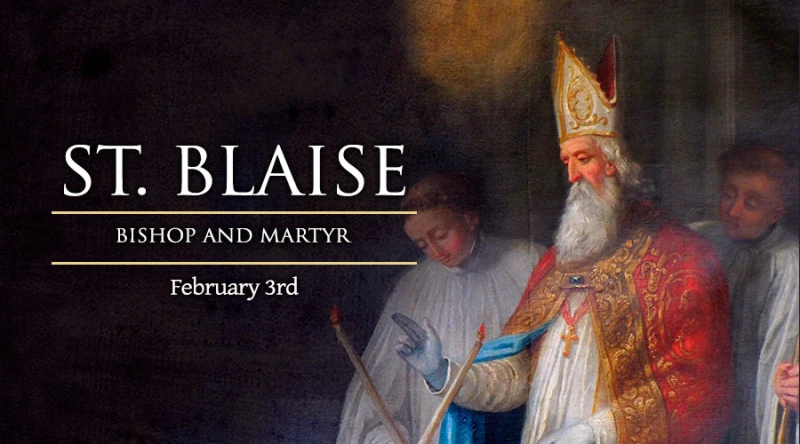
St. Blaise


St. Blaise

Feast date: Feb 03

Blaise was a hard-working bishop dedicated to encouraging the spiritual and physical health of his people in Sebastea, Armenia.

Although the Edict of Toleration which granted freedom of worship in the Roman empire had been signed five years prior, religious persecution still raged in the country.

According to a legend, a mother came to him with her young son who had a fish bone lodged in his throat. At Bishop Blaise’s command, the child coughed up the bone.

In another tale, Blaise was being led to the prison in Sebastea, and on the way came across a poor old woman whose pig had been stolen by a wolf. Blaise commanded the wolf return the pig, which it did -alive and uninjured – to the amazement of all.

In 316 he was beheaded for not sacrificing to the pagan gods. The account of his life was written nearly 400 years later.

The Germans and Slavs hold him in special honor and for decades many United States Catholics have sought the annual St. Blaise blessing for their throats.

St. Blaise Read More »

Feast of the Presentation of the Lord

Reading I Mal 3:1-4

            Thus says the Lord GOD:
Lo, I am sending my messenger
            to prepare the way before me;
And suddenly there will come to the temple
            the Lord whom you seek,
And the messenger of the covenant whom you desire.
            Yes, he is coming, says the Lord of hosts.
But who will endure the day of his coming?
            And who can stand when he appears?
For he is like the refiner’s fire,
            or like the fuller’s lye.
He will sit refining and purifying silver,
            and he will purify the sons of Levi,
Refining them like gold or like silver
            that they may offer due sacrifice to the Lord.
Then the sacrifice of Judah and Jerusalem
            will please the Lord,
            as in the days of old, as in years gone by.

Responsorial Psalm 24:7, 8, 9, 10

R.        (8) Who is this king of glory?  It is the Lord!
Lift up, O gates, your lintels;
            reach up, you ancient portals,
            that the king of glory may come in!
R.        Who is this king of glory?  It is the Lord!
Who is this king of glory?
            The LORD, strong and mighty,
            the LORD, mighty in battle.
R.        Who is this king of glory?  It is the Lord!
Lift up, O gates, your lintels;
            reach up, you ancient portals,
            that the king of glory may come in!
R.        Who is this king of glory?  It is the Lord!
Who is this king of glory?
            The LORD of hosts; he is the king of glory.
R.        Who is this king of glory?  It is the Lord!

Reading II Heb 2:14-18

Since the children share in blood and flesh,
Jesus likewise shared in them,
that through death he might destroy the one
who has the power of death, that is, the Devil,
and free those who through fear of death
had been subject to slavery all their life.
Surely he did not help angels
but rather the descendants of Abraham;
therefore, he had to become like his brothers and sisters
in every way,
that he might be a merciful and faithful high priest before God
to expiate the sins of the people.
Because he himself was tested through what he suffered,
he is able to help those who are being tested.

Alleluia Lk 2:32

R. Alleluia, alleluia.
A light of revelation to the Gentiles,
and glory for your people Israel.
R. Alleluia, alleluia.

Gospel Lk 2:22-40 or 2:22-32

When the days were completed for their purification
according to the law of Moses,
Mary and Joseph took Jesus up to Jerusalem
to present him to the Lord,
just as it is written in the law of the Lord,
Every male that opens the womb shall be consecrated to the Lord,
and to offer the sacrifice of
a pair of turtledoves or two young pigeons,
in accordance with the dictate in the law of the Lord. 

Now there was a man in Jerusalem whose name was Simeon.
This man was righteous and devout,
awaiting the consolation of Israel,
and the Holy Spirit was upon him.
It had been revealed to him by the Holy Spirit
that he should not see death
before he had seen the Christ of the Lord. 
He came in the Spirit into the temple;
and when the parents brought in the child Jesus
to perform the custom of the law in regard to him,
he took him into his arms and blessed God, saying:

            “Now, Master, you may let your servant go 
                        in peace, according to your word,
            for my eyes have seen your salvation,
                        which you prepared in the sight of all the peoples:
            a light for revelation to the Gentiles,
                        and glory for your people Israel.”

The child’s father and mother were amazed at what was said about him;
and Simeon blessed them and said to Mary his mother,
“Behold, this child is destined
for the fall and rise of many in Israel,
and to be a sign that will be contradicted
–and you yourself a sword will pierce–
so that the thoughts of many hearts may be revealed.”
There was also a prophetess, Anna,
the daughter of Phanuel, of the tribe of Asher.
She was advanced in years,
having lived seven years with her husband after her marriage,
and then as a widow until she was eighty-four.
She never left the temple,
but worshiped night and day with fasting and prayer.
And coming forward at that very time,
she gave thanks to God and spoke about the child
to all who were awaiting the redemption of Jerusalem.

When they had fulfilled all the prescriptions
of the law of the Lord,
they returned to Galilee, to their own town of Nazareth.
The child grew and became strong, filled with wisdom;
and the favor of God was upon him.

OR

When the days were completed for their purification
according to the law of Moses,
Mary and Joseph took Jesus up to Jerusalem
to present him to the Lord,
just as it is written in the law of the Lord,
Every male that opens the womb shall be consecrated to the Lord,
and to offer the sacrifice of
a pair of turtledoves or two young pigeons,
in accordance with the dictate in the law of the Lord. 

Now there was a man in Jerusalem whose name was Simeon.
This man was righteous and devout,
awaiting the consolation of Israel,
and the Holy Spirit was upon him.
It had been revealed to him by the Holy Spirit
that he should not see death
before he had seen the Christ of the Lord. 
He came in the Spirit into the temple;
and when the parents brought in the child Jesus
to perform the custom of the law in regard to him,
he took him into his arms and blessed God, saying:

            “Now, Master, you may let your servant go 
                        in peace, according to your word,
            for my eyes have seen your salvation,
                        which you prepared in the sight of all the peoples:
            a light for revelation to the Gentiles,
                        and glory for your people Israel.”

– – –

Lectionary for Mass for Use in the Dioceses of the United States, second typical edition, Copyright © 2001, 1998, 1997, 1986, 1970 Confraternity of Christian Doctrine; Psalm refrain © 1968, 1981, 1997, International Committee on English in the Liturgy, Inc. All rights reserved. Neither this work nor any part of it may be reproduced, distributed, performed or displayed in any medium, including electronic or digital, without permission in writing from the copyright owner.

Feast of the Presentation of the Lord Read More »

Tuesday of the Fourth Week in Ordinary Time

Reading I 2 Sm 18:9-10, 14b, 24-25a, 30–19:3

Absalom unexpectedly came up against David’s servants.
He was mounted on a mule,
and, as the mule passed under the branches of a large terebinth,
his hair caught fast in the tree.
He hung between heaven and earth
while the mule he had been riding ran off.
Someone saw this and reported to Joab
that he had seen Absalom hanging from a terebinth.
And taking three pikes in hand,
he thrust for the heart of Absalom,
still hanging from the tree alive.

Now David was sitting between the two gates,
and a lookout went up to the roof of the gate above the city wall,
where he looked about and saw a man running all alone.
The lookout shouted to inform the king, who said,
“If he is alone, he has good news to report.”
The king said, “Step aside and remain in attendance here.”
So he stepped aside and remained there.
When the Cushite messenger came in, he said,
“Let my lord the king receive the good news
that this day the LORD has taken your part,
freeing you from the grasp of all who rebelled against you.”
But the king asked the Cushite, “Is young Absalom safe?”
The Cushite replied, “May the enemies of my lord the king
and all who rebel against you with evil intent
be as that young man!”

The king was shaken,
and went up to the room over the city gate to weep.
He said as he wept,
“My son Absalom!  My son, my son Absalom!
If only I had died instead of you,
Absalom, my son, my son!”

Joab was told that the king was weeping and mourning for Absalom;
and that day’s victory was turned into mourning for the whole army
when they heard that the king was grieving for his son.

Responsorial Psalm 86:1-2, 3-4, 5-6

R.        (1a)  Listen, Lord, and answer me.
Incline your ear, O LORD; answer me,
            for I am afflicted and poor.
Keep my life, for I am devoted to you;
            save your servant who trusts in you. 
            You are my God.
R.        Listen, Lord, and answer me.
Have mercy on me, O Lord,
            for to you I call all the day.
Gladden the soul of your servant,
            for to you, O Lord, I lift up my soul.
R.        Listen, Lord, and answer me.
For you, O Lord, are good and forgiving,
            abounding in kindness to all who call upon you.
Hearken, O LORD, to my prayer
            and attend to the sound of my pleading.
R.        Listen, Lord, and answer me.

Alleluia Mt 8:17

R. Alleluia, alleluia.
Christ took away our infirmities
and bore our diseases.
R. Alleluia, alleluia.

Gospel Mk 5:21-43

When Jesus had crossed again in the boat
to the other side, 
a large crowd gathered around him, and he stayed close to the sea.
One of the synagogue officials, named Jairus, came forward.
Seeing him he fell at his feet and pleaded earnestly with him, saying,
“My daughter is at the point of death.
Please, come lay your hands on her
that she may get well and live.”
He went off with him
and a large crowd followed him.

There was a woman afflicted with hemorrhages for twelve years.
She had suffered greatly at the hands of many doctors
and had spent all that she had.
Yet she was not helped but only grew worse.
She had heard about Jesus and came up behind him in the crowd
and touched his cloak.
She said, “If I but touch his clothes, I shall be cured.”
Immediately her flow of blood dried up.
She felt in her body that she was healed of her affliction.
Jesus, aware at once that power had gone out from him,
turned around in the crowd and asked, “Who has touched my clothes?”
But his disciples said to him,
“You see how the crowd is pressing upon you,
and yet you ask, Who touched me?”
And he looked around to see who had done it.
The woman, realizing what had happened to her,
approached in fear and trembling.
She fell down before Jesus and told him the whole truth.
He said to her, “Daughter, your faith has saved you.
Go in peace and be cured of your affliction.”

While he was still speaking,
people from the synagogue official’s house arrived and said,
“Your daughter has died; why trouble the teacher any longer?” 
Disregarding the message that was reported,
Jesus said to the synagogue official,
“Do not be afraid; just have faith.”
He did not allow anyone to accompany him inside
except Peter, James, and John, the brother of James.
When they arrived at the house of the synagogue official,
he caught sight of a commotion,
people weeping and wailing loudly.
So he went in and said to them,
“Why this commotion and weeping?
The child is not dead but asleep.”
And they ridiculed him.
Then he put them all out.
He took along the child’s father and mother
and those who were with him
and entered the room where the child was.
He took the child by the hand and said to her, “Talitha koum,” 
which means, “Little girl, I say to you, arise!”
The girl, a child of twelve, arose immediately and walked around.
At that they were utterly astounded.
He gave strict orders that no one should know this
and said that she should be given something to eat.

– – –

Lectionary for Mass for Use in the Dioceses of the United States, second typical edition, Copyright © 2001, 1998, 1997, 1986, 1970 Confraternity of Christian Doctrine; Psalm refrain © 1968, 1981, 1997, International Committee on English in the Liturgy, Inc. All rights reserved. Neither this work nor any part of it may be reproduced, distributed, performed or displayed in any medium, including electronic or digital, without permission in writing from the copyright owner.

Tuesday of the Fourth Week in Ordinary Time Read More »