Please mind our dust!

We are currently working on revamping our website!
Thank you for your patience!

CRD Solutions

St. Brigid of Ireland
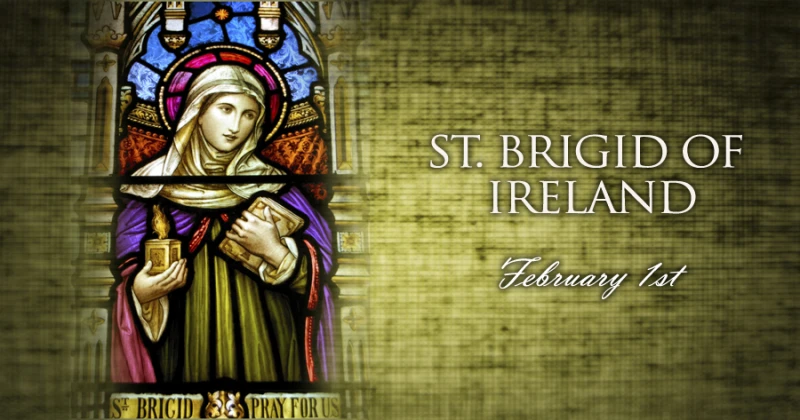

St. Brigid of Ireland

Feast date: Feb 01

On Feb. 1 Catholics in Ireland and elsewhere will honor Saint Brigid of Kildare, a monastic foundress who is – together with Saint Patrick and Saint Columcille – one of the country’s three patron saints.

St. Brigid directly influenced several other future saints of Ireland, and her many religious communities helped to secure the country’s conversion from paganism to the Catholic faith.

She is traditionally associated with the Cross of St. Brigid, a form of the cross made from reeds or straw that is placed in homes for blessing and protection. Some Eastern Catholics and Eastern Orthodox Christians also celebrate her feast.

St. Brigid has been profiled many times by both ancient and modern writers, but it is notoriously hard to establish the historical details of her life, and the various accounts make many conflicting claims. According to one of the more credible biographies of Brigid – Hugh de Blacam’s essay in “The Saints of Ireland,” on which the following account is based – most historians place her birth around the year 450, near the end of Saint Patrick’s evangelistic mission.

Brigid was born out of wedlock, the daughter of a pagan cheiftain named Dubthach and a Christian slave woman named Broicsech. The cheiftain sold the child’s pregnant mother to a new master, but contracted for Brigid to be returned to him eventually. According to de Blacam, the child was probably baptized as an infant and raised as a Catholic by her mother. Thus, she was well-formed in the faith before leaving Broicsech’s slave-quarters, at around age 10, to live with Dubthach and his wife.

Within the new circumstances of the cheiftain’s household, Brigid’s faith found expression in feats of charity. From the abundance of her father’s food and possessions, she gave generously to the poor. Dubthach became enraged, threatening to sell Brigid – who was not recognized as a full family member, but worked as a household servant – to the King of Leinster. But the Christian king understood Brigid’s acts of charity and convinced Dubthach to grant his daughter her freedom.

Released from servitude, Brigid was expected to marry. But she had other plans, which involved serving God in consecrated life. She even disfigured her own face, marring her beauty in order to dissuade suitors. Understanding he could not change her mind, Dubthach granted Brigid permission to pursue her plan, and material means by which to do so. Thus did a pagan nobleman, through this gift to his illegitimate daughter, play an unintentional but immense part in God’s plan for Ireland.

While consecrated religious life was part of the Irish Church before Brigid’s time, it had not yet developed the systematic character seen in other parts of the Christian world by the fifth century. Among women, vows of celibacy were often lived out in an impromptu manner, in the circumstances of everyday life or with the aid of particular benefactors. Brigid, with an initial group of seven companions, is credited with organizing communal consecrated religious life for women in Ireland.

Bishop Mel of Ardagh – St. Patrick’s nephew, and later “St. Mel” – accepted Brigid’s profession as a nun. According to tradition, the disfigurement she had inflicted on her face disappeared that day, and her beauty returned. St. Mel went on to serve as a mentor to the group during their time at Ardagh.

Around the time of his death in 488, Brigid’s community got an offer to resettle. Their destination is known today as Kildare (“Church of the Oak”), after the main monastery she founded there.

Brigid’s life as a nun was rooted in prayer, but it also involved substantial manual labor: cloth-making, dairy farming, and raising sheep. In Ireland, as in many other regions of the Christian world, this communal combination of work and prayer attracted vast numbers of people during the sixth century. Kildare, however, was unique as the only known Irish “double monastery”: it included a separately-housed men’s community, led by the bishop Saint Conleth.

From this main monastery, Brigid’s movement branched out to encompass a large portion of Ireland. It is not clear just how large, but it is evident that Brigid traveled widely throughout the island, founding new houses and building up a uniquely Irish form of monasticism. When she was not traveling, many pilgrims – including prominent clergy, and some future saints – made their way to Kildare, seeking the advice of the abbess.

Under Brigid’s leadership, Kildare played a major role in the successful Christianization of Ireland. The abbess’ influence was felt in the subsequent era of the Irish Church, a time when the country became known for its many monasteries and their intellectual achievements.

St. Brigid of Kildare died around 525. She is said to have received the last sacraments from a priest, Saint Ninnidh, whose vocation she had encouraged. Veneration of Brigid grew in the centuries after her death, and spread outside of Ireland through the work of the country’s monastic missionaries.

St. Brigid of Ireland Read More »
Memorial of Saint John Bosco, Priest

Reading I 2 Sm 15:13-14, 30; 16:5-13

An informant came to David with the report,
“The children of Israel have transferred their loyalty to Absalom.”
At this, David said to all his servants
who were with him in Jerusalem:
“Up!  Let us take flight, or none of us will escape from Absalom.
Leave quickly, lest he hurry and overtake us,
then visit disaster upon us and put the city to the sword.”

As David went up the Mount of Olives, he wept without ceasing.
His head was covered, and he was walking barefoot.
All those who were with him also had their heads covered
and were weeping as they went.

As David was approaching Bahurim,
a man named Shimei, the son of Gera
of the same clan as Saul’s family,
was coming out of the place, cursing as he came.
He threw stones at David and at all the king’s officers,
even though all the soldiers, including the royal guard,
were on David’s right and on his left.
Shimei was saying as he cursed:
“Away, away, you murderous and wicked man!
The LORD has requited you for all the bloodshed in the family of Saul,
in whose stead you became king,
and the LORD has given over the kingdom to your son Absalom.
And now you suffer ruin because you are a murderer.”
Abishai, son of Zeruiah, said to the king:
“Why should this dead dog curse my lord the king?
Let me go over, please, and lop off his head.”
But the king replied: “What business is it of mine or of yours,
sons of Zeruiah, that he curses?
Suppose the LORD has told him to curse David;
who then will dare to say, ‘Why are you doing this?’”
Then the king said to Abishai and to all his servants:
“If my own son, who came forth from my loins, is seeking my life,
how much more might this Benjaminite do so?
Let him alone and let him curse, for the LORD has told him to.
Perhaps the LORD will look upon my affliction
and make it up to me with benefits
for the curses he is uttering this day.”
David and his men continued on the road,
while Shimei kept abreast of them on the hillside,
all the while cursing and throwing stones and dirt as he went.

Responsorial Psalm 3:2-3, 4-5, 6-7

R.        (8a)  Lord, rise up and save me.
O LORD, how many are my adversaries!
            Many rise up against me!
Many are saying of me,
            “There is no salvation for him in God.”
R.        Lord, rise up and save me.
But you, O LORD, are my shield;
            my glory, you lift up my head!
When I call out to the LORD,
            he answers me from his holy mountain.
R.        Lord, rise up and save me.
When I lie down in sleep,
            I wake again, for the LORD sustains me.
I fear not the myriads of people
            arrayed against me on every side.
R.        Lord, rise up and save me.

Alleluia Lk 7:16

R. Alleluia, alleluia.
A great prophet has arisen in our midst
and God has visited his people.
R. Alleluia, alleluia.

Gospel Mk 5:1-20

Jesus and his disciples came to the other side of the sea,
to the territory of the Gerasenes.
When he got out of the boat,
at once a man from the tombs who had an unclean spirit met him.
The man had been dwelling among the tombs,
and no one could restrain him any longer, even with a chain.
In fact, he had frequently been bound with shackles and chains,
but the chains had been pulled apart by him and the shackles smashed,
and no one was strong enough to subdue him.
Night and day among the tombs and on the hillsides
he was always crying out and bruising himself with stones.
Catching sight of Jesus from a distance,
he ran up and prostrated himself before him,
crying out in a loud voice,
“What have you to do with me, Jesus, Son of the Most High God?
I adjure you by God, do not torment me!”
(He had been saying to him, “Unclean spirit, come out of the man!”)
He asked him, “What is your name?”
He  replied, “Legion is my name.  There are many of us.”
And he pleaded earnestly with him
not to drive them away from that territory.

Now a large herd of swine was feeding there on the hillside.
And they pleaded with him,
“Send us into the swine.  Let us enter them.”
And he let them, and the unclean spirits came out and entered the swine.
The herd of about two thousand rushed down a steep bank into the sea,
where they were drowned.
The swineherds ran away and reported the incident in the town
and throughout the countryside.
And people came out to see what had happened.
As they approached Jesus,
they caught sight of the man who had been possessed by Legion,
sitting there clothed and in his right mind.
And they were seized with fear.
Those who witnessed the incident explained to them what had happened
to the possessed man and to the swine.
Then they began to beg him to leave their district.
As he was getting into the boat,
the man who had been possessed pleaded to remain with him.
But Jesus would not permit him but told him instead,
“Go home to your family and announce to them
all that the Lord in his pity has done for you.”
Then the man went off and began to proclaim in the Decapolis
what Jesus had done for him; and all were amazed.

– – –

Lectionary for Mass for Use in the Dioceses of the United States, second typical edition, Copyright © 2001, 1998, 1997, 1986, 1970 Confraternity of Christian Doctrine; Psalm refrain © 1968, 1981, 1997, International Committee on English in the Liturgy, Inc. All rights reserved. Neither this work nor any part of it may be reproduced, distributed, performed or displayed in any medium, including electronic or digital, without permission in writing from the copyright owner.

Memorial of Saint John Bosco, Priest Read More »

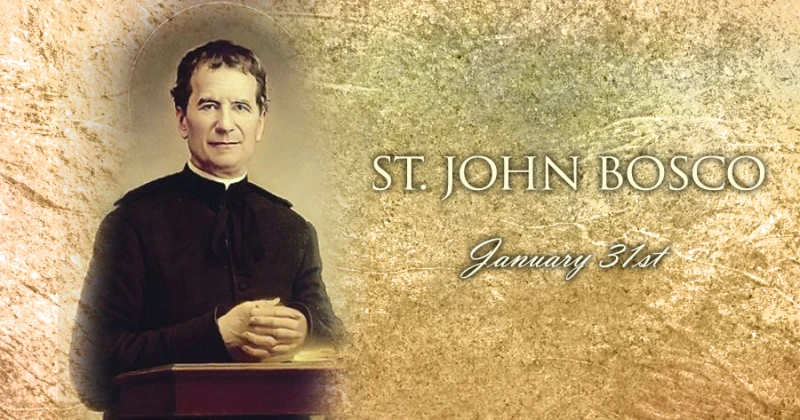
St. John Bosco


St. John Bosco

Feast date: Jan 31

On Jan. 31, the Roman Catholic Church honors St. John Bosco (or “Don Bosco”), a 19th century Italian priest who reached out to young people to remedy their lack of education, opportunities, and faith.

John Bosco was born in August of 1815 into a family of peasant farmers in Castelnuovo d’Asti – a place which would one day be renamed in the saint’s honor as “Castelnuovo Don Bosco.”

John’s father died when he was two years old, but he drew strength from his mother Margherita’s deep faith in God.

Margherita also taught her son the importance of charity, using portions of her own modest means to support those in even greater need. John desired to pass on to his own young friends the example of Christian discipleship that he learned from his mother.

At age nine, he had a prophetic dream in which a number of unruly young boys were uttering words of blasphemy. Jesus Christ and the Virgin Mary appeared to John in the dream, saying he would bring such youths to God through the virtues of humility and charity.

Later on, this dream would help John to discern his calling as a priest. But he also sought to follow the advice of Jesus and Mary while still a boy: he would entertain his peers with juggling, acrobatics, and magic tricks, before explaining a sermon he had heard, or leading them in praying the Rosary.

John’s older brother Anthony opposed his plan to be a priest, and antagonized him so much that he left home to become a farm worker at age 12. After moving back home three years later, John worked in various trades and finished school in order to attend seminary.

In 1841, John Bosco was ordained a priest. In the city of Turin, he began ministering to boys and young men who lived on the streets, many of whom were without work or education.

The industrial revolution had drawn large numbers of people into the city to look for work that was frequently grueling and sometimes scarce. Don Bosco was shocked to see how many boys ended up in prison before the age of 18, left to starve spiritually and sometimes physically.

The priest was determined to save as many young people as he could from a life of degradation. He established a group known as the Oratory of St. Francis de Sales, and became a kindly spiritual father to boys in need. His aging mother helped support the project in its early years.

John’s boyhood dream came to pass: he became a spiritual guide and provider along with his fellow Salesian priests and brothers, giving boys religious instruction, lodging, education, and work opportunities. He also helped Saint Mary Dominic Mazzarello form a similar group for girls.

This success did not come easily, as the priest struggled to find reliable accommodations and support for his ambitious apostolate. Italy’s nationalist movement made life difficult for religious orders, and its anti-clerical attitudes even led to assassination attempts against Don Bosco.

But such hostility did not stop the Salesians from expanding in Europe and beyond. They were helping 130,000 children in 250 houses by the end of Don Bosco’s life. “I have done nothing by myself,” he stated, saying it was “Our Lady who has done everything” through her intercession with God.

St. John Bosco died in the early hours of Jan. 31, 1888, after conveying a message: “Tell the boys that I shall be waiting for them all in Paradise.” He was canonized on Easter Sunday of 1934, and is a patron saint of young people, apprentices, and Catholic publishers and editors.

St. John Bosco Read More »

Fourth Sunday in Ordinary Time

Reading I Jer 1:4-5, 17-19

The word of the LORD came to me, saying:
            Before I formed you in the womb I knew you,
                        before you were born I dedicated you,
                        a prophet to the nations I appointed you.

            But do you gird your loins;
                        stand up and tell them
                        all that I command you.
            Be not crushed on their account,
                        as though I would leave you crushed before them;
            for it is I this day
                        who have made you a fortified city,
            a pillar of iron, a wall of brass,
                        against the whole land:
            against Judah’s kings and princes,
                        against its priests and people.
            They will fight against you but not prevail over you,
                        for I am with you to deliver you, says the LORD.

Responsorial Psalm Ps 71:1-2, 3-4, 5-6, 15-17

R. (cf. 15ab) I will sing of your salvation.
In you, O LORD, I take refuge;
            let me never be put to shame.
In your justice rescue me, and deliver me;
            incline your ear to me, and save me.
R. I will sing of your salvation.
Be my rock of refuge,
            a stronghold to give me safety,
            for you are my rock and my fortress.
O my God, rescue me from the hand of the wicked.
R. I will sing of your salvation.
For you are my hope, O Lord;
            my trust, O God, from my youth.
On you I depend from birth;
            from my mother’s womb you are my strength.
R. I will sing of your salvation.
My mouth shall declare your justice,
            day by day your salvation.
O God, you have taught me from my youth,
            and till the present I proclaim your wondrous deeds.
R. I will sing of your salvation.

1 Cor 12:31—13:13 1 Cor 12:31—13:13

Brothers and sisters:
Strive eagerly for the greatest spiritual gifts.
But I shall show you a still more excellent way.

If I speak in human and angelic tongues,
but do not have love,
I am a resounding gong or a clashing cymbal.
And if I have the gift of prophecy,
and comprehend all mysteries and all knowledge;
if I have all faith so as to move mountains,
but do not have love, I am nothing.
If I give away everything I own,
and if I hand my body over so that I may boast,
but do not have love, I gain nothing.

Love is patient, love is kind.
It is not jealous, it is not pompous,
It is not inflated, it is not rude,
it does not seek its own interests,
it is not quick-tempered, it does not brood over injury,
it does not rejoice over wrongdoing
but rejoices with the truth.
It bears all things, believes all things,
hopes all things, endures all things.

Love never fails.
If there are prophecies, they will be brought to nothing;
if tongues, they will cease;
if knowledge, it will be brought to nothing.
For we know partially and we prophesy partially,
but when the perfect comes, the partial will pass away.
When I was a child, I used to talk as a child,
think as a child, reason as a child;
when I became a man, I put aside childish things.
At present we see indistinctly, as in a mirror,
but then face to face.
At present I know partially;
then I shall know fully, as I am fully known.
So faith, hope, love remain, these three;
but the greatest of these is love.

OR: 

1 Cor 13:4-13

Brothers and sisters:
Love is patient, love is kind.
It is not jealous, it is not pompous,
it is not inflated, it is not rude, 
it does not seek its own interests,
it is not quick-tempered, it does not brood over injury,
it does not rejoice over wrongdoing but rejoices with the truth.
It bears all things, believes all things,
hopes all things, endures all things.

Love never fails.
If there are prophecies, they will be brought to nothing;
if tongues, they will cease;
if knowledge, it will be brought to nothing.
For we know partially and we prophesy partially,
but when the perfect comes, the partial will pass away.
When I was a child, I used to talk as a child,
think as a child, reason as a child;
when I became a man, I put aside childish things.
At present we see indistinctly, as in a mirror,
but then face to face.
At present I know partially;
then I shall know fully, as I am fully known.
So faith, hope, love remain, these three;
but the greatest of these is love.

Alleluia Lk 4:18

R. Alleluia, alleluia.
The Lord sent me to bring glad tidings to the poor,
to proclaim liberty to captives.
R. Alleluia, alleluia.

Gospel Lk 4:21-30

Jesus began speaking in the synagogue, saying:
“Today this Scripture passage is fulfilled in your hearing.”
And all spoke highly of him
and were amazed at the gracious words that came from his mouth. 
They also asked, “Isn’t this the son of Joseph?”
He said to them, “Surely you will quote me this proverb,
‘Physician, cure yourself,’ and say,
‘Do here in your native place
the things that we heard were done in Capernaum.’”
And he said, “Amen, I say to you,
no prophet is accepted in his own native place.
Indeed, I tell you,
there were many widows in Israel in the days of Elijah
when the sky was closed for three and a half years
and a severe famine spread over the entire land.
It was to none of these that Elijah was sent,
but only to a widow in Zarephath in the land of Sidon.
Again, there were many lepers in Israel
during the time of Elisha the prophet;
yet not one of them was cleansed, but only Naaman the Syrian.”
When the people in the synagogue heard this,
they were all filled with fury.
They rose up, drove him out of the town,
and led him to the brow of the hill
on which their town had been built,
to hurl him down headlong.
But Jesus passed through the midst of them and went away.
 

– – –

Lectionary for Mass for Use in the Dioceses of the United States, second typical edition, Copyright © 2001, 1998, 1997, 1986, 1970 Confraternity of Christian Doctrine; Psalm refrain © 1968, 1981, 1997, International Committee on English in the Liturgy, Inc. All rights reserved. Neither this work nor any part of it may be reproduced, distributed, performed or displayed in any medium, including electronic or digital, without permission in writing from the copyright owner.

Fourth Sunday in Ordinary Time Read More »

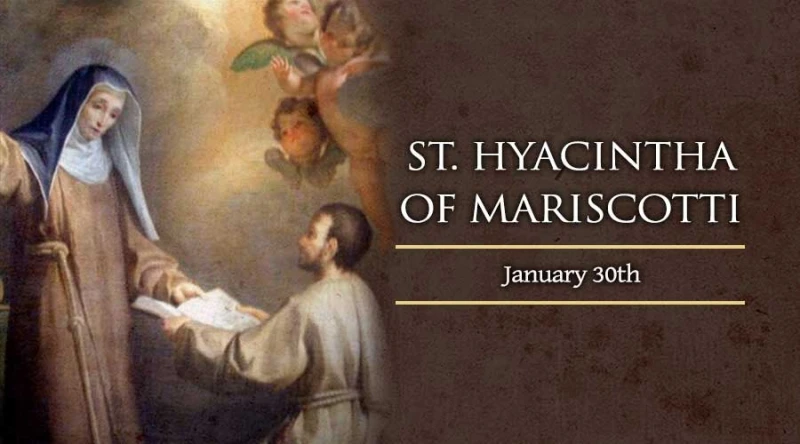
St. Hyacintha of Mariscotti


St. Hyacintha of Mariscotti

Feast date: Jan 30

Born of a noble family near Viterbo (Italy,) Hyacintha entered a local convent of sisters who followed the Third Order Rule. However, she supplied herself with enough food, clothing and other goods to live a very comfortable life amid these sisters who had pledged to mortification.

At one point in her time there, a serious illness required that Hyacintha’s confessor bring Holy Communion to her room. Upon entering, he was scandalized to see how soft of a life she had provided for herself, so he advised her to live more humbly. After hearing this, Hyacintha then disposed of her fine clothes and special foods. She eventually became very penitential in food and clothing, and was ready to do the most humble work in the convent. She developed a special devotion to the sufferings of Christ and by her penances became an inspiration to the sisters in her convent. The people loved her so much that her veil had to be replaced multiple times due to people clipping off pieces of it to keep for themselves. She was canonized in 1807.

St. Hyacintha of Mariscotti Read More »