Please mind our dust!

We are currently working on revamping our website!
Thank you for your patience!

CRD Solutions

Saturday of the Third Week in Ordinary Time

Reading I 2 Sm 12:1-7a, 10-17

The LORD sent Nathan to David, and when he came to him,
Nathan said: “Judge this case for me!
In a certain town there were two men, one rich, the other poor.
The rich man had flocks and herds in great numbers.
But the poor man had nothing at all 
except one little ewe lamb that he had bought.
He nourished her, and she grew up with him and his children.
She shared the little food he had 
and drank from his cup and slept in his bosom.
She was like a daughter to him.
Now, the rich man received a visitor, 
but he would not take from his own flocks and herds 
to prepare a meal for the wayfarer who had come to him.
Instead he took the poor man’s ewe lamb 
and made a meal of it for his visitor.”
David grew very angry with that man and said to him: 
“As the LORD lives, the man who has done this merits death!
He shall restore the ewe lamb fourfold 
because he has done this and has had no pity.”

Then Nathan said to David:  “You are the man!
Thus says the LORD God of Israel:
‘The sword shall never depart from your house, 
because you have despised me 
and have taken the wife of Uriah to be your wife.’
Thus says the LORD:
‘I will bring evil upon you out of your own house.
I will take your wives while you live to see it, 
and will give them to your neighbor.
He shall lie with your wives in broad daylight.
You have done this deed in secret, 
but I will bring it about in the presence of all Israel, 
and with the sun looking down.’”

Then David said to Nathan, “I have sinned against the LORD.”
Nathan answered David: “The LORD on his part has forgiven your sin:
you shall not die.
But since you have utterly spurned the LORD by this deed, 
the child born to you must surely die.”
Then Nathan returned to his house.

The LORD struck the child that the wife of Uriah had borne to David, 
and it became desperately ill.
David besought God for the child.
He kept a fast, retiring for the night 
to lie on the ground clothed in sackcloth.
The elders of his house stood beside him 
urging him to rise from the ground; but he would not, 
nor would he take food with them.

Responsorial Psalm 51:12-13, 14-15, 16-17

R.        (12a)  Create a clean heart in me, O God.
A clean heart create for me, O God,
            and a steadfast spirit renew within me.
Cast me not out from your presence,
            and your Holy Spirit take not from me.
R.        Create a clean heart in me, O God.
Give me back the joy of your salvation,
            and a willing spirit sustain in me.
I will teach transgressors your ways,
            and sinners shall return to you.
R.        Create a clean heart in me, O God.
Free me from blood guilt, O God, my saving God;
            then my tongue shall revel in your justice.
O Lord, open my lips,
            and my mouth shall proclaim your praise.
R.        Create a clean heart in me, O God.

Alleluia Jn 3:16

R. Alleluia, alleluia.
God so loved the world that he gave his only-begotten Son,
so that everyone who believes in him might have eternal life.
R. Alleluia, alleluia.

Gospel Mk 4:35-41

On that day, as evening drew on, Jesus said to his disciples:
“Let us cross to the other side.”
Leaving the crowd, they took Jesus with them in the boat just as he was.
And other boats were with him.
A violent squall came up and waves were breaking over the boat,
so that it was already filling up.
Jesus was in the stern, asleep on a cushion.
They woke him and said to him,
“Teacher, do you not care that we are perishing?”
He woke up,
rebuked the wind, 
and said to the sea, “Quiet!  Be still!”
The wind ceased and there was great calm.
Then he asked them, “Why are you terrified?
Do you not yet have faith?”
They were filled with great awe and said to one another,
“Who then is this whom even wind and sea obey?”

– – –

Lectionary for Mass for Use in the Dioceses of the United States, second typical edition, Copyright © 2001, 1998, 1997, 1986, 1970 Confraternity of Christian Doctrine; Psalm refrain © 1968, 1981, 1997, International Committee on English in the Liturgy, Inc. All rights reserved. Neither this work nor any part of it may be reproduced, distributed, performed or displayed in any medium, including electronic or digital, without permission in writing from the copyright owner.

Saturday of the Third Week in Ordinary Time Read More »
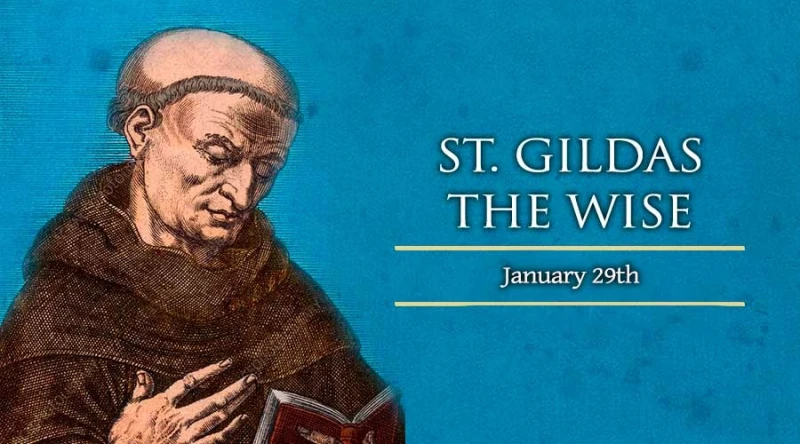
St. Gildas the Wise


St. Gildas the Wise

Feast date: Jan 29

St. Gildas was probably born around 517 in the North of England or Wales. His father’s name was Cau (or Nau) and, came from noble lineage, and he most likely had several brothers and sisters. There is writing which suggests that one of his brothers, Cuil (or Hueil), was killed by King Arthur (who died in 537 AD), and it also appears that Gildas may have forgiven Arthur for this.

There are two accounts of the life of St. Gildas the Wise, neither of which tell the same story.

He lived in a time when the glory of Rome had faded from Britain. The permanent legions had been withdrawn by Maximus, who used them to sack Rome and make himself Emperor.

Gildas was noted in particular for his piety and good education, and was not afraid to publicly rebuke contemporary monarchs at a time when libel was answered by a sword rather than a Court order.

Gildas lived for many years as a very ascetic hermit on Flatholm Island in the Bristol Channel. There he established his reputation for that peculiar Celtic sort of holiness that consists of extreme self-denial and isolation. At around this time, according to the Welsh, he also preached to Nemata, the mother of St David, while she was pregnant with the Saint.

In about 547 he wrote a book De Excidio Britanniae (The Destruction of Britain). In this he writes a brief tale of the island from pre-Roman times and criticizes the rulers of the island for their lax morals and blames their sins (and those that follow them) for the destruction of civilization in Britain. The book was avowedly written as a moral tale.

He also wrote a longer work, the Epistle, which is a series of sermons on the moral laxity of rulers and of the clergy. In these Gildas shows that he was well read in the Bible and some other classic works.

He was also a very influential preacher. Because of his visits to Ireland and the great missionary work he did there, he was responsible for the conversion of many on the island, and may be the one who introduced anchorite customs to the monks of that land.

From there he retired from Llancarfan to Rhuys, in Brittany, where he founded a monastery. Of his works on the running of a monastery (one of the earliest known in the Christian Church), only the so-called Penitential, a guide for Abbots in setting punishment, survives.

He died around 571, at Rhuys.

He is regarded as being one of the most influential figures of the early English Church. The influence of his writing was felt until well into the middle ages, particularly in the Celtic Church. He is also important to us today as the first British writer whose works have survived fairly intact.

St. Gildas the Wise Read More »

Memorial of Saint Thomas Aquinas, Priest and Doctor of the Church

Reading I 2 Sm 11:1-4a, 5-10a, 13-17

At the turn of the year, when kings go out on campaign,
David sent out Joab along with his officers
and the army of Israel, 
and they ravaged the Ammonites and besieged Rabbah.
David, however, remained in Jerusalem.
One evening David rose from his siesta 
and strolled about on the roof of the palace.
From the roof he saw a woman bathing, who was very beautiful.
David had inquiries made about the woman and was told, 
“She is Bathsheba, daughter of Eliam, 
and wife of Joab’s armor bearer Uriah the Hittite.”
Then David sent messengers and took her.
When she came to him, he had relations with her.
She then returned to her house.
But the woman had conceived, 
and sent the information to David, “I am with child.”

David therefore sent a message to Joab,
“Send me Uriah the Hittite.”
So Joab sent Uriah to David.
When he came, David questioned him about Joab, the soldiers, 
and how the war was going, and Uriah answered that all was well.
David then said to Uriah, “Go down to your house and bathe your feet.”  
Uriah left the palace, 
and a portion was sent out after him from the king’s table.
But Uriah slept at the entrance of the royal palace 
with the other officers of his lord, and did not go down 
to his own house.
David was told that Uriah had not gone home.
On the day following, David summoned him, 
and he ate and drank with David, who made him drunk.
But in the evening Uriah went out to sleep on his bed 
among his lord’s servants, and did not go down to his home.
The next morning David wrote a letter to Joab
which he sent by Uriah.
In it he directed:
“Place Uriah up front, where the fighting is fierce.
Then pull back and leave him to be struck down dead.”
So while Joab was besieging the city, he assigned Uriah
to a place where he knew the defenders were strong.
When the men of the city made a sortie against Joab, 
some officers of David’s army fell,
and among them Uriah the Hittite died.

Responsorial Psalm 51:3-4, 5-6a, 6bcd-7, 10-11

R.        (see 3a)  Be merciful, O Lord, for we have sinned.
Have mercy on me, O God, in your goodness;
            in the greatness of your compassion wipe out my offense.
Thoroughly wash me from my guilt
            and of my sin cleanse me.
R.        Be merciful, O Lord, for we have sinned.
For I acknowledge my offense,
            and my sin is before me always:
“Against you only have I sinned,
            and done what is evil in your sight.”
R.        Be merciful, O Lord, for we have sinned.
I have done such evil in your sight
            that you are just in your sentence,
            blameless when you condemn.
True, I was born guilty,
            a sinner, even as my mother conceived me.
R.        Be merciful, O Lord, for we have sinned.
Let me hear the sounds of joy and gladness;
            the bones you have crushed shall rejoice.
Turn away your face from my sins,
            and blot out all my guilt.
R.        Be merciful, O Lord, for we have sinned.

Alleluia See Mt 11:25

R. Alleluia, alleluia.
Blessed are you, Father, Lord of heaven and earth;
you have revealed to little ones the mysteries of the Kingdom.
R. Alleluia, alleluia.

Gospel Mk 4:26-34

Jesus said to the crowds:
“This is how it is with the Kingdom of God;
it is as if a man were to scatter seed on the land
and would sleep and rise night and day
and the seed would sprout and grow,
he knows not how.
Of its own accord the land yields fruit,
first the blade, then the ear, then the full grain in the ear.
And when the grain is ripe, he wields the sickle at once,
for the harvest has come.”

He said,
“To what shall we compare the Kingdom of God,
or what parable can we use for it?
It is like a mustard seed that, when it is sown in the ground,
is the smallest of all the seeds on the earth.
But once it is sown, it springs up and becomes the largest of plants
and puts forth large branches,
so that the birds of the sky can dwell in its shade.”
With many such parables
he spoke the word to them as they were able to understand it.
Without parables he did not speak to them,
but to his own disciples he explained everything in private.

– – –

Lectionary for Mass for Use in the Dioceses of the United States, second typical edition, Copyright © 2001, 1998, 1997, 1986, 1970 Confraternity of Christian Doctrine; Psalm refrain © 1968, 1981, 1997, International Committee on English in the Liturgy, Inc. All rights reserved. Neither this work nor any part of it may be reproduced, distributed, performed or displayed in any medium, including electronic or digital, without permission in writing from the copyright owner.

Memorial of Saint Thomas Aquinas, Priest and Doctor of the Church Read More »

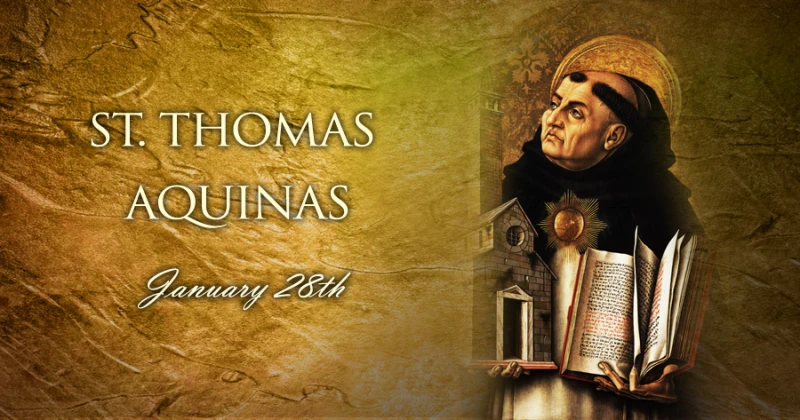
St. Thomas Aquinas


St. Thomas Aquinas

Feast date: Jan 28

On Jan. 28, the Roman Catholic Church celebrates Saint Thomas Aquinas, the 13th century theologian who showed that the Catholic faith is in harmony with philosophy and all other branches of knowledge.

Blessed John Paul II, in his 1998 letter “Fides et Ratio,” said St. Thomas “had the great merit of giving pride of place to the harmony which exists between faith and reason,” knowing that “both the light of reason and the light of faith come from God … Hence there can be no contradiction between them.”

Thomas was born during 1225 into a noble family, having relatives among the rulers of the Holy Roman Empire. His father Landulph was the Count of Aquino, and his mother Theodora, the Countess of Teano. At age five, Thomas was sent to study at Monte Cassino, the abbey founded by St. Benedict.

The boy’s intellectual gifts and serious disposition impressed the monks, who urged his father to place him in a university by the time he was 10. At the University of Naples, he learned philosophy and rhetoric while taking care to preserve his morals against corruption by other students.

It is said that a hermit, before Thomas’ birth, told Theodora that she would have a son who would enter the Dominican Order “and so great will be his learning and sanctity that in his day no one will be found to equal him.” In his adolescence, Thomas’ friendship with a holy Dominican inspired him to join them.

His family, however, did not envision the brilliant young man as a penniless and celibate preacher. His brothers kidnapped him from the Dominicans, took him to the family’s castle, and at one point even sent a woman to seduce him – whom Thomas drove out by brandishing a poker from the fireplace.

Under pressure from both the Pope and the Holy Roman Emperor, Thomas’ brothers allowed him to escape from captivity. He traveled to Rome and received the Pope’s blessing upon his vocation, which would soon take him to Paris to study with the theologian later canonized as Saint Albert the Great.

Thomas’ silent demeanor caused other students to nickname him “the Dumb Ox.” Albert, however, discovered that the young man was a brilliant thinker, and proclaimed: “We call him the Dumb Ox, but he will give such a bellow in learning as will be heard all over the world.”

By the time he was 23, Thomas was teaching alongside his mentor at the university of Cologne. During 1248, he published his first commentaries on the pre-Christian Greek philosopher Aristotle, whose insights on nature, logic, and metaphysics would inform Thomas’ approach to Catholic theology.

Around the middle of the century Thomas was ordained to the priesthood, in which he showed great reverence for the liturgy and skill as a homilist. In keeping with the Dominican order’s charism for preaching, he strove to bring his own family to a sincere practice of the faith, and largely succeeded.

St. Thomas’ best-known achievements, however, are his works of theology. These include the Summa Contra Gentiles, the Compendium Theologiae, and the great Summa Theologica – which was placed on the altar along with the Bible at the 16th century Council of Trent for easy reference during discussions.

In December 1273, however, the scholar proclaimed that he could write no more, following a mystical experience in which he said he had “seen things that make my writings look like straw.” But he complied with a request to attend the Council of Lyon to help reunite the Latin and Greek churches.

On his way there, however, Thomas became ill and stopped at a Cistercian abbey. The monks treated him with reverence, and it was to them that he dictated a final work of theology: a commentary on the Old Testament’s Song of Songs.

The saint did not live to finish this commentary, however. Nearing death, he made a final confession and asked for the Eucharist to be brought to him. In its presence, he declared: “I adore you, my God and my Redeemer … for whose honor I have studied, labored, preached, and taught.”

“I hope I have never advanced any tenet as your word, which I had not learned from you,” he told God, before making his last communion. “If through ignorance I have done otherwise, I revoke everything of that kind, and submit all my writings to the judgment of the holy Roman Church.”

His last words were addressed to one of the Cistercians who asked for a word of spiritual guidance. “Be assured that he who shall always walk faithfully in (God’s) presence, always ready to give him an account of all his actions, shall never be separated from him by consenting to sin,” he declared.

St. Thomas Aquinas died on March 7, 1274. He was canonized in 1323, and made a Doctor of the Church in 1567. In 1965, the Second Vatican Council taught that seminarians should learn “under the guidance of St. Thomas,” in order to “illumine the mysteries of salvation as completely as possible.”

St. Thomas Aquinas Read More »

Thursday of the Third Week in Ordinary Time

Reading I 2 Sm 7:18-19, 24-29

After Nathan had spoken to King David, 
the king went in and sat before the LORD and said, 
“Who am I, Lord GOD, and who are the members of my house, 
that you have brought me to this point?
Yet even this you see as too little, Lord GOD; 
you have also spoken of the house of your servant 
for a long time to come: 
this too you have shown to man, Lord GOD!

“You have established for yourself your people Israel as yours forever, 
and you, LORD, have become their God.
And now, LORD God, confirm for all time the prophecy you have made 
concerning your servant and his house, 
and do as you have promised.
Your name will be forever great, when men say, 
‘The LORD of hosts is God of Israel,’
and the house of your servant David stands firm before you.
It is you, LORD of hosts, God of Israel, 
who said in a revelation to your servant, 
‘I will build a house for you.’
Therefore your servant now finds the courage to make this prayer to you.
And now, Lord GOD, you are God and your words are truth; 
you have made this generous promise to your servant.
Do, then, bless the house of your servant 
that it may be before you forever; 
for you, Lord GOD, have promised, 
and by your blessing the house of your servant 
shall be blessed forever.”

Responsorial Psalm 132:1-2, 3-5, 11, 12, 13-14

R.        (Lk 1:32b)  The Lord God will give him the throne of David, his father.
LORD, remember David
            and all his anxious care;
How he swore an oath to the LORD,
            vowed to the Mighty One of Jacob.
R.        The Lord God will give him the throne of David, his father.
“I will not enter the house where I live,
            nor lie on the couch where I sleep;
I will give my eyes no sleep,
            my eyelids no rest,
Till I find a home for the LORD,
            a dwelling for the Mighty One of Jacob.”
R.        The Lord God will give him the throne of David, his father.
The LORD swore an oath to David
            a firm promise from which he will not withdraw:
“Your own offspring 
            I will set upon your throne.”
R.        The Lord God will give him the throne of David, his father.
“If your sons keep my covenant,
            and the decrees which I shall teach them,
Their sons, too, forever
            shall sit upon your throne.”
R.        The Lord God will give him the throne of David, his father.
For the LORD has chosen Zion,
            he prefers her for his dwelling:
“Zion is my resting place forever;
            in her I will dwell, for I prefer her.”
R.        The Lord God will give him the throne of David, his father.
 

Alleluia Ps 119:105

R. Alleluia, alleluia.
A lamp to my feet is your word,
a light to my path.
R. Alleluia, alleluia.

Gospel Mk 4:21-25

Jesus said to his disciples,
“Is a lamp brought in to be placed under a bushel basket
or under a bed,
and not to be placed on a lampstand?
For there is nothing hidden except to be made visible; 
nothing is secret except to come to light.
Anyone who has ears to hear ought to hear.”
He also told them, “Take care what you hear.
The measure with which you measure will be measured out to you, 
and still more will be given to you.
To the one who has, more will be given; 
from the one who has not, even what he has will be taken away.”

– – –

Lectionary for Mass for Use in the Dioceses of the United States, second typical edition, Copyright © 2001, 1998, 1997, 1986, 1970 Confraternity of Christian Doctrine; Psalm refrain © 1968, 1981, 1997, International Committee on English in the Liturgy, Inc. All rights reserved. Neither this work nor any part of it may be reproduced, distributed, performed or displayed in any medium, including electronic or digital, without permission in writing from the copyright owner.

Thursday of the Third Week in Ordinary Time Read More »