Please mind our dust!

We are currently working on revamping our website!
Thank you for your patience!

CRD Solutions

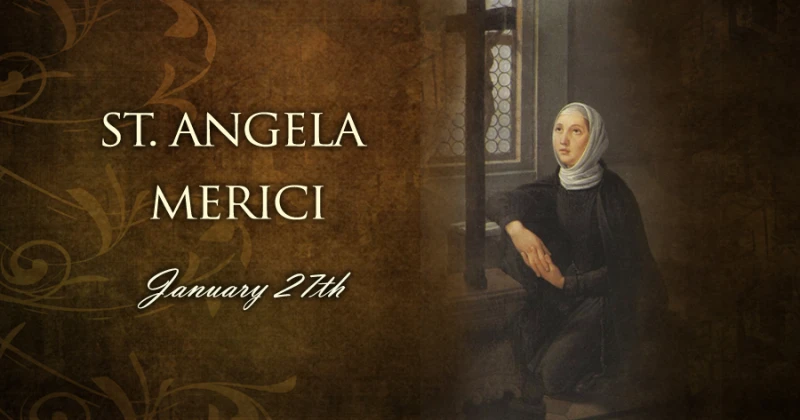
St. Angela Merici


St. Angela Merici

Feast date: Jan 27

Angela Merici, foundress of the Ursuline Sisters, was born in the small Italian town of Desenzano on the shore of Lake Garda in 1474.

As a young girl, Angela lost in succession her sister and both of her parents. She went to live with a wealthy uncle in the town of Salo where, without benefit of formal schooling, Angela grew in poise, wisdom, and grace.

The age in which Angela lived and worked (the 16th Century), was a time which saw great suffering on the part of the poor in society. Injustices were carried on in the name of the government and the Church, which left many people both spiritually and materially powerless and hungry. The corruption of moral values left families split and hurting. Wars among nations and the Italian city-states left towns in ruins.

In 1516, Angela came to live in the town of Brescia, Italy. Here she became a friend of the wealthy nobles of the day and a servant of the poor and suffering. Angela spent her days in prayer and fasting and service. Her reputation spread and her advice was sought by both young and old, rich and poor, religious and secular, male and female. But still, Angela had not yet brought her vision to fruition.

After visiting the Holy Land, where she reportedly lost her sight, Angela returned to Brescia, which had become a haven for refugees from the many wars then wracking Italy. There she gathered around her a group of women who looked toward Angela as an inspirational leader and as a model of apostolic charity. It was these women, many of them daughters of the wealthy, some orphans themselves, who formed the nucleus of Angela’s Company of St. Ursula. Angela named her company after St. Ursula because she regarded her as a model of consecrated virginity.

Angela and her original company worked out details of the rule of prayer, and promises, and practices by which they were to live. The Ursulines opened orphanages and schools. In 1535, the Institute of St. Ursula was formally recognized by the Pope and Angela was accorded the title of foundress.

During the five remaining years of her life, Angela devoted herself to composing a number of Counsels by which her daughters could happily live. She encouraged them to “live in harmony, united together in one heart and one will. Be bound to one another by the bond of charity, treating each other with respect, helping one another, bearing with one another in Christ Jesus; if you really try to live like this, there is no doubt that the Lord our God will be in your midst.”

In 1580, Charles Borromeo, Bishop of Milan, inspired by the work of the Ursulines in Brescia, encouraged the foundation of Ursuline houses in all the dioceses of Northern Italy. Charles also encouraged the Ursulines to live together in community rather than in their own homes. He also exhorted them to publicly profess vows of poverty, chastity, and obedience. These actions formalized Angela’s original “company” into a religious order of women.

Angela Merici died on January 27, 1540, and was canonized in 1807.
St. Angela Merici Read More »

Memorial of Saints Timothy and Titus, Bishops

Reading I 2 Tm 1:1-8

Paul, an Apostle of Christ Jesus by the will of God
for the promise of life in Christ Jesus,
to Timothy, my dear child:
grace, mercy, and peace from God the Father
and Christ Jesus our Lord.

I am grateful to God,
whom I worship with a clear conscience as my ancestors did,
as I remember you constantly in my prayers, night and day.
I yearn to see you again, recalling your tears,
so that I may be filled with joy, 
as I recall your sincere faith
that first lived in your grandmother Lois
and in your mother Eunice
and that I am confident lives also in you.

For this reason, I remind you to stir into flame
the gift of God that you have through the imposition of my hands.
For God did not give us a spirit of cowardice
but rather of power and love and self-control.
So do not be ashamed of your testimony to our Lord,
nor of me, a prisoner for his sake;
but bear your share of hardship for the Gospel
with the strength that comes from God.

OR:

Ti 1:1-5

Paul, a slave of God and Apostle of Jesus Christ
for the sake of the faith of God’s chosen ones
and the recognition of religious truth,
in the hope of eternal life 
that God, who does not lie, promised before time began,
who indeed at the proper time revealed his word
in the proclamation with which I was entrusted
by the command of God our savior,
to Titus, my true child in our common faith:
grace and peace from God the Father and Christ Jesus our savior.

For this reason I left you in Crete
so that you might set right what remains to be done
and appoint presbyters in every town, as I directed you.

Responsorial Psalm 96:1-2a, 2b-3, 7-8a, 10

R.        (3)  Proclaim God’s marvelous deeds to all the nations.
Sing to the Lord a new song;
            sing to the Lord, all you lands.
Sing to the Lord; bless his name.
R.        Proclaim God’s marvelous deeds to all the nations.
Announce his salvation, day after day.
Tell his glory among the nations;
            among all peoples, his wondrous deeds.
R.        Proclaim God’s marvelous deeds to all the nations.
Give to the Lord, you families of nations,
            give to the Lord glory and praise;
            give to the Lord the glory due his name!
R.        Proclaim God’s marvelous deeds to all the nations.
Say among the nations: The Lord is king.
He has made the world firm, not to be moved;
            he governs the peoples with equity.
R.        Proclaim God’s marvelous deeds to all the nations.

Alleluia

R. Alleluia, alleluia.
The seed is the word of God, Christ is the sower;
all who come to him will live for ever.
R. Alleluia, alleluia.

Gospel Mk 4:1-20

On another occasion, Jesus began to teach by the sea.
A very large crowd gathered around him 
so that he got into a boat on the sea and sat down.
And the whole crowd was beside the sea on land.
And he taught them at length in parables, 
and in the course of his instruction he said to them, 
“Hear this! A sower went out to sow.
And as he sowed, some seed fell on the path, 
and the birds came and ate it up.
Other seed fell on rocky ground where it had little soil.
It sprang up at once because the soil was not deep.
And when the sun rose, it was scorched and it withered for lack of roots.  
Some seed fell among thorns, and the thorns grew up and choked it 
and it produced no grain.
And some seed fell on rich soil and produced fruit.
It came up and grew and yielded thirty, sixty, and a hundredfold.”
He added, “Whoever has ears to hear ought to hear.”

And when he was alone, 
those present along with the Twelve 
questioned him about the parables.
He answered them, 
“The mystery of the Kingdom of God has been granted to you.
But to those outside everything comes in parables, so that
            they may look and see but not perceive,
                        and hear and listen but not understand,
                        in order that they may not be converted and be forgiven.

Jesus said to them, “Do you not understand this parable?
Then how will you understand any of the parables?
The sower sows the word.
These are the ones on the path where the word is sown.
As soon as they hear, Satan comes at once 
and takes away the word sown in them.
And these are the ones sown on rocky ground who, 
when they hear the word, receive it at once with joy.
But they have no roots; they last only for a time.
Then when tribulation or persecution comes because of the word, 
they quickly fall away.
Those sown among thorns are another sort.
They are the people who hear the word, 
but worldly anxiety, the lure of riches, 
and the craving for other things intrude and choke the word, 
and it bears no fruit.
But those sown on rich soil are the ones who hear the word and accept it
and bear fruit thirty and sixty and a hundredfold.”

– – –

Lectionary for Mass for Use in the Dioceses of the United States, second typical edition, Copyright © 2001, 1998, 1997, 1986, 1970 Confraternity of Christian Doctrine; Psalm refrain © 1968, 1981, 1997, International Committee on English in the Liturgy, Inc. All rights reserved. Neither this work nor any part of it may be reproduced, distributed, performed or displayed in any medium, including electronic or digital, without permission in writing from the copyright owner.

Memorial of Saints Timothy and Titus, Bishops Read More »

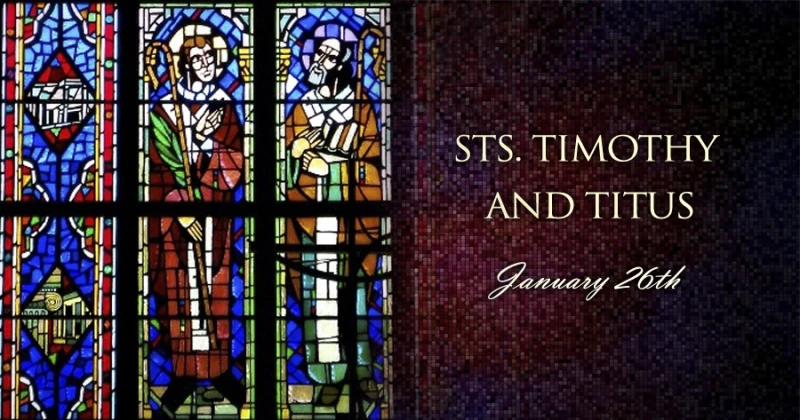
Sts. Timothy and Titus


Sts. Timothy and Titus

Feast date: Jan 26

On Jan. 26, the Roman Catholic Church celebrates the liturgical memorial of Saints Timothy and Titus, close companions of the Apostle Paul and bishops of the Catholic Church in its earliest days.

Both men received letters from St. Paul, which are included in the New Testament.

 
Pope Benedict XVI discussed these early bishops during a general audience on Dec. 13, 2006, noting “their readiness to take on various offices” in “far from easy” circumstances. Both saints, the Pope said, “teach us to serve the Gospel with generosity, realizing that this also entails a service to the Church herself.”

 
The son of a Jewish mother and a non-Jewish father, Timothy came from Lystra in present-day Turkey. His mother, Eunice, and his grandmother, Lois, are known to have joined the Church, and Timothy himself is described as a student of Sacred Scripture from his youth.

After St. Paul’s visit to Timothy’s home region of Lycaonia, around the year 51, the young man joined the apostle and accompanied him in his travels. After religious strife forced Paul to leave the city of Berea, Timothy remained to help the local church. Paul later sent him to Thessalonica to help the Church during a period of persecution.

 
The two met up again in Corinth, and Timothy eventually journeyed to Macedonia on Paul’s behalf. Problems in the Corinthian Church brought Timothy back for a time, after which he joined Paul and accompanied the apostle in subsequent travels.

Like Paul, Timothy endured a period of imprisonment in the course of his missionary work. His release is mentioned in the New Testament Epistle to the Hebrews.

 
Around the year 64, Timothy became the first bishop of the Church of Ephesus. During that same year, he received the first of two surviving letters from St. Paul. The second, written the next year, urges Timothy to visit St. Paul in Rome, where he was imprisoned before his martyrdom.

Ancient sources state that St. Timothy followed his mentor in dying as a martyr for the faith. In the year 93, during his leadership of the Church in Ephesus, he took a stand against the worship of idols and was consequently killed by a mob. The pagan festival he was protesting was held Jan. 22, and this date was preserved as St. Timothy’s memorial in the Christian East.

 
In contrast with Timothy’s partial Jewish descent and early Biblical studies, St. Titus – who was born into a pagan family – is said to have studied Greek philosophy and poetry in his early years. But he pursued a life of virtue, and purportedly had a prophetic dream that caused him to begin reading the Hebrew Scriptures.

 
According to tradition, Titus journeyed to Jerusalem and witnessed the preaching of Christ during the Lord’s ministry on earth. Only later, however – after the conversion of St. Paul and the beginning of his ministry – did Titus receive baptism from the apostle, who called the pagan convert his “true child in our common faith.”

 
St. Paul was not only Titus’ spiritual father, but also depended on his convert as an assistant and interpreter. Titus accompanied Paul to the Apostolic Council of Jerusalem during the year 51, and was later sent to the Corinthian Church on two occasions. After the end of Paul’s first imprisonment in Rome, the apostle ordained Titus as the Bishop of Crete.

 
Paul sent his only surviving letter to Titus around the year 64, giving instructions in pastoral ministry to his disciple as he prepared to meet up with him in the Greek city of Nicopolis. Titus evangelized the region of Dalmatia in modern Croatia before returning to Crete.

 
Titus is credited with leading the Church of Crete well into his 90s, overturning paganism and promoting the faith through his prayers and preaching. Unlike St. Timothy, St. Titus was not martyred, but died peacefully in old age.

Sts. Timothy and Titus Read More »

Feast of the Conversion of Saint Paul, Apostle

Reading I Acts 22:3-16

Paul addressed the people in these words:
“I am a Jew, born in Tarsus in Cilicia,
but brought up in this city.
At the feet of Gamaliel I was educated strictly in our ancestral law
and was zealous for God, just as all of you are today.
I persecuted this Way to death,
binding both men and women and delivering them to prison.
Even the high priest and the whole council of elders
can testify on my behalf.
For from them I even received letters to the brothers
and set out for Damascus to bring back to Jerusalem
in chains for punishment those there as well.

“On that journey as I drew near to Damascus,
about noon a great light from the sky suddenly shone around me.
I fell to the ground and heard a voice saying to me,
‘Saul, Saul, why are you persecuting me?’
I replied, ‘Who are you, sir?’
And he said to me,
‘I am Jesus the Nazorean whom you are persecuting.’
My companions saw the light
but did not hear the voice of the one who spoke to me.
I asked, ‘What shall I do, sir?’
The Lord answered me, ‘Get up and go into Damascus,
and there you will be told about everything
appointed for you to do.’ 
Since I could see nothing because of the brightness of that light,
I was led by hand by my companions and entered Damascus.

“A certain Ananias, a devout observer of the law,
and highly spoken of by all the Jews who lived there,
came to me and stood there and said,
‘Saul, my brother, regain your sight.’
And at that very moment I regained my sight and saw him.
Then he said,
‘The God of our ancestors designated you to know his will,
to see the Righteous One, and to hear the sound of his voice;
for you will be his witness before all
to what you have seen and heard.
Now, why delay?
Get up and have yourself baptized and your sins washed away,
calling upon his name.’”

OR:

Acts 9:1-22

Saul, still breathing murderous threats against the disciples of the Lord,
went to the high priest and asked him
for letters to the synagogues in Damascus, that,
if he should find any men or women who belonged to the Way,
he might bring them back to Jerusalem in chains.
On his  journey, as he was nearing Damascus,
a light from the sky suddenly flashed around him.
He fell to the ground and heard a voice saying to him,
“Saul, Saul, why are you persecuting me?”
He said, “Who are you, sir?”
The reply came, “I am Jesus, whom you are persecuting.
Now get up and go into the city and you will be told what you must do.” 
The men who were traveling with him stood speechless,
for they heard the voice but could see no one.
Saul got up from the ground,
but when he opened his eyes he could see nothing;
so they led him by the hand and brought him to Damascus.
For three days he was unable to see, and he neither ate nor drank.

There was a disciple in Damascus named Ananias,
and the Lord said to him in a vision, AAnanias.”
He answered, “Here I am, Lord.”
The Lord said to him, “Get up and go to the street called Straight
and ask at the house of Judas for a man from Tarsus named Saul. 
He is there praying,
and in a vision he has seen a man named Ananias
come in and lay his hands on him,
that he may regain his sight.”
But Ananias replied,
“Lord, I have heard from many sources about this man,
what evil things he has done to your holy ones in Jerusalem.
And here he has authority from the chief priests
to imprison all who call upon your name.”
But the Lord said to him,
“Go, for this man is a chosen instrument of mine
to carry my name before Gentiles, kings, and children of Israel,
and I will show him what he will have to suffer for my name.”
So Ananias went and entered the house;
laying his hands on him, he said,
“Saul, my brother, the Lord has sent me,
Jesus who appeared to you on the way by which you came,
that you may regain your sight and be filled with the Holy Spirit.”
Immediately things like scales fell from his eyes
and he regained his sight.
He got up and was baptized,
and when he had eaten, he recovered his strength.

He stayed some days with the disciples in Damascus,
and he began at once to proclaim Jesus in the synagogues,
that he is the Son of God.
All who heard him were astounded and said, 
“Is not this the man who in Jerusalem
ravaged those who call upon this name,
and came here expressly to take them back in chains
to the chief priests?”
But Saul grew all the stronger
and confounded the Jews who lived in Damascus,
proving that this is the Christ.

Responsorial Psalm 117:1bc, 2

R.        (Mark 16:15)  Go out to all the world, and tell the Good News.
or:
R.        Alleluia, alleluia.
Praise the Lord, all you nations;
            glorify him, all you peoples!
R.        Go out to all the world, and tell the Good News.
or:
R.        Alleluia, alleluia.
For steadfast is his kindness toward us,
            and the fidelity of the Lord endures forever.
R.        Go out to all the world, and tell the Good News.
or:
R.        Alleluia, alleluia.

Alleluia See Jn 15:16

R. Alleluia, alleluia.
I chose you from the world,
to go and bear fruit that will last, says the Lord.
R. Alleluia, alleluia.

Gospel Mk 16:15-18

Jesus appeared to the Eleven and said to them:
“Go into the whole world
and proclaim the Gospel to every creature.
Whoever believes and is baptized will be saved;
whoever does not believe will be condemned.
These signs will accompany those who believe:
in my name they will drive out demons,
they will speak new languages.
They will pick up serpents with their hands,
and if they drink any deadly thing, it will not harm them.
They will lay hands on the sick, and they will recover.” 

– – –

Lectionary for Mass for Use in the Dioceses of the United States, second typical edition, Copyright © 2001, 1998, 1997, 1986, 1970 Confraternity of Christian Doctrine; Psalm refrain © 1968, 1981, 1997, International Committee on English in the Liturgy, Inc. All rights reserved. Neither this work nor any part of it may be reproduced, distributed, performed or displayed in any medium, including electronic or digital, without permission in writing from the copyright owner.

Feast of the Conversion of Saint Paul, Apostle Read More »

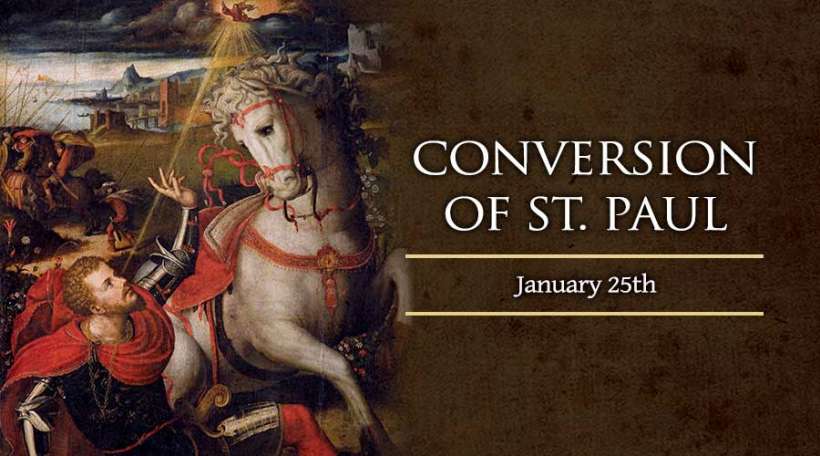
Conversion of St. Paul 


Conversion of St. Paul 

Feast date: Jan 25

The great apostle was a Jew of the tribe of Benjamin.  He surpassed all his peers in zeal for the Jewish law and their traditions, which he thought to be the cause of God, and became one of the most fierce enemies and persecutors of Christians. He was one of the conspirators in the martyrdom of St. Stephan.

After the martyrdom of the holy deacon, the priests and magistrates of the Jews raised a violent persecution against the church at Jerusalem, in which Saul placed himself above the others.

In the fury of his zeal, he appealed to the high priest and Sanhedrin for a commission to take up all Jews at Damascus who confessed Jesus Christ, and bring them bound to Jerusalem, that they might serve as public examples to incite terror into others.

But God was pleased to show forth in Saul his patience and mercy: Saul was almost at the end of his journey to Damascus, when, around noon, he and his company were surrounded by a great light from heaven, and fell to the ground. Then Saul heard a voice, which to him was articulate and distinct, but not understood by the rest: “Saul, Saul, why dost thou persecute me? Christ said not: Why dost thou persecute my disciples, but me: for it is he, their head, who is chiefly persecuted in his servants.” Saul answered: “Who art thou, Lord?” Christ said: “Jesus of Nazareth, whom thou persecute. It is hard for thee to kick against the goad: – to contend with one so much mightier than thyself.”

There was a Christian of distinction in Damascus, Ananius, greatly respected by the Jews for his irreproachable life and great virtue. Christ appeared to this holy disciple, and commanded him to go to Saul, who was at that moment in the house of Judas at prayer. Ananias trembled at the name of Saul, being familiar with the misdeeds he had done in Jerusalem and the errand for which he set out to Damascus. But our Redeemer overruled his fears, and charged him a second time to go, saying: “Go, for he is a vessel of election to carry my name before Gentiles and kings, and the children of Israel: and I will show him how much he has to suffer for my name. For tribulation is the test and portion of all the true servants of Christ.”

Thus a blasphemer and a persecutor was made an apostle, and chosen to be one of the principal instruments of God in the conversion of the world.

St. Paul never recalled his wonderful conversion, from which have poured forth may blessings, without raptures of gratitude and praise to the Divine and His mercy. The Church, in thanksgiving to God for such a miracle of his grace, to commemorate so miraculous an instance of his almighty power and to propose to penitents a perfect model of a true conversion, has instituted this feast, which we find mentioned in several calendars and missals of the eighth and ninth centuries, and which Pope Innocent III commanded to be observed with great solemnity.

Conversion of St. Paul  Read More »