Please mind our dust!

We are currently working on revamping our website!
Thank you for your patience!

CRD Solutions

Memorial of Saint Francis de Sales, Bishop and Doctor of the Church

Reading I 2 Sm 5:1-7, 10

All the tribes of Israel came to David in Hebron and said:
“Here we are, your bone and your flesh.
In days past, when Saul was our king, 
it was you who led the children of Israel out and brought them back.
And the LORD said to you, ‘You shall shepherd my people Israel 
and shall be commander of Israel.’”
When all the elders of Israel came to David in Hebron, 
King David made an agreement with them there before the LORD, 
and they anointed him king of Israel.
David was thirty years old when he became king, 
and he reigned for forty years: 
seven years and six months in Hebron over Judah, 
and thirty-three years in Jerusalem
over all Israel and Judah.

Then the king and his men set out for Jerusalem 
against the Jebusites who inhabited the region.
David was told, “You cannot enter here: 
the blind and the lame will drive you away!” 
which was their way of saying, “David cannot enter here.”
But David did take the stronghold of Zion, which is the City of David. 

David grew steadily more powerful,
for the LORD of hosts was with him.

Responsorial Psalm 89:20, 21-22, 25-26

R.        (25a)  My faithfulness and my mercy shall be with him.
Once you spoke in a vision,
            and to your faithful ones you said:
“On a champion I have placed a crown;
            over the people I have set a youth.”
R.        My faithfulness and my mercy shall be with him.
“I have found David, my servant;
            with my holy oil I have anointed him,
That my hand may be always with him,
            and that my arm may make him strong.”
R.        My faithfulness and my mercy shall be with him.
“My faithfulness and my mercy shall be with him,
            and through my name shall his horn be exalted.
I will set his hand upon the sea,
            his right hand upon the rivers.”
R.        My faithfulness and my mercy shall be with him.

Alleluia See 2 Tm 1:10

R. Alleluia, alleluia.
Our Savior Jesus Christ has destroyed death
and brought life to light through the Gospel.
R. Alleluia, alleluia.

Gospel Mk 3:22-30

The scribes who had come from Jerusalem said of Jesus, 
“He is possessed by Beelzebul,” and
“By the prince of demons he drives out demons.”

Summoning them, he began to speak to them in parables, 
“How can Satan drive out Satan?
If a kingdom is divided against itself, that kingdom cannot stand.
And if a house is divided against itself, 
that house will not be able to stand.
And if Satan has risen up against himself and is divided, 
he cannot stand; 
that is the end of him.
But no one can enter a strong man’s house to plunder his property 
unless he first ties up the strong man.
Then he can plunder his house.  
Amen, I say to you, all sins and all blasphemies 
that people utter will be forgiven them.
But whoever blasphemes against the Holy Spirit 
will never have forgiveness, 
but is guilty of an everlasting sin.”
For they had said, “He has an unclean spirit.” 

– – –

Lectionary for Mass for Use in the Dioceses of the United States, second typical edition, Copyright © 2001, 1998, 1997, 1986, 1970 Confraternity of Christian Doctrine; Psalm refrain © 1968, 1981, 1997, International Committee on English in the Liturgy, Inc. All rights reserved. Neither this work nor any part of it may be reproduced, distributed, performed or displayed in any medium, including electronic or digital, without permission in writing from the copyright owner.

Memorial of Saint Francis de Sales, Bishop and Doctor of the Church Read More »
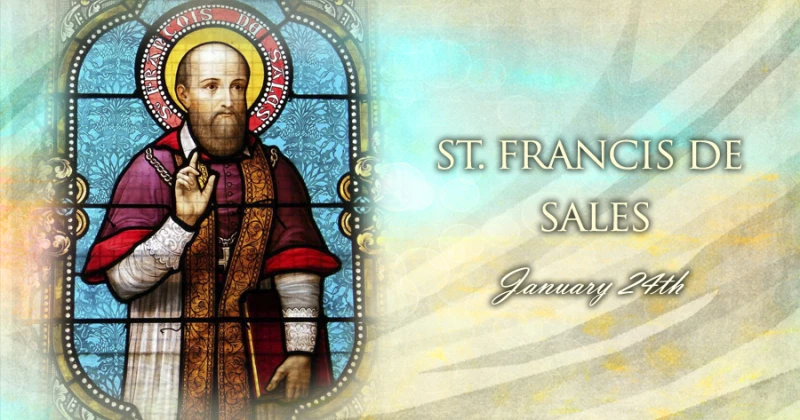
St. Francis de Sales


St. Francis de Sales

Feast date: Jan 24

Jan. 24 marks the Feast of St. Francis de Sales, the patron saint of writers and Christian unity whose role as a priest and bishop helped bring thousands of Protestants back to the Catholic Church.

In the late 16th and early 17th century, St. Frances de Sales conducted spiritual direction both in person and in written correspondence. This inspired his famous work “Introduction to the Devout Life.”

During his ministry in Switzerland, he wrote and distributed religious tracts that made inroads among Protestants and helped between 40,000 and 70,000 return to the Catholic faith.

Because he is a patron saint of writers, his feast day traditionally marks the release of the Pope’s annual message for World Communications Day. Pope Benedict XVI’s 2013 message reflected on social networks and their potential to strengthen unity and harmony between people. He also warned that these enable a mindset that rewards popularity, rather than rewarding what has intrinsic value.

St. Francis de Sales was no stranger to unpopularity. As a priest he volunteered to lead a mission to return the Calvinist Switzerland back to the Catholic faith. He faced much hostility, including death threats and would-be assassins.

He was born in 1567 in the Savoy region in what is now part of France. He was a diplomat’s son, born into a household with great devotion to St. Francis of Assisi.

He studied rhetoric, the humanities and law in preparation for a political career. He had resolved to hold to religious celibacy and he held a deep devotion to the Virgin Mary, but he kept this strong spiritual life secret from the world.

This devotion clashed with the wishes of his father, who had arranged a marriage for him. The Catholic bishop of Geneva found Francis de Sales a position in the Swiss Church, leading to his ordination as a priest in 1593.

He was named Bishop of Geneva in 1602, after which he worked to restore Geneva’s churches and religious orders. He helped the future saint Jean Frances de Chantal, whom he had served as spiritual director, found a women’s religious order.

He died in 1622 in Lyons at a convent he had helped to found. Frances de Sales was canonized in 1665 and named a Doctor of the Church in 1877.

St. Francis de Sales Read More »

Third Sunday in Ordinary Time

Reading I Neh 8:2-4a, 5-6, 8-10

Ezra the priest brought the law before the assembly,
which consisted of men, women,
and those children old enough to understand.
Standing at one end of the open place that was before the Water Gate,
he read out of the book from daybreak till midday,
in the presence of the men, the women,
and those children old enough to understand;
and all the people listened attentively to the book of the law.
Ezra the scribe stood on a wooden platform 
that had been made for the occasion.
He opened the scroll
so that all the people might see it
— for he was standing higher up than any of the people —;
and, as he opened it, all the people rose.
Ezra blessed the LORD, the great God,
and all the people, their hands raised high, answered, 
“Amen, amen!”
Then they bowed down and prostrated themselves before the LORD,
their faces to the ground.
Ezra read plainly from the book of the law of God,
interpreting it so that all could understand what was read.
Then Nehemiah, that is, His Excellency, and Ezra the priest-scribe
and the Levites who were instructing the people
said to all the people:
“Today is holy to the LORD your God.
Do not be sad, and do not weep”—
for all the people were weeping as they heard the words of the law.
He said further: “Go, eat rich foods and drink sweet drinks,
and allot portions to those who had nothing prepared;
for today is holy to our LORD.
Do not be saddened this day,
for rejoicing in the LORD must be your strength!”

Responsorial Psalm Ps 19:8, 9, 10, 15

R. (cf John 6:63c) Your words, Lord, are Spirit and life.
The law of the LORD is perfect,
            refreshing the soul;
The decree of the LORD is trustworthy,
            giving wisdom to the simple.
R. Your words, Lord, are Spirit and life.
The precepts of the LORD are right,
            rejoicing the heart;
The command of the LORD is clear,
            enlightening the eye.
R. Your words, Lord, are Spirit and life.
The fear of the LORD is pure,
            enduring forever;
The ordinances of the LORD are true,
            all of them just.
R. Your words, Lord, are Spirit and life.
Let the words of my mouth and the thought of my heart
            find favor before you,
O LORD, my rock and my redeemer.
R. Your words, Lord, are Spirit and life.

Reading II 1 Cor 12:12-30

Brothers and sisters:
As a body is one though it has many parts,
and all the parts of the body, though many, are one body,
so also Christ.
For in one Spirit we were all baptized into one body,
whether Jews or Greeks, slaves or free persons,
and we were all given to drink of one Spirit.

Now the body is not a single part, but many.
If a foot should say,
“Because I am not a hand I do not belong to the body, “
it does not for this reason belong any less to the body.
Or if an ear should say,
“Because I am not an eye I do not belong to the body, “
it does not for this reason belong any less to the body.
If the whole body were an eye, where would the hearing be?
If the whole body were hearing, where would the sense of smell be?
But as it is, God placed the parts,
each one of them, in the body as he intended.
If they were all one part, where would the body be?
But as it is, there are many parts, yet one body.
The eye cannot say to the hand, “I do not need you, “
nor again the head to the feet, “I do not need you.”
Indeed, the parts of the body that seem to be weaker
are all the more necessary,
and those parts of the body that we consider less honorable
we surround with greater honor,
and our less presentable parts are treated with greater propriety,
whereas our more presentable parts do not need this.
But God has so constructed the body
as to give greater honor to a part that is without it,
so that there may be no division in the body,
but that the parts may have the same concern for one another.
If one part suffers, all the parts suffer with it;
if one part is honored, all the parts share its joy.

Now you are Christ’s body, and individually parts of it.
Some people God has designated in the church
to be, first, apostles; second, prophets; third, teachers;
then, mighty deeds;
then gifts of healing, assistance, administration,
and varieties of tongues.
Are all apostles? Are all prophets? Are all teachers?
Do all work mighty deeds? Do all have gifts of healing?
Do all speak in tongues? Do all interpret?

OR:

1 Cor 12:12-14, 27

Brothers and sisters:
As a body is one though it has many parts,
and all the parts of the body, though many, are one body,
so also Christ.
For in one Spirit we were all baptized into one body,
whether Jews or Greeks, slaves or free persons,
and we were all given to drink of one Spirit.
Now the body is not a single part, but many.
You are Christ’s body, and individually parts of it.

Alleluia Cf. Lk 4:18

R. Alleluia, alleluia.
The Lord sent me to bring glad tidings to the poor,
and to proclaim liberty to captives.
R. Alleluia, alleluia.

Gospel Lk 1:1-4; 4:14-21

Since many have undertaken to compile a narrative of the events
that have been fulfilled among us,
just as those who were eyewitnesses from the beginning
and ministers of the word have handed them down to us,
I too have decided,
after investigating everything accurately anew,
to write it down in an orderly sequence for you,
most excellent Theophilus, 
so that you may realize the certainty of the teachings
you have received.

Jesus returned to Galilee in the power of the Spirit,
and news of him spread throughout the whole region.
He taught in their synagogues and was praised by all.

He came to Nazareth, where he had grown up,
and went according to his custom 
into the synagogue on the sabbath day.
He stood up to read and was handed a scroll of the prophet Isaiah.
He unrolled the scroll and found the passage where it was written:
            The Spirit of the Lord is upon me,
                        because he has anointed me 
                        to bring glad tidings to the poor.
            He has sent me to proclaim liberty to captives
                        and recovery of sight to the blind,
                        to let the oppressed go free,
                        and to proclaim a year acceptable to the Lord.
Rolling up the scroll, he handed it back to the attendant and sat down,
and the eyes of all in the synagogue looked intently at him.
He said to them,
“Today this Scripture passage is fulfilled in your hearing.”

– – –

Lectionary for Mass for Use in the Dioceses of the United States, second typical edition, Copyright © 2001, 1998, 1997, 1986, 1970 Confraternity of Christian Doctrine; Psalm refrain © 1968, 1981, 1997, International Committee on English in the Liturgy, Inc. All rights reserved. Neither this work nor any part of it may be reproduced, distributed, performed or displayed in any medium, including electronic or digital, without permission in writing from the copyright owner.

Third Sunday in Ordinary Time Read More »

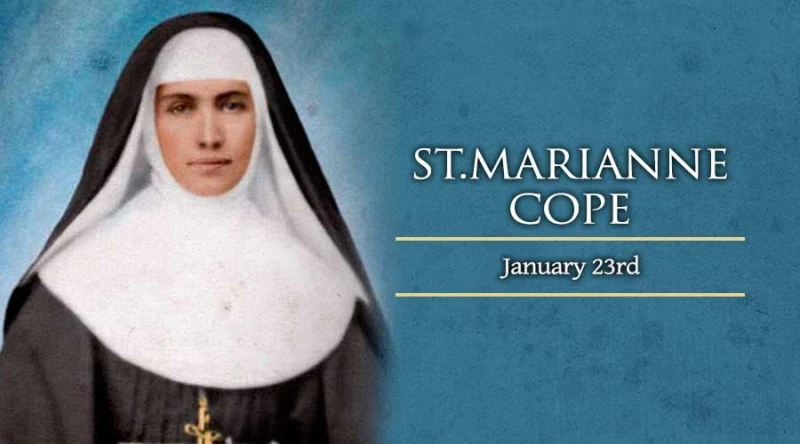
St. Marianne Cope


St. Marianne Cope

Feast date: Jan 23

St. Marianne Cope was born in western Germany in 1838. She entered religious life in Syracuse, N.Y. in 1862. She served as a teacher and principal in several schools in the state and established two of the first hospitals in the central New York area: St. Elizabeth Hospital in Utica and St. Joseph’s Hospital in Syracuse.

In 1883, Mother Marianne’s community was the only one of fifty to respond positively to an emissary from Hawaii who requested Catholic sisters to provide health care on the Hawaiian Islands, especially to those with leprosy.

Over the next five years, St. Marianne set up a system of long-term education and care for her patients.

She ministered to patients at Kalaupapa on the island of Molokai. Her time of service overlapped with the last years of St. Damien of Molokai, a priest who served victims of Hansen’s disease and himself died of leprosy.

St. Marianne promised her sisters that none of them would ever contract the disease. To this day, no sister has. Her care earned her the affectionate title “beloved mother of the outcasts.”

She died in 1918 and was beatified on May 14, 2005 and canonized on October 21, 2012, both by Pope Benedict XVI.

“At a time when little could be done for those suffering from this terrible disease, Marianne Cope showed the highest love, courage and enthusiasm,” Pope Benedict XVI said in his homily during the Mass for her canonization. “She is a shining and energetic example of the best of the tradition of Catholic nursing sisters and of the spirit of her beloved Saint Francis.”

St. Marianne Cope Read More »

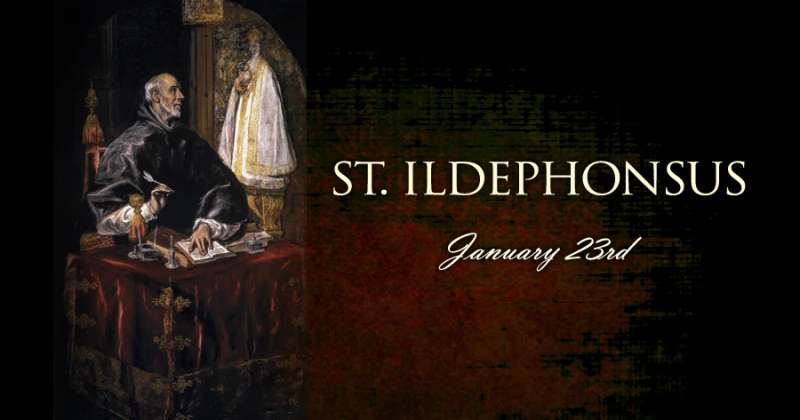
St. Ildephonsus


St. Ildephonsus

Feast date: Jan 23

St. Ildephonsus was the Archbishop of Toledo, and died 23 January, 667. He was born of a distinguished family and was the nephew of St. Eugenius, his predecessor in the See of Toledo. At an early age, despite the determined opposition of his father, he embraced the monastic life in the monastery of Agli, near Toledo. He was ordained a deacon, around the year 630. He was called by King Reccesvinth, near the end of 657 to fill the archiepiscopal throne of Toledo, where he governed the Church of Toledo for just over nine years and was buried in the Basilica of Saint Leocadia.

Ildephonsus had a strong devotion to the Blessd Mother, and it is said that  one day he was praying before the relics of Saint Leocadia, when the martyr arose from her tomb and thanked the saint for the devotion he showed towards the Mother of God. It was also related that on another occasion the Blessed Virgin appeared to him in person and presented him with a priestly vestment, to reward him for his zeal in honoring her.

The literary work of Ildephonsus is more widely known than the details of his life, and merits for him a distinguished place in the role of Spanish writers.

St. Ildephonsus Read More »