Please mind our dust!

We are currently working on revamping our website!
Thank you for your patience!

CRD Solutions

Memorial of Saint Anthony. Abbot

Reading I 1 Sm 15:16-23

Samuel said to Saul:
“Stop! Let me tell you what the LORD said to me last night.”
Saul replied, “Speak!” 
Samuel then said: “Though little in your own esteem,
are you not leader of the tribes of Israel?
The LORD anointed you king of Israel and sent you on a mission, saying,
‘Go and put the sinful Amalekites under a ban of destruction.
Fight against them until you have exterminated them.’
Why then have you disobeyed the LORD?
You have pounced on the spoil, thus displeasing the LORD.”
Saul answered Samuel:  “I did indeed obey the LORD
and fulfill the mission on which the LORD sent me.
I have brought back Agag, and I have destroyed Amalek under the ban.
But from the spoil the men took sheep and oxen,
the best of what had been banned,
to sacrifice to the LORD their God in Gilgal.”
But Samuel said:
            “Does the LORD so delight in burnt offerings and sacrifices
            as in obedience to the command of the LORD?
            Obedience is better than sacrifice,
                        and submission than the fat of rams.
            For a sin like divination is rebellion,
                        and presumption is the crime of idolatry.
            Because you have rejected the command of the LORD,
                        he, too, has rejected you as ruler.”

Responsorial Psalm 50:8-9, 16bc-17, 21 and 23

R.        (23b)  To the upright I will show the saving power of God.
“Not for your sacrifices do I rebuke you,
            for your burnt offerings are before me always.
I take from your house no bullock,
            no goats out of your fold.”
R.        To the upright I will show the saving power of God.
“Why do you recite my statutes,
            and profess my covenant with your mouth,
Though you hate discipline
            and cast my words behind you?”
R.        To the upright I will show the saving power of God.
“When you do these things, shall I be deaf to it?
            Or do you think that I am like yourself?
            I will correct you by drawing them up before your eyes.
He that offers praise as a sacrifice glorifies me;
            and to him that goes the right way I will show the salvation of God.”
R.        To the upright I will show the saving power of God.

Alleluia Hb 4:12

R. Alleluia, alleluia.
The word of God is living and effective,
able to discern reflections and thoughts of the heart.
R. Alleluia, alleluia.

Gospel Mk 2:18-22

The disciples of John and of the Pharisees were accustomed to fast.
People came to Jesus and objected,
“Why do the disciples of John and the disciples of the Pharisees fast,
 but your disciples do not fast?”
Jesus answered them,
“Can the wedding guests fast while the bridegroom is with them?
As long as they have the bridegroom with them they cannot fast.
But the days will come when the bridegroom is taken away from them,
and then they will fast on that day.
No one sews a piece of unshrunken cloth on an old cloak.
If he does, its fullness pulls away,
the new from the old, and the tear gets worse.
Likewise, no one pours new wine into old wineskins.
Otherwise, the wine will burst the skins,
and both the wine and the skins are ruined.
Rather, new wine is poured into fresh wineskins.”
 

– – –

Lectionary for Mass for Use in the Dioceses of the United States, second typical edition, Copyright © 2001, 1998, 1997, 1986, 1970 Confraternity of Christian Doctrine; Psalm refrain © 1968, 1981, 1997, International Committee on English in the Liturgy, Inc. All rights reserved. Neither this work nor any part of it may be reproduced, distributed, performed or displayed in any medium, including electronic or digital, without permission in writing from the copyright owner.

Memorial of Saint Anthony. Abbot Read More »
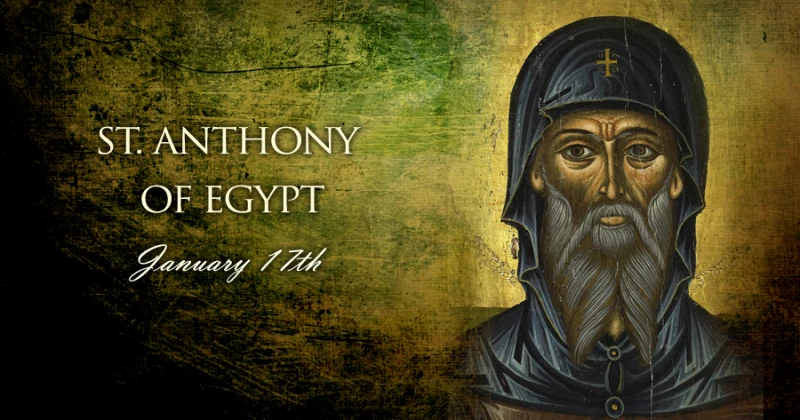
St. Anthony of Egypt


St. Anthony of Egypt

Feast date: Jan 17

On his Jan. 17 feast day, both Eastern and Western Catholics celebrate the life and legacy of St. Anthony of Egypt, the founder of Christian monasticism whose radical approach to discipleship permanently impacted the Church.

In Egypt’s Coptic Catholic and Orthodox Churches, which have a special devotion to the native saint, his feast day is celebrated on Jan. 30.

Anthony was born around 251, to wealthy parents who owned land in the present-day Faiyum region near Cairo. During this time, the Catholic Church was rapidly spreading its influence throughout the vast expanses of the Roman empire, while the empire remained officially pagan and did not legally recognize the new religion.

In the course of his remarkable and extraordinarily long life, Anthony would live to see the Emperor Constantine’s establishment of Christianity as the official religion of the Roman empire. Anthony himself, however, would establish something more lasting – by becoming the spiritual father of the monastic communities that have existed throughout the subsequent history of the Church.

Around the year 270, two great burdens came upon Anthony simultaneously: the deaths of both his parents, and his inheritance of their possessions and property. These simultaneous occurrences prompted Anthony to reevaluate his entire life in light of the principles of the Gospel– which proposed both the redemptive possibilities of his personal loss, and the spiritual danger of his financial gains.

 
Attending church one day, he heard –as if for the first time– Jesus’ exhortation to another rich young man in the Biblical narrative: “If you wish to be perfect, go, sell your possessions, and give the money to the poor, and you will have treasure in heaven; then come, follow me.” Anthony told his disciples in later years, that it was as though Christ has spoken those words to him directly.

He duly followed the advice of selling everything he owned and donating the proceeds, setting aside a portion to provide for his sister. Although organized monasticism did not yet exist, it was not unknown for Christians to abstain from marriage, divest themselves of possessions to some extent, and live a life focused on prayer and fasting. Anthony’s sister would eventually join a group of consecrated virgins.

 
Anthony himself, however, sought a more comprehensive vision of Christian asceticism. He found it among the hermits of the Egyptian desert, individuals who chose to withdraw physically and culturally from the surrounding society in order to devote themselves more fully to God. But these individuals’ radical way of life had not yet become an organized movement.

After studying with one of these hermits, Anthony made his own sustained attempt to live alone in a secluded desert location, depending on the charity of a few patrons who would provide him with enough food to survive. This first period as a hermit lasted between 13 and 15 years.

Like many saints both before and after him, Anthony became engaged in a type of spiritual combat, against unseen forces seeking to remove him from the way of perfection he had chosen. These conflicts took their toll on Anthony in many respects. When he was around 33 years old, a group of his patrons found him in serious condition, and took him back to a local church to recover.

 
This setback did not dissuade Anthony from his goal of seeking God intensely, and he soon redoubled his efforts by moving to a mountain on the east bank of the Nile river. There, he lived in an abandoned fort, once again subsisting on the charity of those who implored his prayers on their behalf. He attracted not only these benefactors, but a group of inquirers seeking to follow after his example.

 
In the first years of the fourth century, when he was about 54, Anthony emerged from his solitude to provide guidance to the growing community of hermits that had become established in his vicinity. Although Anthony had not sought to form such a community, his decision to become its spiritual father – or “Abbot”– marked the beginning of monasticism as it is known today.

 
Anthony himself would live out this monastic calling for another four decades, providing spiritual and practical advice to disciples who would ensure the movement’s continued existence. According to Anthony’s biographer, St. Athanasius, the Emperor Constantine himself eventually wrote to the Abbot, seeking advice on the administration of an empire that was now officially Christian.

“Do not be astonished if an emperor writes to us, for he is a man,” Anthony told the other monks. “But rather: wonder that God wrote the Law for men, and has spoken to us through his own Son.”

Anthony wrote back to Constantine, advising him “not to think much of the present, but rather to remember the judgment that is coming, and to know that Christ alone was the true and Eternal King.”

 
St. Anthony may have been up to 105 years old when he died, sometime between 350 and 356. In keeping with his instructions, two of his disciples buried his body secretly in an unmarked grave.

St. Anthony of Egypt Read More »

Second Sunday in Ordinary Time

Reading I Is 62:1-5

For Zion’s sake I will not be silent,
   for Jerusalem’s sake I will not be quiet,
until her vindication shines forth like the dawn
   and her victory like a burning torch.

Nations shall behold your vindication,
   and all the kings your glory;
you shall be called by a new name
   pronounced by the mouth of the LORD.
You shall be a glorious crown in the hand of the LORD,
   a royal diadem held by your God.
No more shall people call you “Forsaken, “
   or your land “Desolate, “
but you shall be called “My Delight, “
   and your land “Espoused.”
For the LORD delights in you
   and makes your land his spouse.
As a young man marries a virgin,
   your Builder shall marry you;
and as a bridegroom rejoices in his bride
   so shall your God rejoice in you.

Responsorial Psalm Ps 96:1-2, 2-3, 7-8, 9-10

R. (3) Proclaim his marvelous deeds to all the nations.
Sing to the LORD a new song;
            sing to the LORD, all you lands.
Sing to the LORD; bless his name.
R. Proclaim his marvelous deeds to all the nations.
Announce his salvation, day after day.
Tell his glory among the nations;
            among all peoples, his wondrous deeds.
R. Proclaim his marvelous deeds to all the nations.
Give to the LORD, you families of nations,
            give to the LORD glory and praise;
            give to the LORD the glory due his name! 
R. Proclaim his marvelous deeds to all the nations.
Worship the LORD in holy attire.
            Tremble before him, all the earth;
Say among the nations: The LORD is king.
            He governs the peoples with equity.
R. Proclaim his marvelous deeds to all the nations.

Reading II 1 Cor 12:4-11

Brothers and sisters:
There are different kinds of spiritual gifts but the same Spirit; 
there are different forms of service but the same Lord;
there are different workings but the same God
who produces all of them in everyone.
To each individual the manifestation of the Spirit
is given for some benefit.
To one is given through the Spirit the expression of wisdom;
to another, the expression of knowledge according to the
same Spirit;
to another, faith by the same Spirit;
to another, gifts of healing by the one Spirit;
to another, mighty deeds;
to another, prophecy;
to another, discernment of spirits;
to another, varieties of tongues;
to another, interpretation of tongues.
But one and the same Spirit produces all of these,
distributing them individually to each person as he wishes.

Alleluia Cf. 2 Thes 2:14

R. Alleluia, alleluia.
God has called us through the Gospel
to possess the glory of our Lord Jesus Christ.
R. Alleluia, alleluia.

Gospel Jn 2:1-11

There was a wedding at Cana in Galilee,
and the mother of Jesus was there.
Jesus and his disciples were also invited to the wedding.
When the wine ran short,
the mother of Jesus said to him,
“They have no wine.”
And Jesus said to her,
“Woman, how does your concern affect me?
My hour has not yet come.”
His mother said to the servers,
“Do whatever he tells you.”
Now there were six stone water jars there for Jewish ceremonial washings,
each holding twenty to thirty gallons.
Jesus told them,
“Fill the jars with water.”
So they filled them to the brim.
Then he told them,
“Draw some out now and take it to the headwaiter.”
So they took it. 
And when the headwaiter tasted the water that had become wine,
without knowing where it came from
— although the servers who had drawn the water knew —,
the headwaiter called the bridegroom and said to him,
“Everyone serves good wine first,
and then when people have drunk freely, an inferior one;
but you have kept the good wine until now.”
Jesus did this as the beginning of his signs at Cana in Galilee
and so revealed his glory,
and his disciples began to believe in him.

– – –

Lectionary for Mass for Use in the Dioceses of the United States, second typical edition, Copyright © 2001, 1998, 1997, 1986, 1970 Confraternity of Christian Doctrine; Psalm refrain © 1968, 1981, 1997, International Committee on English in the Liturgy, Inc. All rights reserved. Neither this work nor any part of it may be reproduced, distributed, performed or displayed in any medium, including electronic or digital, without permission in writing from the copyright owner.

Second Sunday in Ordinary Time Read More »

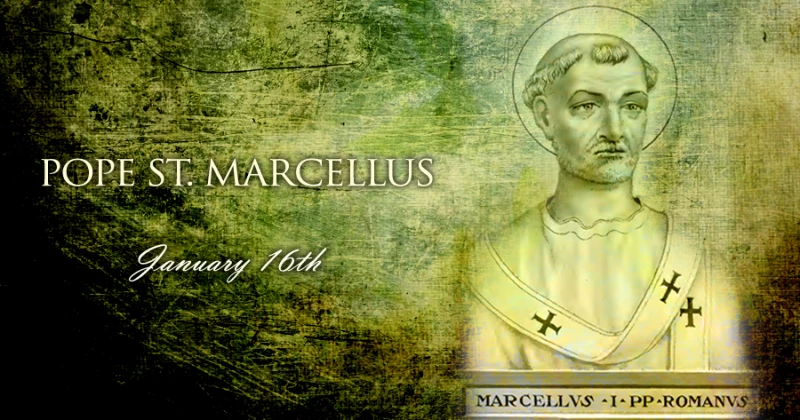
St. Marcellus, Pope 


St. Marcellus, Pope 

Feast date: Jan 16

Nothing of Marcellus’ life before his papacy has survived the centuries. He became Pope at the end of the persecutions of Diocletian in aound 308-309. The persecutions had disrupted the Church so much that there had been a gap of over a year with no Pope. Once he was elected, he faced several challenges, including reconsituting the clergy, which had been decimated and whose remnant had practiced their vocation only covertly and with the expectation of martyrdom. He worked hard to recover and welcome back all who had denied the faith in order to keep from being murdered.

When a group of the apostacized, known as the Lapsi, refused to do penance, Marcellus refused to allow their return to the Church. The Lapsi had a bit of political pull, and some members caused such civil disruption that emperor Maxentius exiled the Pope in order to settle the matter. Legend says that Marcellus was forced to work as a stable slave as punishment, but this appears to be fiction, however we do know that he died of the terrible conditions he suffered in exile, and is considered a martyr because of that.

He was initially buried in the cemetery of Saint Priscilla in Rome, but his relics were later transferred to beneath the altar of San Marcello al Corso Church in Rome where they remain today.

St. Marcellus, Pope  Read More »

Saturday of the First Week in Ordinary Time

Reading I 1 Sm 9:1-4, 17-19; 10:1

There was a stalwart man from Benjamin named Kish,
who was the son of Abiel, son of Zeror,
son of Becorath, son of Aphiah, a Benjaminite.
He had a son named Saul, who was a handsome young man.
There was no other child of Israel more handsome than Saul;
he stood head and shoulders above the people.

Now the asses of Saul’s father, Kish, had wandered off.
Kish said to his son Saul, “Take one of the servants with you
and go out and hunt for the asses.”
Accordingly they went through the hill country of Ephraim,
and through the land of Shalishah.
Not finding them there,
they continued through the land of Shaalim without success.
They also went through the land of Benjamin,
but they failed to find the animals.

When Samuel caught sight of Saul, the LORD assured him,
“This is the man of whom I told you; he is to govern my people.”

Saul met Samuel in the gateway and said,
“Please tell me where the seer lives.”
Samuel answered Saul: “I am the seer.
Go up ahead of me to the high place and eat with me today.
In the morning, before dismissing you,
I will tell you whatever you wish.”

Then, from a flask he had with him, Samuel poured oil on Saul’s head;
he also kissed him, saying:
“The LORD anoints you commander over his heritage.
You are to govern the LORD’s people Israel,
and to save them from the grasp of their enemies roundabout.

“This will be the sign for you
that the LORD has anointed you commander over his heritage.”

Responsorial Psalm 21:2-3, 4-5, 6-7

R.        (2a) Lord, in your strength the king is glad.
O LORD, in your strength the king is glad;
            in your victory how greatly he rejoices!
You have granted him his heart’s desire;
            you refused not the wish of his lips.
R.        Lord, in your strength the king is glad.
For you welcomed him with goodly blessings,
            you placed on his head a crown of pure gold.
He asked life of you: you gave him
            length of days forever and ever.
R.        Lord, in your strength the king is glad.
Great is his glory in your victory;
            majesty and splendor you conferred upon him.
For you made him a blessing forever;            
            you gladdened him with the joy of your face.
R.        Lord, in your strength the king is glad.

Alleluia Lk 4:18

R. Alleluia, alleluia.
The Lord sent me to bring glad tidings to the poor
and to proclaim liberty to captives.
R. Alleluia, alleluia.

Gospel Mk 2:13-17

Jesus went out along the sea.
All the crowd came to him and he taught them.
As he passed by, he saw Levi, son of Alphaeus,
sitting at the customs post.
Jesus said to him, “Follow me.”
And he got up and followed Jesus.
While he was at table in his house,
many tax collectors and sinners sat with Jesus and his disciples;
for there were many who followed him.
Some scribes who were Pharisees saw that Jesus was eating with sinners
and tax collectors and said to his disciples,
“Why does he eat with tax collectors and sinners?” 
Jesus heard this and said to them,
“Those who are well do not need a physician, but the sick do.
I did not come to call the righteous but sinners.”

– – –

Lectionary for Mass for Use in the Dioceses of the United States, second typical edition, Copyright © 2001, 1998, 1997, 1986, 1970 Confraternity of Christian Doctrine; Psalm refrain © 1968, 1981, 1997, International Committee on English in the Liturgy, Inc. All rights reserved. Neither this work nor any part of it may be reproduced, distributed, performed or displayed in any medium, including electronic or digital, without permission in writing from the copyright owner.

Saturday of the First Week in Ordinary Time Read More »